

This plant at Exotenherz
Check the shop offer for current availability, price and what is included.
Check the shop for the price, current availability and what is included.
Your care table
| Topic | What to do | Why it helps |
|---|---|---|
| Light | Filtered; place strongly coloured forms rather more brightly. | Varieties differ in their light requirements. |
| Water | Let the surface dry slightly and keep the root ball moderately moist. | Constant wetness can damage roots. |
| Drainage | Remove excess water. | The outer pot must not contain a permanent water reserve. |
| Temperature | Evenly warm and without cold draughts. | Aglaonema plants are cold-sensitive tropical plants. |
| Substrate | Loose and humus-rich with stable structure. | Air and moisture must be balanced in the root zone. |
| Fertiliser | Moderately during growth according to product instructions. | Reduce accordingly with slower winter growth. |
| Leaves | Remove dust gently and use no shine products. | The natural markings need no coating. |
| Handling | Do not eat foliage or any berries. | Irritating calcium oxalate crystals must be considered. |
Check the compost and pot weight. The care table explains how far the compost may dry.
Water only when needed. The water should reach the root ball without spilling over the rim.
Remove surplus water from the saucer or cachepot. Then return the plant to a suitable position.
A genus with many living leaf patterns
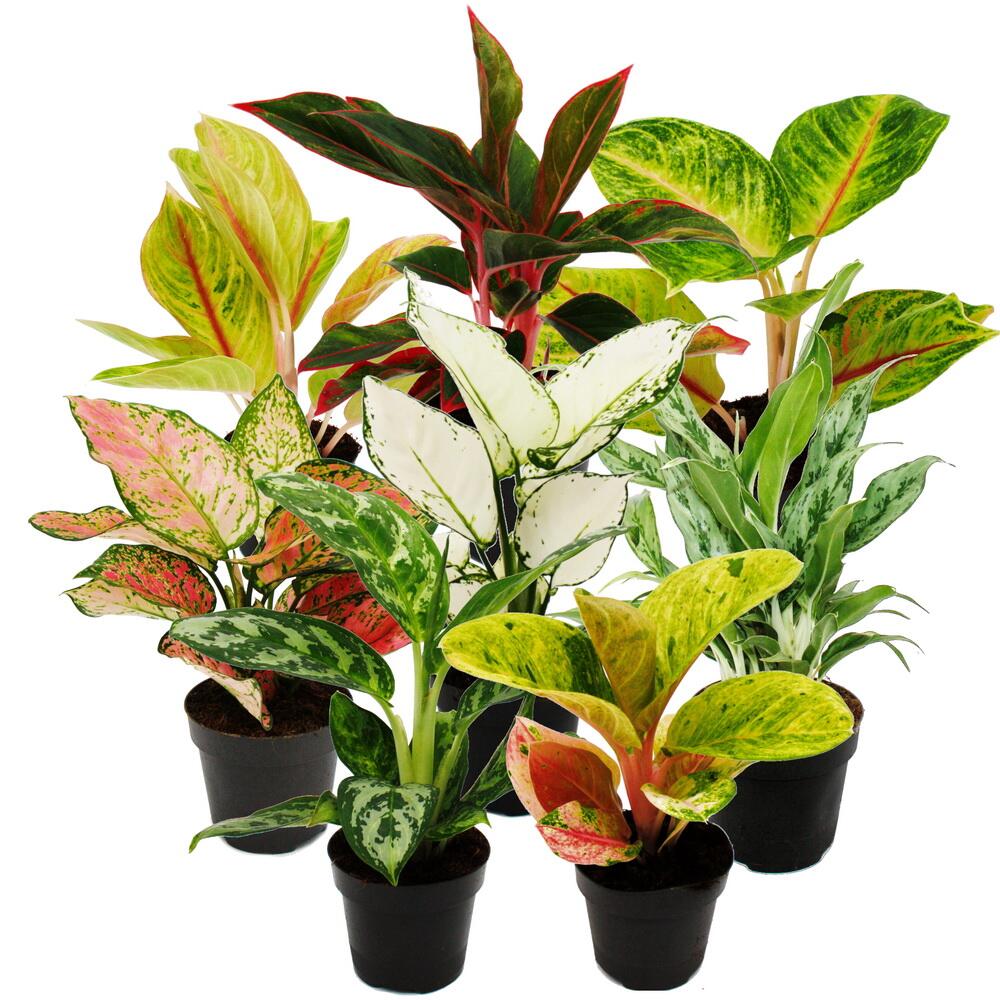
Aglaonema belongs to the genus Aglaonema and the aroid family. Its elongated to oval pointed leaves can carry green, silvery, cream, pink or reddish areas. The exact pattern depends on the variety. The original shop image shows several different plants to illustrate the selection. It is not a single Aglaonema bearing all these patterns at once. The portrait therefore covers the genus and the offered selection of varieties without inventing an unconfirmed species or specific variety name.
Keep selection and delivery contents distinct
The offer specifies a 12 cm pot and approximately 25 to 30 cm overall height. The scene shows one illustrative pink-green form from the selection depicted. This does not promise delivery of every plant in the group image. The linked offer establishes which colour or form is currently available or selectable. Natural variations remain possible. Young plants initially look compact; older specimens can develop more distinct stems and a looser habit. Outer pot, lamp and other furnishings are not automatically part of plant delivery.
Shade tolerance still means a need for light
Aglaonema often suits protected indoor positions with filtered light. Greener forms cope with less brightness than very pale or strongly patterned varieties. A completely dark room corner is still not a suitable permanent position. A bright place without hot direct sunshine makes sense for balanced colour. Acclimatise gently after shipping. Even warmth is particularly important because Aglaonema is sensitive to cold. Avoid cold draughts, a chilling surface below and very cold watering water. Actual conditions matter more than the name of the room.
Allow slight drying, then supply water deliberately
Keep the root ball moderately moist during growth. The top layer may dry a little before the next application. Then water so the root ball is supplied, and allow excess to drain. In winter with less growth, the plant usually needs water less frequently, but not an enforced completely dry rest. A full outer pot can cause root damage. Yellow or limp leaves have different causes; check moisture first. Watering again just because a leaf droops can worsen the situation if the root ball is already wet.
Care attentively for roots and leaves
A loose humus-rich mix with good structure helps combine moisture and air. If needed, move into a slightly larger pot with drainage. Fertilise moderately during active growth according to product instructions. Carefully remove dust with a soft damp cloth while supporting the leaf. Constant misting is neither a substitute for adequate humidity nor a necessary shine treatment. Very dry heated air can encourage brown margins. Find an even position for more sensitive colourful forms rather than constantly moving the plant between rooms of different temperatures.
Flowers, berries and typical checks
Aglaonema can form a spadix inflorescence with a surrounding spathe; its German common name refers to this. Flowering is not guaranteed for the young offer. Any berries are no more suitable for eating than the foliage. Irritating calcium oxalate crystals must be considered with nibbling children and pets. Healthy rooted side shoots can be separated carefully from a sufficiently large plant; the young delivery plant need not be taken apart for this. Regularly check for mealybugs, scale insects, aphids and spider mites. No particular measurable purification of indoor air is promised by this ornamental plant portrait.
One plant, several views
Good to know
Will I receive all the plants from the group image?
The image shows different varieties in the selection. Delivery of all the pictured plants is not guaranteed; the current offer governs.
Which variety is the pink plant?
No reliable specific variety name is confirmed for the selection offer. The scene shows only an illustrative colour form.
Can Aglaonema stand completely without daylight?
No. Shade tolerance means a lower light requirement, not a permanently lightless position.
Are the berries edible?
No. Aglaonema is an ornamental plant with irritating substances and does not belong in food preparation.
Sources and editorial note
Sources checked: 15 September 2026. Product information and the contents of delivery follow the linked shop offer. Care advice was checked against the cited specialist sources and should still be adapted to the plant’s condition, position and season.