
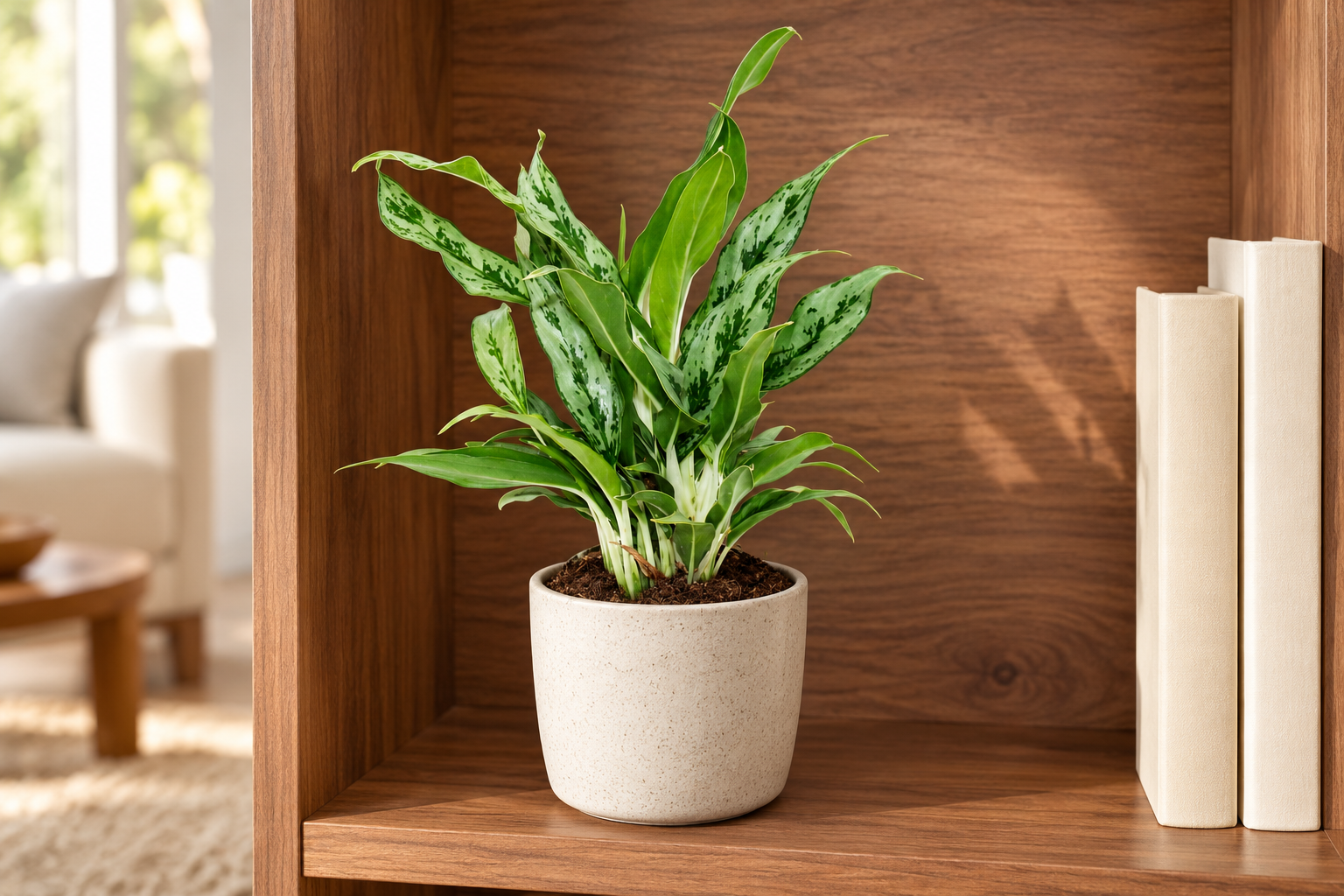
This plant at Exotenherz
Check the shop offer for current availability, price and what is included.
Check the selected shop offer for price, availability and delivery contents.
Your care table
| Topic | What to do | Why it helps |
|---|---|---|
| Shelf position | Choose an open bright compartment with space for leaf tips. | The slender crown must neither be darkened nor squeezed. |
| Light | Use indirect daylight and avoid hot sun. | Pale markings need no intense direct sun. |
| Watering | First check upper soil and pot weight, then water if needed. | Narrow leaf surfaces alone do not reliably show water needs. |
| Drainage | Let nursery pot drip and check cover. | Standing water threatens the supplying root base. |
| Growing medium | Use a structurally stable humus-rich mix in a perforated pot. | Moisture and ventilation belong together. |
| Temperature | Keep steadily warm; avoid cold air during airing. | Chinese evergreens tolerate chilling poorly. |
| Supply | Feed moderately according to fertiliser directions only during growth. | Low winter light is not compensated by high feeding. |
| Leaf bases | Let young rolled leaves open undisturbed and check. | Mechanical pulling may damage the new leaf surface. |
Check the compost and pot weight. The care table explains how far the compost may dry.
Water only when needed. The water should reach the root ball without spilling over the rim.
Remove surplus water from the saucer or cachepot. Then return the plant to a suitable position.
A narrow crown with many small contrasts
Greyhound looks different from a broad-leaved Chinese evergreen through shape alone. The original plant carries elongated narrow leaves whose tips taper distinctly. Silver-green areas alternate with irregular dark green patches. Pale stalks and young still-folded leaves stand between them. This gives the crown lively upright movement. Greyhound is the variety name in the shop; an additionally claimed species assignment is unnecessary for this portrait. The plant belongs to Aglaonema and the arum family. Its effect comes from leaves, not promised flowers.
Leave room before tips bump into things
The offer states a 12 cm pot and about 25 to 30 cm overall height. Even a slender plant needs free space around its crown. Greyhound can look beautiful on an open shelf if the compartment is bright and high enough. Do not push leaves between book spines or beneath a surface that is too low. The nursery pot must stay reachable for checking. Open wrapping first when unpacking and release individual tips gently. Do not pull a pale stalk to lift the whole plant from packaging.
A good shelf position is outside deep shade
Check brightness where the crown will stand. A compartment beside a light source may suit, while a dark one behind many objects suits much less. Filtered daylight maintains a calm home setting without hot direct sun. Acclimatise after shipping. If it turns one-sidedly towards light, turn the pot slightly occasionally. Even warmth also matters: a cold draught can reach leaves even in an otherwise warm room. The shelf must therefore not stand directly in winter airing airflow.
Look between pale stalks down to the soil
With several basal shoots, foliage easily hides the soil surface. Find a clear spot for the finger test and add pot weight. Upper soil may dry somewhat; do not let the root ball repeatedly become completely dry. Water slowly onto soil without constantly directing water into young leaf bases. Then let drip. A tight decorative pot can collect wetness invisibly. Assess hanging tips with root space therefore. A still-wet root ball requires a different response from a dry light pot.
New leaves may unfold themselves
A young leaf first appears as a narrow folded tip. Give it time and do not pull the surface apart with fingers. Its later pattern becomes visible only gradually. Loose humus-rich soil and good drainage give the base suitable conditions. Repotting is sensible when the existing root ball is well rooted and the plant grows. The next pot should offer only somewhat more room. Use extra fertiliser moderately according to label and account for fresh pre-fertilised soil. Vigorous growth begins with well-supplied roots.
Get to know consumption again in winter
The slender silhouette remains appealing in winter. Growth and water use can decrease with less daylight, however. Keep bright and warm, check anew before every watering and reduce nutrient doses according to growth. Do not impose completely dry dormancy. A cold surface may chill the root ball more than room temperature suggests. Avoid strongly dry heating airflow directly on foliage. For new brown tips, note position and moisture rather than changing several care conditions strongly at once.
Look at the pattern and undersides too
A soft lightly damp cloth removes dust from a supported leaf. Treat pale stalks and narrow leaf bases carefully. Dark green patches belong to the pattern; small fixed shields, cottony deposits and fine webs instead need targeted examination. One old leaf surface may be shed. Many simultaneously yellowing leaves prompt joint checking of roots, light and temperature. Do not eat plant parts or leave cuttings accessible. Be cautious when working with sap and protect eyes and mouth. An inaccessible bright position combines the home idea with suitable handling.
One plant, several views
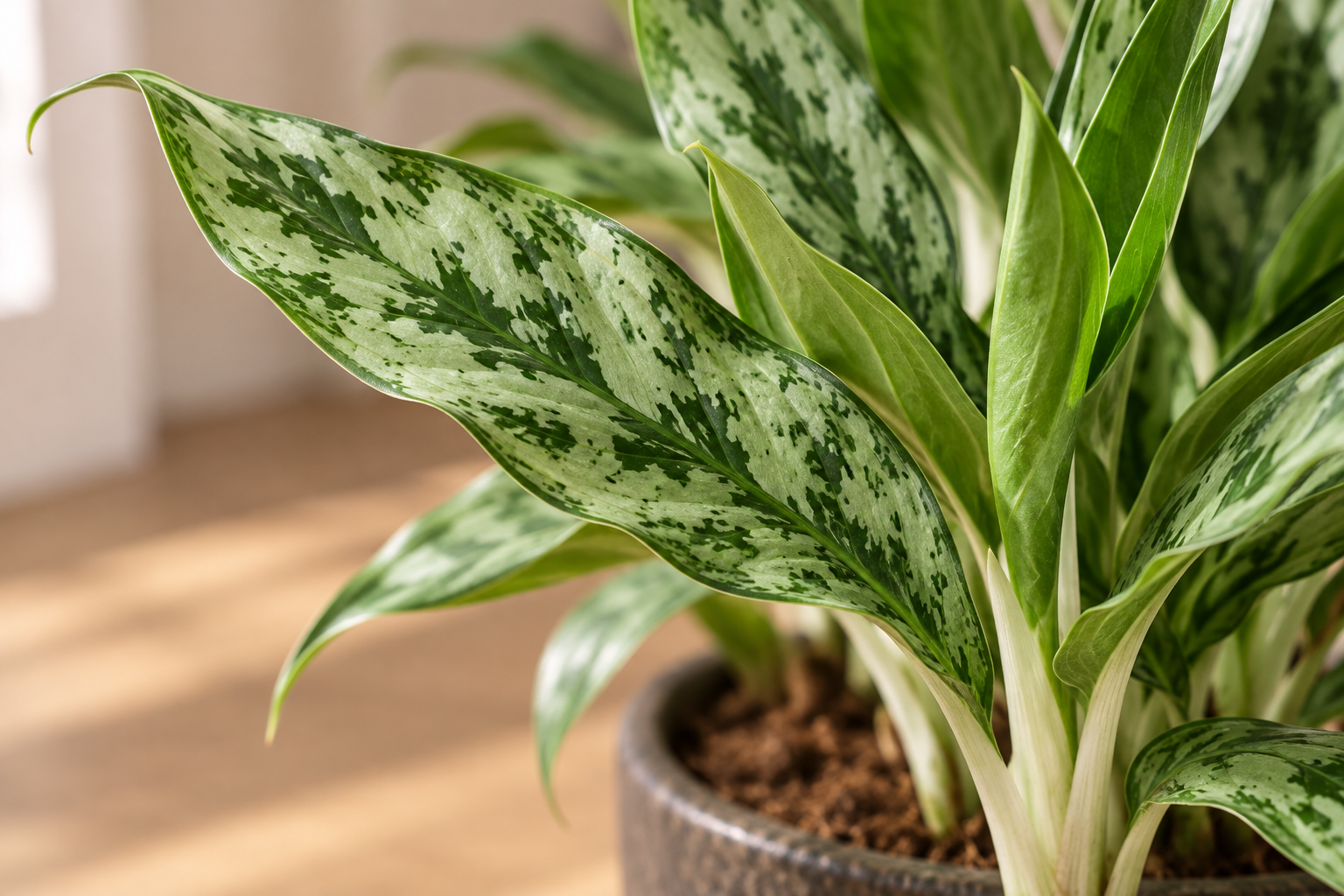
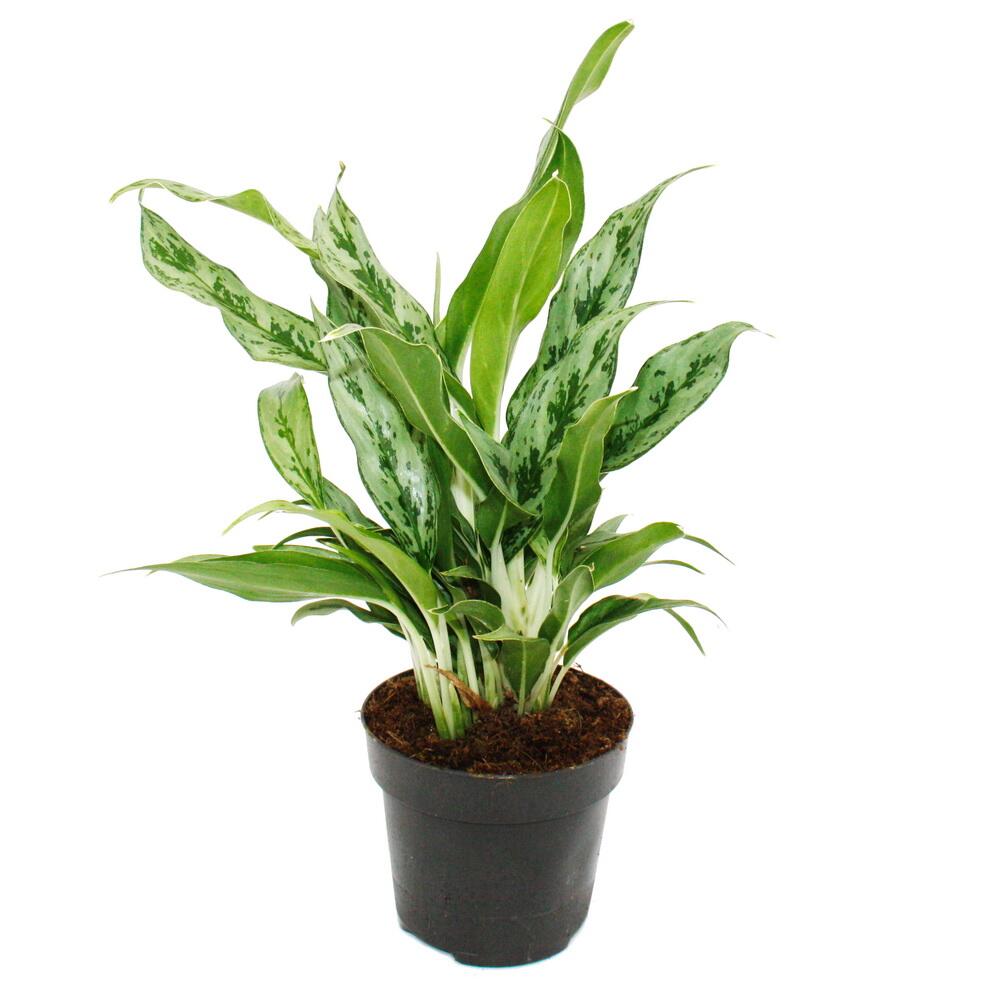
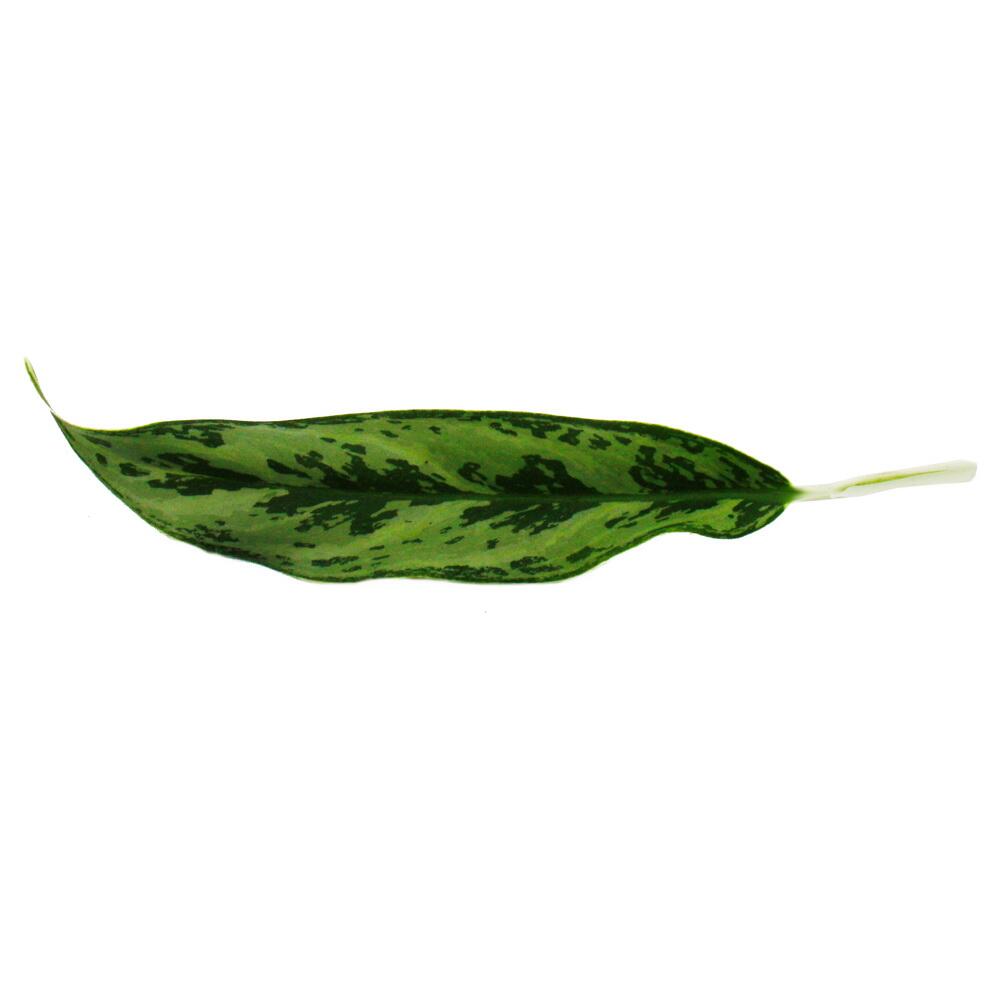
Good to know
Will Greyhound always stay narrow because of its slender leaves?
The offered young plant may produce more shoots and foliage. Leave some room for its later crown.
May it be placed between books?
A bright open compartment suits if leaves stay free and the nursery pot is reachable for checking.
Should I pull open a rolled leaf?
No. The young leaf may unfold itself; mechanical opening can damage it.
Is a pale stalk sick?
Pale stalks belong to the depicted form. Soft, damaged or changed areas should instead be assessed in context.
How often is it watered in winter?
There is no fixed interval. Actual root-ball consumption determines the next dose.
Can it stand next to an open cold door?
Avoid cold draughts. A steadily warm position is better for Chinese evergreens.
Sources and editorial note
- Exotenherz: offer and original images (02.10.2026)
- NC State Extension – Aglaonema: classification, foliage and care (02.10.2026)
- University of Florida IFAS – Aglaonema indoors, warmth and cultivation problems (02.10.2026)
- RHS – houseplants: pot, position and ongoing care (02.10.2026)
Shop offer, article number, GTIN, availability and original images checked directly on 02.10.2026; specialist acceptance 03.10.2026. Specialist sources read directly. Specific offer and both original views read directly on 03.10.2026. Shop variety name Greyhound retained, no unsupported species or hybrid ancestry added. Original leaf form and colour distribution assessed individually. Genus care read directly at NC State and IFAS; general pot practice compared with RHS. No indoor air-purification advertising adopted. 25–30 cm is delivery overall height, not variety final height. Acceptance with aglaonema-guide and aglaonema-lucky-red-guide.