
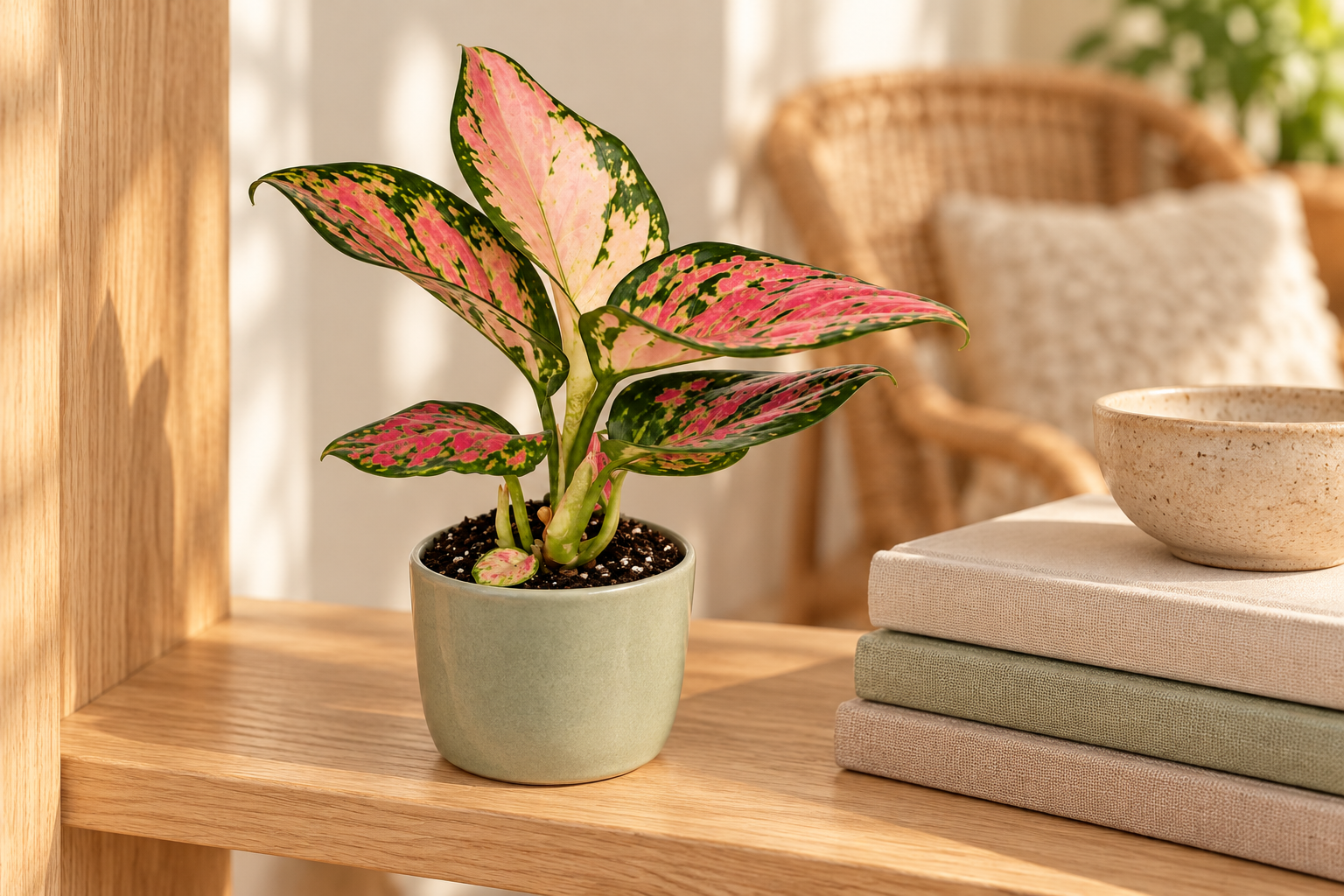
This plant at Exotenherz
Check the shop offer for current availability, price and what is included.
Product details, availability and delivery information are provided in the shop offer.
Your care table
| Topic | What to do | Why it helps |
|---|---|---|
| Light | Bright living space with indirect daylight and no hot direct sun. | The colourful plant needs usable light; a dark shelf is no good permanent position. |
| Water | Let the surface dry slightly, then water the root ball and allow to drain. | Roots tolerate neither permanent wetness nor repeated complete drying well. |
| Warmth | Protect from cold draughts, cold surfaces and sharp temperature changes. | Aglaonema originates from tropical regions and is sensitive to cold. |
| Compost | Use loose, humus-rich houseplant compost and a pot with drainage. | A structurally stable root zone combines moisture storage with aeration. |
| Fertiliser | Apply moderately during visible growth according to the packaging. | Demand falls with reduced growth; plenty of fertiliser does not replace a bright position. |
| Leaf care | Remove dust with a soft damp cloth, supporting the leaf. | Clean leaf surfaces show their natural pattern without leaf-shine spray. |
| Repotting | With a well-rooted root ball, choose only the appropriate next pot size. | A large volume of unrooted soil may remain wet too long. |
| Checks | Regularly inspect leaf undersides, stalks and new growth. | This reveals mealybugs, scale insects and spider mites early; keep sap out of the eyes. |
Check the compost and pot weight. The care table explains how far the compost may dry.
Water only when needed. The water should reach the root ball without spilling over the rim.
Remove surplus water from the saucer or cachepot. Then return the plant to a suitable position.
Colour that looks different on every leaf
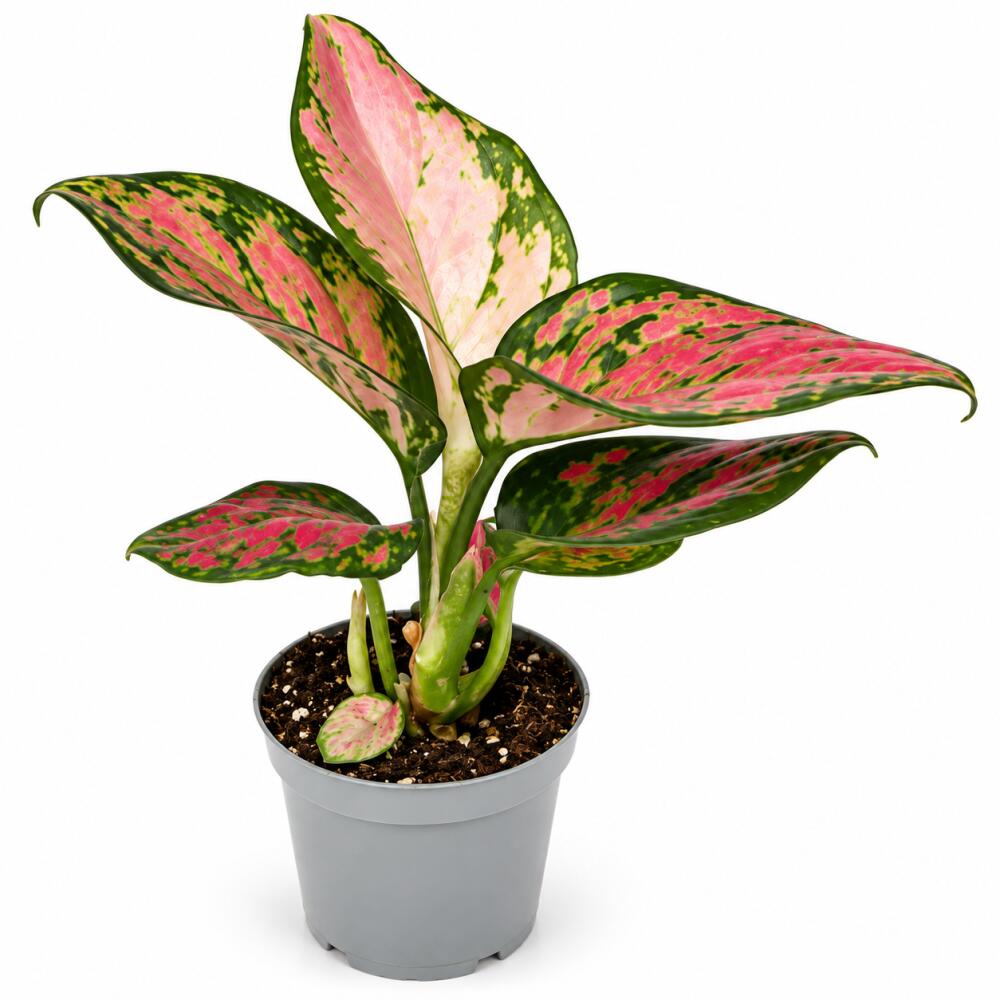
Lucky Red shows how varied a Chinese evergreen can be. The leaf centre glows pink to reddish, while strong green remains at the edges. Between them are speckles and small transitions that do not repeat identically on every leaf. That irregularity is precisely what makes the plant beautiful. We enjoy looking at it on a bright shelf or small ledge where its pattern does not disappear into shade. A quiet outer pot gives the colour space. The red is part of the plant, not painted decoration; it need not therefore produce a particularly uniform pattern.
Mini in the offer, living in its growth
The offered young plant stands in a 6 cm nursery pot at about 8 to 10 cm tall. This is delivery size, not a promise that it will always stay so small. New leaves, side shoots and a stronger base change its form over time. The distribution of pink and green can also vary from leaf to leaf. After shipping we first give it an evenly warm position and check the soil. Do not immediately repot or water as a precaution if the root ball is still moist. The plant can first settle into its familiar root space.
A shelf position really needs daylight
Lucky Red fits nicely into a living corner, but the prettiest position only suits it if enough light reaches it. On a bright open bookshelf near a light source the colourful foliage looks particularly attractive. Deep in the room or behind tall objects brightness is often lacking. We prefer filtered daylight and protect the plant from hot direct sun. Acclimatise freshly unpacked foliage especially gently. If new growth loses vigour, first look at the position. More fertiliser does not make a dark spot brighter.
Water according to need, not a weekly schedule
For Aglaonema, the top soil layer may dry slightly before the next watering. Below that, the root ball should not repeatedly dry out completely. Lift the little pot occasionally: its weight, alongside a finger check, helps build a sense of water use. When water is needed, moisten the root ball evenly and let excess drain. Then empty the outer pot. Continually adding water to already wet soil is easily too much, especially in a small pot. If leaves droop, we therefore check moisture before reaching for the watering can.
Warmth matters at the roots too
Chinese evergreens are tropical plants. They like a quiet, warm living space and no cold draughts when airing the room. In winter we watch the surface beneath them: cold stone or a windowsill can chill the small root ball. Very cold irrigation water is also unnecessary stress. Dry heated air combined with unsuitable watering may encourage brown leaf edges. Lucky Red is therefore poorly placed directly above a radiator. Pleasant room air is more useful than constantly wet foliage. Any brown areas will not disappear again; what matters is that subsequent leaves develop healthily.
Consider soil, pot and nutrients together
Loose humus-rich houseplant compost with good drainage is a suitable foundation. The root ball should hold moisture without sitting in a heavy wet lump. We wait to repot until roots use the existing space well and the plant is growing. Its next pot need only be a little larger. During active growth we feed moderately according to fertiliser instructions. Cautious dosing is sensible for a young plant in particular. With fresh compost also account for fertiliser already present. Too many nutrients at once make neither the pattern more attractive nor the roots stronger.
Through winter without a forced pause
Lucky Red needs no completely dry resting phase. In the darker winter its growth may slow and the soil often takes longer to dry. Adjust water and fertiliser to that rhythm rather than continuing the summer schedule unchanged. Its position remains bright and warm. One older leaf may yellow and fade. If several leaves turn yellow together, we also check root-ball moisture, temperature and light. Wet soil with limp foliage is a reason to look more closely at the roots, not to give another large watering.
Care for leaves and notice changes early
We remove dust with a soft, slightly damp cloth while supporting the leaf from below. Its natural pattern needs no glossy coating. Regularly inspect undersides and stalk bases too: fine webs, small scales or cotton-like deposits often first show there. If suspicious, initially isolate the plant and establish the cause. Chinese evergreens can later form a flower spadix with a spathe; this promises neither a fixed flowering season nor flowers on the young delivery plant. Do not eat foliage or any fruits. Irritating calcium oxalate crystals must also be considered around pets.
One plant, several views
Good to know
Why are not all leaves equally red?
This selection’s leaf pattern is naturally distributed differently. Age, development and position influence appearance; the original photograph is not a promise of an identical pattern.
Can Lucky Red stand on a bookshelf?
Yes, if the position is bright enough directly at the plant and no hot sun falls on its leaves. A dark compartment deep in the room is unsuitable as a permanent position.
Must I repot the small plant immediately?
No. Let it settle in first and observe the root ball. Once roots use their space well and growth is active, a slightly larger pot makes sense.
Why do leaf tips turn brown?
Dry air, uneven water supply or cold may contribute. Check position and root-ball moisture together rather than giving more water just because of one brown tip.
Should it stay completely dry in winter?
No. There is no forced dry rest. With less growth it is watered less often, but the root ball is still supplied according to need.
Is it suitable beside nibbling pets?
No. Aglaonema contains irritating calcium oxalate crystals and must not be eaten. Choose an inaccessible position and handle sap carefully.
Sources and editorial note
- Exotenherz: Lucky Red, delivery size and original image
- NC State Extension: Aglaonema, care and cultivar selection
- University of Florida IFAS: Aglaonema – genus profile and cultivation
- Iowa State Extension: humidity in living spaces
Sources and shop offer read on 30.09.2026. SKU 2145221092026, GTIN 4019515936366; available when checked. The shop states Aglaonema commutatum; NC State lists Lucky Red among Aglaonema cultivars but confirms no parentage. Publicly therefore Aglaonema 'Lucky Red', without additional species or hybrid claims. Genus care used as such; no unsupported eventual cultivar height given. Delivery size and original image checked separately, scene reviewed.