
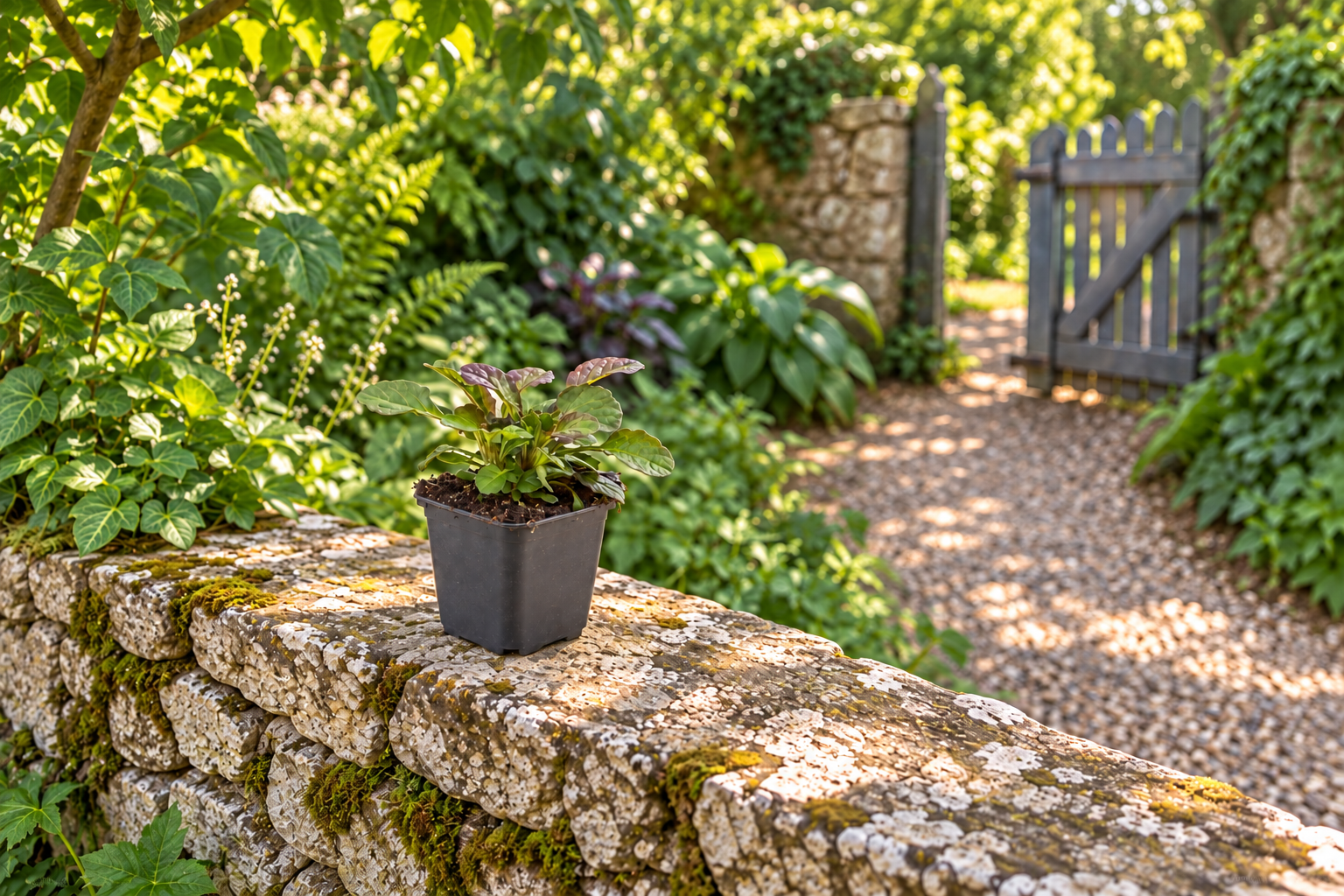
This plant at Exotenherz
Check the shop offer for current availability, price and what is included.
Check the shop for the current price, availability and offer contents.
Your care table
| Topic | What to do | Why it helps |
|---|---|---|
| Position | Choose a fresh woodland edge or partly shaded border. | Large leaves lose their good shape more easily in a hot dry position. |
| Planting | Plant the moist root ball at its previous level and water thoroughly. | The centre stays clear while roots gain soil contact. |
| Spacing | Use 20–25 cm for dense coverage; do not crowd small neighbouring perennials. | Runners later spread Catlin’s Giant beyond the original root ball. |
| Water | Check root-ball moisture during early establishment. | Beneath trees, rain may pass the foliage without sufficiently reaching young roots. |
| Soil | Maintain humus-rich soil and loosen compacted patches carefully. | Even moisture is useful; a closed wet planting pocket is not. |
| Nutrition | In spring, provide moderate compost or suitable fertiliser if needed. | Appropriate supply supports shoots without masking care errors with heavy feeding. |
| Tidying | Lift excess rooted runners; remove damaged leaves individually. | Foliage stays attractive when its edges are managed selectively. |
| Winter | Leave the border planting; shelter container roots and check when frost-free. | The garden perennial is long-lived, but a small pot gives roots little protection. |
Check the compost and pot weight. The care table explains how far the compost may dry.
Water only when needed. The water should reach the root ball without spilling over the rim.
Remove surplus water from the saucer or cachepot. Then return the plant to a suitable position.
A large name for a low garden plant
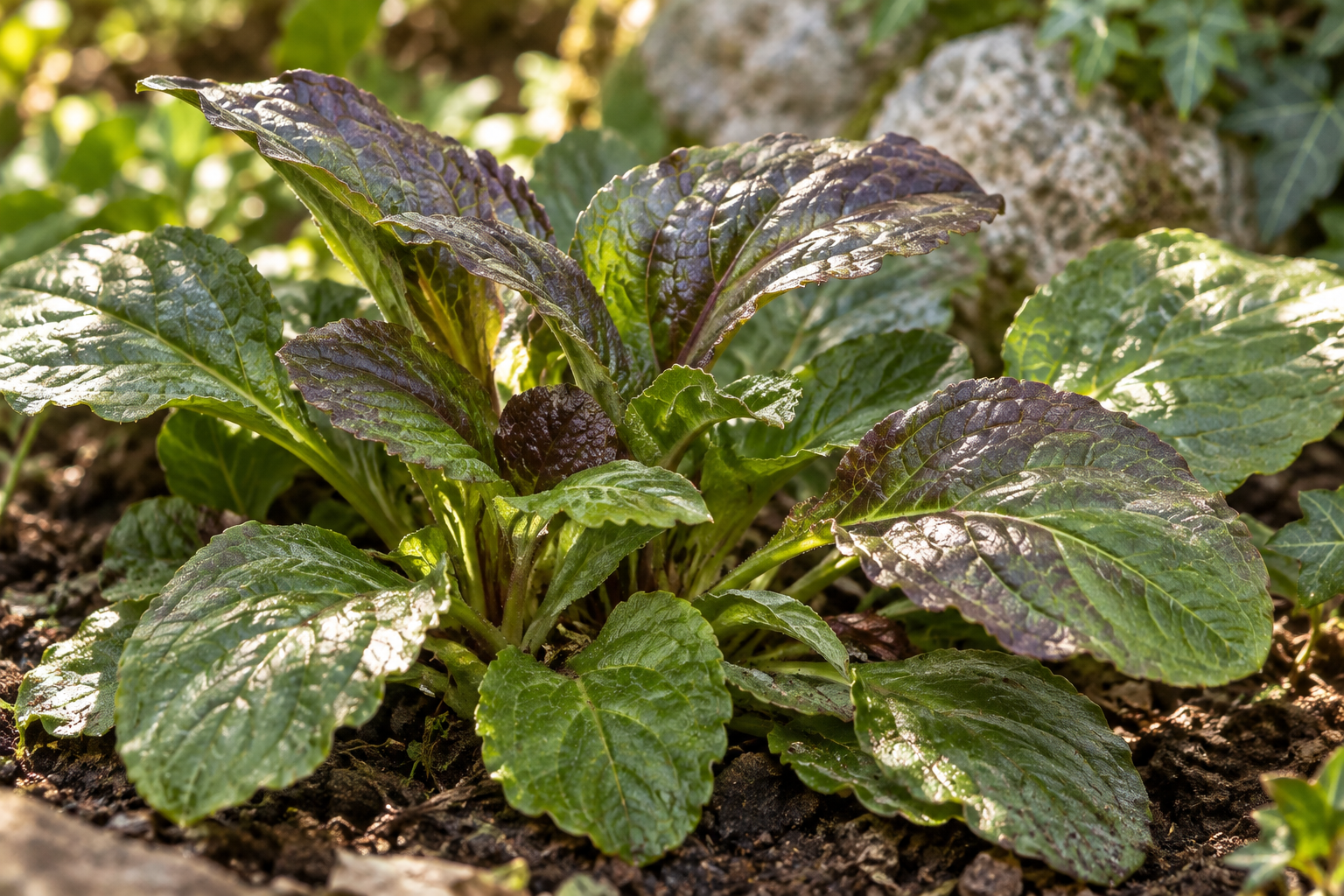
Catlin’s Giant does not become a tall specimen perennial. Its distinctive expression comes from comparatively large glossy leaves. Green and dark bronze to purple tones change with light and development, while rosettes stay close to the ground. Blue flower spikes may rise above them in late spring and summer. Beside a path or in front of larger foliage perennials, these different levels are especially clear. One large leaf fan need not match the next precisely in colour: each plant develops with its position.
Delivery size and later coverage are two pictures
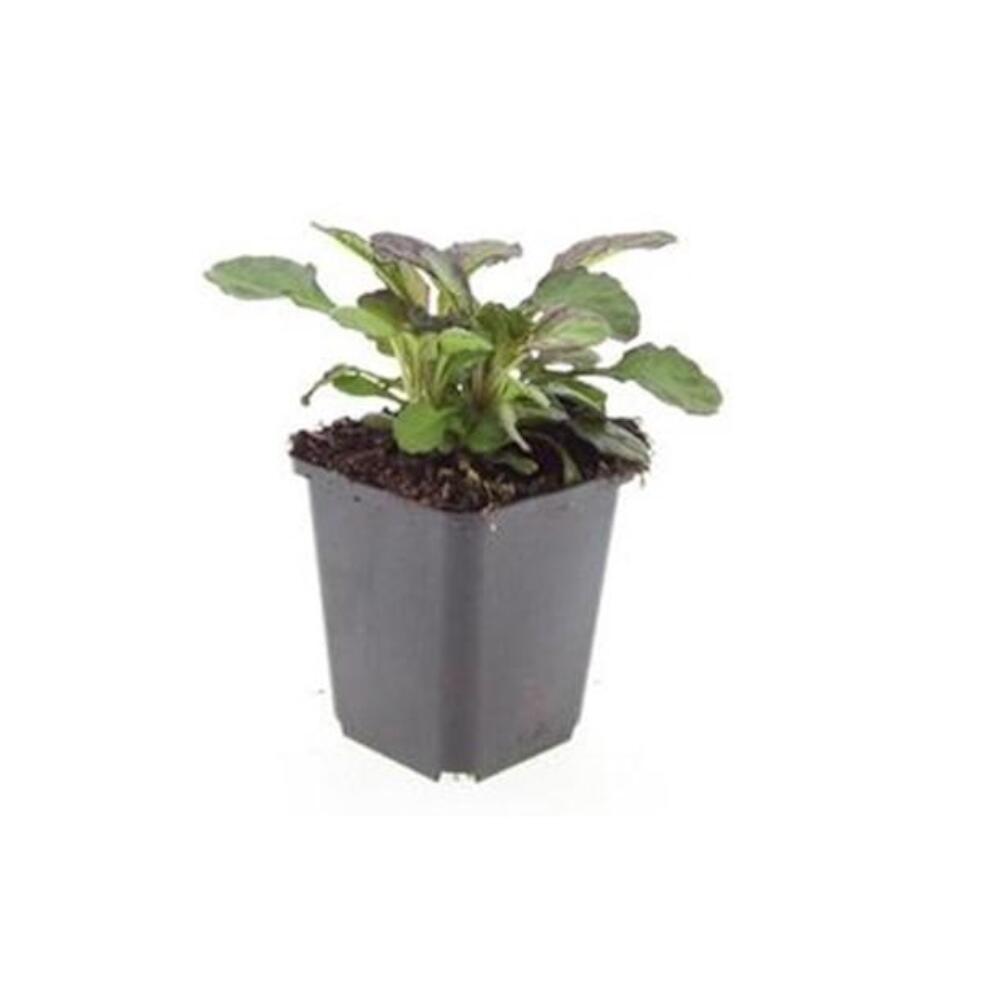
You begin with a young plant in a 9 cm pot, described at approximately 10–25 cm total height including the pot. Sideways-moving coverage develops only after establishment. Shop spacing of 20–25 cm suits a dense start but does not confine the perennial to that circle. Later flower spikes may reach approximately 20–30 cm. Allow extra room particularly beside small slow-growing neighbours and occasionally view the planting from above. Crowding then becomes noticeable in time.
Shade must still supply water
Catlin’s Giant suits partial shade and shade if the root zone stays fresh. A broad tree canopy may protect from hot sun while also blocking rain. Before planting, check whether soil retains moisture somewhat below the surface. Loosen a compacted edge and add some humus-rich material if required without damaging major tree roots. Morning light or filtered daylight reveal leaf structure nicely. At a very dry garden edge, settle water supply first rather than planting bugle solely because the spot is shady.
From a small rosette to new roots
Choose a frost-free, preferably mild planting time. Slowly moisten a dry root ball first. Remove the pot at the root ball instead of pulling large leaves, and set the top level with surrounding soil. Firm gently and water thoroughly. Initially check directly at the former pot root ball: this is still its most important supplying area. A heavy shower farther away says little about that small zone. Spring and early-autumn planting are often easy to support; hot dry weeks demand more frequent checks.
Consider neighbours in a container
Broad bugle leaves can form a lovely lower layer in a larger planter too. Choose companions liking similarly fresh soil. Mixing moisture-needing bugle with plants that must stay permanently dry easily creates care compromises. The planter requires open drainage and sufficient root space. Water slowly, inspect drainage water and do not leave a full saucer. Check under spreading foliage whether compost is dry or still wet. First assess nutrients from existing compost and actual growth; the large cultivar name is no reason for a particularly heavy fertiliser dose.
Runners become design when you guide them
New rosettes can root along runners. They connect coverage but make occasional edge inspection worthwhile. Beside paths, between stones or directly next to a small perennial, carefully lift excess rooted pieces. They can start again in a free area. Young pieces also help if an old centre becomes gappy. Regular complete cutting is unnecessary. Remove only troublesome old flower spikes or damaged leaves and let healthy rosettes retain their low structure.
Check roots in winter and shoots in spring
The perennial remains in the garden. Not every old leaf needs to stay beautiful in harsh weather; loose dead parts can be removed carefully later. Containers create different conditions: cooling from all sides and drying on windy frost-free days. Shelter them and check moisture without watering frozen soil. In spring fresh growth shows how the plant continues. With a whitish coating or weak coverage, inspect leaves and roots first rather than increasing water, fertiliser and cutting back all at once as a precaution.
One plant, several views
Good to know
Does Catlin’s Giant really become huge?
The name mainly refers to large leaves. Bugle remains groundcover; flower spikes reach approximately 20–30 cm.
Why are some leaves greener?
Colour tone and sheen change with light and leaf age. Foliage is not constantly equally dark purple.
Should I space it at 20 cm?
The shop suggests 20–25 cm for dense coverage. Give small neighbours more room and plan for later runners.
Does it suit deep shade?
Shade is possible if soil stays fresh enough. Root competition and rain interception under trees must be considered.
Must it be divided every year?
No. Divide only when needed, for overwide edges or renewal of older gappy patches.
Why do I sometimes still water after rain?
Tree canopies can intercept water. Check moisture at the young root ball first and water only if genuinely needed.
Sources and editorial note
- Exotenherz: offer and original photographs (03/10/2026)
- RHS: Ajuga reptans Catlin’s Giant — cultivar profile (03/10/2026)
- RHS: bugle — soil and rejuvenation (03/10/2026)
- Exotenherz: checked child offer of 6 (03/10/2026)
- Exotenherz: checked child offer of 12 (03/10/2026)
- Exotenherz: checked child offer of 20 (03/10/2026)
- Exotenherz: checked child offer of 40 (03/10/2026)
- Exotenherz: checked child offer of 60 (03/10/2026)
Shop offer, article number, availability and original images checked directly on 03/10/2026. Specialist sources read directly. Cultivar profile with large bronze-purple foliage and 20–30 cm flower spikes read directly. Dense shop planting distinguished from later spread. Neighbour planning, planting procedure and container advice are justified horticultural practice, not additional fixed cultivar values. All five child offers freshly read individually with SKU, GTIN where available, and availability; orderable quantities: 6, 12, 60. Scene shows one plant; quantity follows selected set.