

This plant at Exotenherz
Check the shop offer for current availability, price and what is included.
Product details, availability and delivery information are provided in the shop offer.
Your care table
| Topic | What to do | Why it helps |
|---|---|---|
| Light | A sunny outdoor position with air exchange | The species needs plenty of light |
| Water | Water thoroughly after slight drying | A small container offers little drought reserve |
| Drainage | Do not leave water constantly standing | Pine roots need airy conditions |
| Compost | A free-draining, structurally stable bonsai mix | Compaction obstructs water and air movement |
| Winter | Bright and cool; protect the container in severe frost | Hardiness in the ground is not a pot guarantee |
| Repotting | Protect roots and do not routinely wash everything away | A stable root environment supports recovery |
| Pruning | Keep healthy needles and plan species-specific interventions | Not every pine tolerates the same shoot technique |
| Fertiliser | Feed moderately during healthy growth according to the label | A weakened tree first needs its cause investigated |
Check the compost and pot weight. The care table explains how far the compost may dry.
Water only when needed. The water should reach the root ball without spilling over the rim.
Remove surplus water from the saucer or cachepot. Then return the plant to a suitable position.
A Mediterranean tree in a deliberately small format
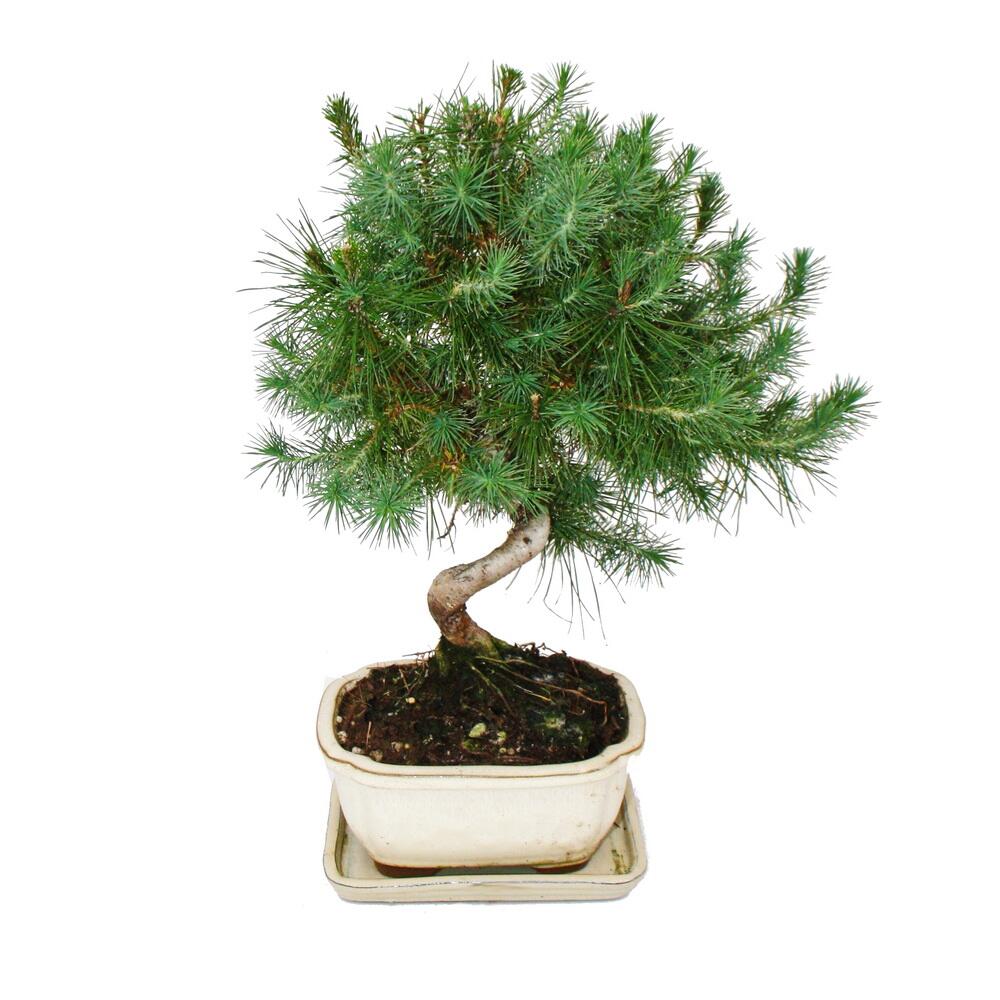
The curved trunk and fine needles give this bonsai its light silhouette. The offer states approximately seven to eight years, a container around 16 × 12 cm and 30 to 35 cm overall height. The eventual size of a freely growing Aleppo pine has little to do with this delivery size: only years of training and care maintain the small format. Each tree has its own trunk line. The colour of the container and saucer may also differ from the product photograph.
What its Mediterranean origin means for care
Pinus halepensis belongs to the pine family and is native to the Mediterranean region and adjoining western Asia. It is evergreen and very light-loving. On mature shoots, needles are typically arranged in pairs; young foliage or foliage influenced by care may look different. Its adaptation to dry sites does not mean that a bonsai can manage without regular checks. In the ground, a large tree can explore far more root space. A small container loses its reserve much faster and needs its own careful supply.
Choose the sunny outdoor position carefully
Aleppo pine is not a houseplant for a half-dark shelf. It needs sunshine and air exchange outside. After transport or prolonged sheltered cultivation, acclimatise gradually to strong sunlight. In summer, check whether the dark container heats intensely on stone or beside a hot wall. The crown can remain bright while the root zone is protected from extreme temperatures. A wind-stable position prevents the small container from tipping or drying quickly. Regular observation is more valuable than a particularly decorative but unsuitable position.
Water thoroughly, then let air reach the roots
Water when the surface has dried slightly and supply the whole root ball. Water must be able to drain after every application. The pine should neither remain constantly wet nor repeatedly dry out completely. With heavy compacted compost, check permeability first. Frequent tiny water applications can conceal dry areas inside. Water use falls in winter, but evergreen foliage continues losing moisture. Check on frost-free days and water cautiously if needed. A wet saucer is unsuitable during the cold season too.
Work cautiously on roots and needles
Pines benefit from a healthy root environment. Do not routinely wash away all the soil when repotting or severely prune the entire root ball. A suitable structurally stable bonsai mix supports air and drainage. Plan extensive work according to tree condition and a suitable spring date, then allow time for roots to establish. Do not broadly cut away healthy needles. Special techniques for removing complete spring shoots on certain black pines cannot automatically be applied to every Aleppo pine. For a newly acquired tree, stable cultivation and moderate maintenance of shape matter more initially than rapid refinement.
Overwinter cool and assess changes correctly
The RHS describes a degree of winter hardiness for the species. This is not a guarantee for a small unprotected bonsai pot. Protect the container from severe frost and drying wind; a bright cool shelter with frost protection during hard freezes is a cautious option. Constant living-room warmth does not suit winter rest. Older inner needles may naturally change colour and fall. If whole shoot tips brown or the root ball stays wet for a long time, investigate root problems, pests or an unsuitable position more closely. Establish the cause before applying extra fertiliser or heavy pruning.
One plant, several views

Good to know
Is Aleppo pine an indoor bonsai?
No. It needs a sunny outdoor position and a suitable cool winter place.
Does its origin mean it barely needs watering?
Even drought-adapted trees can dry quickly in a small container. Check regularly and water thoroughly as needed.
May I wash all roots clean when repotting?
This should not be routine for this pine. Protect healthy roots and part of the existing root environment.
Can I follow instructions for black pines?
Not automatically. Growth, condition and species must suit the technique; completely removing fresh shoots particularly requires species-specific experience.
Sources and editorial note
- Product and delivery contents: Exotenherz
- Royal Horticultural Society: plant and care information
- Royal Horticultural Society: plant and care information
Sources checked: 15 September 2026. Product information and the contents of delivery follow the linked shop offer. Care advice was checked against the cited specialist sources and should still be adapted to the plant’s condition, position and season.