

This plant at Exotenherz
Check the shop offer for current availability, price and what is included.
Check the selected shop offer for price, availability and delivery contents.
Your care table
| Topic | What to do | Why it helps |
|---|---|---|
| Light | Bright indirect light without hot direct sun. | Dark foliage does not make a lightless position suitable. |
| Water | Allow the top of the soil to dry slightly, then water and let it drain. | Steady slight moisture is better than lasting wetness or repeated drying out of the root ball. |
| Roots | Choose loose soil that holds its structure and a nursery pot with drainage. | Even a small alocasia needs air between the substrate particles. |
| Warmth | Keep it steadily warm, consistently above 15 °C. | A cold root ball and draughts put stress on this tropical plant. |
| Humidity | Avoid direct air from heaters and humidify very dry indoor air if needed. | Keeping the velvety leaves constantly wet does not replace suitable room conditions. |
| Feeding | Feed moderately only during active growth, following the product instructions. | Heavy feeding will not speed up its slow growth. |
| Leaves | Remove dust very gently; do not scrub or use leaf-shine products. | The matt, velvety appearance is part of the natural surface. |
| Checks | Look at the undersides and the bases of the leaf stalks; also check the root ball if leaf loss is unusual. | Pests, cold and unsuitable moisture can cause similar changes. |
Check the compost and pot weight. The care table explains how far the compost may dry.
Water only when needed. The water should reach the root ball without spilling over the rim.
Remove surplus water from the saucer or cachepot. Then return the plant to a suitable position.
Dark velvet in a small format
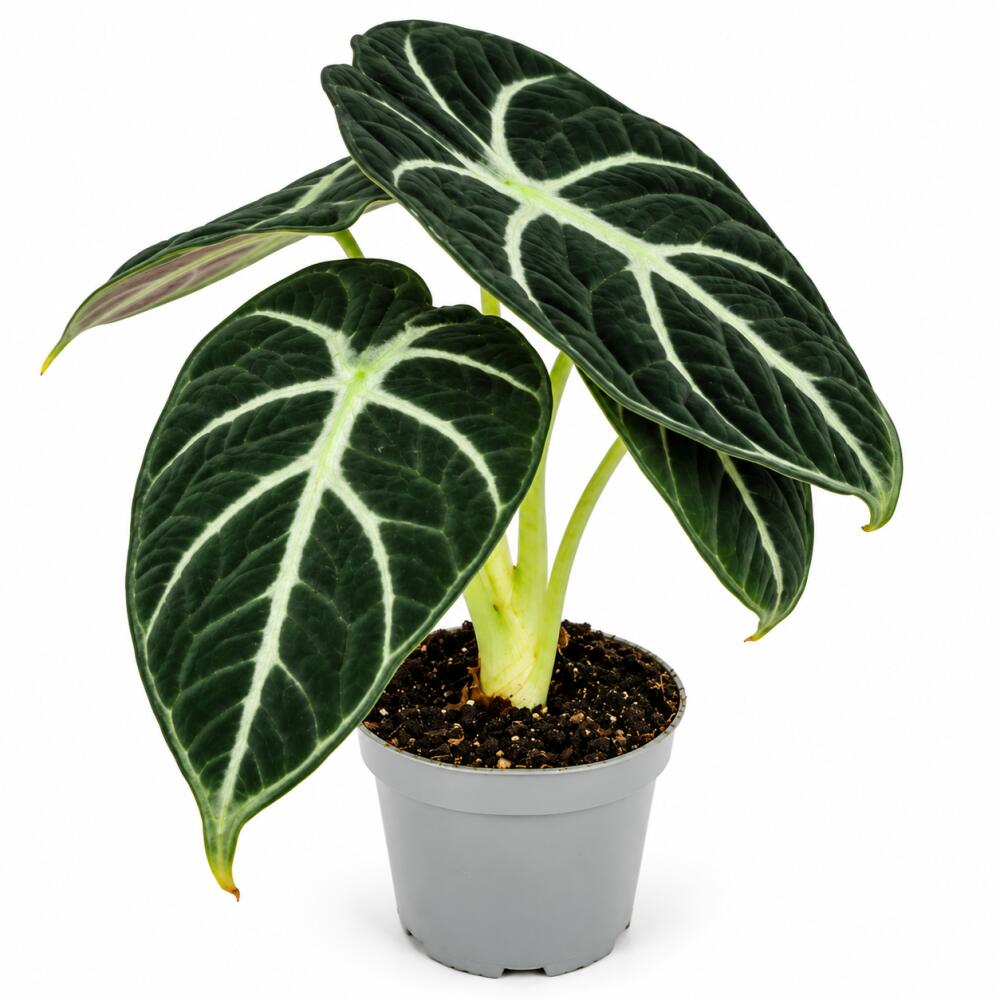
Black Velvet has a leaf pattern that is hard to mistake for another houseplant: very dark green looks almost black, with pale main veins clearly traced across it. The surface looks soft and velvety, although the leaf has a sturdy structure. We particularly like it in a small, quiet arrangement. On a bright desk beside a simple ceramic piece or a notebook, its pattern stands out without the plant taking up much space. The foliage needs no artificial shine. Its matt depth and pale lines are exactly what makes this alocasia special.
Let the miniature plant grow at its own pace
The confirmed article starts in a 6 cm nursery pot at approximately 8 to 10 cm total height. Black Velvet grows rather slowly and remains comparatively compact, but it is not a miniature frozen in time. Larger, older plants may reach approximately 50 cm; actual growth depends on position and cultivation. After shipping, we allow time for it to settle in. Check the moisture first, place it somewhere warm and bright, and watch the next new growth. A large new pot or plenty of fertiliser will not turn the young plant into a healthy mature specimen any faster.
Dark leaves need a bright position
With this leaf colour, you might imagine a shade plant for the darkest corner of the room. Indoors, we still prefer a bright position with indirect daylight. That supports growth and shows the veins beautifully. We avoid hot direct sun, especially just after unpacking. A desk is suitable only if light really reaches the plant. Distance from a light source, shade from furniture and the season matter more than the name of the room. Cold draughts and windowsills that become very cold are unsuitable too. Keep its indoor position as evenly warm as possible.
Pay attention to the small root ball
A 6 cm pot holds little reserve. Even so, we do not automatically water every day. Feel the top of the soil first and notice how heavy the pot still is. Once the surface has dried slightly, water the root ball evenly and allow it to drain. Remove any water from the outer pot afterwards. If the soil stays wet for a long time, look for the cause first: little light, low temperature or a missing outlet can all contribute. Do not blindly add more water when the foliage looks limp. Repeated complete drying out is equally unhelpful; the skill is learning the young plant’s actual water use.
Airy soil rather than an oversized reserve pot
The roots appreciate a loose, well-aerated root space. Suitable houseplant compost with stable structural ingredients is more useful than a dense, wet mixture. The nursery pot needs drainage holes. We move up to a slightly larger size only when roots fill the root ball well and the plant is growing. Handle the fine roots gently when repotting. A very large pot contains plenty of soil that roots scarcely use at first, which can stay moist for a long time. We also supply nutrients moderately during active growth, taking account of the fertiliser instructions and any feed already in the substrate.
Care gently for the velvety surface
Dust quickly shows on dark leaves. Remove it carefully, supporting the leaf from underneath. Vigorous rubbing or a leaf-shine product is more likely to spoil its lovely appearance than improve it. Do not place Black Velvet directly in hot, dry air from a heater. Effective humidification can help if the room air is very dry; a brief mist is no lasting substitute. The plant does not need to look constantly wet. An enclosed glass container is not an essential condition for good care either. A bright, warm indoor position with properly supplied roots remains the foundation we establish first.
Winter care follows visible growth
As the days shorten, new growth may slow down and the soil may stay moist longer. We then reduce water and fertiliser accordingly. The position remains bright and warm; this young indoor specimen does not need a forced cool, dry rest. The plant may shed an older leaf. If several leaves turn yellow quickly or the stalks become soft, however, we check more closely whether the root ball and roots are healthy. Not every change is a normal rest. Good light, an undisturbed position and patient care help more than constant moves, extra feeding and precautionary watering.
Small checks and a safe place in the home
We occasionally check the undersides of the leaves and their bases. Fine webs, pale speckles or small cottony patches can suggest pests. First separate a plant that looks unusual and examine it more closely. A single damaged leaf alone does not prove an infestation. Later, Black Velvet can produce an inflorescence with a spadix and spathe; the miniature delivery plant is not promised as a flowering plant. The foliage and sap are not for consumption. Irritating calcium oxalate crystals need to be considered around children and pets. Wear gloves when removing damaged plant parts and keep the sap out of your eyes.
One plant, several views
Good to know
Are the leaves really black?
They are very dark green and look almost black depending on the light. The pale silvery veins strengthen the contrast. Colour may vary slightly between individual leaves.
Can it stand on a dark shelf?
For a permanent position it needs usable daylight. Dark foliage does not mean that the plant can grow healthily without brightness.
Will Black Velvet remain a miniature forever?
No. The 8–10 cm describes the delivery size. It grows slowly and compactly but may become considerably larger later.
Does it absolutely need a terrarium?
No. A bright, warm indoor position with suitable humidity and attentively supplied roots can work well. An enclosed glass container is not required.
Can I speed up growth with more fertiliser?
That is not a sensible approach. First provide suitable light, warmth and root space. Feed moderately during active growth according to the fertiliser instructions, rather than giving heavy doses.
Is Black Velvet safe for pets?
No. Alocasia contains irritating substances and must not be eaten. Place it out of reach of pets and children that might nibble it.
Sources and editorial note
- Exotenherz: confirmed miniature Black Velvet variant and original image
- RHS: Alocasia 'Black Velvet'
- RHS: growing alocasias
- NC State Extension: Alocasia including reginula
- Iowa State Extension: indoor humidity
Sources and the specific miniature variant read on 30.09.2026. SKU 2145621092026, GTIN 4019515936373; immediately available, with consistent 6 cm and 8–10 cm measurements. The shop names Alocasia reginula, NC State names reginula/Black Velvet, and the RHS names Alocasia 'Black Velvet'. The other offer, SKU 206118112021, remains held as a variant because of an 11/12 cm discrepancy. No African origin is inferred from the trade name African Mask. Growth guidance of up to approximately 50 cm is distinguished from delivery height. Original-to-scene comparison passed.