
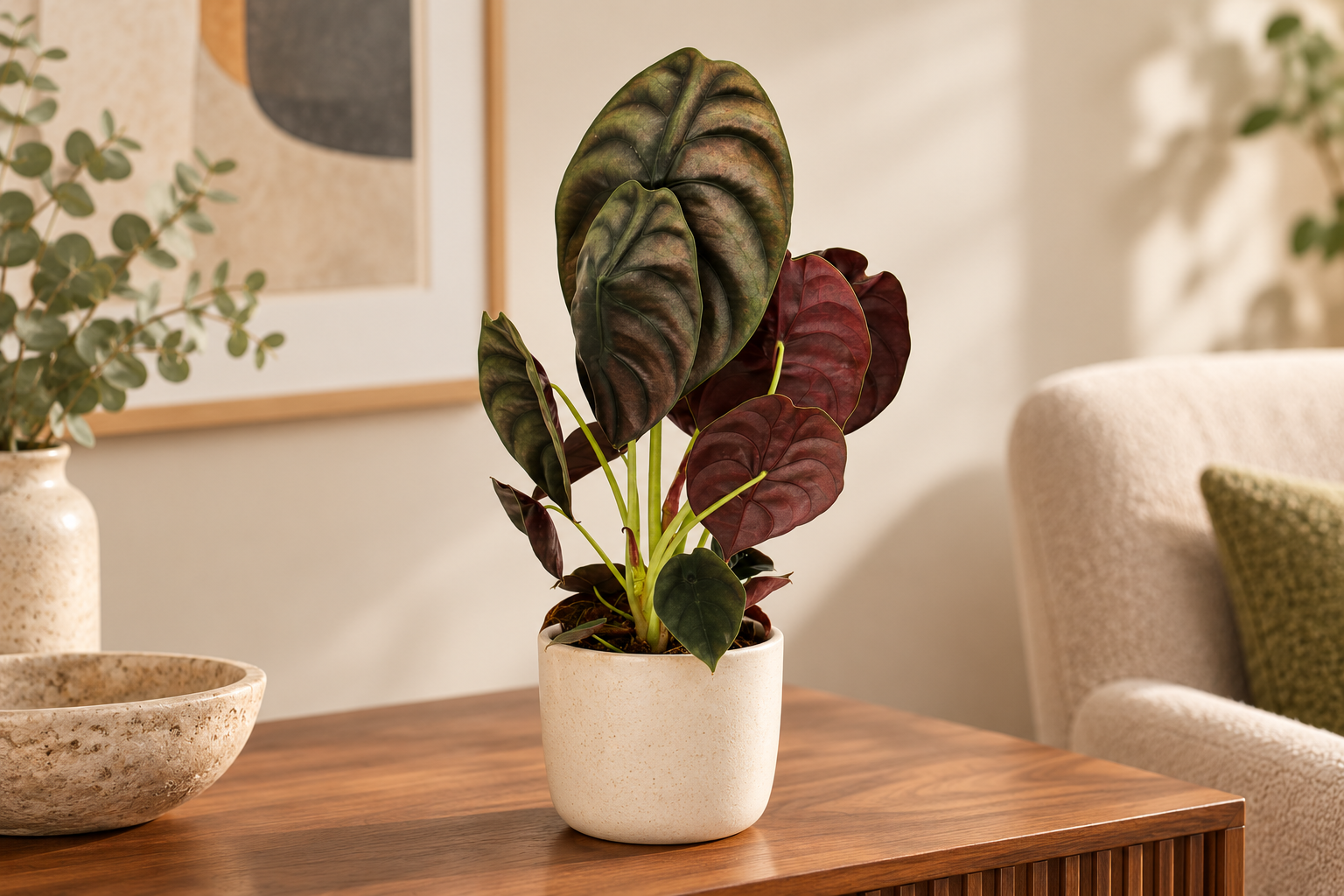
This plant at Exotenherz
Check the shop offer for current availability, price and what is included.
Product details, availability and delivery information are provided in the shop offer.
Your care table
| Topic | What to do | Why it helps |
|---|---|---|
| Light | Bright indirect daylight; avoid hot direct sun. | Gentle light shows the texture and enables growth without sun stress. |
| Water | Let the top dry slightly, then water evenly and allow to drain. | The root ball should neither dry out completely nor stay permanently wet. |
| Warmth | Choose a warm position, preferably consistently above 18 °C. | A cold root ball can also impair this tropical plant’s growth. |
| Humidity | Avoid dry heated positions; humidify room air deliberately if needed. | A brief mist creates no lasting suitable humidity. |
| Compost | Loose houseplant compost with, for example, perlite and a pot with drainage. | Air in the root zone is particularly important with regular water supply. |
| Nutrients | Feed moderately during visible growth following product instructions. | With little winter growth demand falls; additional fertiliser does not replace light. |
| Repotting | Move into a pot only slightly larger once the root ball is well rooted. | Excessive fresh compost stays moist a long time without corresponding roots. |
| Leaf care | Clean carefully and inspect undersides regularly. | The natural surface needs no shiny coating; detect pests early. |
Check the compost and pot weight. The care table explains how far the compost may dry.
Water only when needed. The water should reach the root ball without spilling over the rim.
Remove surplus water from the saucer or cachepot. Then return the plant to a suitable position.
A leaf that plays with light
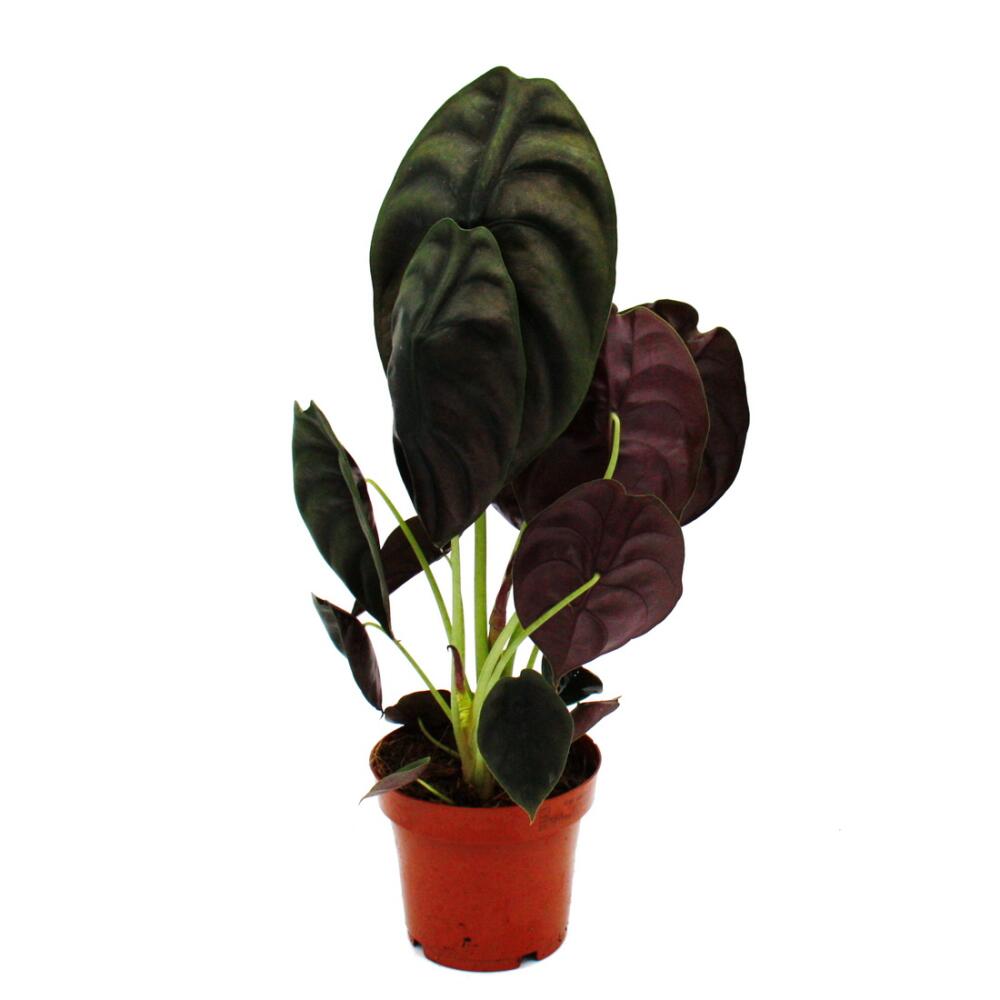
Red Secret deserves a second look. From one direction its sturdy leaves appear dark green; from another a bronze to coppery sheen emerges. Burgundy is added underneath. Deep veins cross the surface like little valleys, giving it a distinctive three-dimensional quality. We like placing it where both upper and lower surfaces can be seen without constantly turning or touching it. A bright position on a sideboard can be attractive for that. Light effects are part of its charm; uniformly vivid red leaf tops would not be an accurate picture of this plant.
Distinguish the delivery plant from later growth
The offer has Red Secret in a 12 cm nursery pot at about 25 to 30 cm total height. In good conditions it may later take up considerably more space; strong older specimens reach approximately 80 cm. This is a guide, not the measurement of the delivered plant. After unpacking we first check whether the root ball is moist and the leaves have arrived undamaged. It then receives a quiet, warm position. A larger pot and heavy feeding are no necessary welcome. Young roots may first use their existing space while the plant becomes accustomed to its living space.
A bright living space with gentle transitions
Bright indirect daylight is a good start. The plant should receive light without being exposed to midday sun behind hot glass. A dark leaf may look impressive at the back of a room, but there is often too little light for lasting growth. We therefore check brightness at the plant itself. Acclimatise gradually after a change of position, especially after shipping. Even warmth is just as important. Keep Red Secret away from cold draughts and chilling surfaces, and preferably find a spot above 18 °C. Root-ball temperature counts too.
Water the root ball, not fill the outer pot
Before watering we check the upper soil layer and pot weight. Slight drying is sensible; repeated complete drying of the root ball is not. When water is needed, the soil is moistened evenly; the nursery pot can then drain thoroughly. Remove excess from the outer pot. With this strongly leafed plant, a drooping leaf is quickly noticed and makes us want to help. The watering can is still the second step: if the soil is already wet, more water can burden the roots. A bright warm position and an aerated root ball belong together rather than being treated independently.
Roots need structure and a suitable pot
Red Secret is not an aquatic plant. Loose humus-rich houseplant compost with structural ingredients, such as perlite, holds moisture while allowing air to the roots. A drainage hole in the nursery pot remains necessary even with decorative ceramic outside it. Repotting is worthwhile once the root ball has rooted well into its space and the plant is growing. The next size need only be slightly larger. We handle roots carefully and maintain the previous planting level. During active growth we feed moderately following the packaging and account for fertiliser already included in fresh compost.
Humidity and leaf care with a steady hand
This tropical alocasia dislikes being directly in dry, hot air from heating. Choose a spot not directly over a radiator. With very dry room air, effective humidification makes more sense than constantly damp leaf surfaces. A pebble tray must not put the pot base in water; it does not replace checking the room climate either. We remove dust with a soft, slightly damp cloth while supporting the leaf underneath. Its bronze effect needs no leaf-shine product. Strong rubbing, coatings or constant misting do not improve its beautiful natural surface.
Support reduced winter growth attentively
In winter water consumption may drop and an older leaf may fade. We therefore keep Red Secret bright and warm and only water again after a moisture check. Fertiliser is adjusted to actual growth. Cool dry storage like that used for some garden tubers does not suit this indoor specimen. If the root ball stays unusually wet for a long time, we check light, warmth and drainage. With substantial leaf loss or soft stalk bases, look more closely rather than dismissing it as winter rest. Healthy new growth later is a better sign than trying to preserve every old leaf permanently.
Flowers are possible, but attention matters more
Red Secret may later form a flower spadix with a spathe. Neither flowers nor a fixed annual flowering time are promised for the young delivery plant; its special leaf texture is the focus here. Occasionally check undersides and stalk bases for spider mites or mealybugs. Fine webs, pale speckles or cotton-like areas deserve closer attention. Gloves make sense when removing damaged leaves. Alocasia contains irritating calcium oxalate crystals, must not be eaten and should stand out of reach of nibbling children and animals. Keep plant sap out of your eyes during care.
One plant, several views
Good to know
Why does Red Secret sometimes look green instead of red?
Depending on age and light angle, the upper leaf surface shows dark green, bronze and coppery tones. The burgundy underside strengthens the colour impression. A uniformly red surface is not expected.
Will it stay 25 to 30 cm tall?
That is delivery height. Older, well-cultivated specimens can become substantially larger, up to roughly 80 cm. Later growth also depends on its indoor position.
May the outer pot contain a water reservoir?
No. The nursery pot must drain; excess is removed afterwards. Permanent water at the pot base can harm roots.
Should I keep it cool in winter?
For this tropical indoor specimen a bright warm position remains suitable. Reduce water and fertiliser with less growth without allowing a living root ball to dry out completely.
Must I spray the glossy leaves?
No leaf-shine spray is needed for the natural sheen. Gently remove dust; support suitable humidity through the position or room air.
Is Red Secret an edible plant?
No. This offer is for an ornamental plant with irritating substances. Do not eat it and protect from nibbling children and pets.
Sources and editorial note
- Exotenherz: Red Secret, delivery size and original image
- RHS: Alocasia cuprea 'Red Secret'
- RHS: growing Alocasia indoors
- NC State Extension: Alocasia and Red Secret
- Iowa State Extension: humidity for houseplants
Source comparison and shop check on 30.09.2026. SKU 241829112022, GTIN 4019515919390, immediately available. Name and delivery size match the shop; RHS and NC State list Alocasia cuprea 'Red Secret'. RHS name status 'unresolved' is not reinterpreted as confirmed breeding parentage. Colour effect described as variable, not as purely red upper leaf surfaces. The size guide up to about 80 cm refers to older cultivated plants, not delivery size. Original and scene visually compared.