
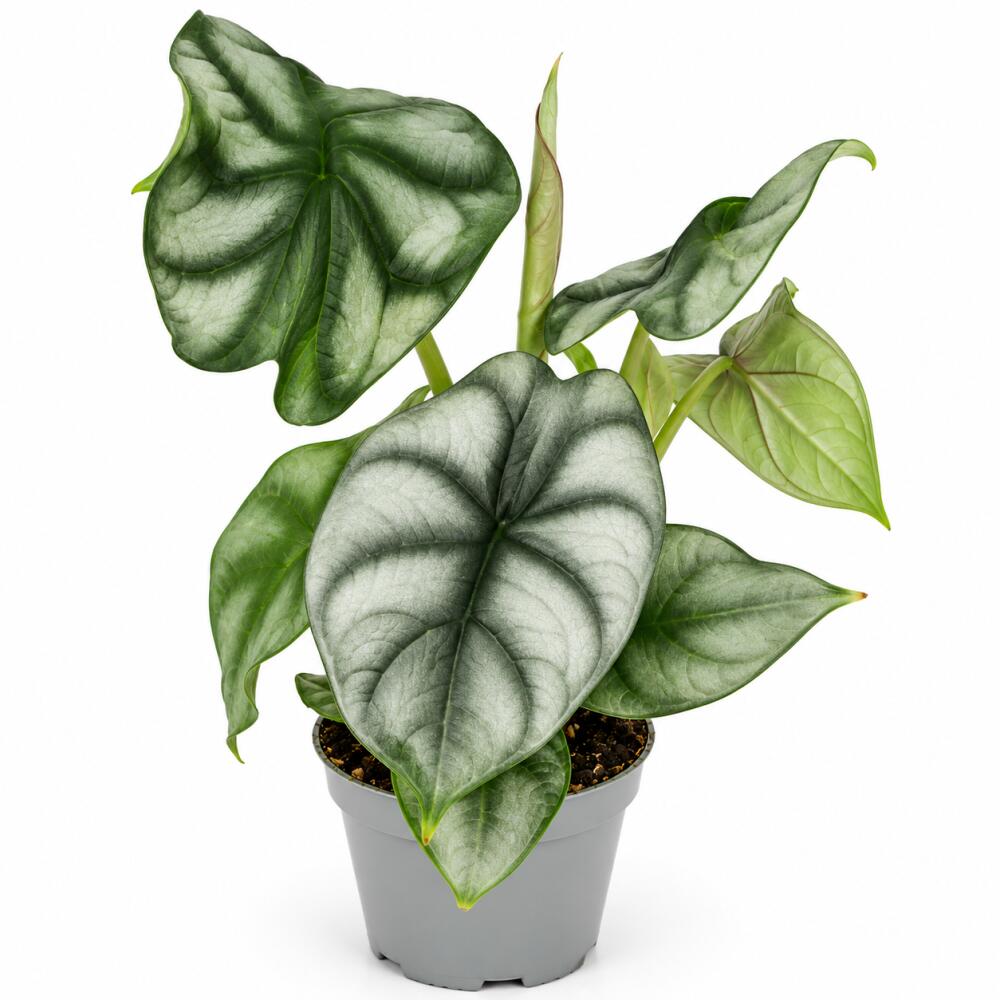
This plant at Exotenherz
Check the shop offer for current availability, price and what is included.
Product details, availability and delivery information are provided in the shop offer.
Your care table
| Topic | What to do | Why it helps |
|---|---|---|
| Light | Bright, filtered daylight; protect from hot midday sun. | Good brightness supports growth; harsh sun can damage leaves. |
| Water | Check the upper compost layer; water thoroughly as needed and allow to drain. | The small root ball should stay slightly moist, not permanently wet. |
| Root zone | Loose houseplant compost with structural ingredients and drainage holes. | Roots need air as well as moisture; compacted wet soil is unfavourable. |
| Warmth | Keep evenly warm, not permanently below 15 °C. | Cold surfaces and draughts stress a tropical alocasia. |
| Humidity | Avoid dry heated air; humidify the room effectively if necessary. | Brief misting does not replace lasting suitable humidity. |
| Nutrients | Feed moderately during active growth according to fertiliser instructions. | A small pot allows little room for overdosing; feed less in winter. |
| Repotting | Only move into a slightly larger pot once the root ball is well rooted. | Too much unrooted soil can remain moist unnecessarily long. |
| Checks | Inspect leaf undersides and stalks for pests; wear gloves when cutting. | Early checks help with spider mites and mealybugs; sap can irritate. |
Check the compost and pot weight. The care table explains how far the compost may dry.
Water only when needed. The water should reach the root ball without spilling over the rim.
Remove surplus water from the saucer or cachepot. Then return the plant to a suitable position.
A small silver dragon for your living space
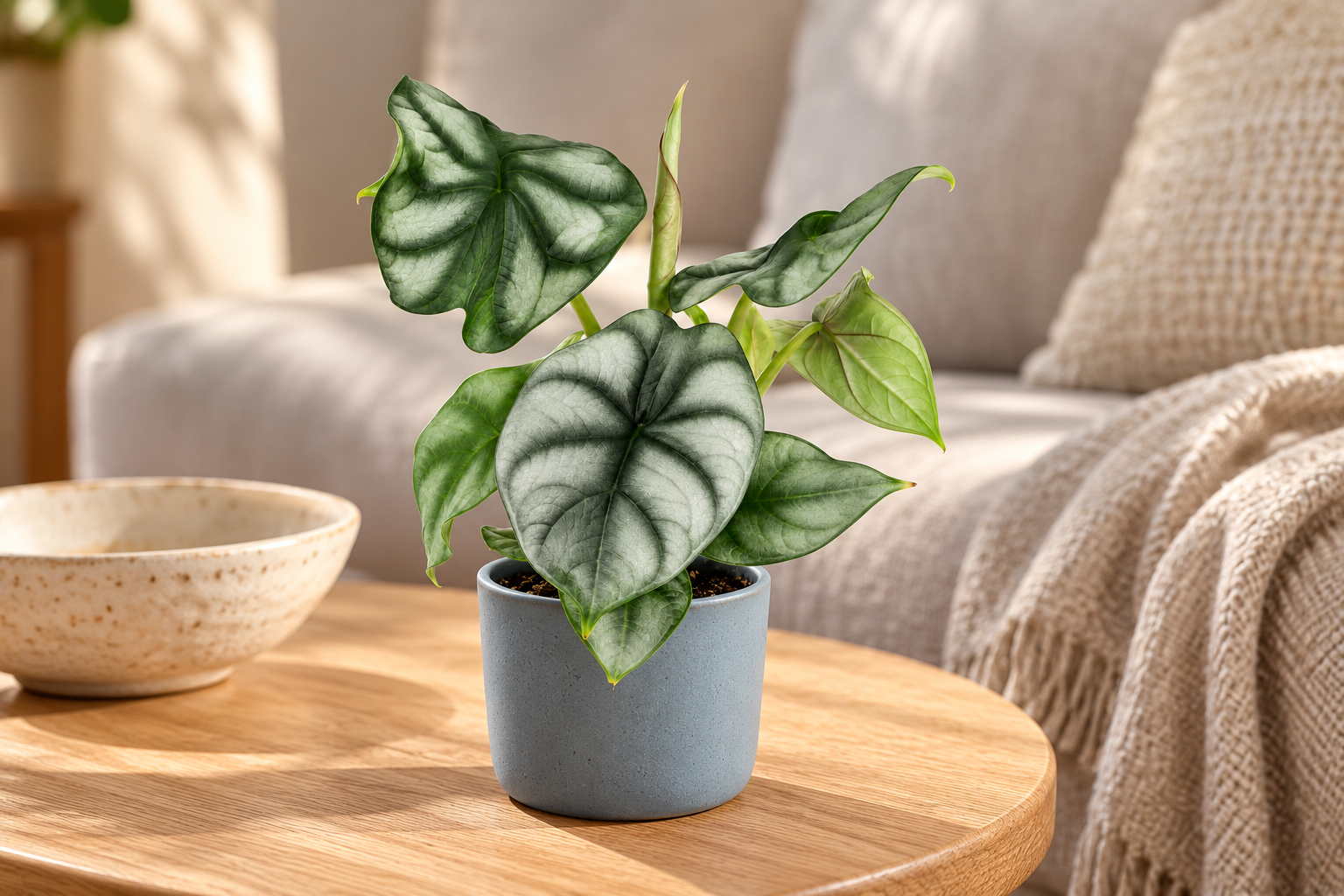
Some plants need many leaves to stand out. With Silver Dragon, just one well-developed leaf is enough: the pale surface looks almost metallic, while dark veins clearly trace its texture. Yet the foliage is living and soft, not a decorative object. We particularly like how light makes this alocasia’s small raised areas visible. A quiet spot where it can also be admired close up suits it well. A plain outer pot keeps attention on the plant. Its colour comes from the leaf pattern; it needs no leaf-shine spray.
Let the young plant settle in slowly
The offer starts in a 6 cm nursery pot at about 8 to 10 cm total height. It is a young plant, not a permanently fixed miniature. Leaf number and arrangement can change with growth; a newly unfurled leaf also often looks paler than an older one. After unpacking we first find a warm, bright position without draughts. Check the root ball before watering and give the plant time to adjust to the home. An immediate move to a large pot is unnecessary. A small outer pot is attractive but must not obstruct drainage.
Brightness that does not scorch the leaves
Silver Dragon likes plenty of indirect daylight. A bright side table or open shelf near a light source can work well. What matters is brightness right at the plant: a lovely shelf deep in the room is not automatically a good permanent spot. We avoid hot direct sun behind glass, especially for a recently acclimatised plant. Turn the pot a little occasionally if the foliage leans strongly towards the light. The position should also remain evenly warm. A cold windowsill in winter can chill the root ball more than the air temperature might suggest.
Watering begins by looking into the pot
For such a small pot, frequent brief checks are worthwhile rather than a fixed watering day. If the top layer still feels wet and the pot is heavy, we wait. Once it dries slightly and the root ball becomes noticeably lighter, the plant receives water. Water so the soil is evenly moistened; excess must then drain away. No water should remain in the outer pot. We want neither to let this alocasia dry out completely nor to keep topping it up. A drooping leaf is initially a reason to check: in wet soil, extra moisture can worsen the problem.
Airy compost and a suitable next pot
The root zone should hold moisture without becoming dense and heavy. Good houseplant compost with a structural ingredient such as perlite is a useful starting point. A pot with drainage holes remains essential. Once the root ball is well rooted and the plant visibly growing, we move it into a pot only slightly larger. We work gently rather than needlessly pulling fine roots apart. Fertiliser is given moderately during active growth following product instructions. The small delivery plant grows through good conditions, not through as much fertiliser as possible in one dose.
Humidity without constantly wet leaves
Care can become more demanding in dry heated air. We therefore do not place Silver Dragon directly above a radiator. If room air is very dry, effective room humidification helps more than a brief mist. A well-positioned group of plants can also make the surroundings somewhat more favourable. The leaves need not be constantly wet. We gently remove dust with a soft, slightly damp cloth while supporting the leaf with the other hand. Its texture stays visible without vigorous rubbing. Air movement should be gentle; a cold draught is no substitute.
Follow the plant’s rhythm in winter
As days shorten, Silver Dragon may slow its growth and lose some older leaves. It then often needs less water and nutrients. We keep its position bright and warm rather than moving it into cool winter quarters. Check the soil before every watering and respond to actual use. Reduced growth is no reason to let a still-living root ball dry out completely. With substantial leaf loss we look more closely at warmth, light and roots. One old leaf may fade; several rapidly yellowing leaves together with permanently wet soil are a different signal.
Observe closely and handle it safely
Occasionally it is worth looking beneath leaves and around stalk bases. Fine webs, pale speckles or cotton-like areas deserve a closer look; initially separate affected plants from others. Not every brown leaf-edge section is already a pest infestation, however. Always check position and root-ball moisture too. Alocasia is an ornamental plant with irritating calcium oxalate crystals and does not belong in the mouth. Gloves are sensible when removing damaged leaves; choose a position where children and animals cannot nibble it. Later flowering is possible, but is not the focus of this young foliage plant.
One plant, several views
Good to know
Will Silver Dragon stay as small as when delivered?
No. The 8–10 cm refers to the young shop plant. Good care produces larger leaves and a stronger plant; its space and pot can grow with it later.
Is the silver leaf coated with something?
No. The silvery-green effect is part of this selection’s natural leaf pattern and texture. Leaf-shine products are neither necessary nor helpful.
Can it stand in a closed outer pot?
As a decorative sleeve, yes, provided the nursery pot has drainage holes and excess water is removed. It is poorly suited to permanently wet soil without drainage.
Why does it lose a leaf in winter?
Less light and slower growth can contribute to older leaves fading. With heavy or rapid loss also check warmth, root-ball moisture and root condition.
Does daily misting help against dry room air?
A brief mist raises humidity only temporarily. A suitable position and effective room humidification if needed are a better foundation.
Is Silver Dragon suitable for nibbling pets?
No. Like other Alocasia, it contains irritating calcium oxalate crystals. Keep the plant out of reach and do not eat it.
Sources and editorial note
- Exotenherz: specific delivery plant and original image
- RHS: Alocasia 'Silver Dragon' – cultivar profile
- RHS: growing Alocasia
- NC State Extension: Alocasia – genus and handling
- Iowa State Extension: humidity for houseplants
Sources and shop offer read on 30.09.2026. SKU 2145321092026, GTIN 4019515936380; available when checked. RHS lists Alocasia 'Silver Dragon' as a cultivar. No unsupported species assignment added. Genus care guidance is separated from cultivar features; delivery height is not eventual height. The second shop view is itself labelled as an AI image and is not used as a botanical original. Source comparison and original/scene-image acceptance completed.