

This plant at Exotenherz
Check the shop offer for current availability, price and what is included.
Check the selected shop offer for price, availability and delivery contents.
Your care table
| Topic | What to do | Why it helps |
|---|---|---|
| Light | Place in bright, gentle, indirect daylight. | Long leaf stalks need sufficient light; hot sun can damage the leaf surfaces. |
| Water | Allow the top to dry slightly, then water the root ball evenly. | Roots need moisture and air together, rather than lasting wetness. |
| Outer pot | Allow to drain after watering and remove remaining water. | An attractive decorative pot does not replace free drainage. |
| Temperature | Keep warm, preferably above 16 °C; avoid cold draughts. | Cool roots and wet soil are an unfavourable combination, especially in winter. |
| Humidity | Do not place directly beside a heater; humidify dry room air effectively if needed. | A spray briefly moistens the air and does not replace conditions that remain suitable. |
| Substrate | Use loose houseplant compost with structural ingredients and drainage holes. | An airy mixture supports the roots without allowing the root ball to dry immediately. |
| Nutrients | Feed moderately during visible growth, following the fertiliser instructions. | Extra fertiliser fixes neither a lack of light nor damaged roots. |
| Care | Clean the leaves gently; check the root space and leaf undersides too. | This helps you notice dust, pests and an overcrowded pot early. |
Check the compost and pot weight. The care table explains how far the compost may dry.
Water only when needed. The water should reach the root ball without spilling over the rim.
Remove surplus water from the saucer or cachepot. Then return the plant to a suitable position.
The stripes are on the leaf stalks
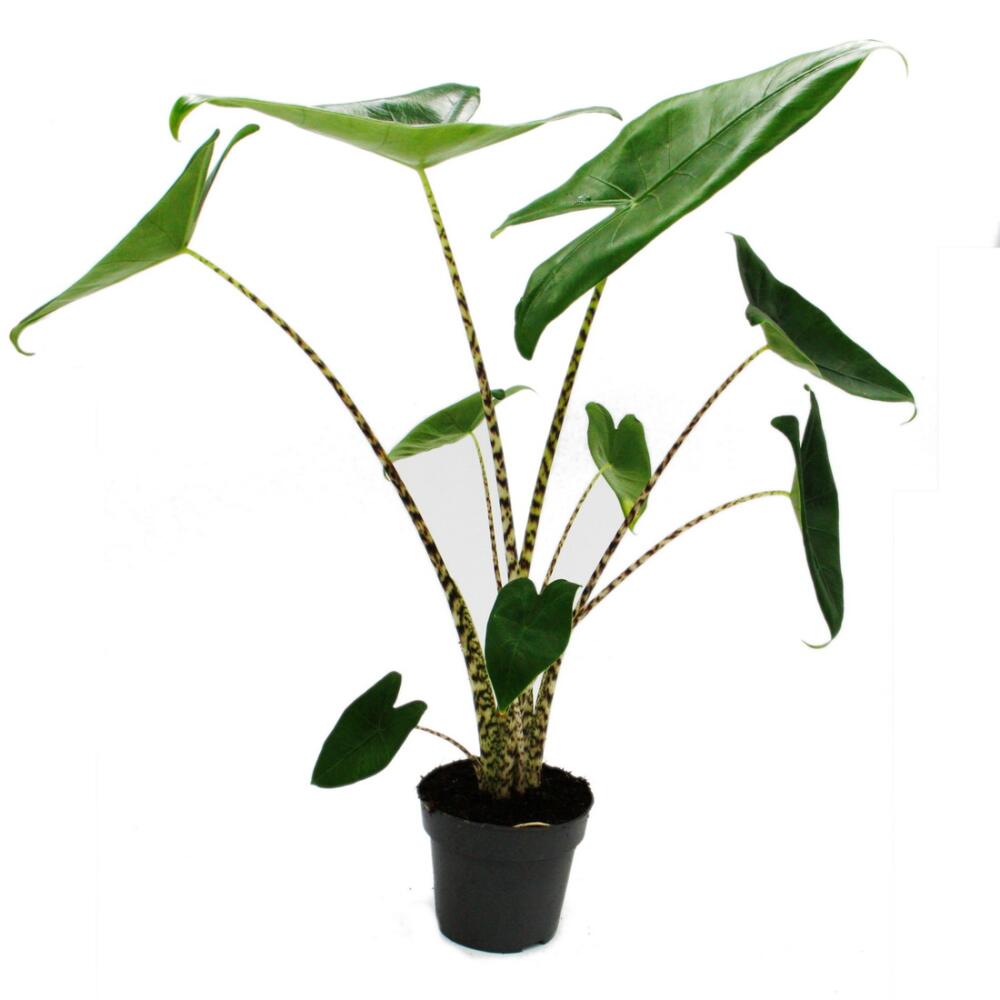
Not every attractive plant pattern is on the leaf itself. With Zebrina, your gaze follows the long stalks downwards: dark irregular stripes and spots appear against a pale background. Above them are glossy green arrow-shaped leaves. Its open growth habit is what makes this alocasia feel so light and lively. We like to place it slightly raised on a bench or plant table, where the stalks remain visible. A dense group directly in front would hide much of its character. It needs neither extra leaf patterns nor a lavish bouquet to stand out; its own silhouette is enough.
Give the young plant room to unfold
The shop offer describes a 14 cm pot and approximately 35 to 45 cm total height. This starts as a manageable indoor specimen, not a mature tropical plant. With good cultivation, Zebrina can later become noticeably taller and wider; approximately 50 to 100 cm is a guide to later growth. Leave room beside the pot for the sideways-spreading leaves. When unpacking, we support large leaf surfaces carefully rather than pulling on their stalks. Then choose a suitable bright position and give the plant time. Immediate repotting is unnecessary if the root ball and its container are working well.
Good light also shows in growth
A bright position with indirect daylight suits Zebrina well. Strong midday sun, especially through glass, can put the green surfaces under stress. An east- or west-facing area can often be arranged well; actual light conditions matter more than compass direction alone. A curtain can soften hot sun. If the plant stands deep inside the room, an attractive window somewhere in the distance offers little help. If growth leans strongly to one side towards the light, check the position and occasionally turn the pot a little. Please do not force newly unfurled leaves to bend in another direction.
Water according to root-ball moisture, not the calendar
The large leaf surfaces use more water in a warm, bright summer than on short winter days. That is why we feel the soil first and also check the pot’s weight. When the top layer has dried slightly, we water the root ball evenly and let excess water drain away. Nothing should remain in the outer pot. A dry surface alone does not prove that the centre of the root ball is dry, however. Limp leaves in still-moist soil are a reason to look more closely, not to add water immediately. A completely dried-out root ball is no more the aim than lasting wetness. Regular observation helps you find the right rhythm.
An airy root space supports the long stalks
Zebrina is best kept in a nursery pot with unobstructed drainage holes. Loose houseplant compost can be opened up with perlite or other suitable structural ingredients, for example. When the roots have developed well and use most of their space, we repot during active growth into a container only slightly larger. A lot of unrooted soil in an enormous pot can stay moist for a long time. Do not plant deeper than before when repotting, and handle the bases of the leaf stalks gently. Feeding during growth follows the product instructions; we take already fertilised compost into account. A stable outer pot can help secure the tall silhouette.
Warmth and humidity go together
Zebrina is a tropical houseplant and is unsuitable for cold draughts. A steadily warm room, preferably above 16 °C, is a good starting point. In winter, do not leave it between an open window and a radiator. Hot, dry air directly against the foliage is also unhelpful. If indoor air stays dry, effective humidification helps more than frequent brief sprays. The leaves do not need to be kept constantly wet as a result. A quiet, bright corner beside other plants can be pleasant, provided light and air movement remain. Continue checking the root ball independently of air humidity.
One leaf says goodbye while the plant keeps growing
Zebrina may shed older leaves while new ones form. A single outer leaf slowly yellowing alongside healthy new growth is therefore not automatically a care mistake. Several leaves turning yellow quickly, soft stalk bases or an unpleasant-smelling root ball, however, call for a check of the roots and water supply. Growth may become quieter on short days. Then water less and do not push the plant into new growth with extra fertiliser. Its position still stays warm and bright. Cut only clearly dead or damaged parts with a clean tool; healthy green leaves continue helping the plant use light.
Attentive care and a safe position
When watering, occasionally look beneath the leaves and at the stalk bases. Pale speckles with fine webs can fit spider mites, while small cottony patches can fit mealybugs. Separate unusual-looking plants first and check the findings more carefully. To clean a leaf, support it from underneath and wipe gently. Leaf shine is unnecessary. Alocasia is not an edible plant either: its constituents can cause irritation when eaten or on contact. Gloves help when pruning and repotting; do not touch your eyes with sap-stained hands. Choose a stable position that nibbling animals and young children cannot reach.
One plant, several views
Good to know
Why is it called tiger arrow-leaf?
The dark patterns are on the pale leaf stalks. The green leaves above are arrow-shaped. The pattern belongs to the plant and is not a sign of infestation.
Can Zebrina go directly beside a south-facing window?
Only if hot direct sun is softened sufficiently. A bright position with gentle light is better than unprotected midday sun through glass.
Why is it losing an older leaf?
A single old leaf can be shed as the foliage renews. If several leaves yellow quickly, also check root-ball moisture, roots, light and temperature.
Will it remain at 35–45 cm?
No. That is the delivery height. With good care it develops larger leaves and can grow taller too.
Can it stay cold and dry in winter?
For the young indoor specimen, we continue choosing a bright, warm position. Water demand falls when growth is slow; a forced cold, dry rest is unnecessary.
Is it safe for pets?
No. Do not allow plant parts to be eaten, and place the pot out of reach of pets and children that might nibble it.
Sources and editorial note
- Exotenherz: the specific delivery plant and original image
- RHS: Alocasia zebrina, species characteristics and cultivation
- RHS: growing alocasias indoors
- NC State Extension: Alocasia, growth and handling
- Iowa State Extension: humidity for houseplants
Shop offer checked directly on 30.09.2026: SKU 242030112022, GTIN 4019515919468, immediately available, 14 cm pot and 35–45 cm height. The RHS confirms the species, Philippine origin and cultivated size guidance of 0.5–1 m. The shop’s general claim about improving indoor air is not adopted. Leaf stalks are botanically distinguished from a trunk. There is no claim that delivery always carries exactly the same number of leaves as the sample photograph. Text written independently; scene approved against the original. Original and scene compared directly by sight: species characteristics, leaf outline, stalk markings, proportions, soft light and labelling accepted.