
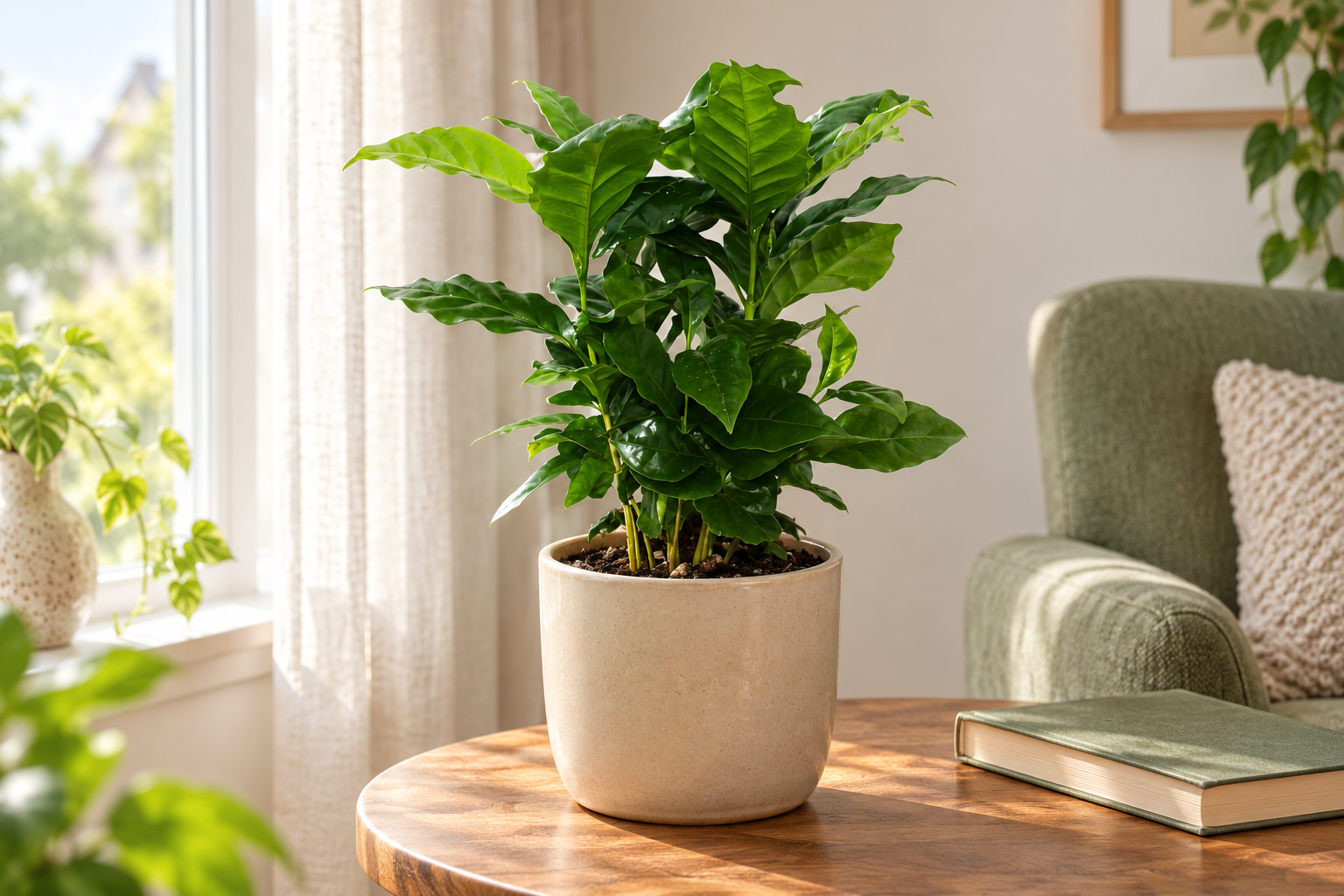
This plant at Exotenherz
Check the shop offer for current availability, price and what is included.
Check the shop for the current price, availability and offer contents.
Your care table
| Topic | What to do | Why it helps |
|---|---|---|
| Position | Bright filtered daylight, protected from hot window sun. | Foliage grows with light; a young delivery plant is moved gradually. |
| Water | Supply evenly when the surface dries slightly; do not dry the rootball. | Coffee needs reliable water, not saturated roots. |
| Drainage | Let surplus drain and remove it from the outer pot. | Free drainage combines moisture with root-zone air. |
| Room conditions | Steadily warm without cold draughts or direct heater warmth. | Tropical coffee reacts to sudden cold and dry warm air. |
| Soil | Humus-rich peat-free potting soil, well structured and slightly acidic to neutral. | A loose rootball stays supplied and aerated. |
| Feeding | Feed moderately during active growth by a suitable liquid fertiliser label. | New leaves need nutrients; allow for pre-fertilised soil and slow winter growth. |
| Repotting | With dense rooting, choose a reasonably larger pot in spring. | A young rootball uses a little extra space better than an oversized wet pot. |
| Leaves | Remove dust gently with a soft damp cloth and inspect undersides. | Clean surfaces and checks help detect changes early. |
Check the compost and pot weight. The care table explains how far the compost may dry.
Water only when needed. The water should reach the root ball without spilling over the rim.
Remove surplus water from the saucer or cachepot. Then return the plant to a suitable position.
Coffee begins with living foliage
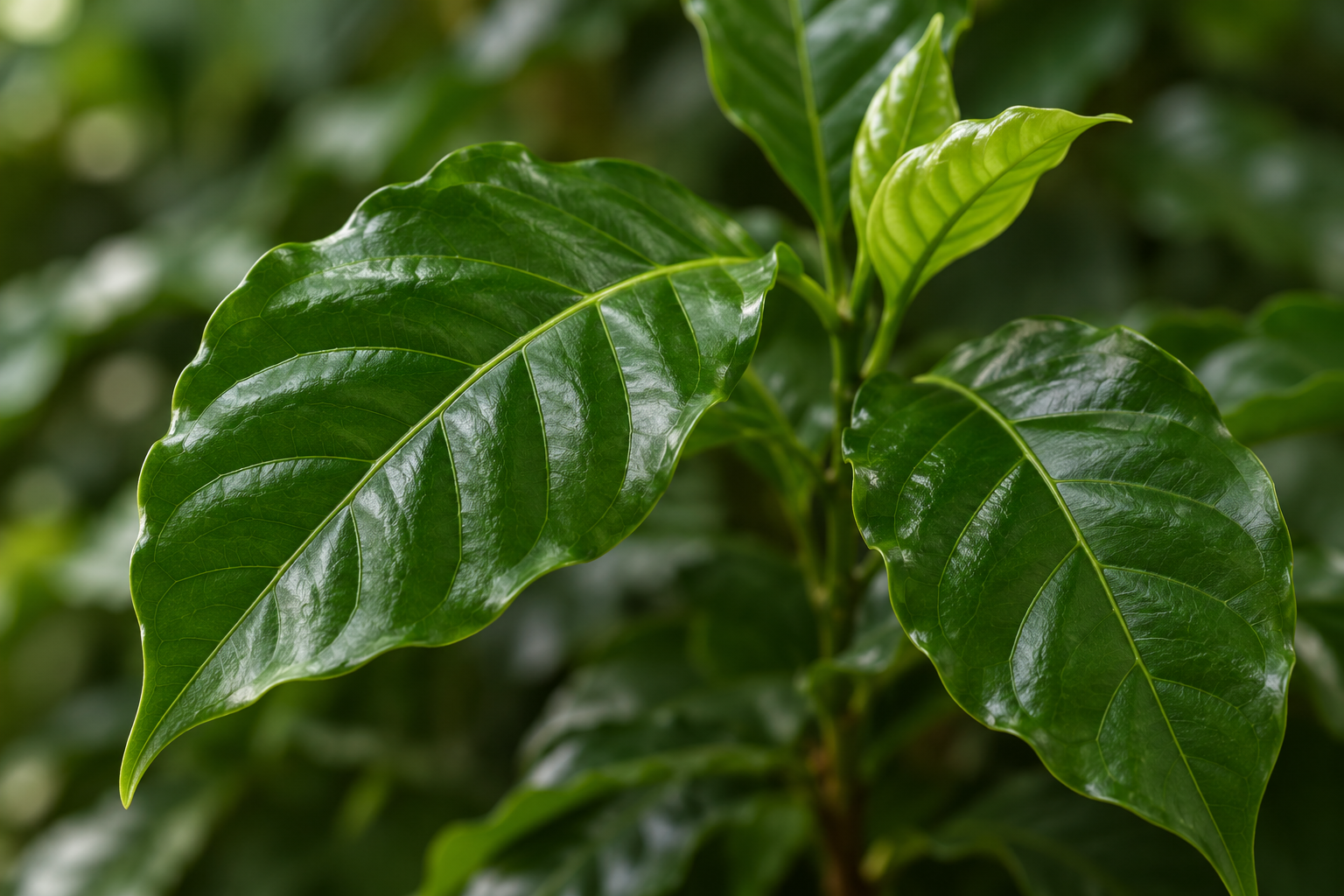
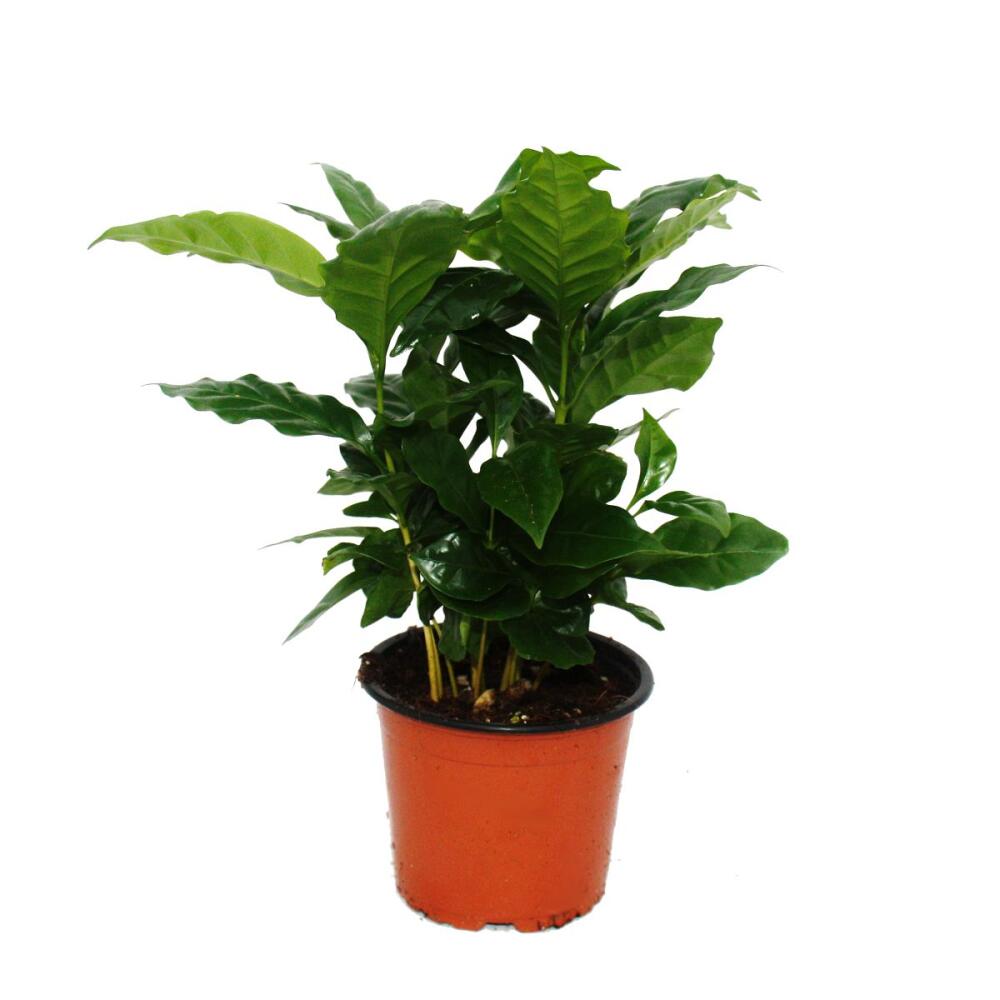
Young Coffea arabica looks like a dense little green bouquet. Several thin shoots carry glossy elliptical leaves with slightly wavy edges. Clear side veins extend from the midrib; fresh leaves are paler than older ones beneath. The clean original shows exactly this young foliage plant. It needs no cup beside it to tell its special background. A simple outer pot lets you admire leaves from side and above. Leave them free without catching them when opening a window. Each new shoot slightly changes its structure without already needing flowers.
An African species with a well-travelled name
Coffea arabica belongs to Rubiaceae, the bedstraw family. Its natural area is north-eastern tropical Africa, including Ethiopia and South Sudan; Kew also gives northern Kenya. Arabica is therefore no evidence of origin in the Arabian Peninsula. The beverage connection is correct: so-called beans are seeds of later fruits. Arabica and Robusta are different coffee species, not size grades of one houseplant. This offer names Coffea arabica but no additional cultivar. The proven species remains the reference; no unnamed plantation cultivar or special yield feature is added.
A suitable start for the small delivery plant
The current single offer describes a 12 cm pot and about 25–30 cm total height. This guides the young offered plant including its pot, not a particular age or harvest date. Hold the nursery pot and gently release packaging between leaves. Check moisture and drainage afterwards. Multiple shoots need no immediate separation: dense foliage can initially stay together. Choose a stable place with an accessible rootball. A decorative but hard-to-reach spot makes checks needlessly awkward.
Filtered daylight instead of rapid moves
A bright window with soft daylight suits this tropical foliage plant. A light curtain helps at hot glass; increase direct-sun hours carefully after transport. Air should circulate behind leaves without cold airflow constantly passing through stems. Directly above a heater is unsuitable too. Enough room humidity helps, but wet leaves alone cannot replace suitable room conditions. A summer outdoor place is considered only after acclimatisation and in reliably warm weather. A calm indoor position is easier initially: observe growth, leaf arrangement and water use together instead of linking each new leaf to another location.
Retain moisture and drain surplus
Check the rootball once upper soil dries slightly. Water slowly to reach existing roots, then drain. Soil should stay evenly supplied without prolonged saturation. A completely dry surface is no reason to neglect the pot for days. Equally, a hanging leaf does not prove thirst: feel the rootball first. Water consumption often falls in the cooler darker part of the year. Adjust intervals to actual moisture. Lifting the inner pot occasionally teaches the weight of a freshly watered and subsequently lighter rootball as well as surface condition.
Accompany roots and leaf surfaces
Humus-rich stable potting soil combines water retention and drainage. With dense roots, some extra room in spring helps; check the new pot has holes first. During visible growth, suitable fertiliser supports nutrition by label, including pre-fertilised soil. Coffee grounds are not an automatic replacement for this balanced care. Remove dust gently while supporting broader leaves. Inspect undersides and shoot bases too. Investigate deposits, small animals or rapid leaf loss before generally increasing water or feed. A later larger shrub can be moderately shaped when needed.
From possible flowers to coffee cherries
White scented flowers may appear in leaf axils on older well-developed plants. The often-cited roughly four-year guidance is no promise for the young offer or indoor cultivation. After successful fruit formation, initially green coffee cherries ripen over a long period and usually hold two seeds. Self-fertility likewise does not guarantee fruit in every living-room climate. The delivery is therefore described as a foliage plant. Following development first shows new leaf pairs and changing shoots. Later flowers or a small harvest may follow depending on age, light and cultivation. Neither a bean quantity nor first-cup date is promised.
One plant, several views
Good to know
Is Arabica coffee really a houseplant?
Yes. Coffea arabica can be kept as tropical foliage in a bright warm room with an evenly supplied rootball.
Does it come from Arabia?
Its natural area is north-eastern tropical Africa. Arabica is not evidence of natural Arabian origin.
What is the current delivery size?
A 12 cm pot and about 25–30 cm total height; living plants may vary.
Are coffee beans guaranteed on the young plant?
No. Delivery is young foliage; later flowering or fruit is not promised.
What are coffee cherries?
The plant’s later drupes, usually containing two seeds known as coffee beans.
Should soil dry completely?
No. Water again after slight surface drying and keep the rootball evenly moist, not wet.
Must I separate several shoots immediately?
No. The existing young group can settle together first.
Why less water in winter?
Less daylight and slower growth often reduce use. Actual rootball moisture remains decisive.
Sources and editorial note
- Exotenherz: offer and original photographs (03.10.2026)
- RHS: Coffea arabica, development and pot cultivation (03.10.2026)
- NC State Extension: Coffea arabica, foliage and indoor care (03.10.2026)
- Kew POWO: Coffea arabica, origin and botanical background (03.10.2026)
- UF/IFAS: coffee, leaf arrangement and fruit biology (03.10.2026)
Shop offer, article number, GTIN, availability and originals directly checked on 03.10.2026. Specialist sources directly read. Coffea arabica species identity, no additional unnamed cultivar; opposite leaves according to RHS and UF/IFAS. Kew read directly via web.open; local HTML 403 not presented as full-text evidence. Delivery separated from later flowers and harvest.