
This plant at Exotenherz
Check the shop offer for current availability, price and what is included.
Product and delivery details are given in the individual offer.
Your care table
| Topic | What to do | Why it helps |
|---|---|---|
| Light | Low to filtered daylight without strong direct sun. | Completely dark rooms remain unsuitable. |
| Water | Keep slightly moist during growth; check roots before every watering. | Good moisture supply does not mean continual wetness. |
| Drainage | Remove leftover water from the decorative pot. | Roots and rhizomes also need air. |
| Room climate | Choose a sheltered fairly cool position. | The cast-iron plant needs no hot room corner. |
| Soil | Use a loose potting mix with free drainage. | Structure should combine moisture and air around roots. |
| Feeding | Feed moderately according to label during growth. | Quiet growth needs no large nutrient reserve. |
| Leaves | Wipe dust carefully with a damp cloth. | Stalks and surfaces remain undamaged. |
| Repotting | Pot a little larger only when roots use the existing space well. | A large wet soil reserve does not suit slow growth. |
Check the compost and pot weight. The care table explains how far the compost may dry.
Water only when needed. The water should reach the root ball without spilling over the rim.
Remove surplus water from the saucer or cachepot. Then return the plant to a suitable position.
Individual stalks form a green clump
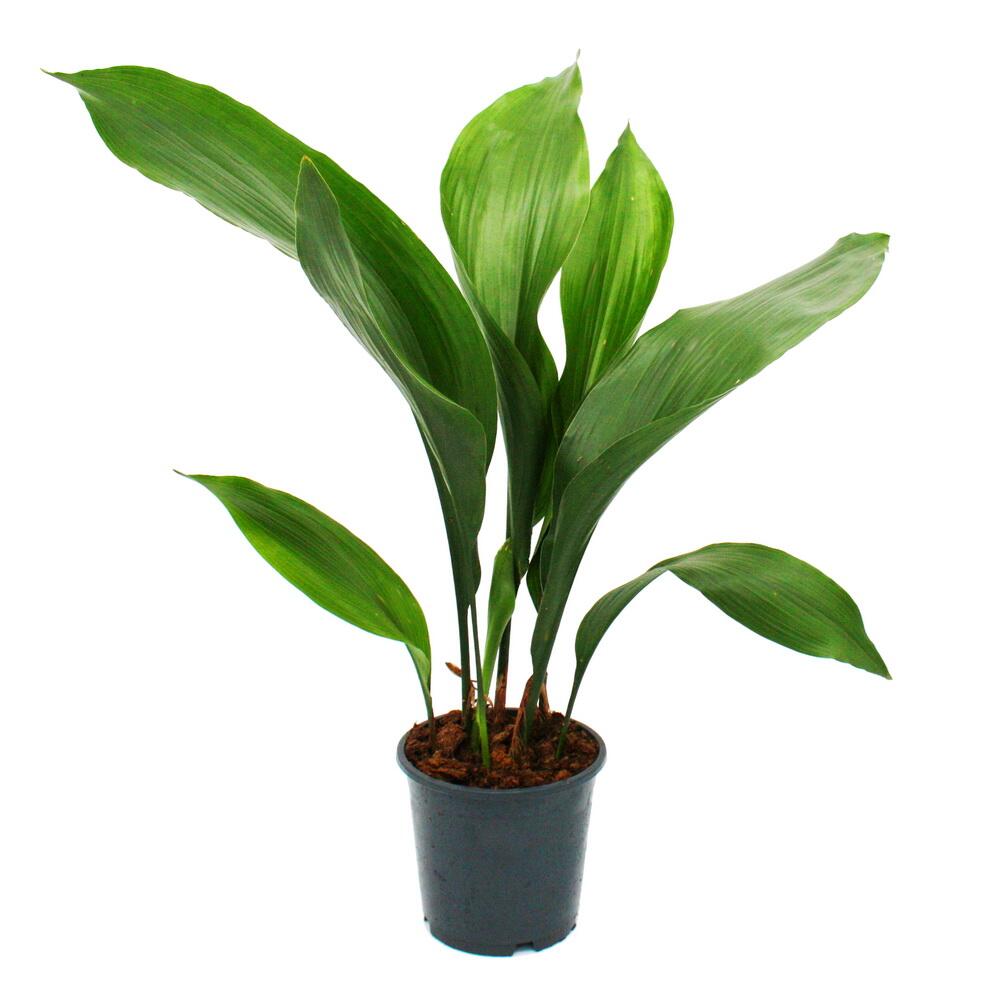
Aspidistra elatior shows its whole form with only a few leaves. Long green stalks carry leathery pointed blades; fine lengthwise veins are especially visible in side light. Leaves arise separately from the base. Despite its German name meaning cobbler’s palm, it has no palm trunk: it belongs to the asparagus family and grows with underground rhizomes. The offered green plant is in a 15-cm pot and about 40–50 cm total height. Later the clump expands slowly. It often reaches around 60 cm; the species can grow taller in suitable conditions. Delivery size describes its current state.
A hallway with daylight can stay a little cooler
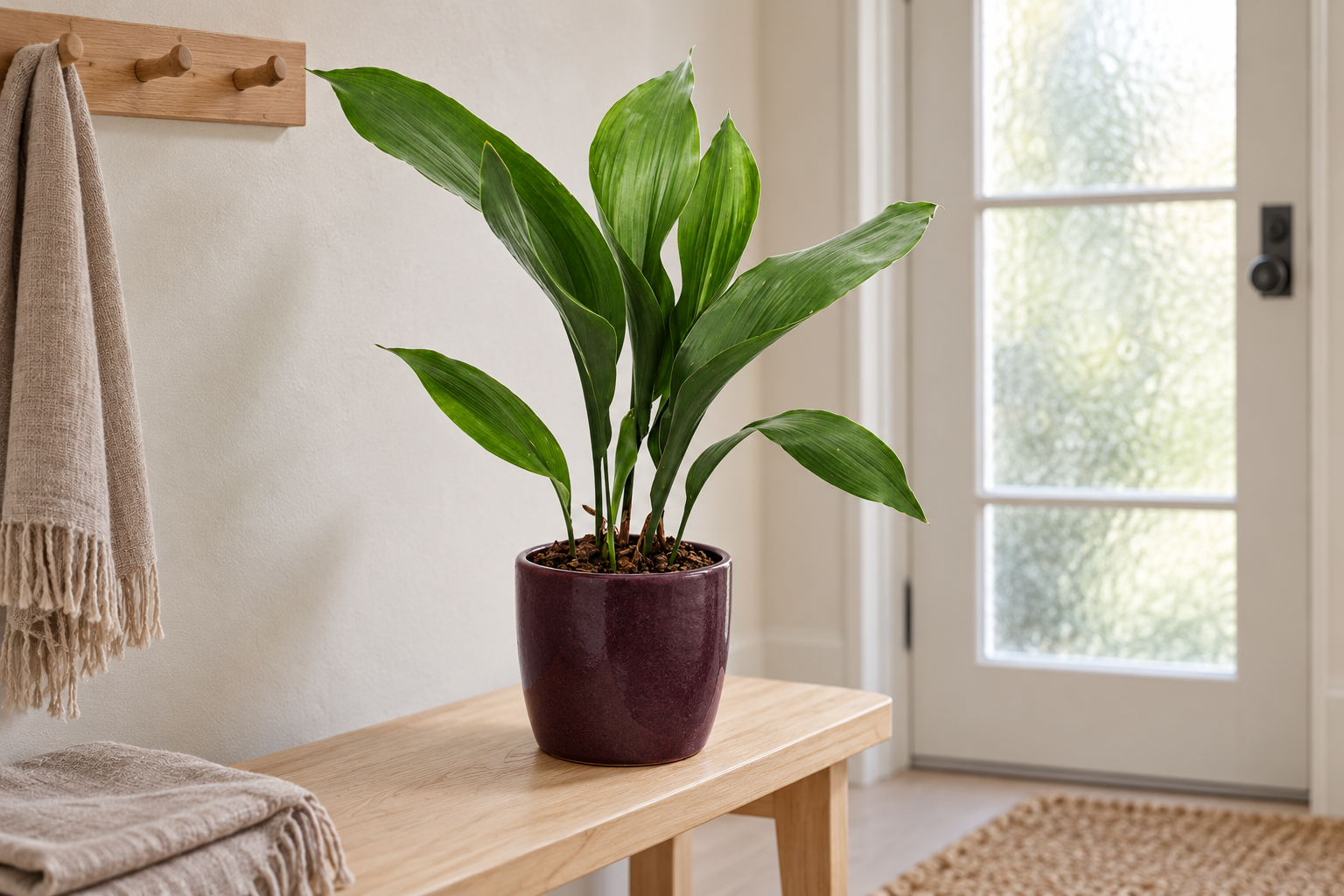
A bright hallway without sunbeams on foliage can be a good position. Aspidistra also copes with less light and does not need a tropical warm corner. Yet a room without daylight is not a suitable permanent place. In weak light its already quiet development slows further. Keep broad tips out of walkways so bags and coats do not brush them. The scene shows a low bench with side daylight; bench and decorative pot are furnishings. Unpack carefully and do not use stalks as handles.
Check moist soil rather than topping up by calendar
Large green leaves should not live for long on a completely dried root ball. During growth keep soil slightly moist without continually soaking it. Feel the upper layer and lift the inner pot: a heavy moist root ball needs no extra water yet. When water is needed, supply evenly and let it drain freely. Empty the outer pot. Cooler conditions and less winter light lower demand. Water more sparingly then, yet do not keep roots dry for weeks. A fixed weekday poorly reflects these differences.
Slow growth needs no enormous new pot
Let the plant settle in its suitable nursery pot first. Pot slightly larger only when roots use the available space well and appear at drainage holes. A large reserve of unrooted wet soil is no advantage. Spring lets this change accompany new growth. Choose a loose free-draining houseplant mix with some mineral structure and reliable drainage. Keep the base at the same height. Settle new soil gently without burying the rhizome deeply. Preserve healthy roots as far as possible. Moderate food during growth supports this development but cannot accelerate it without limit.
Leaf surfaces show everyday care
Long blades collect dust over time. A soft damp cloth removes it gently while the other hand supports the leaf below. Leaf-shine spray and hard rubbing are unnecessary. The detail enlarges green surfaces, lengthwise veins and separate stalks compared with a distant view. A completely yellow old leaf may be removed close to the base. Healthy leaves are not regularly cut to equal length. Brown tips will not regrow green, but new foliage can emerge undamaged when position and water supply suit.
Summer stays and winter positions remain sheltered
A sheltered shady summer place is possible once weather is pleasant. Acclimatise the houseplant gradually and avoid strong sun, wind and cold nights. Frost-free overwintering is the reliable choice for the offered potted plant. Advice for established garden plants does not simply transfer to a small mobile root ball. A fairly cool room away from heating suits quiet winter growth. If hardly any foliage appears in winter, no regular extra fertiliser is needed. Adjust supply to actual demand again at the next new shoot.
Assess changes across the whole clump
One old yellow leaf may belong to normal leaf turnover. If several turn yellow quickly, first inspect soil and drainage. Sun may cause brown areas; fine pale speckling also calls for checking undersides. Look there and at stalk bases for spider mites, scale insects and small cottony nests. Quiet growth alone is not a disease sign. A large strong clump can be divided in spring: each piece needs a suitable rhizome section, its own roots and several leaves. A cut single leaf does not replace that living base. Small delivered plants should develop further first.
One plant, several views

Good to know
Is the cast-iron plant really a palm?
No. Aspidistra elatior belongs to the asparagus family; leaves arise from a rhizome at the base.
Can it stand in a windowless hallway?
The hallway needs usable daylight. The plant copes with less light, but completely dark rooms are not permanent positions.
Should I cut off every yellow edge?
First check the cause and whole clump. Completely old yellow foliage can be removed; healthy leaves need no regular shaping.
Will it remain exactly 40–50 cm tall?
That is the current offer’s total height in a 15-cm pot. The clump slowly grows on.
Must I spray daily?
Normal room air is usually enough. Cleaning leaves and checking actual root moisture help more than a fixed spraying plan.
How can a large clump be propagated?
By dividing suitable rhizome sections with roots and several leaves, preferably in spring.
Sources and editorial note
- Exotenherz: directly checked offer and delivery measurements (accessed 03.10.2026)
- RHS: directly read species profile, family, habit and flowering (accessed 03.10.2026)
- RHS: light, room temperature and leaf shape (accessed 03.10.2026)
- RHS: complete growing guide (accessed 03.10.2026)
- Plant Heritage: growing observations from the National Collection (accessed 03.10.2026)
Product and specialist sources read directly on03.10.2026. Current own shop HTML evidence with identifiers, availability and basket retained; older search copies may differ. Specialist sources, original and AI images checked separately. Website and publication acceptance handled centrally.