
This plant at Exotenherz
Check the shop offer for current availability, price and what is included.
Check the shop for the current price, availability and offer contents.
Your care table
| Topic | What to do | Why it helps |
|---|---|---|
| Position | Choose a bright border edge with air between plants. | The low flowering group stays visible and less crowded by large neighbours. |
| Soil | Prepare humus-rich moisture-retentive soil without permanent waterlogging. | Even supply supports autumn development, but wet roots may be damaged. |
| Planting | Plant moistened root balls at the previous level and firm soil well. | Roots should continue from small pots into the border. |
| Watering | During establishment and prolonged dry periods check and water at the base. | Low plant height does not make dry root balls harmless. |
| Feeding | Allow for spring soil supply and supplement only as needed. | Excess replaces neither moisture nor a bright position. |
| Pruning | Remove dead stems before spring growth. | New basal shoots are then visible and have space. |
| Colony care | Divide older dense groups in spring if needed. | Strong outer pieces can renew an ageing colony. |
| Leaf checks | Watch whitish deposits and reduce dense neighbours. | Asters may get powdery mildew; good air movement supports healthy management. |
For young plants, feel the soil directly at the root ball. The surface and deeper soil may have different moisture levels.
Water thoroughly after planting; later, water according to the soil, weather and establishment rather than a fixed calendar.
Avoid standing water. For plants in containers, also check that water runs out of the drainage hole.
Lavender blue stays near the garden path
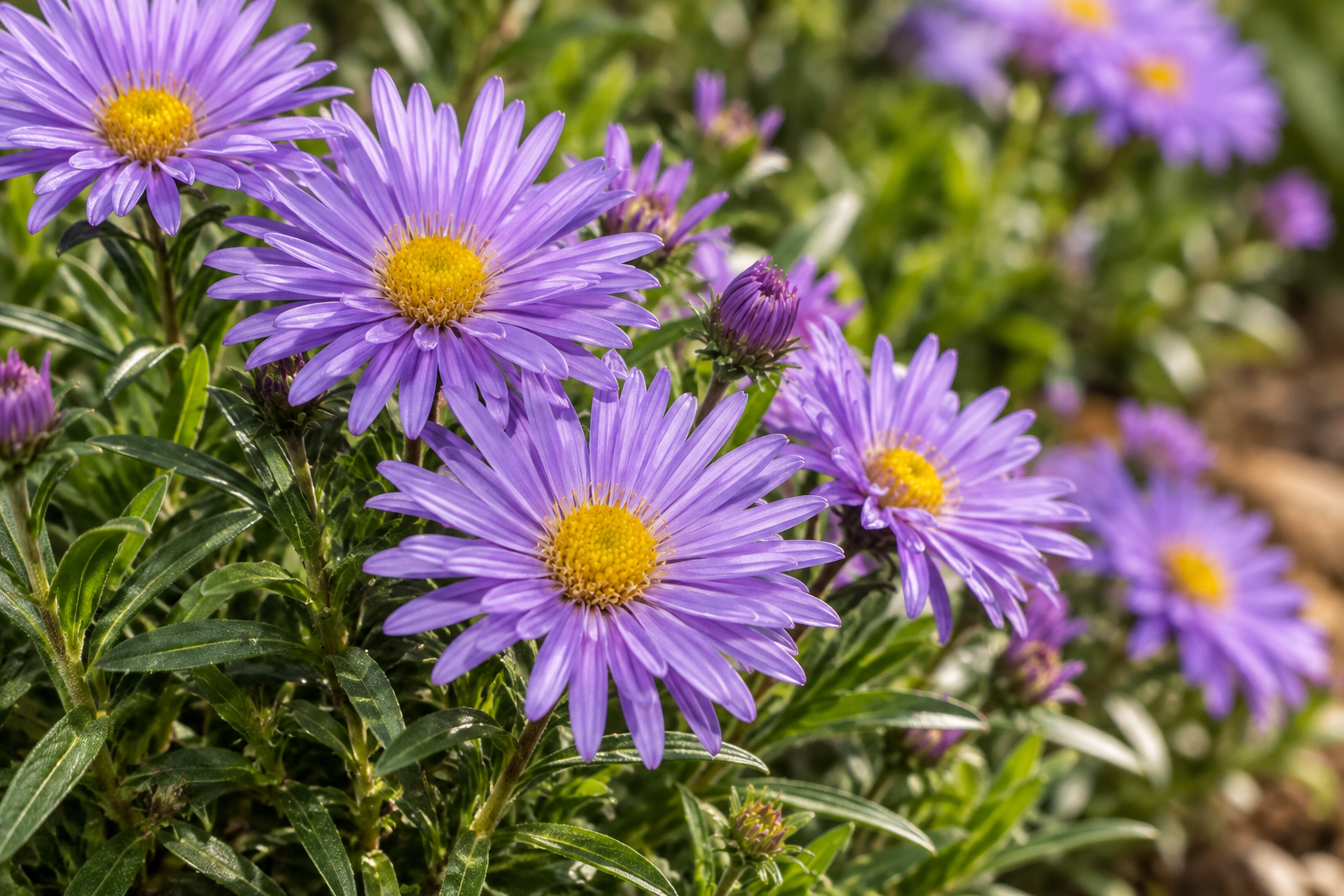
Prof. Anton Kippenberg carries typical aster heads in a low bushy group. Lavender-blue to violet-blue flowers are semi-double: several rows of slender rays give fullness while the yellow centre remains recognisable. Together with narrow green leaves, the impression is more compact than tall autumn asters. Individual flowers are easily observed at the front border. Among grass tufts or before larger perennials, colour creates a calm focus. Flowering belongs to late summer and autumn; German evaluation recorded late September to late October. Exact timing depends on the garden year.
Cushion aster and its current botanical name
The shop calls the offer Aster dumosum Prof. Anton Kippenberg. German evaluation uses dumosus; RHS uses the older Aster novi-belgii ‘Professor Anton Kippenberg’. Morton Arboretum classifies the known cultivar as Symphyotrichum novi-belgii. These names form one cultivar identity here, not three plants. The shop name remains recognisable while this portrait states current specialist classification. Cushion aster mainly describes low garden character. It is perennial and deciduous, rebuilding through the season rather than retaining a permanently green flowering cushion in winter.
Small pots become a group only in the border
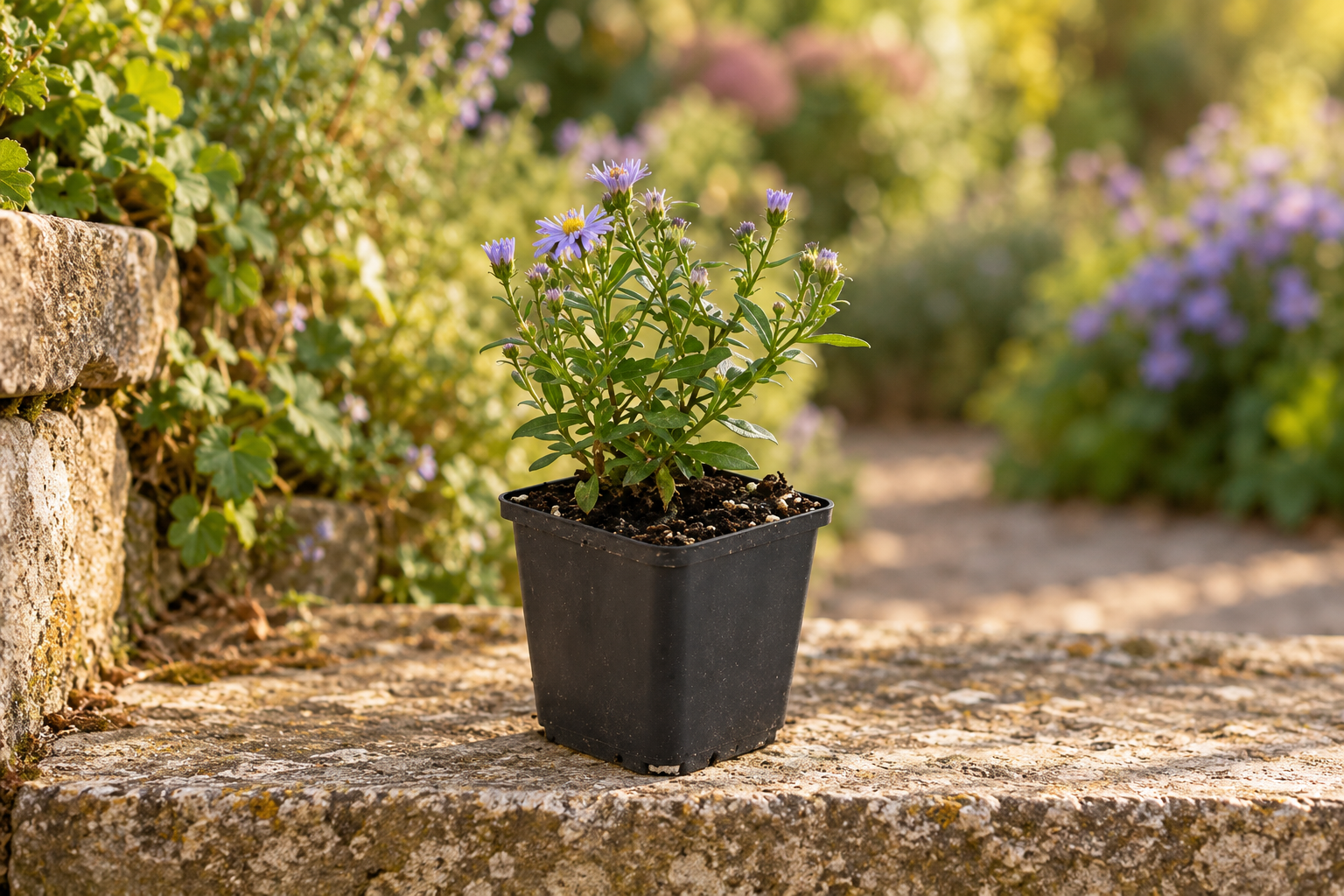
The clean original shows a young plant with some flowers and several buds. This visible condition does not promise every delivery flowers equally. Sets comprise 9 cm pots at approximately 10–25 cm total height including the pot. For developed plants the shop gives about 30–40 cm, RHS approximately up to 45 cm. These measurements aid planning without a centimetre-exact boundary. Spread may also differ by garden. About 35 cm is shop guidance. Leave extra space near already-spreading neighbouring clumps so the small asters initially retain light.
Store moisture, release excess water
A sunny to lightly shaded position with humus-rich well-supplied soil is favourable. Moisture retention matters for this cushion aster; a hot fully dried-out gravel strip is no equivalent to a properly prepared border. Rainwater must nevertheless drain. Permanently wet roots do not encourage healthy development. Check after rain and loosen compacted areas before planting. Prepare connected root space. A small hole in a hard soil layer quickly becomes a wet pocket. The same principles apply in containers: suitable perennial or planting compost, sufficient root room and open drainage rather than a constantly full saucer.
Establishment decides the green structure
Plant in spring or autumn when soil is frost-free and workable. Moisten the container root ball first, unpot carefully and plant at its previous level. Firm soil and water slowly and thoroughly. Check directly at the root ball over subsequent weeks. Roots initially cannot use the entire border. Inspect more often in warm dry weather. Later, root-zone checks also help during longer dryness. Water the base according to demand and let soil take in air between applications. Small daily splashes often supply a dried-out root ball less effectively than a thorough appropriate watering.
Keep low growth open and renewable
Prof. Anton Kippenberg does not need routine heavy summer pruning modelled on tall easily falling asters. The cultivar already brings its compact growth. Focus on water, room and leaf condition. Asters can develop powdery mildew; inspect whitish coatings rather than dismissing them as normal leaf colour. Reduce larger neighbours if the group disappears beneath them. Older dense colonies can be divided in spring and renewed with strong outer pieces. Newly planted pieces need establishment supply again. Supplement nutrients as required allowing for border supply, rather than heavily feeding at every flowering pause.
Autumn flowers end, the perennial stays
After late flowering, above-ground rest begins. Healthy dry stems may initially remain; remove them no later than before fresh spring shoots. Remove diseased material promptly. Winter roots must still not stand in water. Shelter containers outdoors and maintain drainage; pot roots are more exposed to cold than border roots. New green shoots show continuation next spring. Give the small group time to rebuild. Individual delivery plants then form a connected autumn accent with flowers especially visible near the garden path.
One plant, several views

Good to know
Which botanical name is correct?
The shop uses Aster dumosum. Older profiles give Aster novi-belgii, Morton Arboretum Symphyotrichum novi-belgii Professor Anton Kippenberg. The same cultivar is intended.
Are flowers double?
They are described as semi-double. Several rows of lavender-blue rays surround a still-visible yellow centre.
How tall is it?
The shop states about 30–40 cm, RHS up to approximately 45 cm. These guide developed plants without a fixed maximum guarantee.
Does every plant arrive flowering?
The original shows some flowers but sets no uniform delivery condition. Season and development may change flower coverage.
Does it tolerate permanent dryness?
Moisture-retentive drained soil is preferable. Check roots during establishment and prolonged dryness, watering as needed.
Should I prune heavily in summer?
Routine heavy pruning for tall asters does not automatically suit this low cultivar. Water, light and room come first.
When should I divide dense growth?
Replant strong outer pieces in spring and support establishment. This can renew an older group.
What about white leaf coating?
It may be powdery mildew. Inspect leaves, create air between plants and seek specialist advice for severe infection.
Sources and editorial note
- Exotenherz: offer and original photographs (03/10/2026)
- RHS: Professor Anton Kippenberg, older name and cultivation (03/10/2026)
- Perennial evaluation: Prof. Anton Kippenberg cushion aster (03/10/2026)
- Morton Arboretum: current Symphyotrichum classification (03/10/2026)
- RHS: garden aster care (03/10/2026)
- Exotenherz: directly orderable set of 6, own SKU/GTIN (03/10/2026)
- Exotenherz: directly orderable set of 12, own SKU/GTIN (03/10/2026)
- Exotenherz: directly orderable set of 60, own SKU/GTIN (03/10/2026)
Shop offer, article number, GTIN, availability and original images checked directly on 03/10/2026. Specialist sources read directly. Botanical name identity checked directly against RHS/Morton/evaluation; no new identity through dumosum/dumosus/novi-belgii. Flowering original young plant without delivery flowering guarantee.