
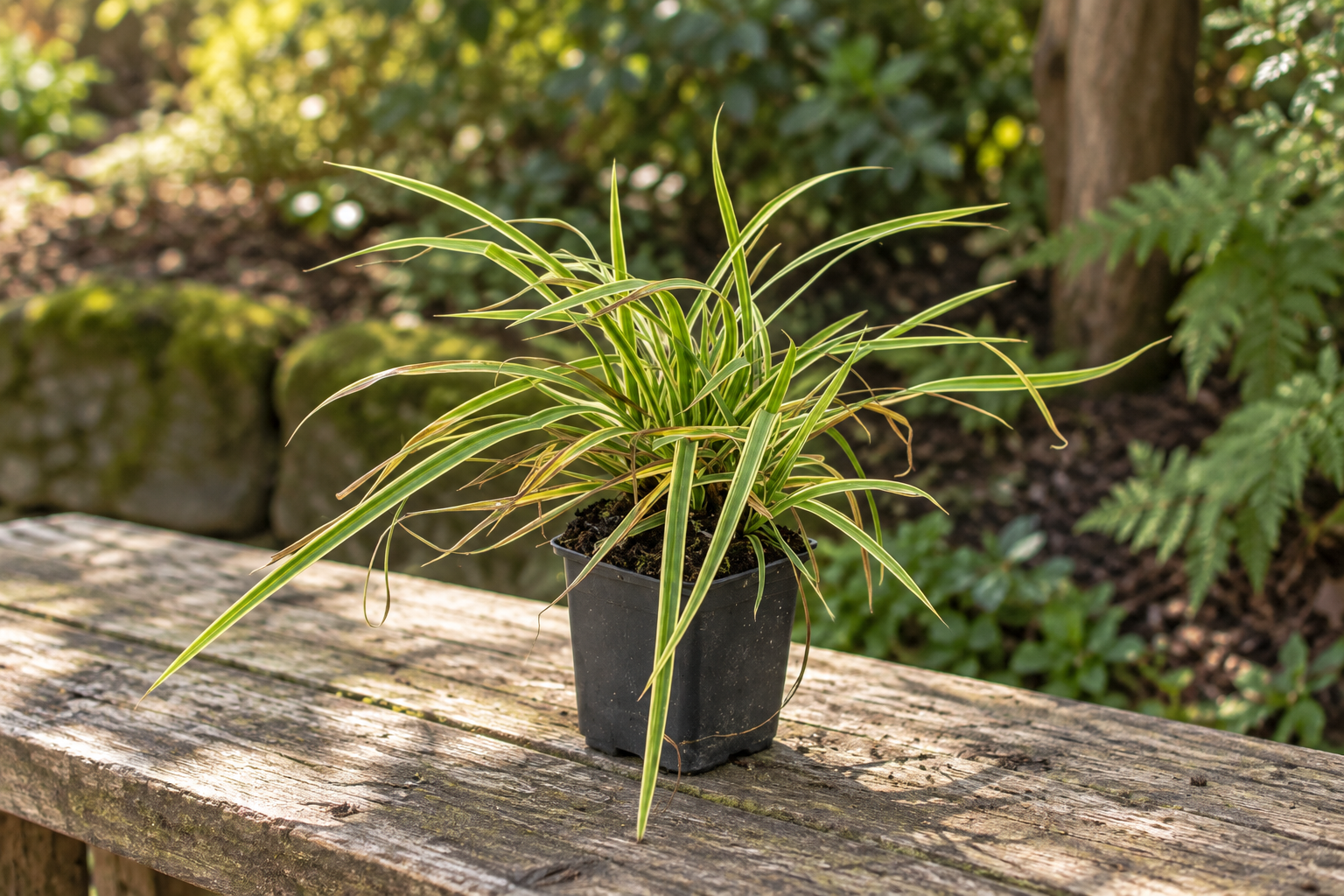
This plant at Exotenherz
Check the shop offer for current availability, price and what is included.
Check the shop for the current price, availability and offer contents.
Your care table
| Topic | What to do | Why it helps |
|---|---|---|
| Position | Prefer partial shade or changing light beneath trees and shrubs. | Golden-yellow margins show clearly before dark foliage without needing heat stress. |
| Soil | Prepare fresh humus-rich soil loosely and let rainwater drain. | Golden-edged foliage does not reliably thrive over a permanently dry or waterlogged root ball. |
| Planting | Moisten the root ball and plant at its previous height. | Planting too deeply buries the leaf-clump base. |
| Spacing | Plan about 30–40 cm for a border; loose groups may stand further apart. | Later leaf spread determines how plants meet, not delivery pot size. |
| Water | Check root ball and surrounding soil together; water thoroughly as needed. | The two areas may dry at different rates during rooting. |
| Cutting | Gently tidy dead leaves, retaining living yellow-green arches. | A general deep cut removes the main cultivar ornament. |
| Feeding | For weak growth, first check moisture and roots, then supplement modestly. | Generous feeding does not solve a site problem. |
| Container culture | Choose a larger outdoor container with free drainage and stable soil structure. | The 9 cm delivery pot is not a long-term root space. |
| Cold season | Protect containers from strong changes and use frost-free days to check moisture. | Winter-green does not mean leaves and roots need no protection. |
For young plants, feel the soil directly at the root ball. The surface and deeper soil may have different moisture levels.
Water thoroughly after planting; later, water according to the soil, weather and establishment rather than a fixed calendar.
Avoid standing water. For plants in containers, also check that water runs out of the drainage hole.
Gold sits at the leaf edge
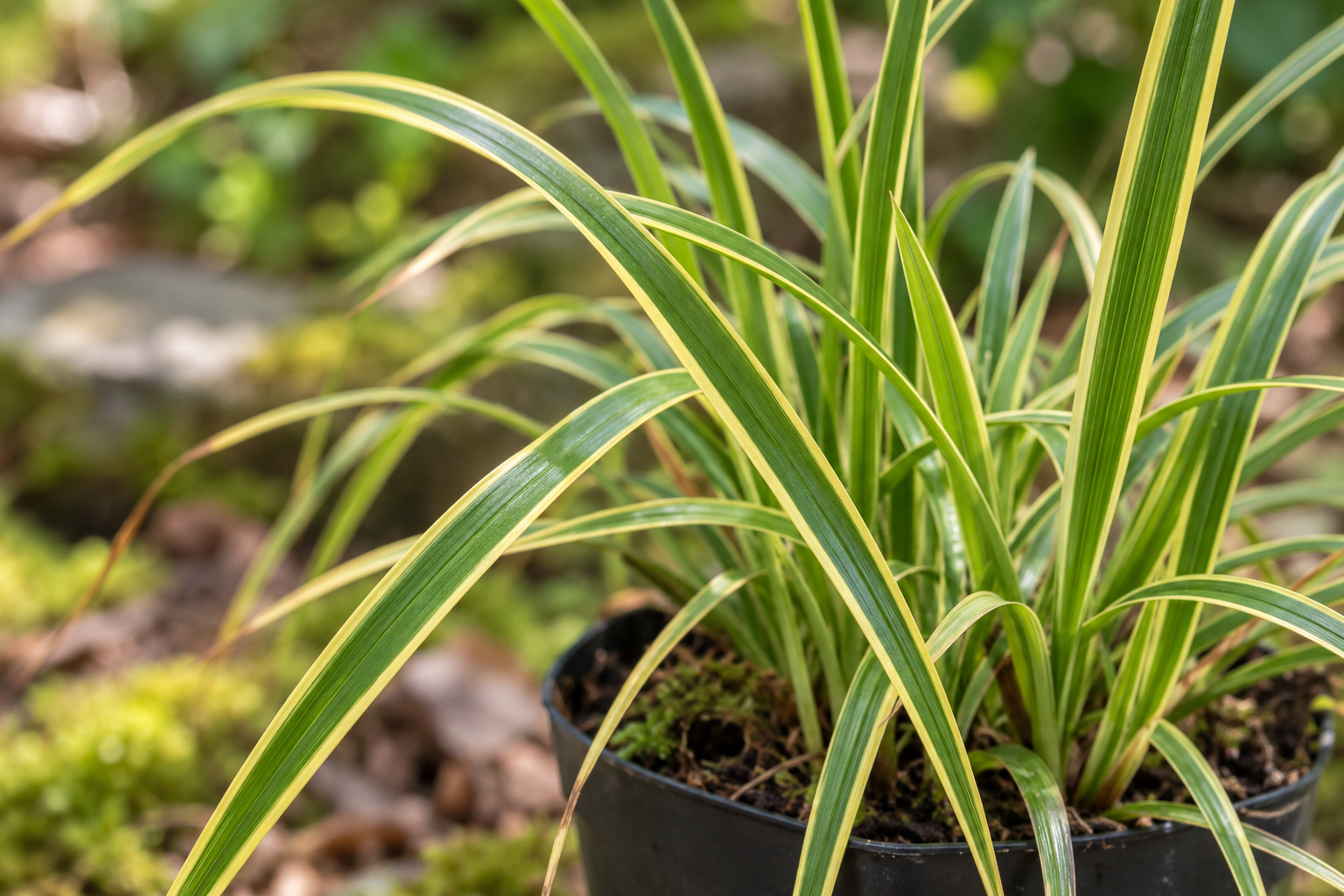
This Japanese sedge’s colour makes most sense up close: green leaf surfaces have pale yellow to golden-yellow margins. The whole cushion looks brighter without losing its green base. Aureovariegata is a named cultivar and, as a sedge, belongs to the Cyperaceae family. Its pattern shows well in front of a dark shrub or beside broad green perennial leaves. Small spring spikes do not compete with large garden flowers; they complement a plant picture mainly sustained by lasting leaf arches.
Separate leaf height and flower height
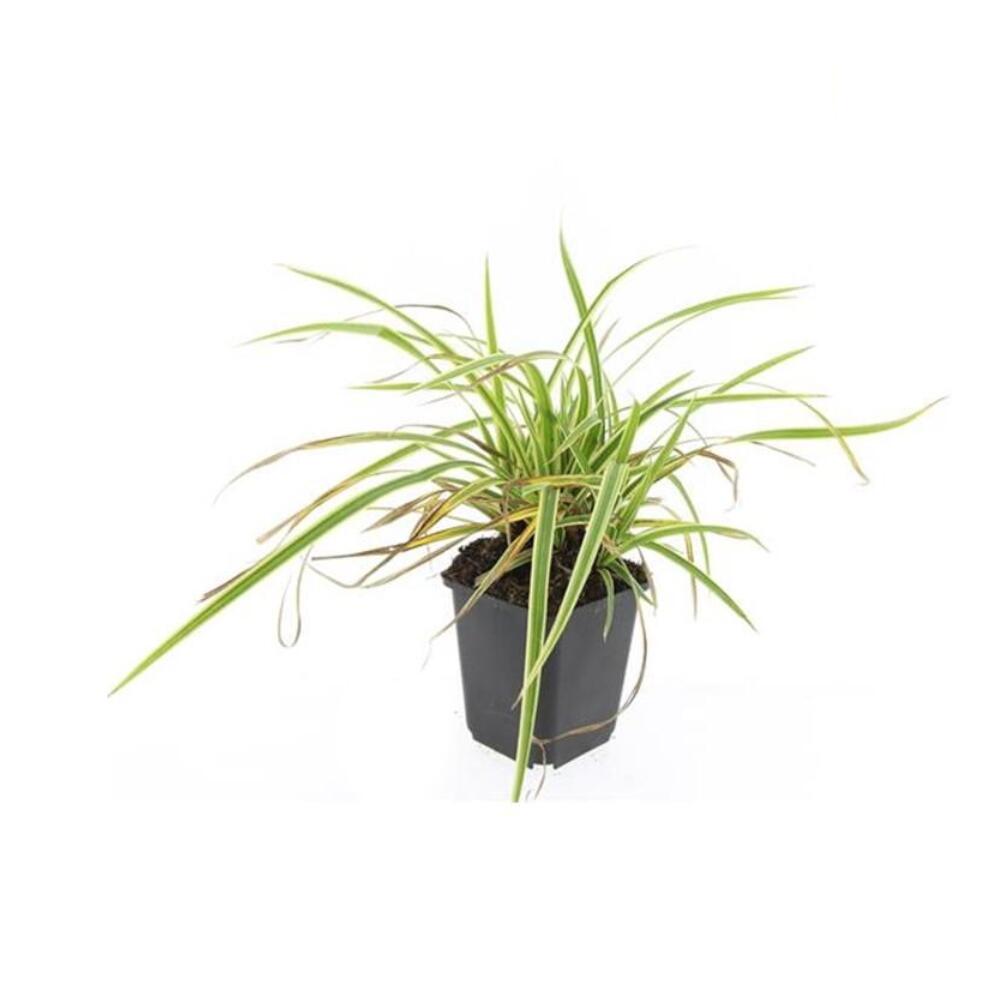
Young plants arrive in 9 cm pots at about 10–25 cm total height including the container. The selected shop set determines count. Once established, the foliage reaches approximately 30 cm, individual flower stems about 40 cm. For a low bed edge, about 30–40 cm between plant centres is a good guide. A loose group can stand further apart; the specialist nursery gives 30–50 cm depending on use. Try arranging the pots before planting, as soft leaf arches need more sideways room than the small delivery root ball initially suggests.
Partial shade brings out the leaf pattern
A spot with changing light beneath open trees or shrubs suits Aureovariegata. The planting remains visually light there and handles less heat than in front of sunlit stone. Soil should be fresh and humus-rich without collecting standing water. Especially beneath old trees, check moisture deeper in the root zone. Woody roots can make shaded ground surprisingly dry. Before planting, loosen compacted earth and improve a weak structure across the planting area instead of filling only a small hole with entirely different soil.
Support its start in the garden carefully
Mild weeks in spring or early autumn are favourable for planting. Leave frozen or water-saturated soil alone initially. Give a dried-out pot root ball water before planting; its surface then stays at the same height. Water in thoroughly and check both the root ball and surrounding soil during establishment. If rain falls only onto foliage, the small ball can remain dry. A thin layer of suitable garden compost between plants supports the soil but must not bury the sedge base.
Clean rather than shear off the golden edge
Tidy its winter-green leaves gently. Pull out completely brown loose leaves and cut attached dead leaves individually. Leave healthy leaf ribbons standing. Regular deep shearing would remove precisely what makes this cultivar interesting for many months. If an old clump develops unevenly, division during growth can provide strong pieces. Check the base and moisture while working: a soft wet root zone calls for a better position and does not become healthy through more fertiliser.
Balance water reserve and drainage in a container
On a partially shaded terrace, the golden-edged sedge can also accompany a container. It needs drainage holes, structurally stable soil and more volume than the delivery pot. Water according to root-ball condition without leaving the saucer permanently full. With weak spring growth, first check space, moisture and roots; add a small suitable feed only if needed. In winter, this garden plant stays outdoors, protected from drying wind and strong changes around the pot. Moisture checks on frost-free days remain part of care.
One plant, several views
Good to know
Does Aureovariegata have the same pattern as Evergold?
No. Aureovariegata is described with light leaf margins; Evergold has a yellow leaf centre with green edges.
How high should I plan the border?
Foliage reaches about 30 cm; flower stems may stand around 40 cm tall. The delivered plant is much smaller.
When does golden-edged sedge flower?
From spring to early summer, depending on site and weather. Small brown to yellowish-brown spikes are inconspicuous.
Does it need dry soil?
No. Fresh soil with drainage suits it better; permanent drought and standing water are both unfavourable.
Can the pot remain outdoors in winter?
The garden plant stays outside, but its restricted root space needs a protected spot and possibly insulation. Use frost-free days to check moisture.
Sources and editorial note
- Exotenherz: parent offer, dimensions and original images (accessed 3 October 2026)
- Specialist reference: aureovariegata-haeussermann (read directly 3 October 2026)
- Specialist reference: carex-nc (read directly 3 October 2026)
- Specialist reference: grasses-cutting (read directly 3 October 2026)
- Specialist reference: grasses-growing (read directly 3 October 2026)
- Exotenherz: checked 6-plant child offer (accessed 3 October 2026)
- Exotenherz: checked 12-plant child offer (accessed 3 October 2026)
- Exotenherz: checked 20-plant child offer (accessed 3 October 2026)
- Exotenherz: checked 40-plant child offer (accessed 3 October 2026)
- Exotenherz: checked 60-plant child offer (accessed 3 October 2026)
Parent offer and all associated child offers read directly on 3 October 2026; article numbers, GTIN where present in child offers, availability and files documented separately. Delivery height 10–25 cm including a 9 cm pot explicitly separated from later garden height. Quantity variants are not new plant identities. Specialist sources read directly, complete reference portraits fargesia-rufa-guide and heidelbeere-jersey-guide compared. Clean original view 2 retained unchanged; stamped montages excluded. Scene shows one young reference plant regardless of set count. Draft; shared-page and browser acceptance still pending.