
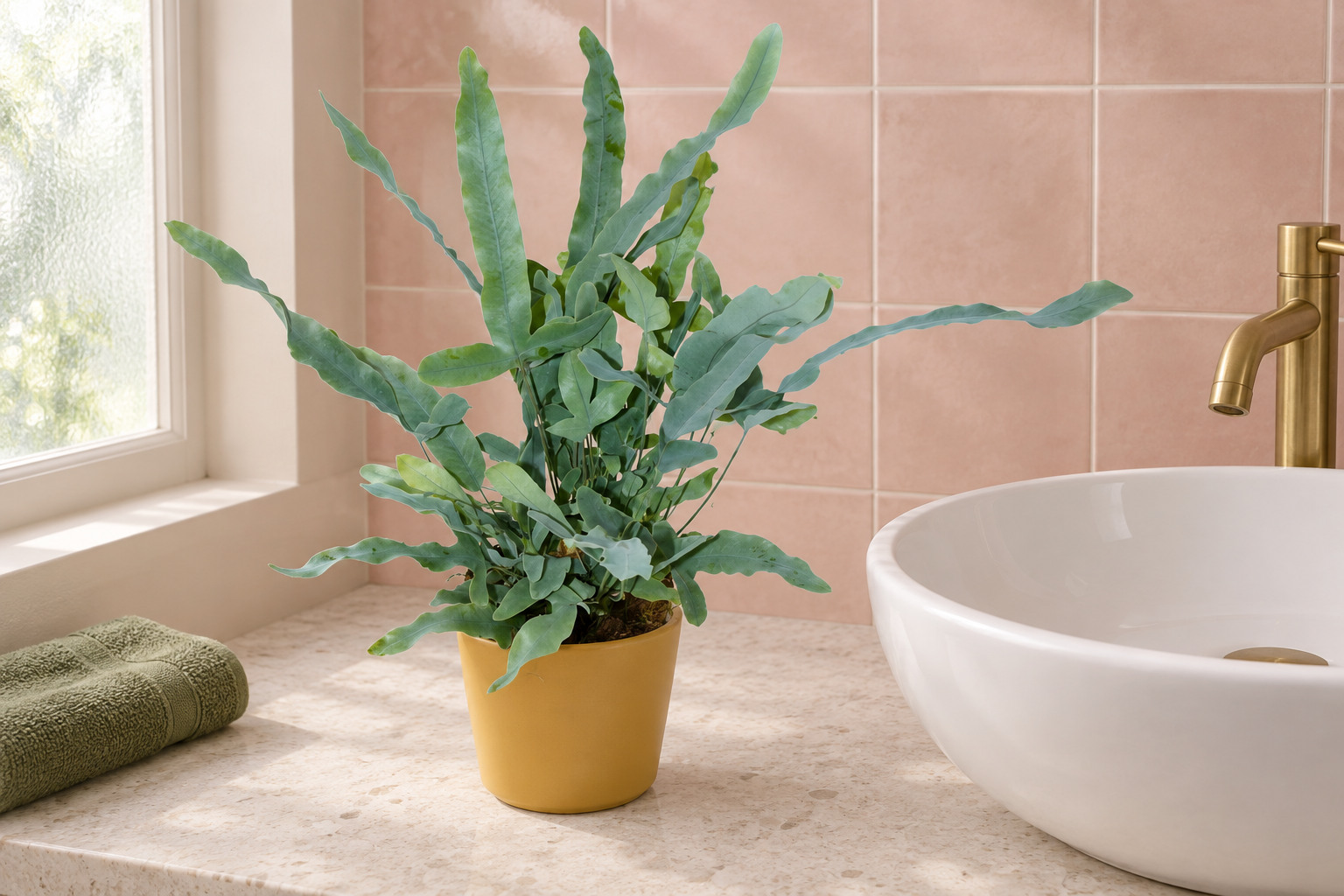
This plant at Exotenherz
Check the shop offer for current availability, price and what is included.
Link to the offer in German. Check the shop for the current price, availability and delivery contents.
Your care table
| Topic | What to do | Why it helps |
|---|---|---|
| Light | Provide bright indirect daylight protected from intense midday sun. | Blue-green fronds should receive enough light without scorching. |
| Watering | Let the upper compost dry slightly, check remaining moisture, then water evenly. | The fern needs dependable moisture and air in its root area too. |
| Drainage | Remove leftover water from the decorative pot; no permanent water tray beneath the pot. | Waterlogging can harm roots and the plant base. |
| Rhizomes | Keep scaled creeping shoots near the surface when repotting. | They are part of its growth and are not buried deeply like accidentally exposed roots. |
| Room conditions | Keep warm and protected from draughts; avoid direct radiator air. | Consistent conditions and adequate humidity support fronds. |
| Fertiliser | Feed moderately during active growth according to the label. | A fern does not need heavy nutrient applications to maintain its leaf colour. |
| Pruning | Remove dead fronds cleanly near the base. | Keep healthy green parts where possible; the fern is not clipped into a ball. |
| Winter | Keep bright and frost-free and consider slower water use. | Reduced growth often lengthens the time to the next watering. |
A fern that breaks familiar shapes
Blue Star is listed in the range under Phlebodium aureum. Its fronds are broad, wavy and lobed to varying degrees. Young leaves may have a simpler shape than older ones. The matte blue-green shows particularly well against calm, warm colours. Creeping rhizomes with golden-brown scales grow at the base. They are living shoots and contribute to its distinctive appearance. The fern produces no flowers. Propagation by spores is a different plant strategy, which can be discovered on leaf undersides with a little attention.
Between a small pot and spreading fronds
The version shown has a 12 cm pot and approximately 35 to 40 cm overall height. Another shop size has a 17 cm pot and approximately 40 to 50 cm overall height. Both are linked in this portrait. Sideways spread matters as well as height: individual fronds need room and should not be constantly pressed against a wall. A small pot does not mean a narrow, strictly upright plant here. The original shop image helps assess its natural silhouette. Later growth is not presented as delivery size.
A bright bathroom can suit it
A bathroom with daylight can offer a good position for this fern. Temporarily higher humidity is welcome but replaces neither light nor regular root-ball checks. Keep it away from direct splashes of soap and cleaning products. A windowless bathroom without suitable plant lighting is not a permanent solution. A bright living-room corner is also possible if it receives enough indirect light and does not stand in warm radiator airflow. Choose a plant according to conditions, not just the colour of its decorative pot.
Keep moist with air in between
Check the upper compost before watering. It may dry slightly while the root ball should not stay completely dry for long periods. Water slowly over accessible compost and let leftovers drain. If rhizomes and frond stalks densely cover the surface, a narrow spout helps targeted watering. Check the decorative pot afterwards. A layer of decorative stones hides this check and is unnecessary for the fern. Wet soil and dry room air can occur together; more frequent watering therefore does not solve every problem with brown tips.
The golden-brown rhizomes belong there
Creeping shoots lie near the surface and can grow over the pot edge. Do not scrape off their scales. Keep them in a similar position when repotting instead of burying them under a thick soil layer. Choose loose, humus-rich, well-drained compost and a pot with clear drainage holes. A moderately larger container makes moisture easier to monitor. Do not pull the fern out of its old pot by individual fronds. Support the root ball and release it carefully so the connection between rhizomes and roots remains intact.
Read the dots beneath fronds correctly
Regularly arranged round spore clusters on the undersides of mature fronds can be entirely normal. They are not automatically scale insects. Look at arrangement, surface and the rest of the plant before treating anything. Irregular soft patches, spreading discolouration or actual insects require a different assessment. Old fronds also age eventually even though the fern is evergreen. Remove fully dead parts with clean tools. Leaf-shine spray cannot improve healthy blue-green; the natural surface already adorns this plant.
Division rather than flowers on demand
A strong older plant can be divided at a suitable repotting time. Each piece needs enough healthy rhizome, roots and preferably existing fronds. Very small pieces lose water faster and demand more attention. Spring at the start of growth is more favourable than intervening in an already weakened winter plant. After division, keep position and care consistent. Propagation from spores is also possible but requires more patience and suitable raising conditions. For everyday enjoyment, it is often nicer to follow the development of one well-grown specimen first.
Brown edges are a reason to look closely
With dry frond edges, first check the combination of root-ball moisture, air and light. Had the soil dried out? Was the plant in direct sun or immediately beside a heater? Is the root ball permanently wet despite brown tips? Nutrient concentration and water quality may also contribute. One symptom does not reliably reveal the cause. Change a recognisably unfavourable condition and watch new growth. Already brown areas will not turn green again. What matters is whether new fronds develop healthily and other leaves remain stable.
The year in small observations
With lengthening days, Blue Star can unfurl new fronds faster. Water and nutrient needs often increase then. Winter care becomes more restrained without allowing the plant to dry unchecked. Do not open fresh, still-curled fronds with your fingers. Note in the plant book which position works and how quickly the root ball dries there. A photo of a leaf underside with normal spore clusters is also helpful: it makes later comparisons easier and avoids unnecessary treatment. Understanding of its distinctive way of life grows together with the fern.
One plant, several views
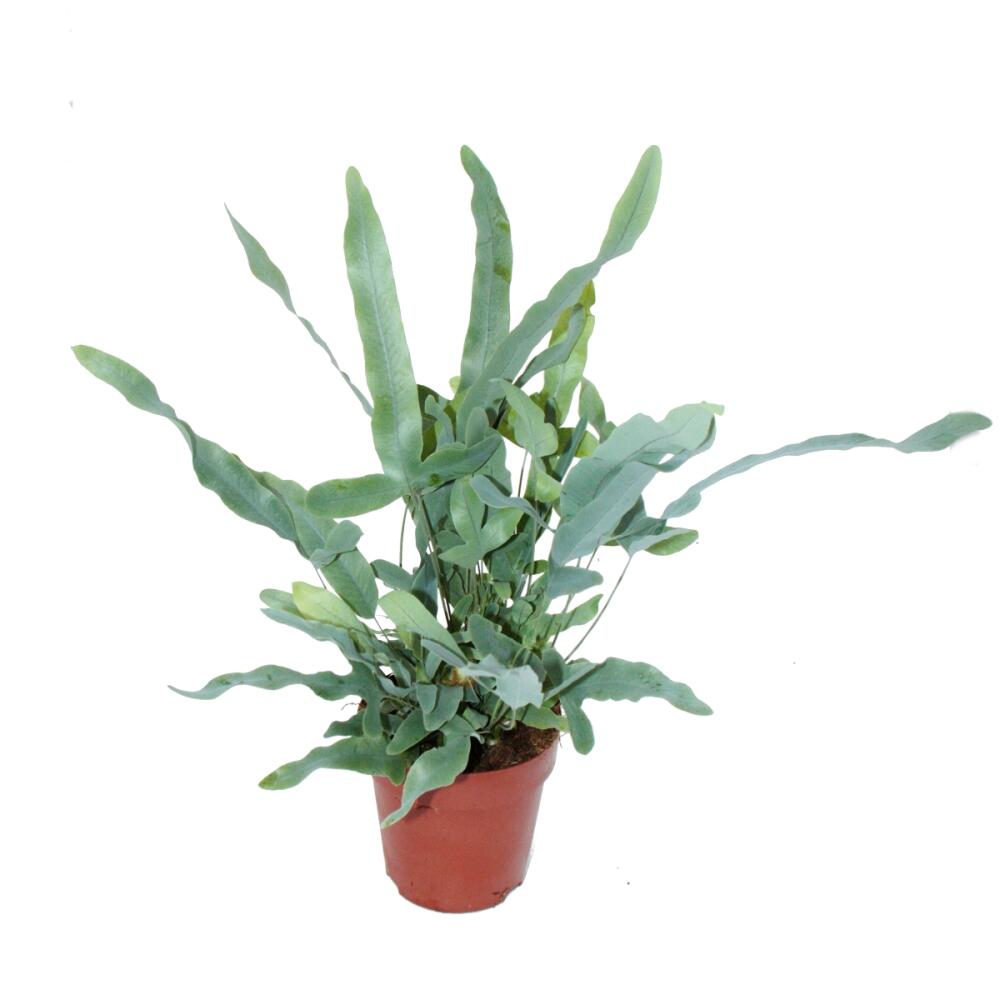
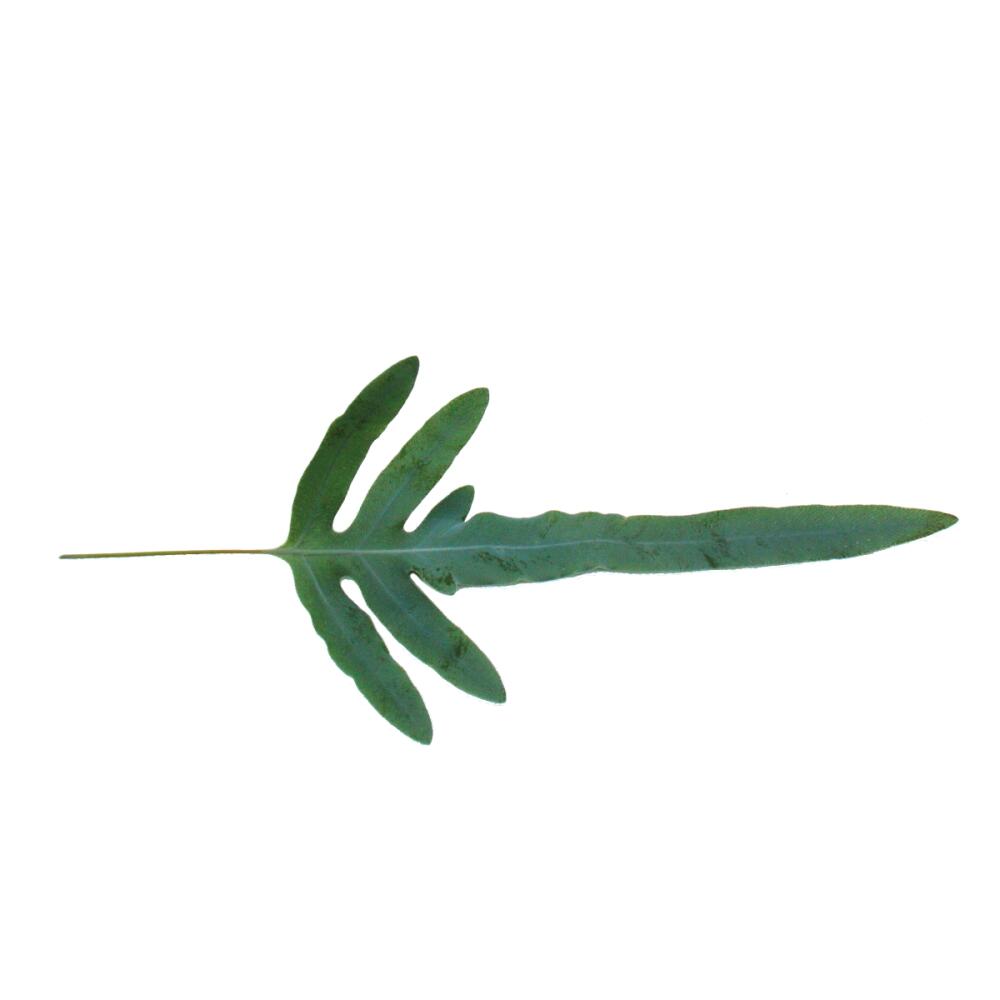
Good to know
Is the blue-green colour sprayed on?
The characteristic matte colour belongs to Blue Star’s appearance. It is not treated with leaf-shine products.
Do I need to bury the brown hairy parts?
Scaled rhizomes grow near the surface. Keep them at a similar height when repotting.
Are dots under the leaves pests?
Regular round spore clusters may be normal. Unusual deposits or insects must be checked separately.
Can Blue Star go in a bathroom?
Yes, if there is enough daylight, warmth and a sheltered position. A dark windowless bathroom is insufficient.
Why does an evergreen fern lose old fronds?
Evergreen does not mean each leaf lives indefinitely. Individual old fronds may age; rapid changes in many leaves should be checked.
Sources and editorial note
- Product and delivery size: Exotenherz
- Blue Star in a 17 cm pot
- RHS: Blue Star
- NC State Extension: Phlebodium aureum
- RHS: position and care for Blue Star
- RHS: ferns as houseplants
Sources checked: 14 September 2026. The specific version follows the shop offer and care follows the linked specialist sources. Plant condition, position and season determine the appropriate action.