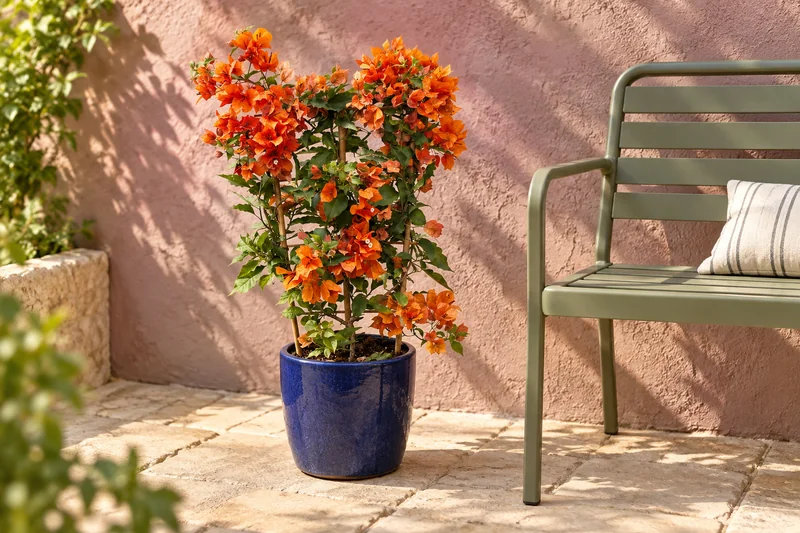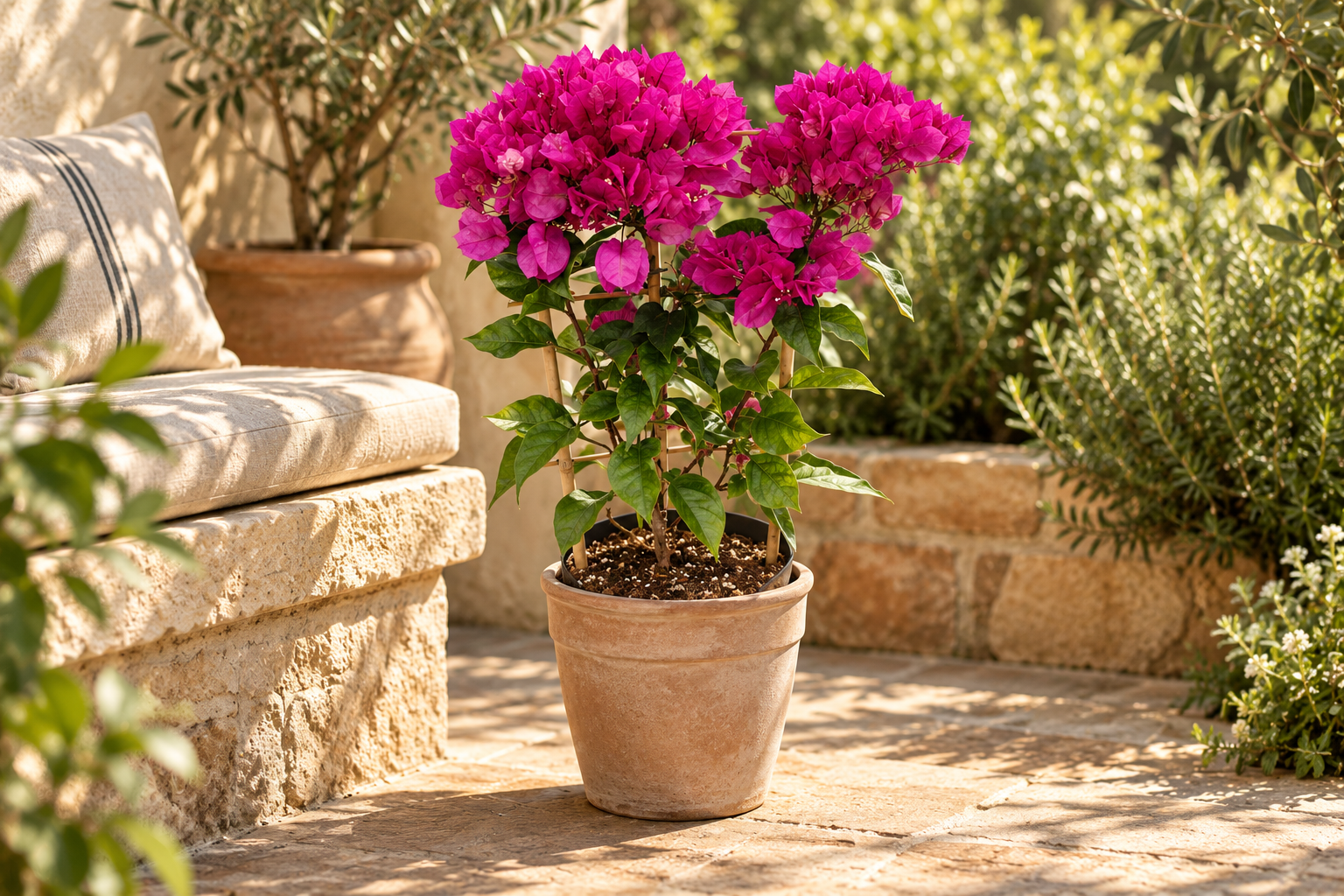
This plant at Exotenherz
Check the shop offer for current availability, price and what is included.
Check the shop for the current price, availability and offer contents.
Your care table
| Topic | What to do | Why it helps |
|---|---|---|
| Summer position | Very bright to sunny, outside after acclimatisation. | Consider light supply and heat development together. |
| Glasshouse cultivation | Ventilate and protect from strong overheating. | Closed panes change the climate. |
| Watering | Check soil and pot weight before watering. | Falling bracts alone do not prove dryness. |
| Drainage | Remove excess and keep container holes free. | Roots need air as well as moisture. |
| Substrate | Structurally stable, free-draining container-plant soil. | Repot carefully and only as needed. |
| Supply | Dose according to the fertiliser label during growth. | Account for existing fertiliser. |
| Training | Check loose ties and long side shoots. | The young delivered form continues growing. |
| Winter | Bright, frost-free, preferably at least 10 °C at night. | Account for limited growth when watering. |
Check the compost and pot weight. The care table explains how far the compost may dry.
Water only when needed. The water should reach the root ball without spilling over the rim.
Remove surplus water from the saucer or cachepot. Then return the plant to a suitable position.
Purple comes alive against green foliage
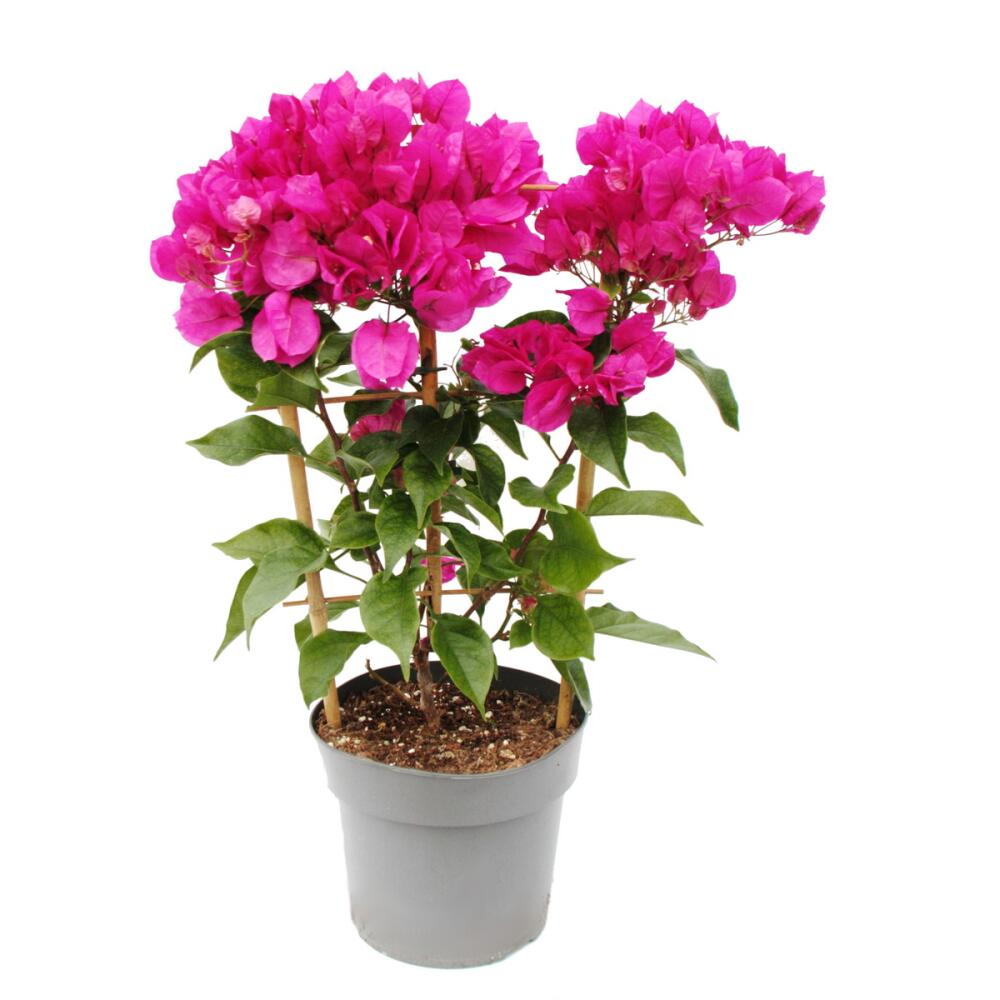
Dark Violett shows dark violet-pink bracts that stand out clearly against oval green foliage. In the original, some groups look more deeply purple, while others look lighter when light passes through the fine surface. Small pale actual flowers sit in the centre. The offered name describes a colour selection, not a blue flower. On a simple patio, this contrast between foliage and papery surfaces can make an impact. Large background decoration is unnecessary; the small trained crown already has its own visible structure.
The young climber gets an accessible position
A 19-cm pot and approximately sixty centimetres total height provide the offer’s size reference. The trellis holds the young shoots together. Further branches later need suitable training and loose ties. Before placing the container directly against a railing, consider how it will remain accessible for rootball checks. At passageways the crown should not project into clothing and hands; thorny sections of shoots can be troublesome. When moving it, carry the pot rather than using the support as a handle or pulling individual branches.
A bright summer position supports its colour effect
A very bright to sunny outdoor position suits it in summer once frost risk has passed and the plant has been slowly acclimatised. At a glazed seating area, accumulated warmth must also be considered. Sunshine behind closed panes can create different conditions from moving outdoor air. Observe fresh growth after a move. A shaded spot where the colour briefly looks decorative may not provide sufficient light over weeks. Position choice therefore combines the attractive view of the crown with actual conditions for its further development.
Water is decided at the root zone
Check the soil and pot weight before the next application. During active growth, carefully water the soil and allow excess to drain. A few bracts falling after transport are no automatic instruction to add water. Check an already heavy, wet rootball first. After rain, look in saucers and cover pots. When growth slows in autumn, intervals change too. A permanently identical weekly routine overlooks this transition and can turn well-intentioned supply into unnecessarily prolonged wetness.
The trellis remains part of care
Free-draining container-plant soil, open drainage and a sufficiently stable pot belong together. Repot as needed in spring, treating the existing base gently. During growth, feed according to the fertiliser label without forgetting pre-fertilised soil. Long side shoots can be selectively organised after a colour phase. The shape can be adjusted more fundamentally before new growth starts. Check leaf undersides as well as ties. Unusual deposits or distorted tips are examined more closely before further care steps are inferred from a single symptom.
Think beyond summer
Dark Violett is cultivated as a perennial frost-sensitive woody plant. A bright, protected winter position with preferably at least ten degrees at night is a suitable guide. With little new growth, water use falls; the rootball is still checked occasionally and supplied when needed. A warm living room is not automatically a good substitute for a bright growing room. In the plant book, a close-up of the small flower between the bracts and a photograph of the whole training arrangement are worthwhile. Add a note on moving outside: development and care can then be compared the following year.
One plant, several views


Good to know
Are the flowers blue?
The selection shows violet-pink to purple bracts and small pale actual flowers.
Can it climb without support?
The young shoots are loosely trained on suitable support.
Is 60 cm the mature height?
No, it is the approximate total height of the offered article.
Should I water when bracts fall?
Only after checking the rootball; their fall alone does not prove a water shortage.
Is it a winter-hardy garden plant?
It needs a protected winter position in frost-prone locations.
Sources and editorial note
- Exotenherz: offer and original photographs (03.10.2026)
- RHS – bougainvilleas, summer and winter (03.10.2026)
- University of Hawaii – Bougainvillea, bracts and cultivation (03.10.2026)
Shop offer, article number, GTIN, availability and original photographs checked directly on 02.10.2026; specialist acceptance 03.10.2026. Specialist sources read directly. Specific SKU, measurements, original photographs and orderability checked directly in the shop on 03.10.2026. Relevant specialist sections checked; shop name and botanical synonyms remain distinguishable. Currently not orderable: knowledge portrait without purchase link, social drafts without sending approval. No Wawi, server or tool changes. Currently not orderable: knowledge portrait without purchase link; social drafts not approved for sending.