
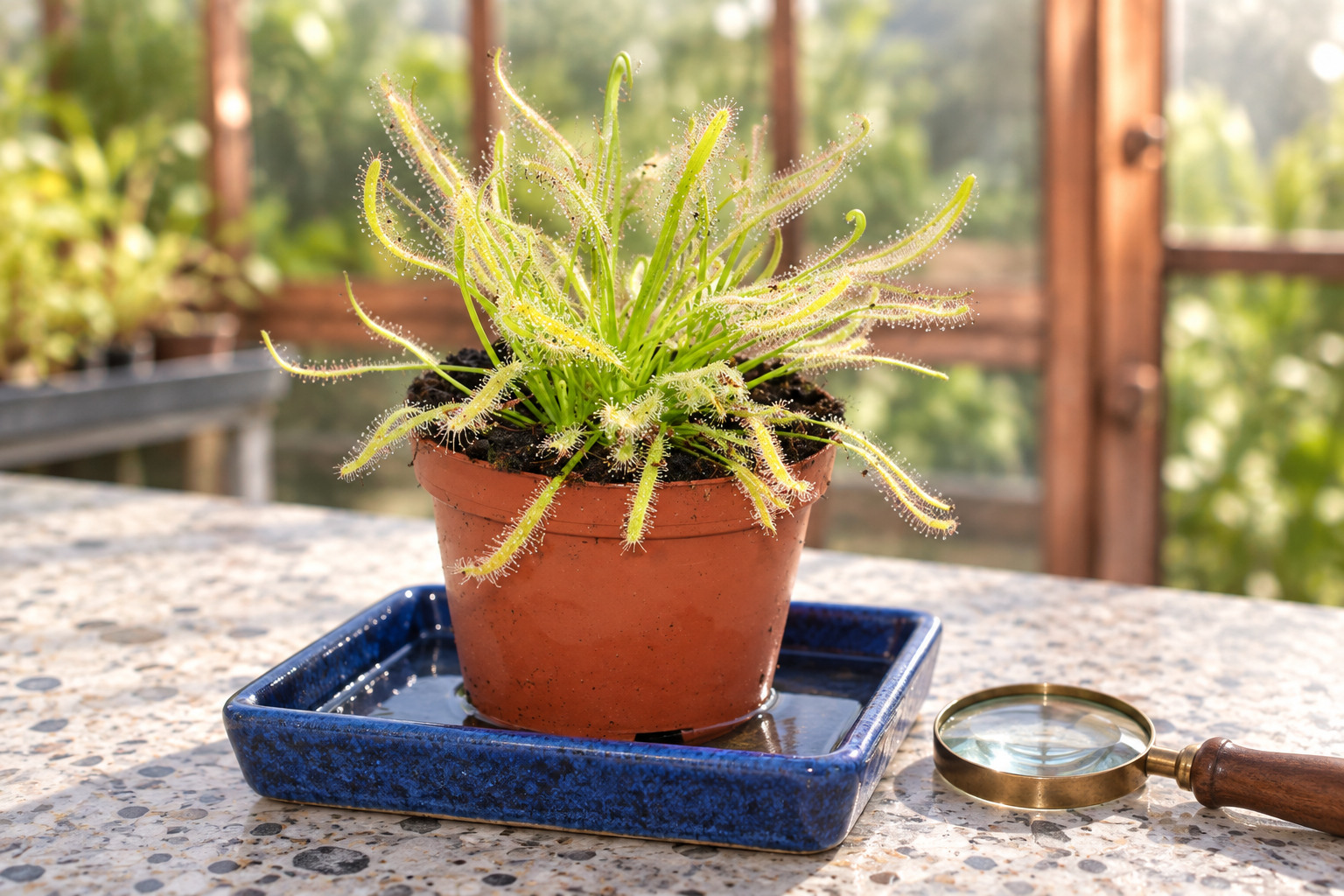
This plant at Exotenherz
Check the shop offer for current availability, price and what is included.
Link to the offer in German. Check the shop for the current price, availability and delivery contents.
Your care table
| Topic | What to do | Why it helps |
|---|---|---|
| Light | Keep very bright, acclimatise gradually to sun and avoid heat build-up behind glass. | Good light supports strong trapping leaves and gland function. |
| Water | Use clean rainwater or suitable distilled or reverse-osmosis water. | Low-mineral watering protects the nutrient-poor root area. |
| Water tray | Keep the pot evenly moist in a shallow tray with a little water. | Drosera capensis must not dry out like a succulent. |
| Compost | Use suitable unfertilised carnivorous-plant compost. | Ordinary potting compost often contains too many nutrients or unsuitable additives. |
| Leaves | Do not wipe trapping leaves or replace dew with constant spraying. | Droplets are glandular secretions, not sprayed water. |
| Nutrients | Do not provide houseplant fertiliser in normal hobby growing. | Suitable prey supplements nutrients without fertilising the root ball. |
| Winter | Continue care bright and frost-free without a forced cold rest. | This South African species needs no obligatory winter rest like many temperate carnivorous plants. |
| Propagation | Scatter ripe seed on damp suitable compost without burying it. | Fine seed germinates on the surface; young plants need particularly consistent conditions. |
Use clean rainwater or suitable distilled water. An ordinary jug filter does not reliably remove dissolved salts.
Put a little water in the saucer. The base of the pot stands in water; the compost surface and centre of the plant remain well above it.
Keep the root ball moist and the saucer clean. Light, temperature and the species-specific winter care in the table determine its needs.
The dew is part of the plant
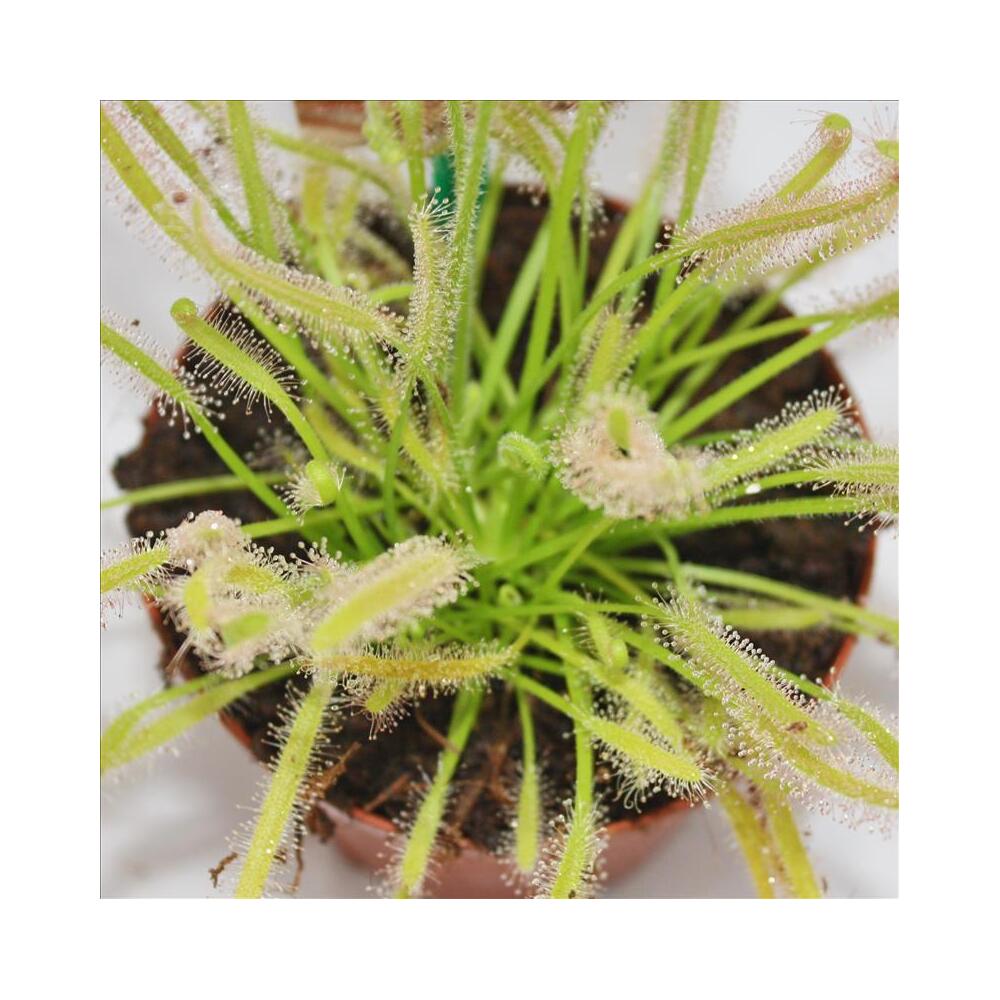
Droplets on Drosera capensis form on glandular hairs on its narrow trapping leaves. Their sticky secretion holds small prey. The hairs and leaf can move slowly towards the prey. This movement is much slower than a Venus flytrap snapping shut, which makes it particularly interesting to watch. Cape sundew comes from damp habitats in southwestern South Africa. It obtains additional nutrients from prey but remains a plant that needs light for energy. Feeding alone therefore does not make its droplets more attractive.
Start small and discover details
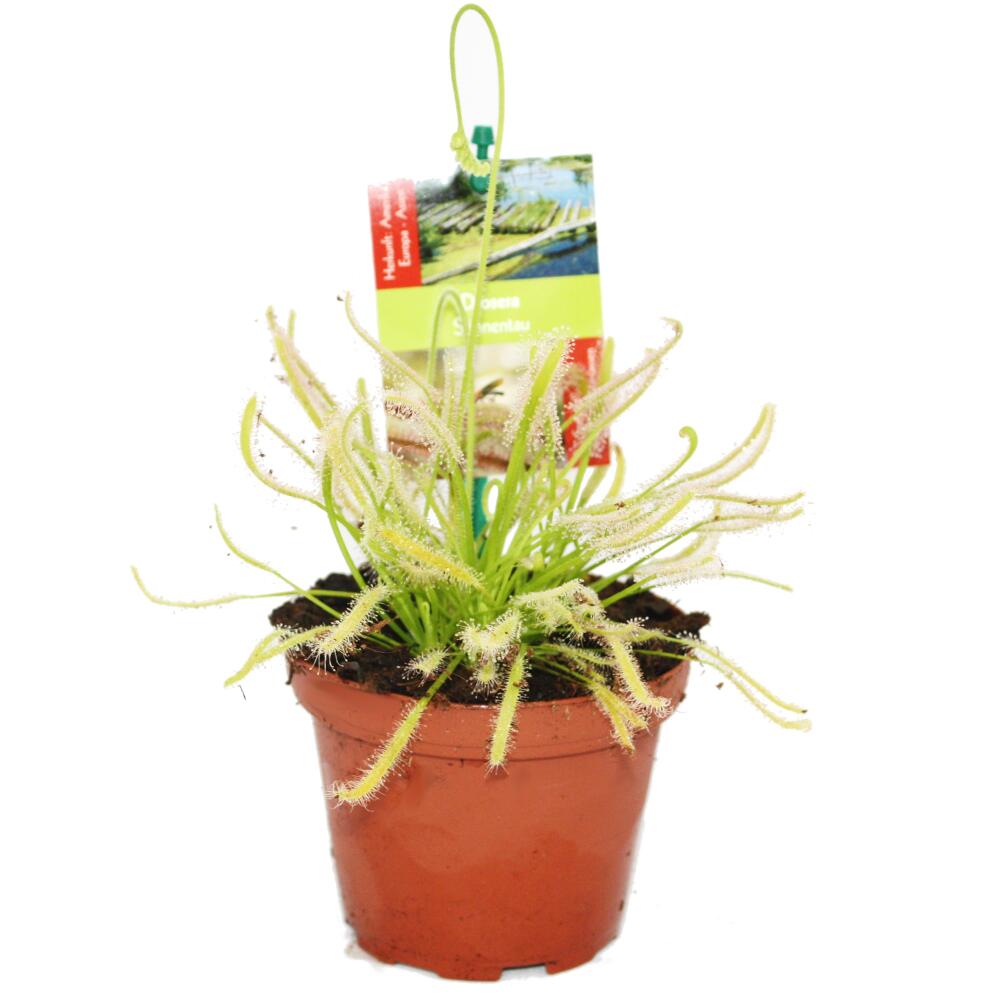
The shop offer lists Drosera capensis in a 9 cm pot. No definite overall height is given; the illustration follows the original image and pot diameter. Leaves and any flower stems may spread to different extents. A macro view of individual glandular hairs shows detail, not the size of the whole specimen. A magnifying glass complements the observation spot in our scene. It does not need to touch the plant. Such a small station can be remarkably varied even with only a single pot.
Bright, without an overheated glass box
A very bright position supports trapping-leaf development. Gradually acclimatise a newly received plant to stronger sun. Glass can also lead to high temperatures; good airflow and attention to water level then matter. A closed terrarium is not required for this species. A sheltered outdoor position is also possible in warm, frost-free summer weather. Indoors, proximity to suitable light remains decisive. An attractive table scene only makes long-term sense if the sundew really receives enough daylight or suitable plant lighting there.
A small water tray with great importance
Keep compost continuously moist. A low water reserve beneath the nursery pot is practical. Do not submerge the rosette centre, and clean the tray regularly. Use low-mineral water from clean collection or a suitable distilled or reverse-osmosis alternative. If other plants on the same table receive fertiliser, keep their water leftovers separate from the sundew. Check how quickly the tray empties on warm days. A small pot responds to sun and airflow considerably faster than a large planted container.
When leaves barely sparkle anymore
Dew may temporarily be absent after transport or a move. Light, water balance, heat and general plant condition also belong in the assessment. Judge newly developing leaves above all. Constant spraying produces water droplets but does not replace healthy glands’ function. Do not wipe trapping leaves or rub supposed dust out of the tentacles. Adjust a recognisably unfavourable condition specifically and observe development instead of changing several things at once every day. This makes it easier to see what actually helps your specimen.
Prey and flowers are no shortcut to care
Outdoors, sundew often finds small prey itself. Indoors, a sparing suitable supplement may help if it encounters hardly any prey over time. Overloading leaves with large food pieces is not sensible. Meat scraps, milk or sweets do not belong on the plant. Nor should it be advertised as guaranteed protection from fungus gnats. If other pots are infested, address the causes separately. Flowers appear on raised stems and open only temporarily. Their development is an attractive addition, not a necessary proof that every care action is correct.
Cape sundew does not need a forced winter
Drosera capensis continues growing bright and frost-free. An obligatory cold rest is not part of normal care for this species. Do not confuse it with winter-resting sundew species from other origins. Shorter days can slow growth and reduce water use. The root ball stays moist nevertheless. A warm, dark place above a radiator is unfavourable: the plant loses water while insufficient light limits strong replacement growth. Check new shoots in winter and plan a better position if brightness is permanently inadequate.
Changing compost and raising young plants
A pot change makes sense when root space is too tight or compost clearly spent. Use fresh, unfertilised carnivorous-plant compost and disturb roots as little as possible. Keep the plant base at a similar height. Under suitable conditions, Cape sundew can be propagated by seeds and vegetatively. For a first attempt, scatter ripe fine seed on the damp surface rather than covering it with a thick layer of soil. Keep the small seed pot bright and evenly moist. Label it with species and date so young plants are not later confused with other sundews.
Careful tidying
Fully dead leaves can be carefully removed without pulling living trapping leaves. Check the plant centre and pot edge while doing so. Carnivorous plants can also suffer from pests; their traps do not make them immune to every infestation. With twisted new growth, unusual insects or deposits, precise identification is useful first. Then choose only actions suitable for the sensitive plant and particular infestation. Personal notes on light and water in the plant book help interpret recurring changes. Gardening experience grows from these small, attentive observations.
One plant, several views
Good to know
Are the droplets simply water?
No. Glandular hairs produce a sticky secretion. Sprayed water does not replace this function.
Does Drosera capensis need a cold winter rest?
This species does not need an obligatory rest period. Continue care bright and frost-free; compost stays moist.
Can sundew reliably eliminate my fungus gnats?
It can catch small insects but is not dependable as the sole control. Investigate the cause of an infestation separately.
Why is dew missing after shipping?
Transport and adjustment may contribute. Check light and water and watch new leaves particularly closely.
Can I plant it together with all other carnivorous plants?
Only if the particular species’ position, water, compost and winter care match. The shared name carnivorous plants is not enough.
Sources and editorial note
- Product and pot size: Exotenherz
- SANBI: Drosera capensis from a botanical perspective
- RHS: Drosera capensis
- ICPS: Cape sundew and no obligatory dormancy
- RHS: growing carnivorous plants
- ICPS: digestion and nutrient uptake
Sources checked: 14 September 2026. Product and delivery size are described from the shop offer; care takes account of the linked botanical specialist sources. Guidance applies to this species and should be adjusted to plant condition, position and season.