
This plant at Exotenherz
Check the shop offer for current availability, price and what is included.
Product details, availability and delivery information are provided in the shop offer.
Your care table
| Topic | What to do | Why it helps |
|---|---|---|
| Position | Choose a lightly shaded to shady garden position. | Water needs increase in strongly sunny positions; beneath trees and shrubs the foliage fits more readily into a cool planting. |
| Soil | Prepare humus-rich, loose soil that retains moisture but still drains water. | Roots should be neither permanently dry nor trapped in a compacted hollow. |
| Planting season | Preferably plant in spring or autumn in frost-free soil. | Milder weather gives the small root ball time to root into the surrounding soil. |
| Spacing | Initially allow roughly 35–45 cm from one clump centre to the next. | The species can later grow about 30–45 cm wide; closer or wider spacing changes coverage. |
| Watering in | Water thoroughly after planting and check moisture at the original root ball. | A 9 cm root ball can dry out even if the border surface still looks dark. |
| Summer | During prolonged drought check the root zone and water thoroughly if needed. | Tree and shrub roots often remove a great deal of water from shady borders. |
| Pruning | In spring carefully pull out or individually remove dead or damaged leaves. | Healthy wintergreen arches remain; a blanket low cut removes their effect. |
| Containers | In a container pay particular attention to drainage and root-ball moisture. | A small container dries out faster and can freeze more deeply in winter than a border. |
For young plants, feel the soil directly at the root ball. The surface and deeper soil may have different moisture levels.
Water thoroughly after planting; later, water according to the soil, weather and establishment rather than a fixed calendar.
Avoid standing water. For plants in containers, also check that water runs out of the drainage hole.
A calm edge of green arches
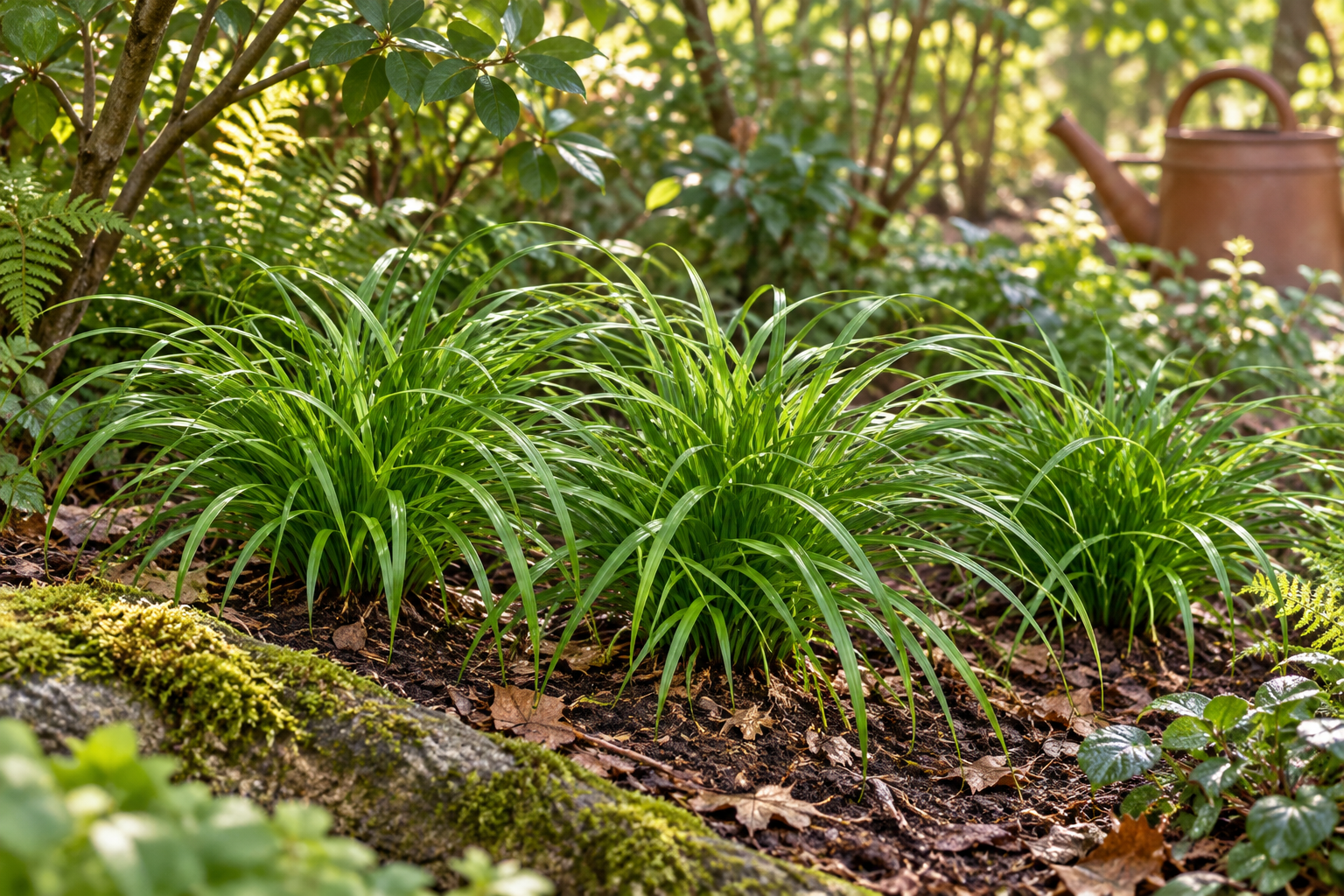
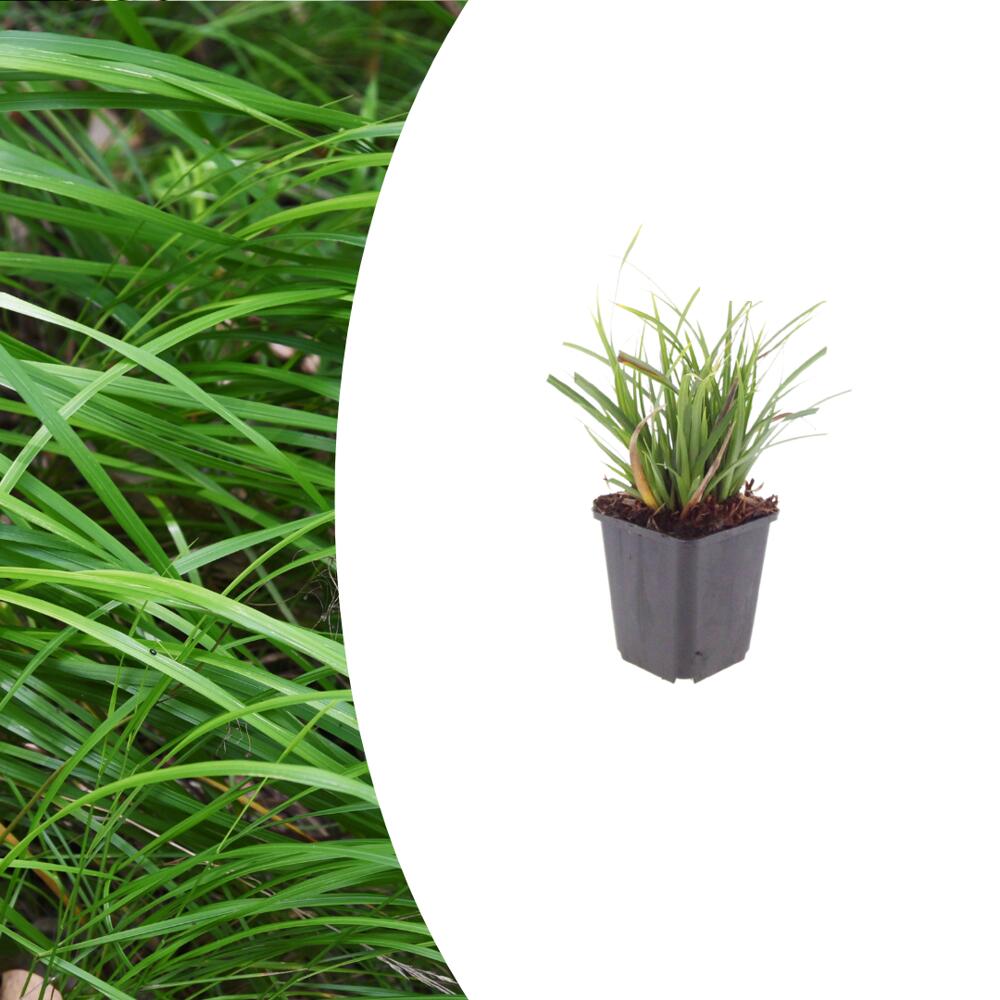
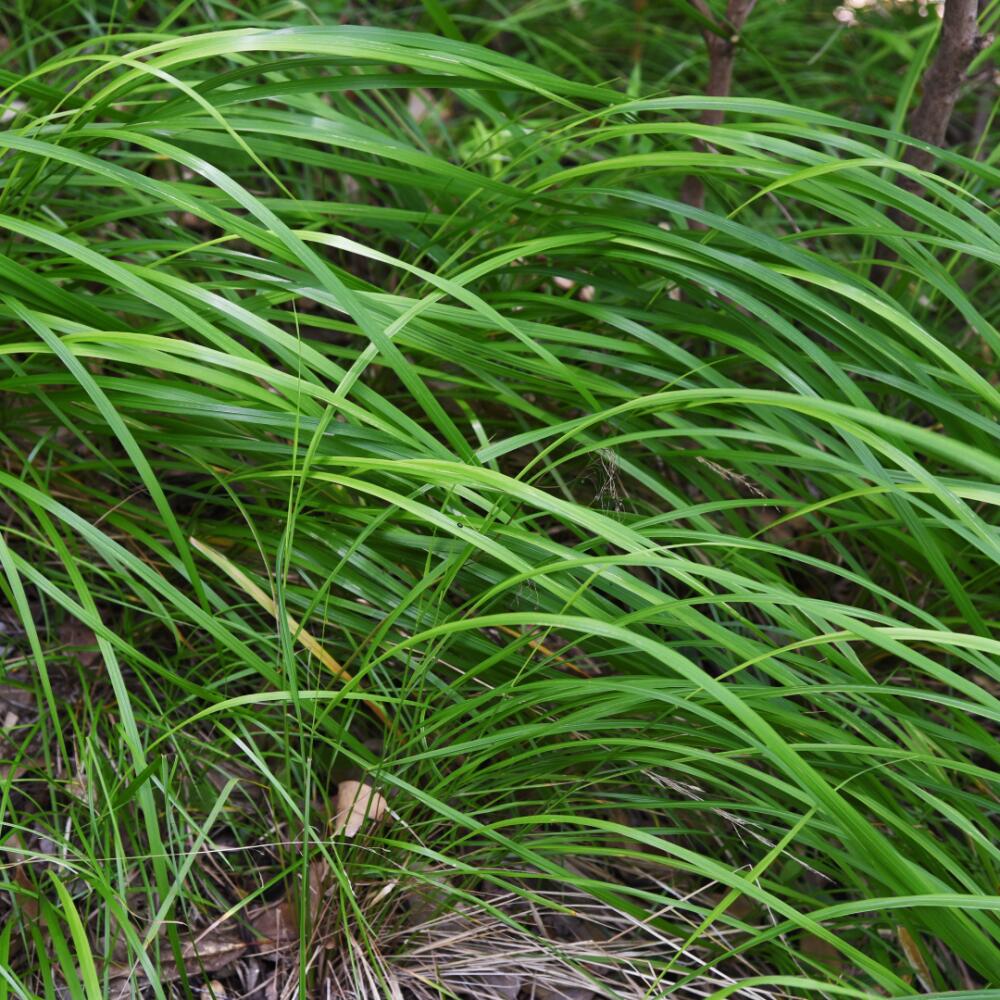
At the edge of trees and shrubs, I look beyond flowers. Attractive foliage often holds a border together for much longer. Carex morrowii does exactly that: narrow green leaves grow from a low centre, arching outwards to form a soft clump. The shop offers a young plant in a 9 cm pot at roughly 10 to 25 cm delivery height. The established border in our scene shows its possible later effect. These two stages should be kept apart when planning the area.
Shade does not automatically mean moist soil
I like planting Japanese sedge in partial shade to shade, for example in front of shrubs or beneath an open tree canopy. There the leaf colour remains calm and water needs are more manageable than in full sun. Soil should be humus-rich and relatively moist. Beneath a large tree I still check more carefully: its roots draw up plenty of moisture even if the position looks cool. A hand test a few centimetres deep tells me more than the surface’s dark colour. I loosen heavy, compacted soil before planting; the little sedge does not belong in a wet, airless hollow.
Plant young pots with future clumps in mind
Before planting I trial the positions of the 9 cm pots on the border. The species can later reach about 30 to 45 cm in height and width. I therefore allow approximately 35 to 45 cm between clump centres as a guide, depending on how quickly I want a continuous edge. This is not a promise of the exact size of this shop batch. I set each root ball at its previous height, gently firm the soil and water thoroughly. In the first weeks I specifically check the original small root ball until its roots have reached the garden soil. The different shop sets allow a small group or a longer border edge; the selected quantity is what is supplied.
Water according to soil and season
Newly planted sedges need more attention than established clumps. I do not water by weekday but consider soil moisture, weather and leaf condition. In summer even a shady border beneath trees can dry out. Then I water the root zone rather than giving the foliage a quick splash. If the soil is still clearly moist, I wait. In full sun the moisture supply would need to be considerably more reliable; for an already dry site I would prefer to find partial shade. The same observation applies in a container, but its smaller root ball reacts more quickly.
Preserve the wintergreen foliage gently
Japanese sedge is perennial and often keeps much of its foliage through winter in suitable positions. Some outer leaves may nevertheless brown after frost or drought. In spring I remove those leaves individually and leave the healthy green arches. Cutting radically to ground level would remove precisely what I planted it for. The small greenish spring spikes are botanically interesting, but foliage plays the main role in the design. If an older clump becomes thin in the centre, I can divide it in early spring and replant the strong pieces.
Let it grow with the planting area
One young sedge does not yet fill a large woodland edge. I combine several plants where the line of the border could use some calm, leaving room for them to thicken. Their fine leaves show their shape particularly well in front of ferns or among larger foliage. After the first summer I check which areas really are too dry or too deeply shaded rather than simply adding more fertiliser. Suitable soil with enough moisture usually achieves more than an extra application. That is how individual 9 cm pots gradually become a connected planting that still feels light.
One plant, several views
Good to know
Is Japanese sedge a grass?
It looks grass-like but botanically belongs to the sedge family (Cyperaceae).
How tall does Carex morrowii grow?
The mature species can reach roughly 30–45 cm tall and wide. The shop offer describes young plants at about 10–25 cm delivery height in 9 cm pots.
Does it need full sun?
Partial shade to shade is the natural choice for this border portrait. Full sun only makes sense with a reliably sufficient supply of soil moisture.
How far apart should I plant them?
About 35–45 cm between clump centres is a gardening guide based on eventual width; spacing can be adjusted for a different rate of coverage.
Should I cut all the foliage back in spring?
For a wintergreen sedge I prefer to remove only dead leaves and old spikes. Healthy green leaves stay in place.
When does it flower?
Small, rather inconspicuous greenish spikes may appear in spring. The green foliage structure defines its garden position far more strongly.
Can I divide it?
Yes. If an older clump weakens in the centre, strong divisions can be replanted in early spring.
Sources and editorial note
- Exotenherz: shop name, 9 cm pot, delivery height, variants and original images (accessed 30.09.2026)
- NC State Extension: Carex morrowii, habit, flowering and position (accessed 30.09.2026)
- Royal Horticultural Society: caring for and dividing evergreen sedges (accessed 30.09.2026)
- Royal Horticultural Society: pruning evergreen sedges (accessed 30.09.2026)
Shop name, parent article 2079326032026, five selectable child articles, 9 cm pot, 10–25 cm delivery height and original images checked in the live shop on 30.09.2026. The shop photograph shows a green-leaved plant without a cultivar name; white-edged cultivars from specialist sources must not be transferred. Species cultivation and growth information checked against NC State Extension; evergreen pruning and division additionally against RHS. Spacing of 35–45 cm is a gardening inference from the supported eventual width of about 30–45 cm, not an exact cultivar promise. The scene shows a later garden effect, not delivery size.