

This plant at Exotenherz
Check the shop offer for current availability, price and what is included.
Check the selected shop offer for price, availability and delivery contents.
Your care table
| Topic | What to do | Why it helps |
|---|---|---|
| Light | Choose bright partial shade or gentle morning and evening sun. | Hot sun makes the pale flower pattern fade faster. |
| Soil | Prepare humus-rich, moisture-retentive soil with drainage. | Roots should receive an even supply of water and good aeration. |
| Planting | Use mild frost-free days; set the top of the rootball 5–8 cm deeper. | Large-flowered hybrids form new basal shoots more easily this way. |
| Support | Choose an airy trellis with thin supports. | Leaf stalks grip them and flowers have room. |
| Water | Check rootball moisture rather than following a weekly schedule. | Containers and rain-sheltered wall strips dry at different speeds. |
| Nutrients | Feed pots during growth according to the label; care for border soil as needed. | More fertiliser does not compensate for an excessively hot position. |
| Pruning | Pruning group 2: shorten dead ends to healthy buds early in the year. | Last year’s wood supports the first flowering flush. |
| Repeat flowering | Gently shorten individual finished shoots to strong buds. | New growth may carry further flowers. |
| Winter | Protect container rootballs and check occasionally on frost-free days. | Leaf fall is normal; living stems remain important for the next season. |
For young plants, feel the soil directly at the root ball. The surface and deeper soil may have different moisture levels.
Water thoroughly after planting; later, water according to the soil, weather and establishment rather than a fixed calendar.
Avoid standing water. For plants in containers, also check that water runs out of the drainage hole.
The bright side of clematis
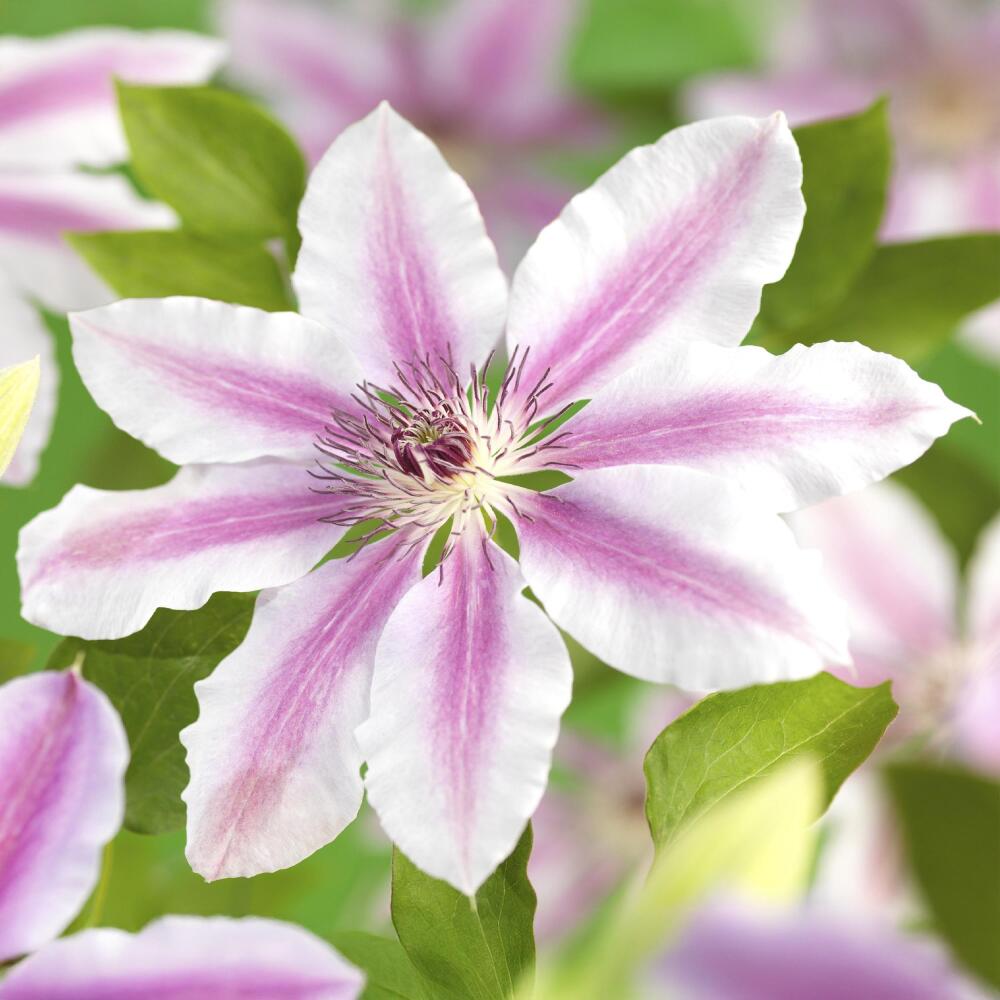
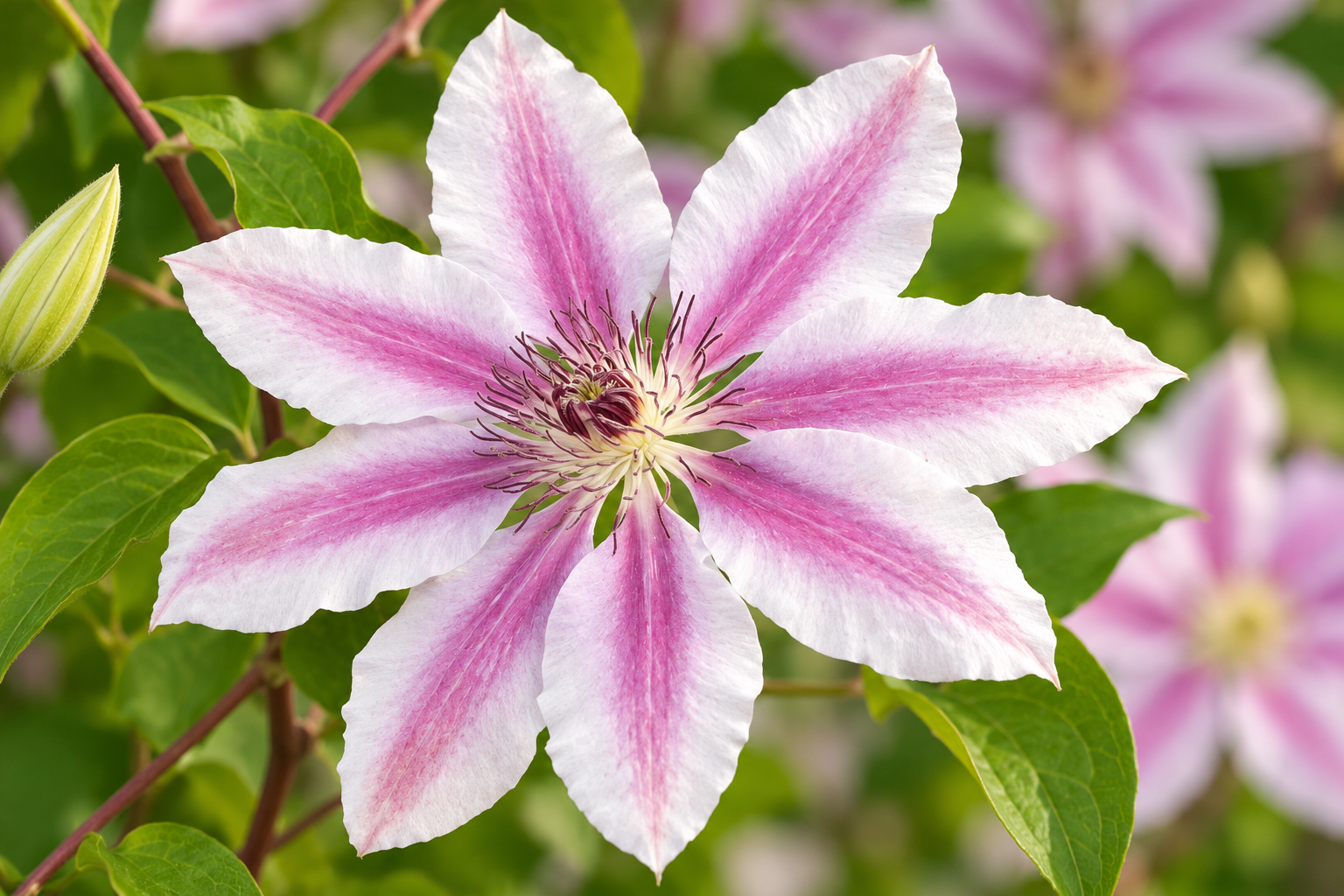
Nelly Moser looks particularly welcoming beside dark wood or a green shrub. Its broad petals, usually eight, have a pale pink-lilac background and a stronger central stripe. The large flowers may become around 20 cm wide; reddish stamens stand at their centre. Despite these conspicuous flowers, the variety remains a climbing, deciduous plant with delicate young stems. It belongs to the early large-flowered clematis group. In the garden, it is therefore a good choice if you want flowers at eye level and to distribute shoots deliberately over a manageable trellis.
Two young plants are not yet a full privacy screen
The linked set contains two clematis, each in an 11 cm pot at about 40 cm total height including the pot. Later height is approximately 1.5–2.5 m as a guide; a strong root zone needs to develop first. Carefully release the thin shoots from packaging and support when unpacking. Initially place the plants somewhere bright and sheltered after checking the rootball. A small leafy framework suits this young stage. Flowering shop images and our labelled scenes show the varietal pattern but do not promise a fully developed canopy of flowers in the delivery package.
Where the pink stripes retain their colour
A position with morning or evening light and bright partial shade is particularly appealing for Nelly Moser. Intense hot sun can make its delicate pale flower colour fade faster. This does not mean it belongs in a dark, dry wall corner: leaves need light and soil should hold moisture dependably. Plan an airy support over which individual shoots can be spread. This keeps the flowers from all overlapping. Shade the root area rather than the entire climbing surface. Leave low companion perennials away from the rootball so that their roots do not immediately crowd the young clematis.
A good planting spot begins below the surface
Plant Nelly Moser on mild days in spring or early autumn when the ground is frost-free and not waterlogged. Loosen the planting area and improve heavy or rapidly drying soil with suitable organic material. For this large-flowered hybrid, the top of the rootball sits approximately 5–8 cm beneath the eventual surface. This encourages additional basal shoots. At a wall, keep the planting point about 30–45 cm from its base because rain may not reach there. Water thoroughly and guide the young shoot towards the trellis with a narrow support. Do not pull it tight: a little movement in the wind must remain possible.
In a container, care involves the whole rootball
Nelly Moser can also grow on a terrace if the roots have space. For permanent cultivation, a container about 45 cm deep and wide with drainage is a useful guide. An 11 cm nursery pot is the starting container, not a permanent substitute. Check moisture in the root zone and water so that the rootball is moistened through. Remove standing water from a saucer. During growth, container plants can be fed according to the manufacturer’s instructions. In a fertile border, soil care with a loose mulch layer is often enough; do not heap it against the stems. A pale flower edge is not an automatic sign of insufficient fertiliser.
Pruning group 2 needs living buds
Early flowers form on short new side shoots of last year’s wood. In late winter or early spring, therefore, look first for healthy pairs of buds and remove only dead or weak ends above them. An even, severe cut of every shoot would reduce early flowering. After the first flush, individual finished stems can be shortened to strong buds below them to encourage new development. A very young plant with only a few unbranched shoots may initially receive its own formative pruning. Accept the possible loss of early flowers deliberately; do not repeat this youthful framework-building every year on an adult Nelly Moser.
From a summer display to winter rest
Protect sensitive young growth from slug damage and check loose ties as the trellis fills. If shoots droop, check rootball moisture and stems for injuries; fungal infection is only one possible explanation. Nelly Moser loses its leaves in autumn. Keep living shoots until the appropriate pruning time and do not pull down every bare stem. In a border, the established variety can spend winter in the garden; in a pot, the root zone needs additional shielding from severe cold. On frost-free days, a quick look at the soil matters too: winter rest means less water, not a rootball left completely dry for months.
One plant, several views
Good to know
Why is partial shade recommended for Nelly Moser?
Its pale flowers with a strong central stripe fade more easily in very hot sun. A bright, airy position is still necessary.
How big does the variety become later?
About 1.5–2.5 m climbing height is a guide for the developed plant. The set delivers two young plants in 11 cm pots at around 40 cm total height.
Can it stay in the small delivery container?
For a few days with suitable care, yes; for permanent cultivation, no. Plan a container about 45 cm wide and deep with drainage holes.
Why should I retain old shoots?
Nelly Moser belongs to pruning group 2; last year’s wood contributes to early flowering. Selectively remove dead and weak ends during maintenance pruning.
Is a second flowering guaranteed?
A later flush is typical of this group but depends on development, position and pruning. A fixed number of flowers cannot be promised.
Are bare winter shoots dead?
Not necessarily. The variety is deciduous. Check buds and living tissue at pruning time rather than removing every stem in autumn.
Sources and editorial note
- Exotenherz: parent offer read directly, delivery measurements and original gallery (03.10.2026)
- Specialist reference: clematis-nelly (read directly 03.10.2026)
- Specialist reference: clematis-growing (read directly 03.10.2026)
- Specialist reference: clematis-pruning2-guide (read directly 03.10.2026)
- Specialist reference: clematis-wilt (read directly 03.10.2026)
Identity and independent profile checked against the canonical 642 entries and shared and isolated portraits and assignments. Parent offer and all associated child offers read directly on 03.10.2026 with precise URL and file hashes. Total delivery height distinguished from later growth height; sets do not count additionally. Specialist sources read directly. Text and image comparison checked in isolation; PDF and page acceptance bound to actual file hashes. No publication acceptance: Root checks the shared page build.