
This plant at Exotenherz
Check the shop offer for current availability, price and what is included.
Check the selected shop offer for price, availability and delivery contents.
Your care table
| Topic | What to do | Why it helps |
|---|---|---|
| Flower appearance | Distinguish early double flowers from later single flowers. | Piilu’s flower form is linked to shoot age and season. |
| Light | Choose sun or bright partial shade with a cool root zone. | Leaves need light; the rootball should not overheat. |
| Planting | In frost-free soil, set the top of the rootball 5–8 cm below the surface. | The large-flowered hybrid can branch from below. |
| Support | Provide thin supports and spread shoots loosely. | Leaf stalks can grip them. |
| Water | Check moisture in the young rootball and water thoroughly as needed. | New roots only gradually explore the garden soil. |
| Feeding | Feed containers during growth according to the label; check border need. | Nutrients do not force a change to double flowering. |
| Pruning | Pruning group 2: retain living buds during maintenance pruning. | Old shoots support the early flowering flush. |
| Containers | Choose a stable container with drainage and enough root space. | The support and larger growth need secure anchoring. |
| Winter | Shield the pot rootball from severe cold and check on frost-free days. | The leafless plant still needs an intact root zone. |
For young plants, feel the soil directly at the root ball. The surface and deeper soil may have different moisture levels.
Water thoroughly after planting; later, water according to the soil, weather and establishment rather than a fixed calendar.
Avoid standing water. For plants in containers, also check that water runs out of the drainage hole.
Piilu may look different in the same garden
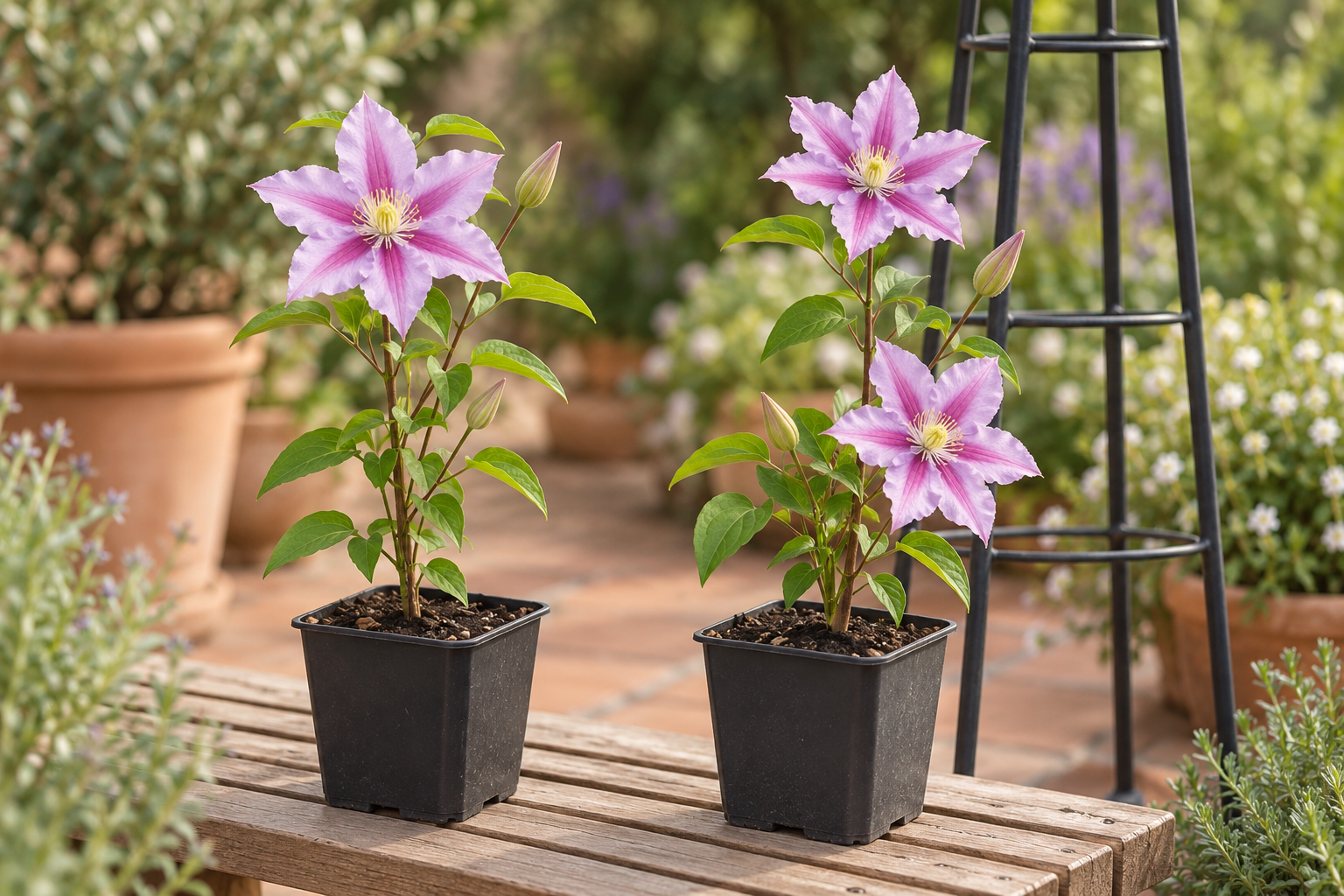
A single pink star and a more densely double flower can belong to the same Piilu. On retained older shoots, the early flowers often open more petals; on new shoots, later flowers are usually single and slightly paler. The darker pink central band and pale flower centre connect these views. The documented variety belongs to the early-flowering large-flowered clematis. It is a good example of why a garden plant should not be judged by a single flower photograph alone. Development, season and pruning are part of its appearance.
The start consists of roots and thin climbing stems
The linked set contains two plants, each in an 11 cm pot. The approximately 40 cm total height includes the pot; it does not describe the later space requirement. In the garden, Piilu can reach about 1.5–2.5 m climbing height. Release the packaging without pulling the thin stems and initially leave the young plant on its support. Check rootball moisture before planting. Neither single nor double flowers should be assumed for every young delivery plant at every season. In particular, the first framework may consist more of new green shoots than of a finished canopy of flowers.
An obelisk needs suitable soil
Piilu looks attractive on a slender garden obelisk or a small trellis that guides its stems upwards within reach. Sun or bright partial shade suits it, while the root zone remains as cool and evenly supplied as possible. Humus-rich, well-drained soil matters more than a decorative gravel ring over compacted ground. Plant on mild, frost-free days in spring or early autumn. The top of this large-flowered hybrid’s rootball may sit around 5–8 cm beneath the eventual surface. Firm it in carefully and water so that dry voids do not remain around the rootball.
Leaf stalks grip fine supports
A clematis wraps its support with leaf stalks. Provide thin supports or wires instead of relying on a broad, smooth post as the sole anchor. Spread young stems loosely and fasten them with soft ties without constricting the shoot. At a wall or under an overhang, the rootball is best around 30–45 cm in front of the base so that it is not in the driest strip. For a permanent container display, Piilu needs substantially more root space than its delivery nursery pot: a well-drained container about 45 cm wide and deep is a good growing guide. The support must be firmly anchored in it.
Water and food follow the growth
In the first year, pay particular attention to the original rootball. When it dries, water thoroughly enough to reach the root zone. Brief daily sprinkling does not replace this supply. In a container, sun, wind and leaf mass affect demand; standing water should drain away at the same time. During active growth, a suitable fertiliser used according to the label can be useful there. In a fertile border, regular feeding is not always necessary. A loose organic soil covering supports moisture and structure but stays away from the stem base. A later flush of single flowers is not a reason to try forcing double flowers again with extra fertiliser.
The secateurs help determine early flowering
Piilu belongs to pruning group 2. On established plants, remove weak and dead shoot ends in late winter or early spring, cutting above a pair of living buds. Retained wood is important for early flowering. If the entire plant is cut severely close to the ground, the early double flowers may be absent while later single flowers on new shoots remain possible. After the first flowering, individual finished shoots can be shortened to strong buds. A low formative cut on an unbranched young plant is a separate step, not an annual rule for an adult Piilu. Wear gloves when pruning because clematis can cause skin irritation.
Observe the season rather than count flowers
Piilu loses its leaves in autumn while the perennial base remains. Rootball protection and moderate moisture checks on frost-free days accompany winter. In spring, inspect buds and ties before the stems start growing again. If unexpected wilting occurs, check soil, stem injuries and feeding damage at the base; clematis wilt is only one possible cause. Flowers can also vary with weather and age. Remember which shoot flowered when rather than expecting a rigid number of double and single blooms. This makes the variety’s distinctive features understandable in your own garden.
One plant, several views


Good to know
Is my single-flowered Piilu a different variety?
Not automatically. Piilu often forms early double flowers on older wood and later mostly single flowers on new growth.
What does the total height in the shop mean?
The approximately 40 cm includes each 11 cm pot. The linked offer contains two young plants; later climbing height may be around 1.5–2.5 m.
Can I force double flowers with fertiliser?
No. Shoot age, season, development and pruning are decisive for the change in flowers. Feed according to the needs of cultivation.
What happens after severe spring pruning?
Early flowering on retained wood may decrease or be absent. Later single flowers on new growth remain possible but are not guaranteed.
Which support suits it?
A trellis or slender obelisk with thin supports. You can guide young shoots loosely until the leaf stalks find a grip.
Is it suitable for a container too?
It is possible with a large, stable container, drainage and regular moisture checks. An 11 cm delivery nursery pot is not sufficient permanently.
Sources and editorial note
- Exotenherz: parent offer read directly, delivery measurements and original gallery (03.10.2026)
- Specialist reference: clematis-piilu (read directly 03.10.2026)
- Specialist reference: clematis-growing (read directly 03.10.2026)
- Specialist reference: clematis-pruning2-guide (read directly 03.10.2026)
- Specialist reference: clematis-wilt (read directly 03.10.2026)
Identity and independent profile checked against the canonical 642 entries and shared and isolated portraits and assignments. Parent offer and all associated child offers read directly on 03.10.2026 with precise URL and file hashes. Total delivery height distinguished from later growth height; sets do not count additionally. Specialist sources read directly. Text and image comparison checked in isolation; PDF and page acceptance bound to actual file hashes. No publication acceptance: Root checks the shared page build.