
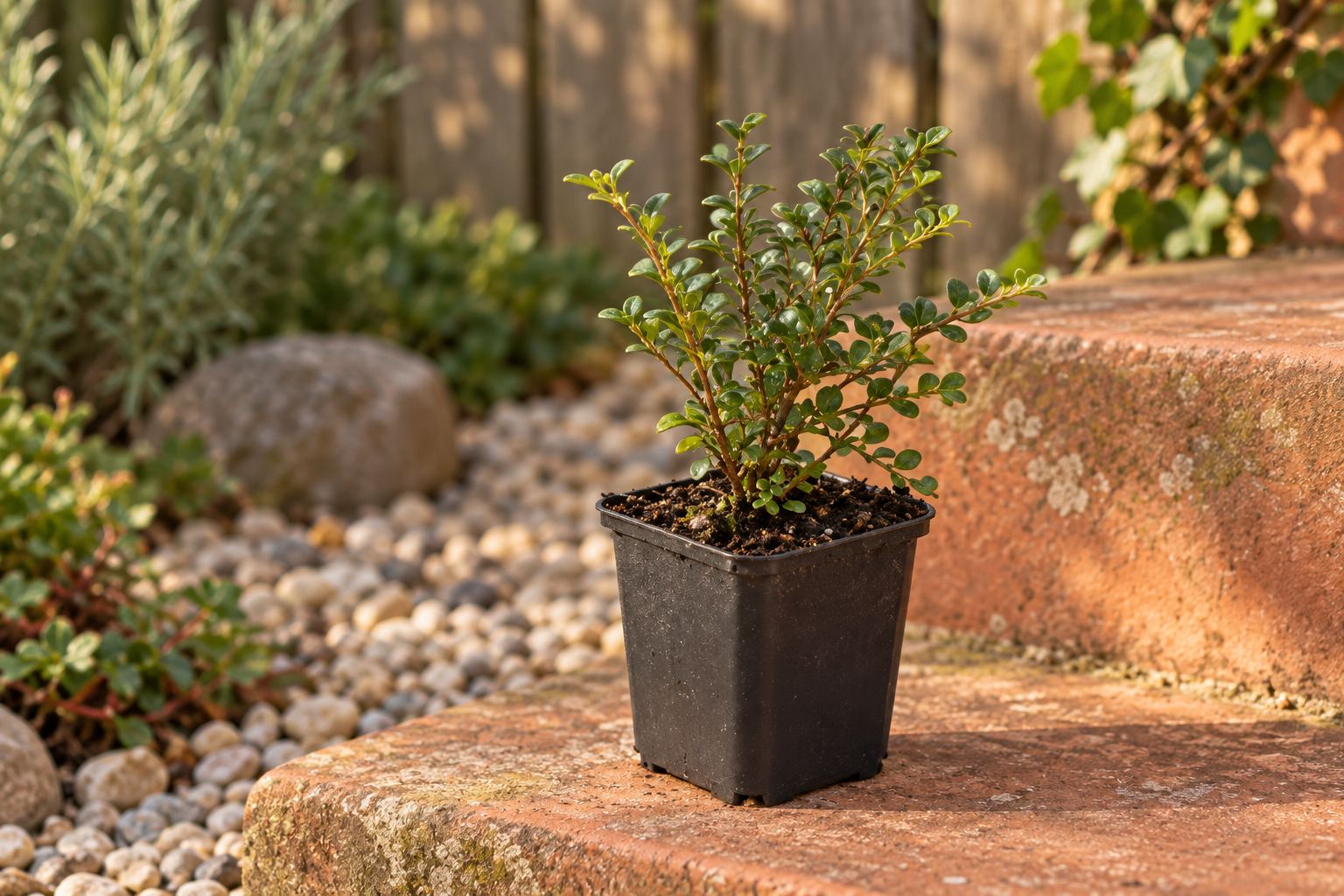
This plant at Exotenherz
Check the shop offer for current availability, price and what is included.
Check the selected shop offer for price, availability and delivery contents.
Your care table
| Topic | What to do | Why it helps |
|---|---|---|
| Light | Choose sun to partial shade. | A bright position shows the branch framework and seasonal display well. |
| Space | Allow for broad branches in front of walls and paths. | The small delivery plant can grow well beyond a close planting distance. |
| Planting | Plant a moistened rootball at its previous level. | The young pot rootball needs contact with garden soil. |
| Water | Check moisture directly in the root zone during establishment. | Rain elsewhere does not supply a dry rootball at a wall base. |
| Soil | Choose loose, well-drained garden soil. | Water standing for longer does not suit a well-aerated root zone. |
| Shape | Shorten troublesome branches individually and remove dead shoots. | Selective pruning preserves the characteristic side branching. |
| Wall | Provide suitable fastenings for a wall-trained plant. | Wall cotoneaster has no self-clinging climbing organs. |
| Winter | Allow leaf fall; protect container rootballs from severe chilling and drying. | Wintergreen behaviour depends on climate and is not guaranteed generally. |
Check the compost and pot weight. The care table explains how far the compost may dry.
Water only when needed. The water should reach the root ball without spilling over the rim.
Remove surplus water from the saucer or cachepot. Then return the plant to a suitable position.
The branches are a subject in their own right
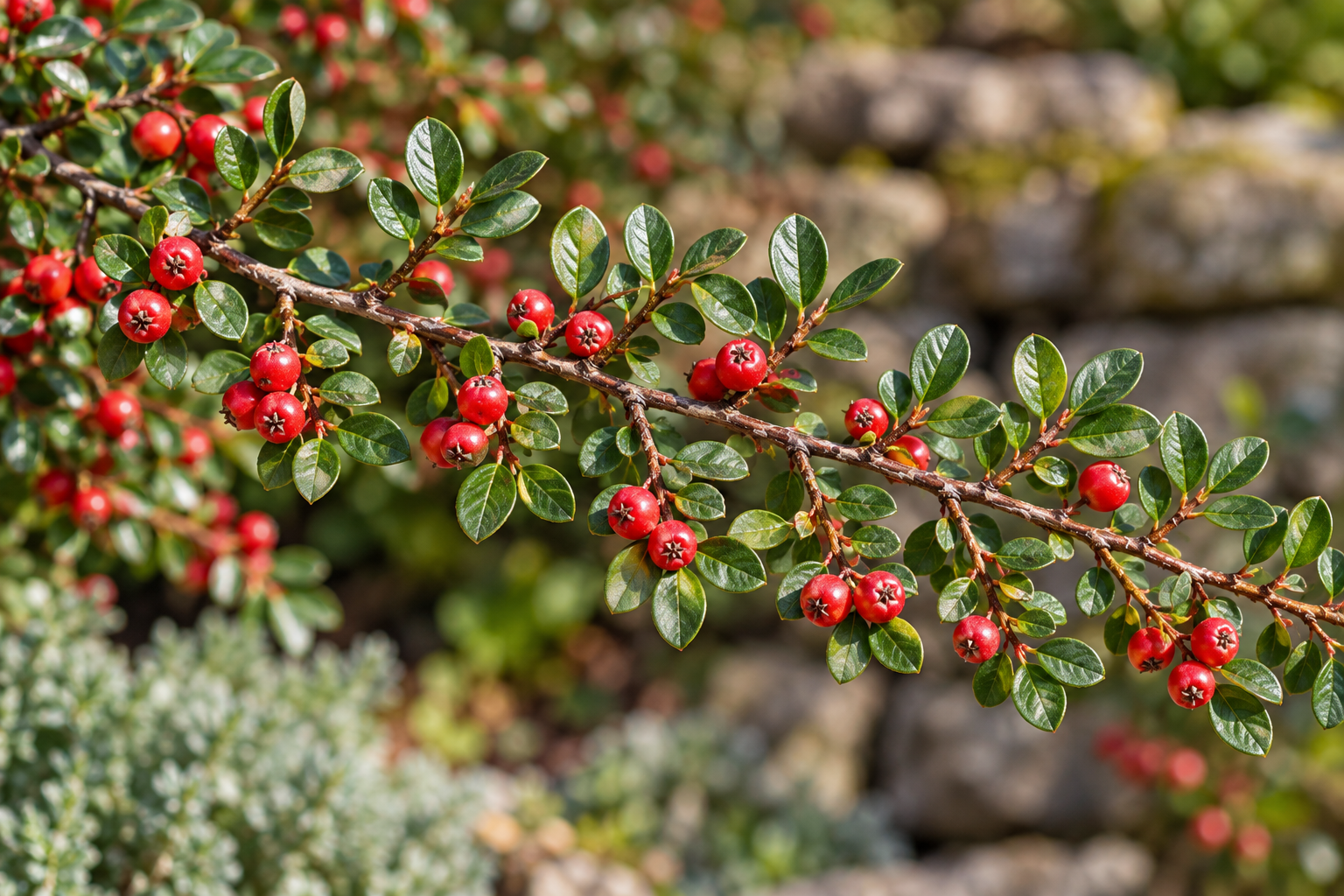
With wall cotoneaster, it is worth letting your eye follow a single branch. Short side branches stand in a distinctive arrangement along the longer shoots. This framework recalls small fans or a herringbone pattern and distinguishes the species from an ordinary green groundcover. Little entire leaves accompany the lines. White to pink flowers may appear in spring; red ornamental fruits follow later. Against a quiet stone surface, the architecture is particularly clear. The young plant shows only its beginning, while an older shrub takes up considerably more room over the years.
A low shrub is not automatically tiny
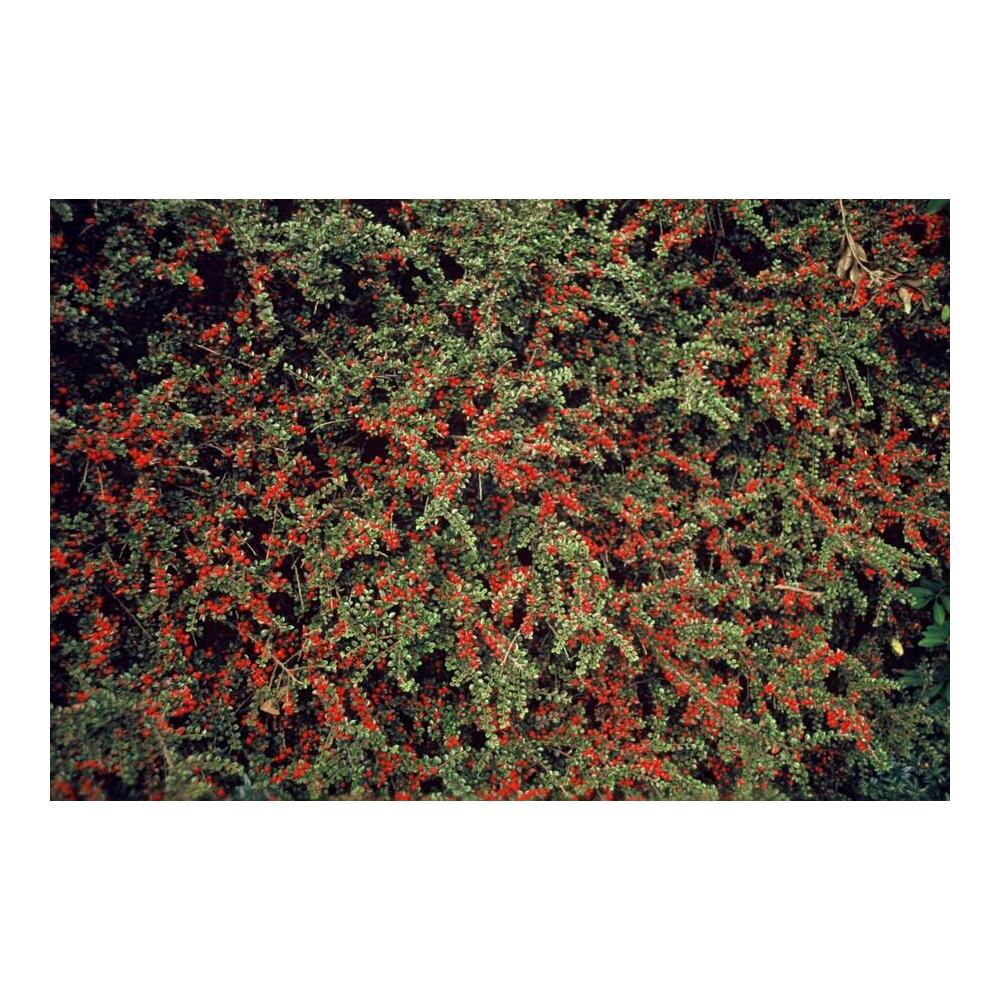
You receive Cotoneaster horizontalis in a 9 cm pot at approximately 10 to 25 cm total height including the pot. The North Carolina State University species profile describes developed plants at around 60 to 90 cm tall and roughly 1.8 to 2.4 m wide. Soil, care and position affect actual size. The shop gives 40 to 50 cm spacing for an area planting. This does not promise the later individual width. Plan the edge of a path and distance from sensitive neighbours based on the developed shrub. The small sales pot makes later space needs easy to underestimate.
A wall emphasises shape but does not replace good soil
Sun to partial shade and loose, well-drained garden soil suit wall cotoneaster. Branches may stand out particularly clearly in front of a low wall. At a wall base, however, the soil is often drier than it first appears. Check the soil and access for watering. If you want to train the shrub against a wall, it needs suitable fastenings; it does not cling independently like a climbing plant. A free-growing planting remains broadly spreading instead. Avoid permanently wet hollows and leave sufficient room for development between the planting point and dense neighbours.
The first step is a well-supplied rootball
Planting is especially convenient to plan in spring or early autumn. What matters is frost-free, workable soil that is not soaked. Moisten a dry rootball before carefully releasing the pot. Young branches are not handles. Plant at the previous level, fill with soil and water thoroughly. Afterwards, check moisture directly at the former pot rootball. The delivery plant does not yet have the large root reserves of an older garden shrub. It may need water in warm wind despite some rain. If its root zone remains moist, extra watering does not help.
The year may show in the leaves
Wall cotoneaster is described predominantly as deciduous; in mild climates it may behave partly wintergreen. Do not expect an equally green winter area everywhere. Autumn colour can range from red to purple and complements the red fruits. Colour, strength and duration depend on weather and position. Detail images show a developed branch, not a guaranteed unpacking condition. Red fruits are treated as ornamental fruits, not produce for snacking. A shrub that changes seasonally can be healthy: leaf fall alone is not an instruction to feed more strongly or water more often.
Prune with the branch framework
Good pruning follows the branches. Remove dead or damaged shoots and shorten individual branches growing into a passage. Look at where side branches sit and where flowers or fruits can remain. General hedge clipping quickly turns the distinctive fan framework into a uniform surface. If you want to keep the plant compact, check the edge regularly rather than intervening severely only every few years. Also remove young seedlings in unwanted garden spots early. The species can spread by seed; a maintained garden edge therefore occasionally needs more than pruning the mother shrub alone.
A pot needs its own winter routine
In an outdoor container, moisture checks remain important even when leaves fall. A larger pot with open holes and well-drained soil makes drainage easier. Remove water from a saucer and check whether dense branches hide the surface. In winter, position the rootball sheltered and check it in frost-free weather. Do not water frozen soil. In spring, first wait for new growth and selectively remove dead areas. If part stays weak, consider soil moisture, drainage and light separately. A clear look at the root zone helps more than several simultaneous changes whose effects are hard to distinguish afterwards.
One plant, several views
Good to know
Why is it described as having fan-like branches?
Its short side branches create a striking fan or herringbone framework along longer branches. This is particularly visible on older branches.
Does it stay green in winter?
Not reliably. The species is predominantly deciduous and can be semi-evergreen in mild regions. Autumn colour and leaf fall are part of normal development.
How big does it grow?
The species profile used gives approximately 60–90 cm height and 1.8–2.4 m width. These are guides for developed plants, not delivery measurements.
Does it climb a wall independently?
No. You can train it against a wall but must fasten the branches suitably. It has no self-clinging climbing organs.
May I eat the red fruits?
No, do not use the fruits as snack fruit. They serve an ornamental purpose here.
When should I plant it?
Spring or early autumn in frost-free, non-waterlogged soil. Then support moisture in the young rootball.
Sources and editorial note
- Exotenherz: offer and original images (03.10.2026)
- NC State Extension: Cotoneaster horizontalis – species profile (03.10.2026)
- RHS: cotoneaster in the garden – planting and care (03.10.2026)
- Exotenherz: verified 6-plant child offer (03.10.2026)
- Exotenherz: verified 12-plant child offer (03.10.2026)
- Exotenherz: verified 20-plant child offer (03.10.2026)
- Exotenherz: verified 40-plant child offer (03.10.2026)
- Exotenherz: verified 60-plant child offer (03.10.2026)
Shop offer, article number, availability and original images checked directly on 03.10.2026. Specialist sources read directly. NC State species profile read directly: 2–3 ft height and 6–8 ft width converted to cm, herringbone framework, white/pink spring flowers, red fruits and deciduous/semi-evergreen depending on climate. No evergreen promise and no German legal classification inferred from UK information. Shop measurements and spacing individually documented. All five child offers individually read freshly and documented with SKU, GTIN where present and availability; orderable quantities: 6, 12, 60. The scene shows one plant; quantity follows the selected set.