
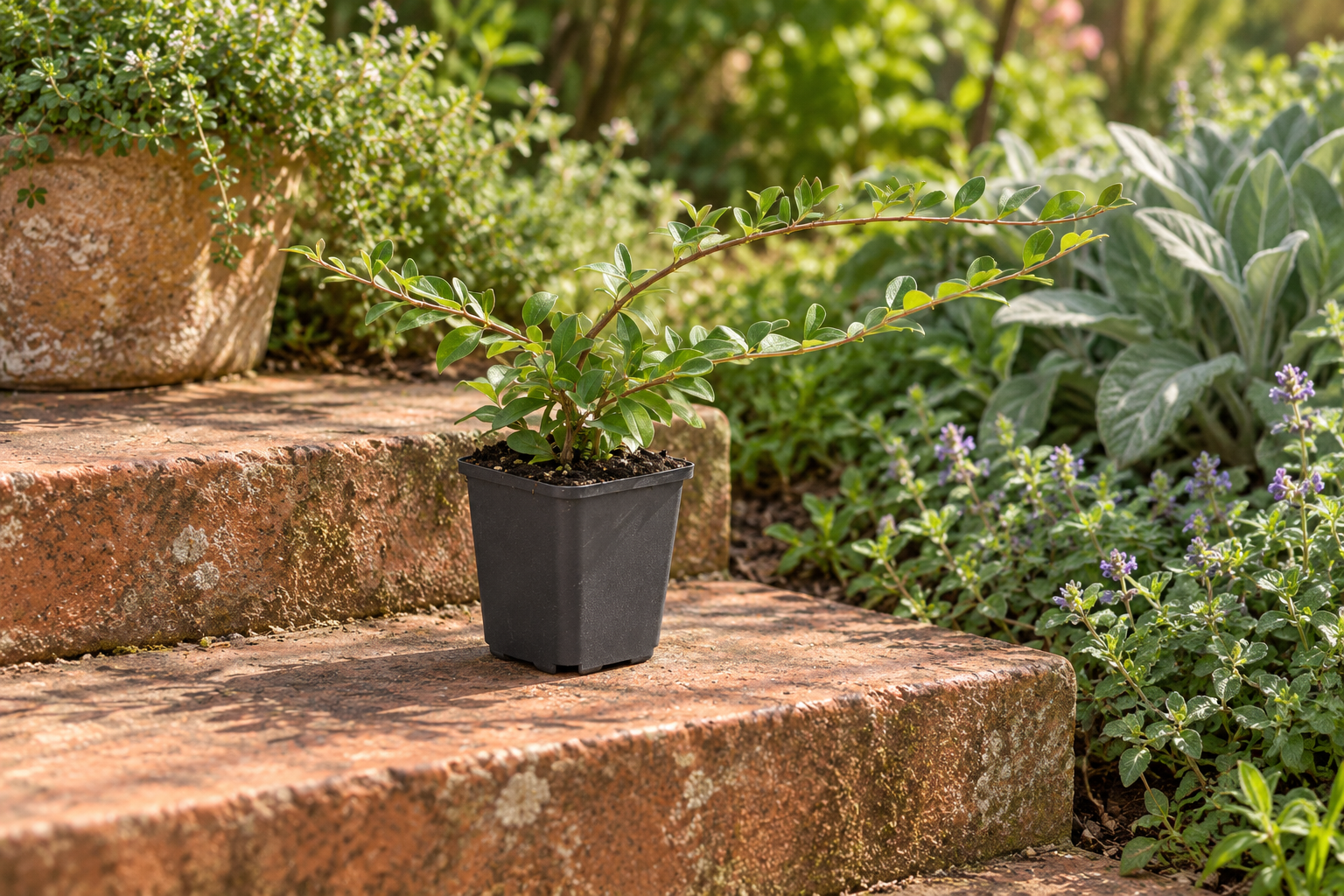
This plant at Exotenherz
Check the shop offer for current availability, price and what is included.
Check the selected shop offer for price, availability and delivery contents.
Your care table
| Topic | What to do | Why it helps |
|---|---|---|
| Light | Choose a sunny to lightly shaded garden position. | Flowers and fruits develop better with sufficient light than in deep shade. |
| Planting | Plant the moist rootball at its previous level and water in. | A young 9 cm rootball first needs contact with surrounding soil. |
| Spacing | For a dense area, use 30–35 cm as the shop guide. | Major stays low but can grow far beyond the original planting point over time. |
| Water | Check moisture directly at the rootball while establishing. | An older planting reaches more soil; the small delivery plant does not yet have this reserve. |
| Soil | Use well-drained soil and avoid compacted wet spots. | Standing water at the roots cannot be compensated for with extra care. |
| Nutrition | Feed moderately in spring if soil is poor. | Observe actual growth rather than preventively applying high fertiliser amounts. |
| Pruning | Selectively shorten troublesome shoots and remove dead branches. | Individual branch pruning preserves the low framework and spares remaining flowering and fruiting shoots. |
| Winter | Leave garden plantings in place; shelter container rootballs and check when soil is frost-free. | Evergreen foliage continues to lose moisture; a small potted plant should neither dry out nor become waterlogged. |
Check the compost and pot weight. The care table explains how far the compost may dry.
Water only when needed. The water should reach the root ball without spilling over the rim.
Remove surplus water from the saucer or cachepot. Then return the plant to a suitable position.
A low plant with flowing lines
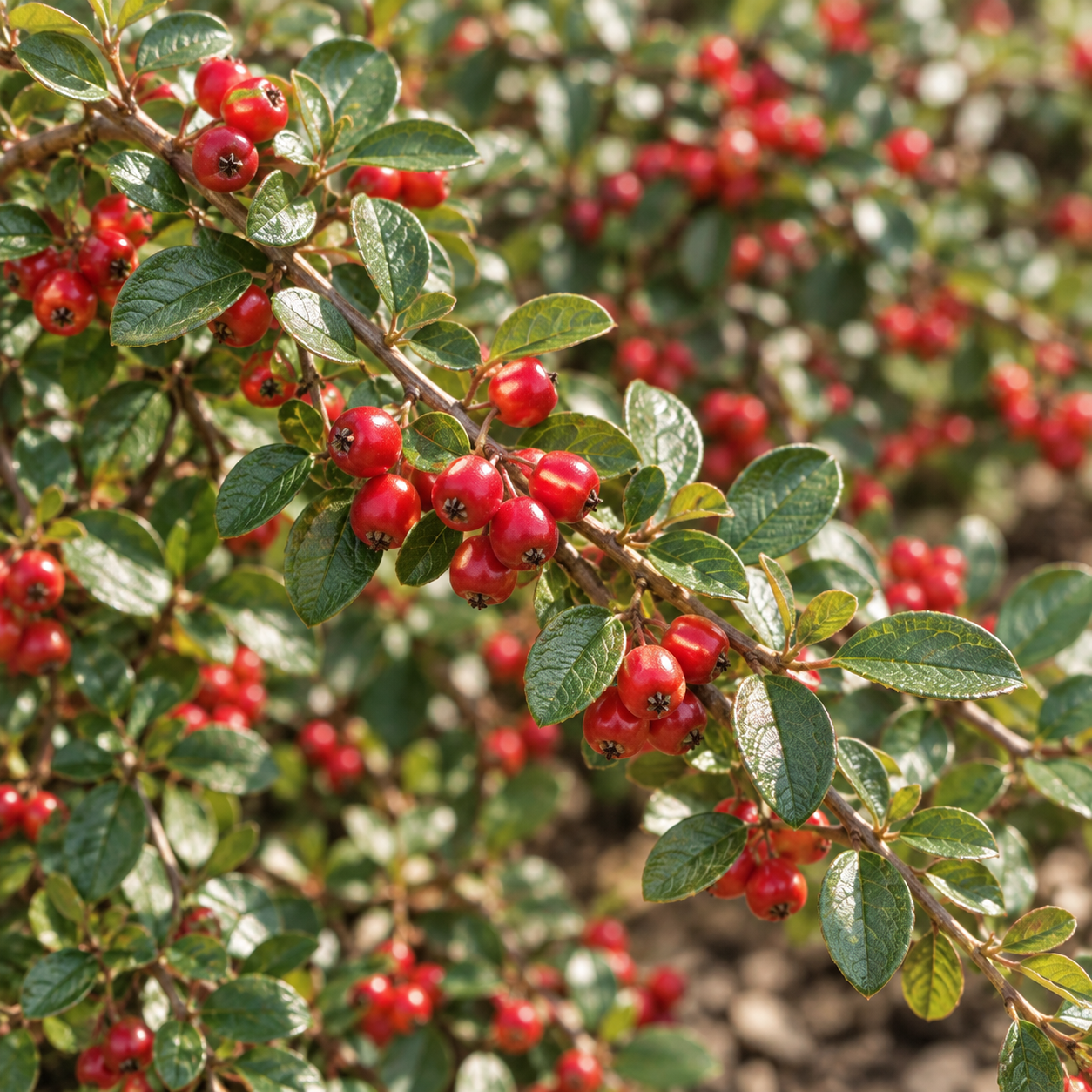
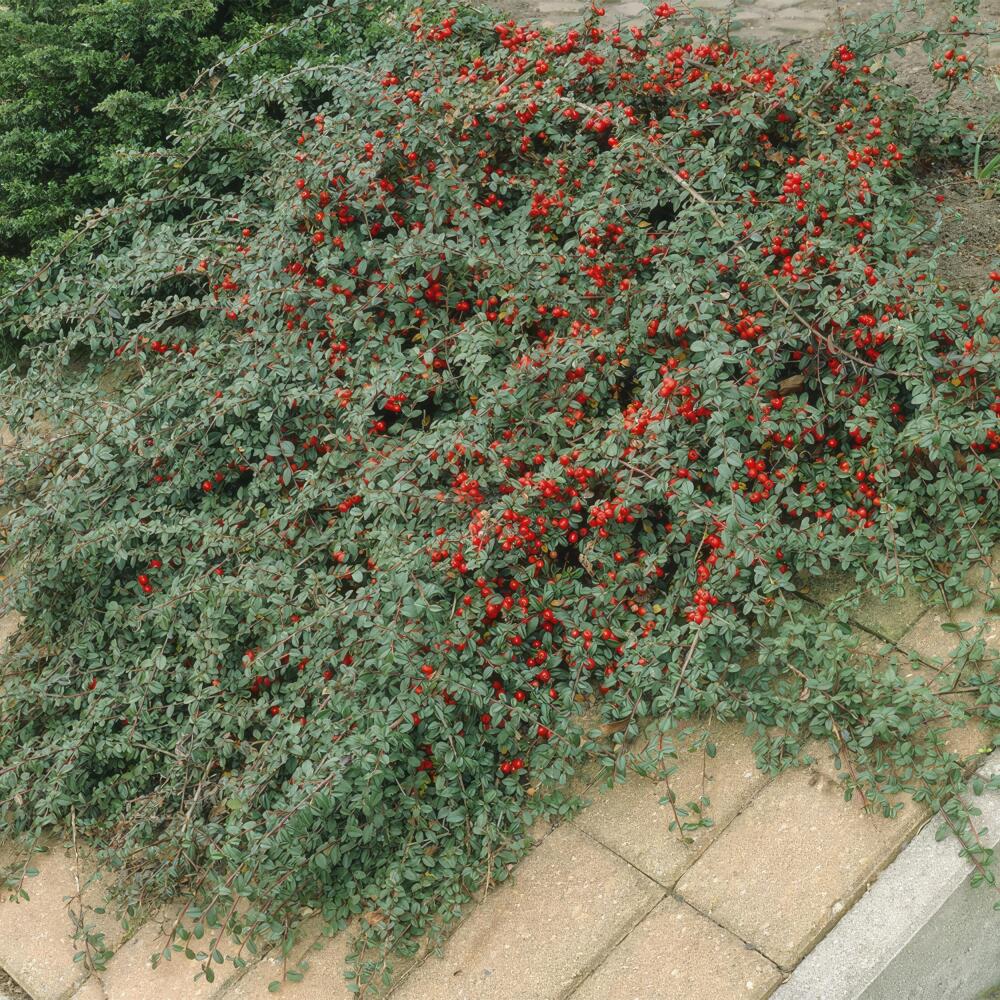
Major cotoneaster draws the garden with long, low branches. Its little glossy leaves are densely arranged along them, giving the area a calm green base. This framework shows well between stones, along a low wall or in front of larger shrubs. Small white flowers may appear in May and June; later, red fruits stand out among the foliage. A newly planted specimen is not yet a finished carpet. The open gaps initially reveal how branches grow and gradually take their place.
Major stays low and still needs room
You receive a young plant in a 9 cm pot at approximately 10 to 25 cm total height including the pot. That is its delivery size. A later planting may reach roughly 20 to 30 cm high and develop considerably farther sideways. The nursery description also lists Major under the name Cotoneaster dammeri 'Radicans'. The shop gives 30 to 35 cm spacing for dense planting. This value describes the start of an area, not an eventual boundary for individual branches. Beside a small perennial or narrow path, allow a little more free space and occasional edge checks.
Light and drainage determine the place
Sun to light partial shade suits this groundcover cotoneaster. The green planting may still grow in deep shade, but a rich flower or fruit display is not a reliable expectation there. Soil is equally important: ordinary garden soil is possible as long as excess water drains away. Check a hollow after heavy rain before planting there. If it stays wet for a long time, a larger planting hole alone does little. At a dry wall edge, conversely, the young rootball needs particularly attentive support initially. The later robustness of an established plant is not something the small pot already brings in full.
Take the small root zone seriously when planting
Spring and early autumn are comfortable planting periods if soil is frost-free and not waterlogged. Slowly moisten a dry rootball first. Carefully slide off the pot without using fine branches as handles. Plant at the previous level, firm gently and water thoroughly. Initially check moisture directly at this point. A dry surface farther away or rain on the garden table says little about the small rootball. Check more often in warm, windy weeks; if soil is still moist, do not add water according to a calendar.
In a container, Major shows another side
Low shoots can drape loosely over a larger container’s edge. Choose a pot with open drainage holes and enough root space rather than leaving the young plant permanently in its small sales pot. Water slowly and check that excess water runs out. Empty a full saucer. Beneath dense foliage, the soil surface is not always easy to see; feel carefully at an open spot to check moisture. In spring, suitable feeding according to soil and growth is enough. Heavy fertiliser does not turn a wet rootball or missing light into a good position.
Stay in shape with a few selective cuts
Major does not have to be cut back entirely every year. Its spreading lines are precisely its appeal. Remove dead or damaged branches and shorten only shoots that extend into a path or small neighbours. Look for flowers and fruits before intervening: severe area pruning can substantially reduce this effect for a while. If you want an even edge, guide individual branches early. The red fruits are ornamental and do not belong on the table as snack fruit. An attractive detail image is therefore not evidence of an edible harvest either.
Distinguish winter in borders from winter in pots
Major is a perennial garden shrub and stays in the border. Evergreen foliage may change under weather influences; not every older leaf remains flawless. A container needs more attention than garden soil because its rootball chills from every side and dries out more easily. Position it sheltered and check moisture on frost-free days. Do not water a frozen rootball. In spring, assess damaged areas and selectively remove dead branches. If growth is weak, inspect the root zone, drainage and light first before simultaneously trying extra water, fertiliser and severe pruning.
One plant, several views
Good to know
How tall does Major grow?
The nursery gives around 20–30 cm as a guide. It grows mainly in width; delivery height with the pot does not yet describe the garden planting.
Are Major and Radicans different plants?
The nursery description read directly lists Cotoneaster dammeri 'Major' as a synonym of 'Radicans'. The shop name Major is retained in the article.
When does it flower?
Small white flowers usually appear in May and June. Timing and strength depend on position and development.
May I eat the red fruits?
No, treat them as ornamental fruits and do not use them for snacking.
Is 30 cm spacing also its final width?
No. The shop’s 30–35 cm figure is a guide for dense area planting. Branches spread beyond it later.
Must I water an older planting daily?
No. Moisture, weather and soil determine this. During establishment and in containers, the small root zone needs particular checks.
Sources and editorial note
- Exotenherz: offer and original images (03.10.2026)
- Lappen nursery: Cotoneaster dammeri Radicans, synonym Major – variety profile (03.10.2026)
- RHS: Cotoneaster dammeri – species profile (03.10.2026)
- RHS: cotoneaster in the garden – planting and care (03.10.2026)
- Exotenherz: verified 6-plant child offer (03.10.2026)
- Exotenherz: verified 12-plant child offer (03.10.2026)
- Exotenherz: verified 20-plant child offer (03.10.2026)
- Exotenherz: verified 40-plant child offer (03.10.2026)
- Exotenherz: verified 60-plant child offer (03.10.2026)
Shop offer, article number, availability and original images checked directly on 03.10.2026. Specialist sources read directly. Shop delivery measurements and planting distance distinguished from later spread. Lappen profile read directly: Major as a synonym of Radicans, around 20–30 cm high, white flowers May/June. Species and genus care read directly from RHS. Planting sequence and container care are horticultural implementation; no edible fruit or fixed final width promised. All five child offers individually read freshly and documented with SKU, GTIN where present and availability; orderable quantities: 6, 12, 60. The scene shows one plant; quantity follows the selected set.