This plant at Exotenherz
Check the shop offer for current availability, price and what is included.
Check the shop for the current price, availability and offer contents.
Your care table
| Topic | What to do | Why it helps |
|---|---|---|
| Light | Place very bright and gradually acclimatise to stronger sun. | Even pale succulent foliage may be damaged after an abrupt change. |
| Water | Supply carefully after distinct drying. | Fleshy leaves store water. |
| Drainage | Remove residual water from the outer pot. | Permanent waterlogging threatens roots and the stem base. |
| Compost | Very free-draining mix with suitable mineral components. | Soil should be able to dry again after watering. |
| Fertiliser | Sparingly during growth following product instructions. | Small succulents need no intensive applications. |
| Pot change | Increase only slightly if needed. | Too much long-wet soil burdens a small root group. |
| Handling | Treat leaves carefully and do not polish their surface away. | The natural surface is part of the plant. |
| Winter | Keep bright and frost-free, continue checking consumption. | A South African flowering calendar is not adopted as an indoor date. |
Check the compost and pot weight. The care table explains how far the compost may dry.
Water only when needed. The water should reach the root ball without spilling over the rim.
Remove surplus water from the saucer or cachepot. Then return the plant to a suitable position.
Pale leaves with a fine red finish
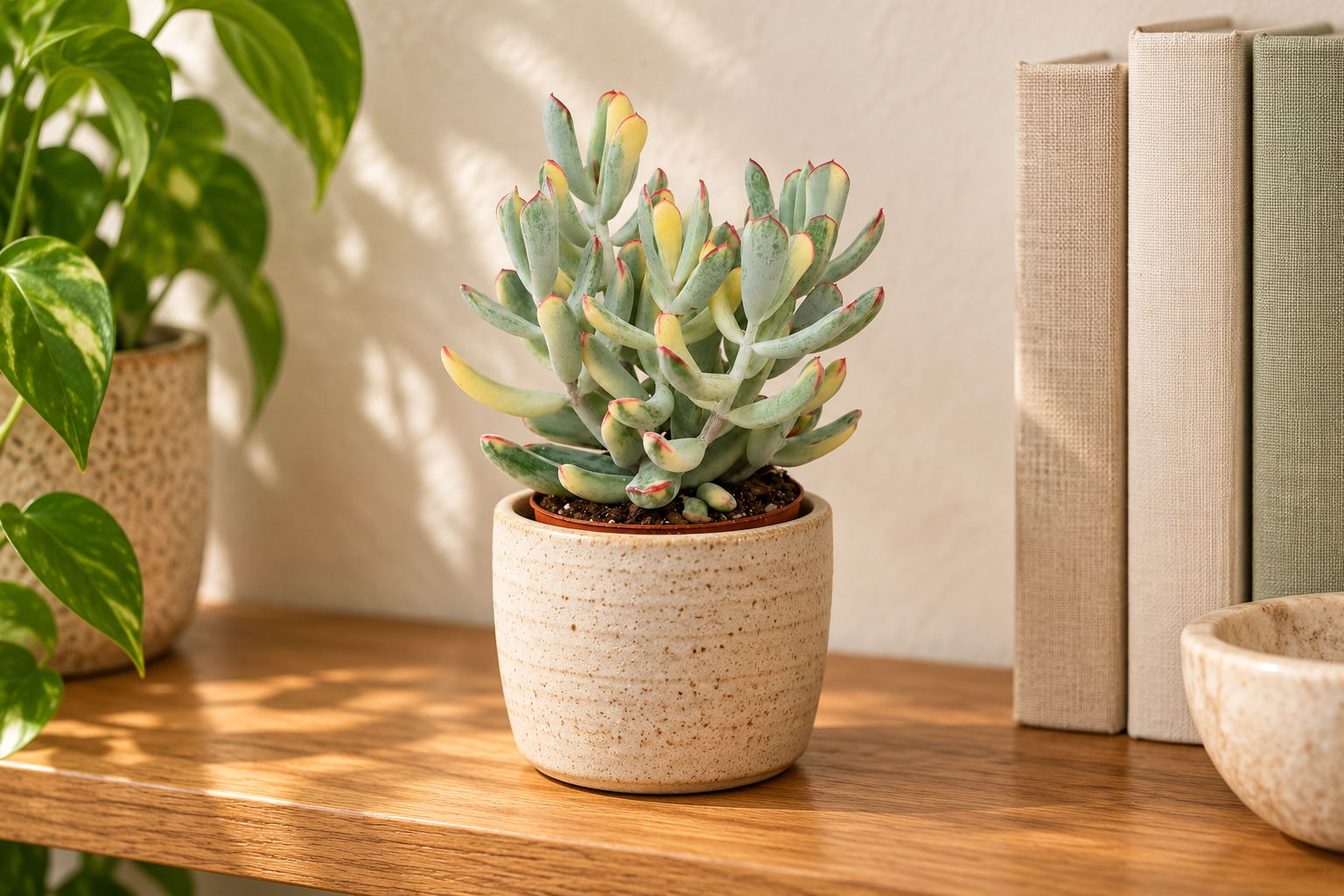
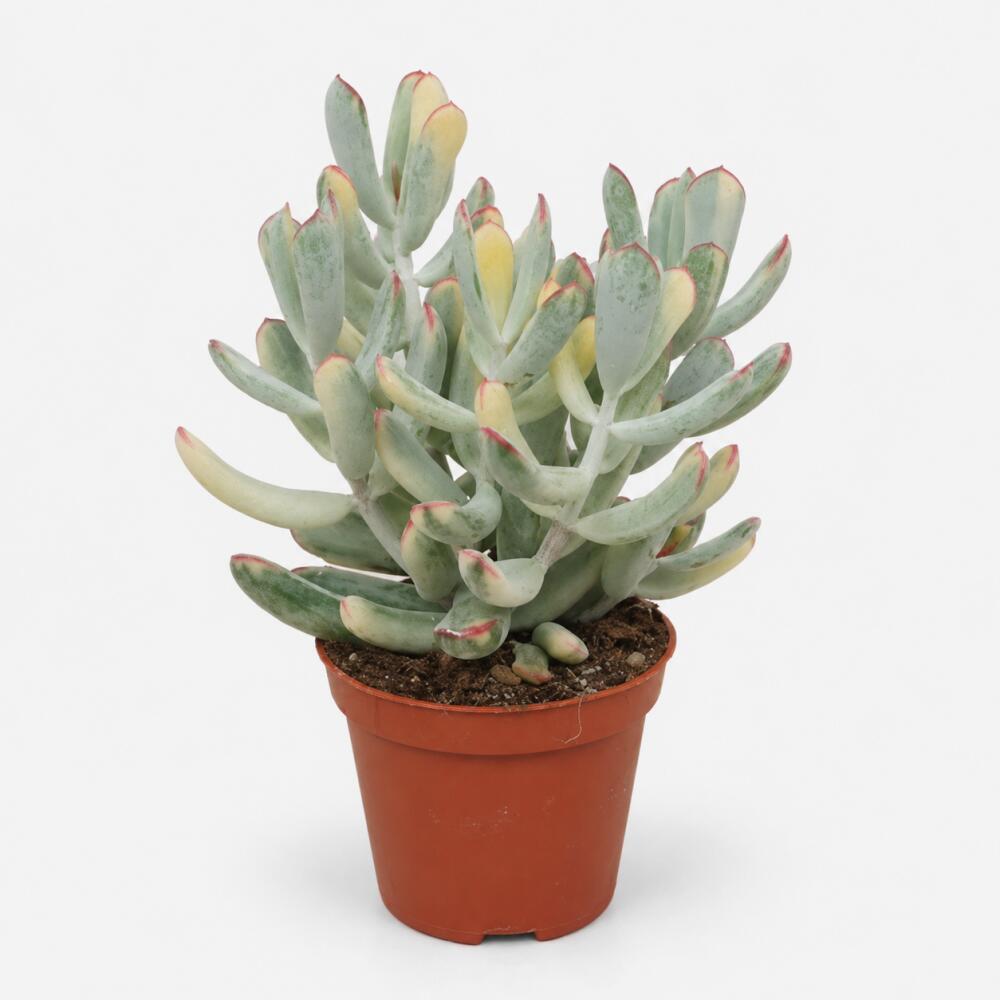
This cotyledon looks special even at a small size. Its fleshy elongated leaves show pale greenish and cream areas; a fine red line may run along their tips and edges. The naturally matt surface gives foliage a soft effect. I choose a quiet small outer pot so the different pale leaf surfaces remain easy to see. The offer states eight-and-a-half centimetres pot size and about twelve centimetres height. The scene follows this young compact plant. It promises no large, already strongly woody succulent and adds no invented flowers merely to make the small format more striking.
A variegated form of a variable species
Cotyledon orbiculata has different leaf shapes depending on its form. The offer calls the variegated plant variegata. We keep that familiar shop name recognisable without deriving an unconfirmed registered individual cultivar. The actual elongated fleshy leaf shape in the original photograph remains decisive for representation. One leaf may show more pale or green area than its neighbour. That is not automatically a fault to fix with extra fertiliser. With development shoots may branch more strongly and gain volume. Stated shop size describes the starting condition, not a permanent eventual height.
Place very bright and build sun exposure gently
The plant needs a very bright position. After transport it is slowly acclimatised to stronger direct sun. A warm morning ray differs from hot south-facing glass in midsummer. I observe leaves and temperature at the position before increasing sun duration. Even a pale plant on an open bookshelf needs enough actual daylight; a deep niche stays dark despite attractive decoration. Brightness remains important in winter. A cooler environment is chosen only frost-free and considered alongside water needs. South African origin is no blanket assurance for a German winter in a border.
Provide water when the root ball needs it
Fleshy leaves store water. Watering is therefore restrained and distinct drying is allowed between applications. I check soil and small-pot weight before supplying again. A heavy still-wet root ball needs no further water merely because the surface looks paler already. When watered, soil receives water and can then drain completely. Nothing remains in the decorative outer pot. A blanket weekly schedule poorly suits different rooms and seasons. Longer grey periods slow consumption; a bright warm position may raise it again despite the same plant being in the same container.
A small root group gets only a little more room
Free-draining succulent compost or a suitable loose mix with mineral ingredients keeps care manageable. What matters is that the root ball absorbs water and can then dry again. Existing rooting is inspected first when repotting. A slightly larger nursery pot with drainage is enough if needed. I do not put the young plant into a large amount of soil that stays wet. Feeding can be sparing during visible growth depending on product and existing fertiliser. More food does not make a dark position brighter or reliably produce a stronger red leaf edge.
The matt leaf surface may stay natural
Pale leaves are handled carefully. Their natural surface is not coated with leaf shine or vigorously polished away. For moving I hold the container rather than grabbing an apparently firm cluster of leaves. Individual dry remains are gently removed. Shaping with a clean tool is possible later if needed; major intervention simply for symmetry is unnecessary. Flowers are possible on well-developed plants, but a South African seasonal calendar is not transferred unchanged to a German houseplant. This portrait therefore promises neither a fixed flowering month nor already-flowering delivery.
Position it deliberately as an ornamental plant
Cotyledon is placed out of reach of children and pets that might put plant parts in their mouths. It is no edible or feed plant. If stems soften or several leaves show unusual damage, I first check root-ball moisture and drainage. Dry wrinkled leaves and damaged wet roots need different responses. An identifiable cause is corrected specifically rather than precautionarily providing more water. The unchanged original image stays in the gallery. The living scene adds a bright shelf idea with unlabelled books; the outer pot and furnishings do not thereby belong to the offered delivery contents.
One plant, several views
Good to know
What does variegata mean in the shop name ?
The offered form has differently pale and green leaf areas; no unconfirmed registered individual cultivar is inferred.
Are red edges normal ?
Fine red tones at edges and tips may belong to its natural leaf appearance.
Must it remain permanently moist ?
No. The root ball may dry distinctly between controlled applications.
Can it go straight into full midday sun ?
After transport acclimatise slowly to stronger sun.
Does it need a large pot straight away ?
No. Increase only slightly if needed and use free-draining compost.
May a pet eat it ?
It is no feed plant and stays protected from nibbling.
Is a particular indoor flowering time guaranteed ?
No. Origin and the South African calendar are no fixed flowering promise for German indoor cultivation.
Sources and editorial note
- Exotenherz: offer and original images (01.10.2026)
- SANBI PlantZAfrica: Cotyledon orbiculata (01.10.2026)
Shop offer, SKU, GTIN and availability checked live on 01.10.2026. Original photograph unchanged. Our own researched gardening texts and individually accepted scene. Variegated form without an unconfirmed registered cultivar assignment. South African flowering season not transferred as German indoor flowering.