
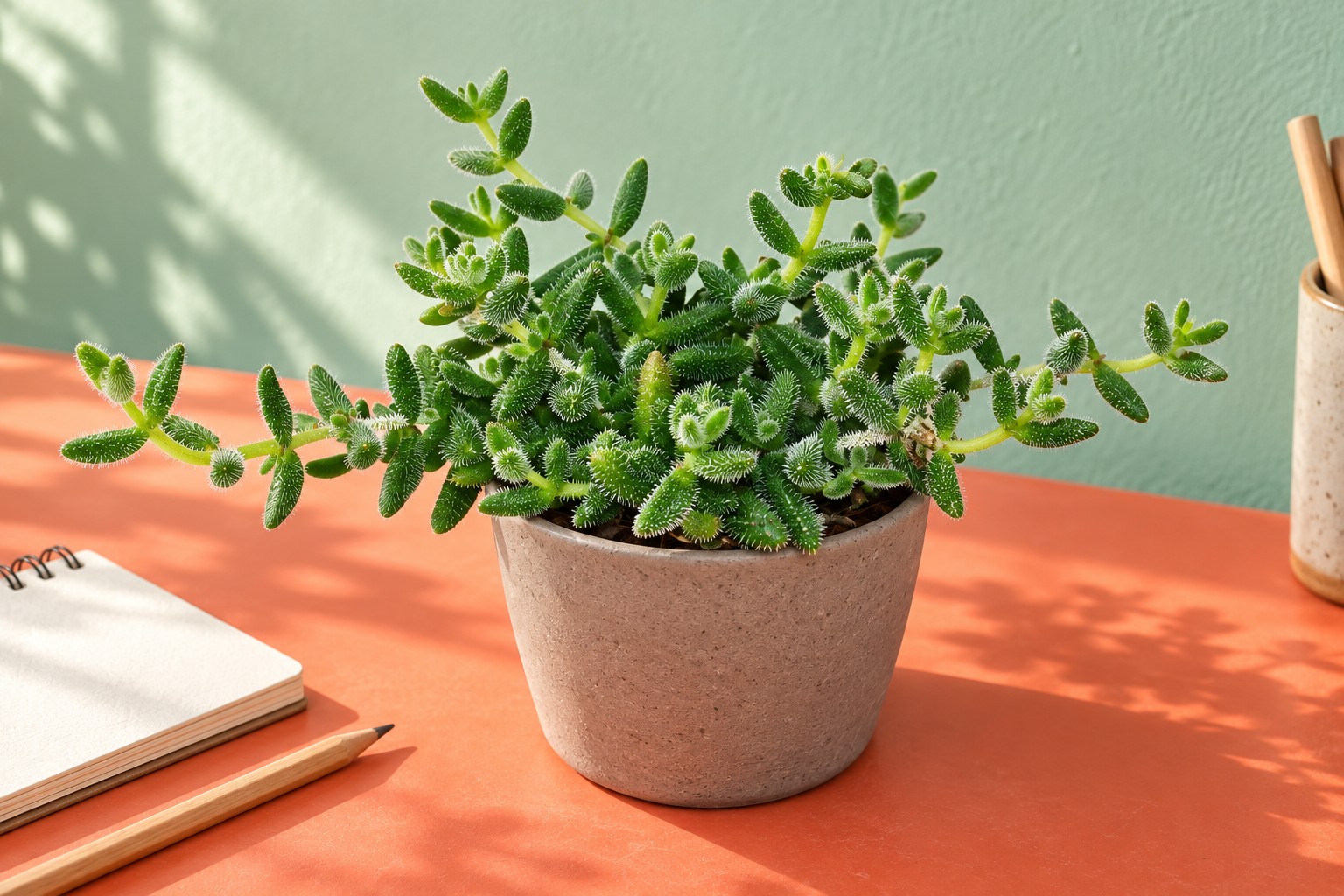
This plant at Exotenherz
Check the shop offer for current availability, price and what is included.
Link to the offer in German. Check the shop for the current price, availability and delivery contents.
Your care table
| Topic | What to do | Why it helps |
|---|---|---|
| Position | Bright to sunny, including direct sun after acclimatisation. | Too little light readily produces long, loose new growth. |
| Water | Water again only after good drying. | Small storage leaves buffer dry periods between applications. |
| Compost | Well-drained cactus compost and clear drainage holes. | Persistently moist compost encourages root rot. |
| Nutrients | Feed weakly about monthly during growth. | The small plant needs no strong continuous feeding. |
| Winter | Keep bright, frost-free and much drier. | This species is not a hardy garden groundcover. |
| Pruning | Shorten only when needed; use healthy shoots as cuttings. | Spring and summer suit new rooting. |
| Repotting | Move carefully when well rooted or compost is compacted. | Provide only a little more root space. |
| Checking | Compare soft areas with moisture and temperature. | Distinguish natural hairs from unusual deposits. |
Check the compost and pot weight. The care table explains how far the compost may dry.
Water only when needed. The water should reach the root ball without spilling over the rim.
Remove surplus water from the saucer or cachepot. Then return the plant to a suitable position.
The name describes the leaves
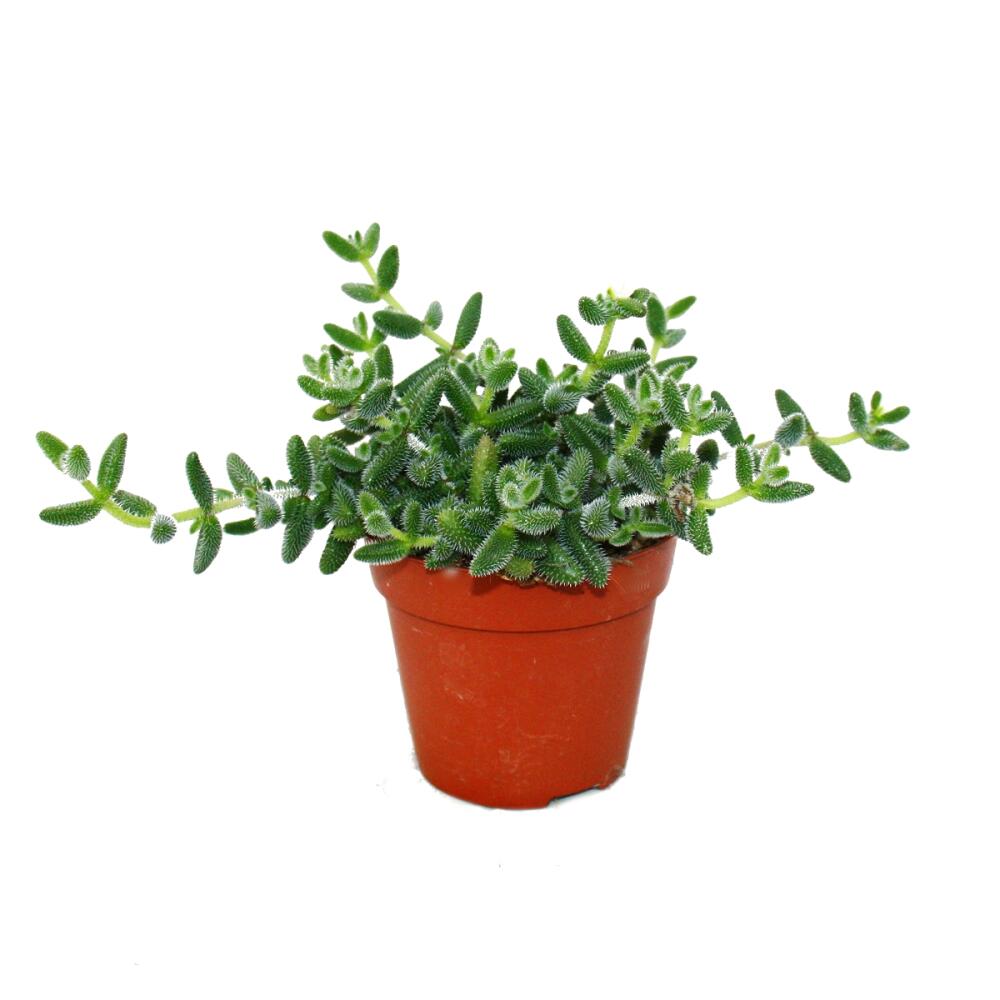
Delosperma echinatum does not grow edible cucumbers. Its German name refers to the small elongated storage leaves with fine white hairs. They sit in pairs on branched shoots which can grow upright at first and later trail. The species belongs to the ice-plant family and comes from South Africa’s Cape region. Side lighting particularly reveals its unusual surface without needing abundant flowers.
A small format for close observation
A pot of about 12 cm and approximately 15 cm overall height are verified. On a bright shelf the low plant therefore looks different from a tall leafy bush: you tend to look slightly down into its branching. Individual shoots may extend sideways over the edge. The scene shows this size class with small leaves. Yellow flowers are possible in summer; here they are presented neither as a permanent feature nor as a guaranteed delivery condition.
Light protects against loose growth
A bright to sunny position is the basis for compact shoots. After delivery, acclimatise gradually to intense sun instead of putting it immediately behind hot south-facing glass. If new growth becomes unusually long and leaf pairs widely spaced, a position correction is worth considering first. Even a decorative shelf may be too dark far from daylight. A readily accessible, sufficiently bright shelf suits close observation.
Water thoroughly after a dry period
The storage leaves explain why compost can dry well before the next application. Also check deeper in the pot: a dry surface over a wet centre is not a signal to add water. Then water slowly until the root ball is supplied and let the remainder drain. Persistently moist compost increases root-rot risk. Demand falls sharply in the low-light season. Wrinkled leaves together with wet compost call for checking the cause rather than adding more water.
Maintain structure in the pot
Well-drained cactus compost with mineral components provides a suitable base. Clear drainage holes remain essential even in an attractive decorative pot. Repotting becomes useful when the plant is well rooted or the mixture has lost its loose structure. Restrained feeding is sufficient during growth; the RHS recommends a weak monthly application. Longer healthy shoots can serve as cuttings in spring or summer. The plant does not need regular heavy shaping cuts.
Stay frost-free and distinguish changes
Not all Delosperma species have the same hardiness. This pickle plant is grown frost-free and does not belong unprotected in a winter rock garden. Soft, translucent or dark areas should be assessed differently from older firm stem sections. If its condition is unusual, check drainage, root ball and temperature first. Fine white hairs are a natural feature, whereas cotton-like gatherings in leaf axils should be examined more closely. Despite its playful name, it remains purely ornamental.
One plant, several views

Good to know
Can I eat the small pickles?
No. The name refers to leaf shape; it is an ornamental plant.
Are the white hairs an infestation?
Fine, even hairs belong to the plant. Irregular cotton-like gatherings should be examined instead.
Can it overwinter in the garden?
No, frost-free cultivation is intended for Delosperma echinatum. Other species in the genus can have different needs.
Why are shoots becoming long and thin?
First check the light supply. A brighter position helps new growth more than additional fertiliser.
Sources and editorial note
Sources checked: 15 September 2026. Product information and delivery contents follow the linked shop offer. Care has been checked against the stated specialist sources and remains subject to plant condition, position and season.