

This plant at Exotenherz
Check the shop offer for current availability, price and what is included.
The linked shop is in German. Product details, availability and delivery information are provided in that shop.
Your care table
| Topic | What to do | Why it helps |
|---|---|---|
| Light | Very bright and sunny after acclimatisation. | Edge colour and compact form benefit from light. |
| Water | Let compost dry well between waterings. | Fleshy leaves store moisture for dry pauses. |
| Pot | Choose free drainage and a suitable small root space. | An oversized wet container dries unfavourably slowly. |
| Compost | Loose, loosened with mineral ingredients and freely draining. | Roots need air again after watering. |
| Feed | Use weak doses during active growth. | More nutrients do not replace suitable brightness. |
| Surface | Handle leaves as little as possible and do not polish. | The natural coating and intact edges stay more attractive. |
| Winter | Bright, frost-free and almost dry during rest. | Cool cultivation is not the same as frost tolerance. |
| Checks | Check for mealybugs and soft areas on leaves or the base. | Distinguish damage early from normal ageing of individual leaves. |
Check the compost and pot weight. The care table explains how far the compost may dry.
Water only when needed. The water should reach the root ball without spilling over the rim.
Remove surplus water from the saucer or cachepot. Then return the plant to a suitable position.
The red edge reveals leaf arrangement
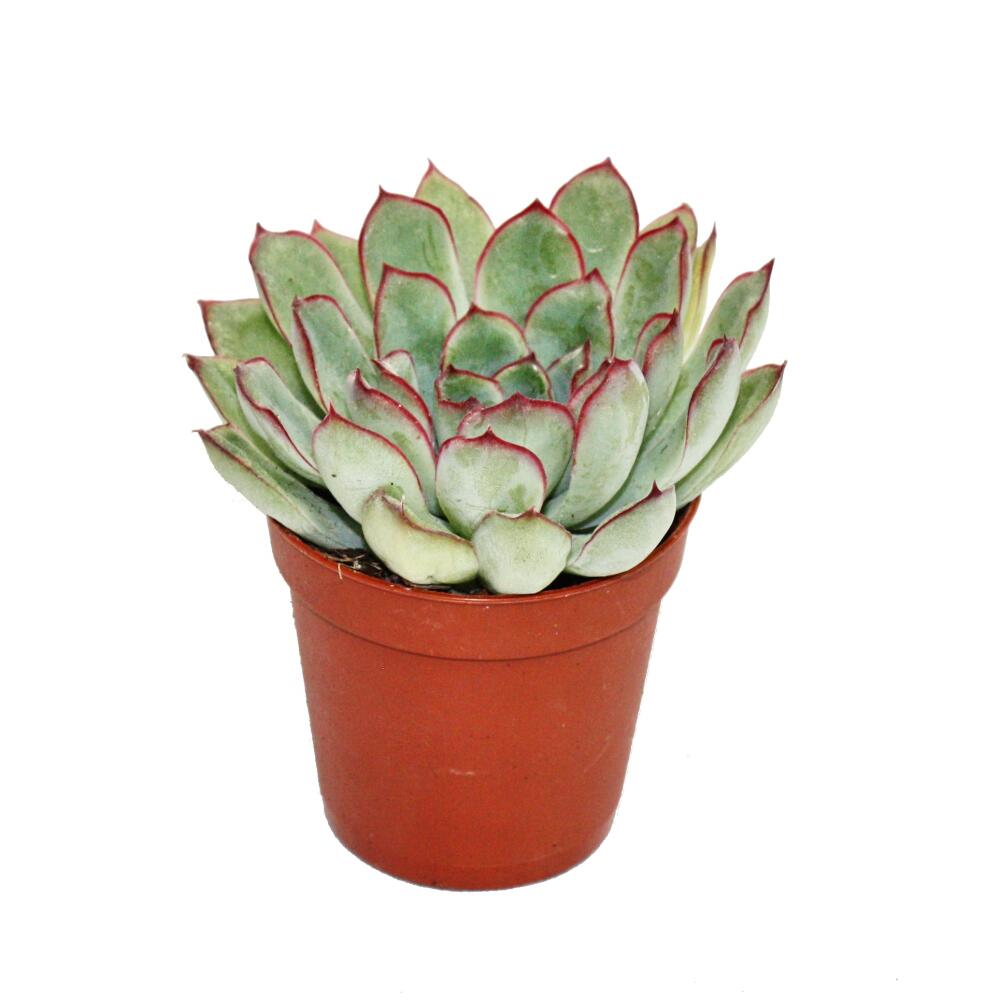
Echeveria pulidonis belongs to the stonecrop family. Its grey-green fleshy leaves have a narrow dark-red edge and end in a small point. Together, they form a compact rosette. In strong light, the edge colour can appear more intense. Yellow flowers on longer curved stems are possible later. Its natural origins lie in Mexico; the shop’s statement of Africa is incorrect for this species. The calm structure suits a small succulent collection in which different leaf forms remain individually recognisable.
A small plant with clear size information
The offer is an approximately two-year-old plant in a 5.5 cm pot, with around 6 to 8 cm overall height. The original photograph shows the rosette and nursery pot together. This small size matters for expectations: a close-up leaf pattern does not turn the plant into a large mature specimen. A small spoon provides a size reference in the scene. Larger rosettes and side offsets may develop over time. A newly purchased small pot initially needs a suitable bright position and an easily monitored water supply.
Build up sunshine gradually
Choose a very bright position and gradually accustom the plant to direct sun. Coloured edges benefit from enough light, but an abrupt move can burn succulent leaves too. In a position that is too dark, growth often becomes more open and stretched. Place the plant close to a suitable natural light source, without pressing it against cold glass. Sheltered outdoor cultivation is possible in summer. Prolonged rain and cold nights do not suit a small pot with a slowly drying root ball.
The pot must dry between waterings
Water only after checking the compost and let it dry well between applications. Then thoroughly water the root area and allow excess to drain. A constantly filled outer pot is unsuitable. Loose succulent compost with mineral ingredients supports this cycle. Do not scatter a few drops over the rosette every day: this keeps the surface moist while inner roots may receive hardly any water. Water much less in winter according to reduced growth. The actual interval depends on temperature, light, pot and compost.
Few interventions preserve the natural appearance
Touch the leaves as rarely as possible and do not use leaf-shine products. A fine natural surface coating may remain. Remove dry lower leaves only if they detach easily; do not break healthy leaves off for symmetry. During active growth, supply a suitable weak-dose fertiliser moderately. Inspect leaf bases for mealybugs and the base for soft areas. A mushy translucent leaf calls for a check of wetness or cold damage. A single old outer leaf slowly drying out can instead be normal leaf turnover.
Support rosette growth and winter rest
In winter, keep bright and reliably frost-free, almost dry during a cool rest, and stop feeding. A cool phase does not mean outdoor hardiness. With new spring growth, cautiously return to stronger supplies. Vigorous daughter rosettes can later be used for propagation, and leaf cuttings are also possible. Choose healthy material and first allow wounded areas to dry. The small starting plant need not be divided immediately. Patience preserves a strong mother rosette whose form, colour and possible flowers can be observed over time.
One plant, several views
Good to know
Does Echeveria pulidonis come from Africa?
No. The specialist source states Mexico. The different shop origin statement is corrected here.
Are red leaf edges damage?
The narrow dark-red edge is typical of the species. Additional soft or burnt areas need separate assessment.
Can I overwinter it outside with hardy houseleeks?
Frost-free overwintering is intended for this plant. Similar rosettes do not mean equal hardiness.
Must it be watered every week?
No. Check the compost first. Little light and cool cultivation may require much longer dry pauses.
Sources and editorial note
- Product and delivery contents: Exotenherz
- Royal Horticultural Society: plant and care information
- NC State Extension: plant profile
Sources checked: 15 September 2026. Product information and the contents of delivery follow the linked shop offer. Care advice was checked against the cited specialist sources and should still be adapted to the plant’s condition, position and season.