
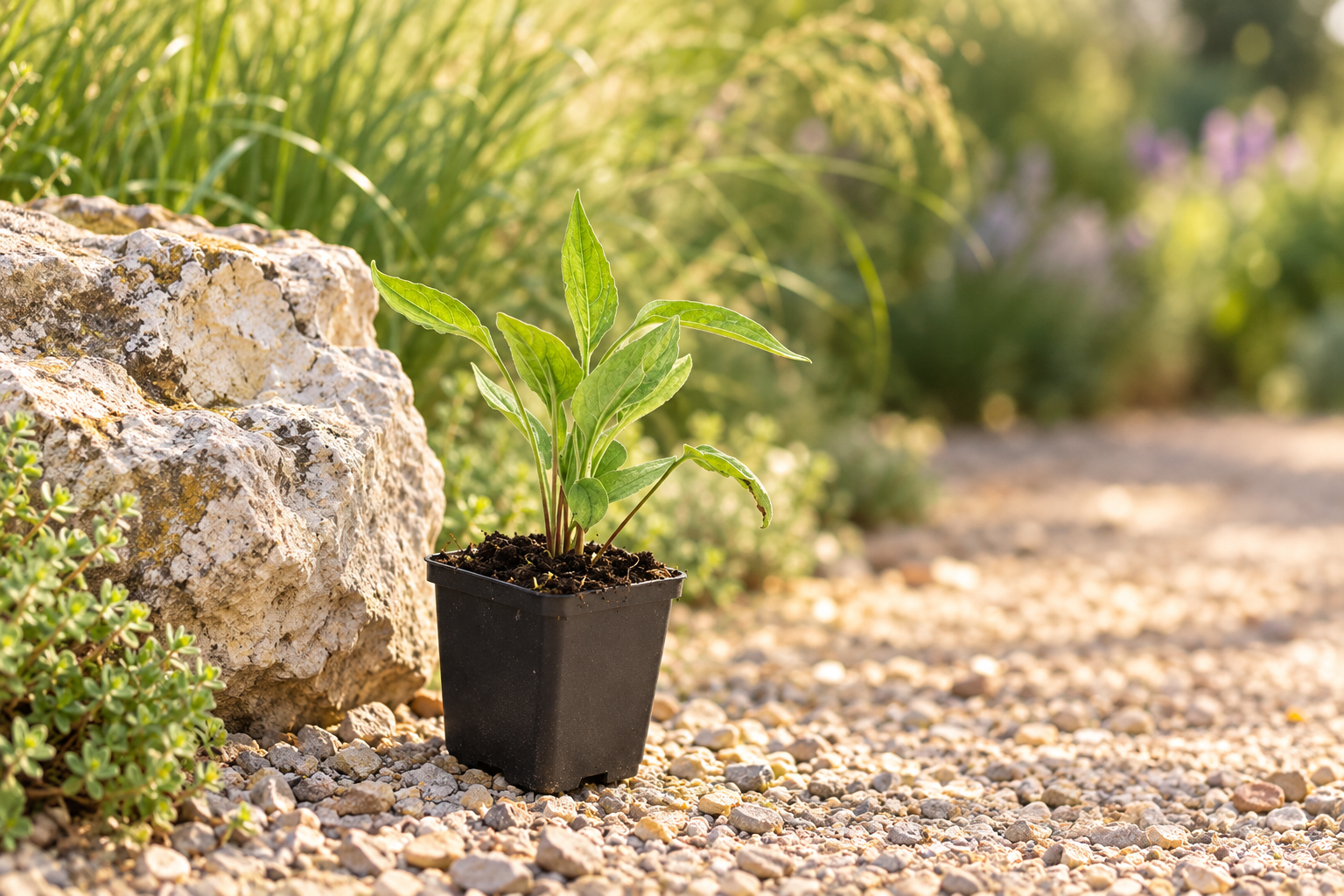
This plant at Exotenherz
Check the shop offer for current availability, price and what is included.
Product and delivery details are given in the individual offer.
Your care table
| Topic | What to do | Why it helps |
|---|---|---|
| Light | Choose sun; avoid an overly dark garden edge. | White Swan tolerates light partial shade; good light supports flowers. |
| Soil | Use humus-rich moisture-retentive soil with good drainage. | Roots need summer moisture and protection from excess winter wet. |
| Planting | Plant the moistened ball at its previous depth in spring to early summer. | A longer start before winter helps establishment. |
| Watering | Supply the young root zone slowly and thoroughly in dry conditions. | An established perennial has different reserves from a newly planted 9-cm root ball. |
| Container | Provide more root room and open drainage holes as it develops. | The small sales pot is no permanent foundation for a large flowering clump. |
| Flower care | Cut spent stems as desired; optionally preserve healthy later heads. | Pruning can encourage more flowers; seed heads bring a different seasonal effect. |
| Feed | Add nutrients only according to soil or container supply. | Heavy feeding does not fix shade or wet-root problems. |
| Inspection | Check young shoots for slug damage and the base for wet soft areas. | Early observation distinguishes feeding damage, seasonal retreat and root harm. |
For young plants, feel the soil directly at the root ball. The surface and deeper soil may have different moisture levels.
Water thoroughly after planting; later, water according to the soil, weather and establishment rather than a fixed calendar.
Avoid standing water. For plants in containers, also check that water runs out of the drainage hole.
White with a warm focal point
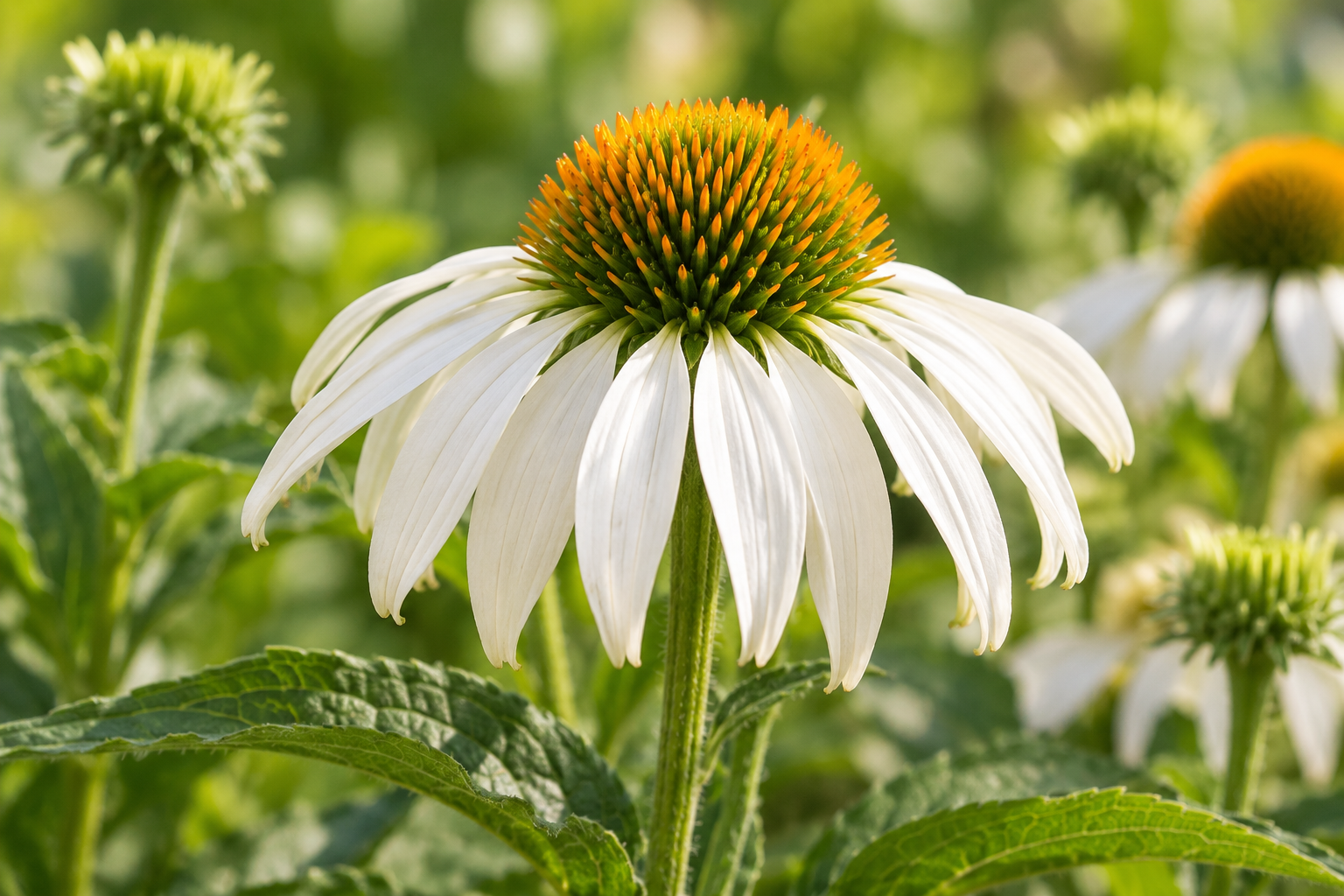
White Swan shows how much colour a white flower can contain. Pale rays spread around the raised centre; its cone looks orange to greenish-brown, changing impression with light and development. Rays lean slightly downwards, keeping the centre particularly visible from the side. Among dark green foliage this structure looks calm and clear. Despite its white ring of petals, the cultivar belongs to Echinacea purpurea. The species name does not fix this named cultivar’s colour to purple. White Swan forms large daisy-like heads and offers a different garden accent from yellow Rudbeckia coneflowers.
A young foliage plant needs time for this display
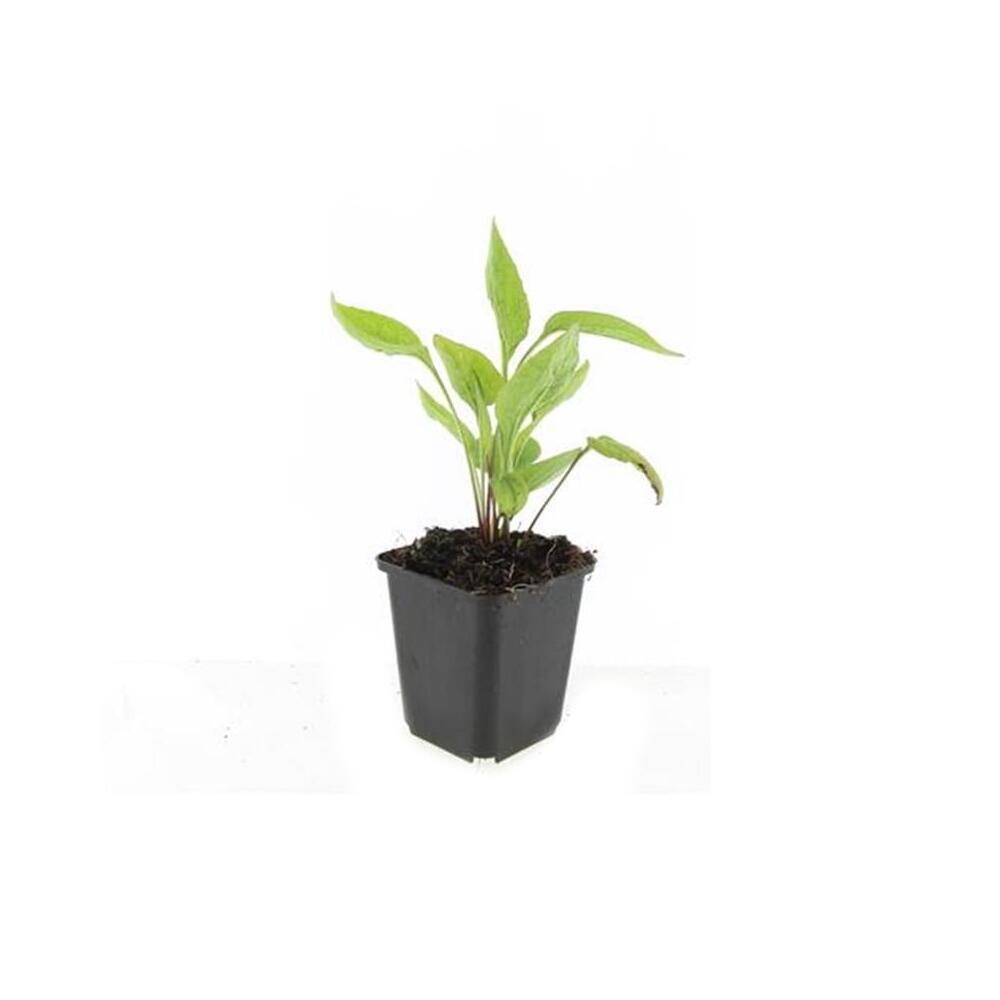
The original shop photograph shows a young flowerless White Swan. Its green foliage begins a perennial clump. Selectable sets contain plants in individual 9-cm pots with roughly 10 to 25 cm total height including container. Later, the RHS cultivar profile describes around 70 cm and the shop up to roughly 80 cm. Treat both as guidance for developed flowering growth, not conflicting delivery measurements or fixed upper limits. White Swan flowers from midsummer into autumn. Duration depends on weather and plant development; a small new pot need not immediately provide flowers every month.
Pale flowers belong in a well-lit position
Sun gives coneflower a suitable starting point. Light partial shade is possible, but heavy shade tends towards weak flowering. Plan the pale accent where lower leaves retain enough light too. White heads stand out beside a dark hedge provided the clump avoids its dense root competition. Allow roughly 40 to 50 cm in the bed as shop guidance and account for existing neighbours. The set determines young plant number, not an instantly completed area. Accessible gaps help watering and observation until individual clumps gradually widen.
Think of spring planting and winter drainage together
Humus-rich soil that stores and releases water suits White Swan. Look at the planned spot after rain: a persistently wet hollow is no good foundation, especially in cold seasons. Echinacea is preferably planted in spring to early summer when ground is frost-free and not waterlogged. Autumn planting in heavy wet soil can raise rot risk. Moisten the ball first, unpot gently and preserve existing planting depth. Bring loose soil close and water slowly. A dry container root ball should not stay unnoticed and dry within wet surroundings; check the actual root-ball position.
Water demand cannot be read from flower colour
White rays mean neither special drought sensitivity nor low water demand. Roots, soil, warmth and development matter. Supply newly planted specimens as needed until established in garden soil. An older clump can buffer temporary drought better; longer dry periods still prompt checking. Water slowly at the base to supply roots. Check containers more often and provide sufficient room as development continues. A small sales pot offers little buffer for a large summer clump. Moderate nutrients matched to actual supply complement care. With wilted foliage, inspect moisture first instead of automatically increasing water and fertiliser together.
Summer flowers and winter heads are two garden pictures
Spent stems may be cut during the season; this can encourage further flowers. Later you can retain healthy firm heads. After white rays fall, their sculptural centres remain visible beside dry grasses. A well-kept plant need not disappear completely in autumn. Remove diseased or soft rotting parts selectively, however, and examine the cause. Check young spring leaves for slug feeding. Missing leaf pieces and an overall wet wilting clump need different responses. Observation thus leads to understandable care decisions rather than treating every change with the same action.
Let the perennial clump continue quietly
White Swan dies back above ground for winter rest. Next growth comes from the retained rootstock; winter’s absent leaves alone do not prove a dead coneflower. In a container, keep the ball sheltered outdoors and drainage open even during cold weeks. Protection from excess winter wet matters as much as frost. Gently tidy dead material in spring and preserve fresh tips. A well-positioned echinacea does not need frequent division or moving. Choose a suitable place early where the clump can grow for several years. Small green set plants then gradually become the pale flowering stand giving the summer garden its quiet colour.
One plant, several views
Good to know
Why is the white cultivar called Echinacea purpurea?
Purpurea is the species name. White Swan is a named cultivar with white flower rays.
How tall does White Swan grow?
The RHS profile gives around 70 cm, the shop up to around 80 cm. These guide developed flowering growth, not guaranteed fixed maxima.
When do flowers appear?
Midsummer to autumn in appropriately developed plants. Young deliveries need not flower yet.
Is autumn planting especially favourable?
Echinacea is preferably planted in spring to early summer. Late autumn planting can be riskier in heavy wet soils.
Why are heads sometimes left?
Healthy firm seed heads give the winter bed structure. During summer flowering, pruning can instead encourage further flowers.
Can White Swan stay in the small delivery container?
Only temporarily. Allow sufficient root space and free drainage for later container development.
Sources and editorial note
- Exotenherz: offer and original photographs (03.10.2026)
- RHS: White Swan – exact cultivar profile read directly (03.10.2026)
- NC State Extension: Echinacea purpurea with Magnus and White Swan – read directly (03.10.2026)
- RHS: Echinacea – position, spring planting and winter wet (03.10.2026)
- Exotenherz: checked 6-plant child offer (03.10.2026)
- Exotenherz: checked 12-plant child offer (03.10.2026)
- Exotenherz: checked 20-plant child offer (03.10.2026)
- Exotenherz: checked 40-plant child offer (03.10.2026)
- Exotenherz: checked 60-plant child offer (03.10.2026)
Shop offer, article number, availability and original images checked directly on 03.10.2026. Specialist sources read directly. Stored RHS and NC State sources read directly on 03.10.2026. RHS White Swan gives 70 cm, white flowers with orange/ginger-green centre and midsummer–autumn; shop guidance up to 80 cm kept separate. NC describes slightly drooping White Swan rays. No blanket autumn planting: RHS spring/summer, winter wet danger. Original gallery-2 visually checked flowerless and without advertising. Sets 6/12/60 available; main chat adds direct child links. All five child offers checked separately; available quantities: 6, 12, 60. Clean original view reused unchanged; young scene and leaf or flower detail appropriately captioned.