
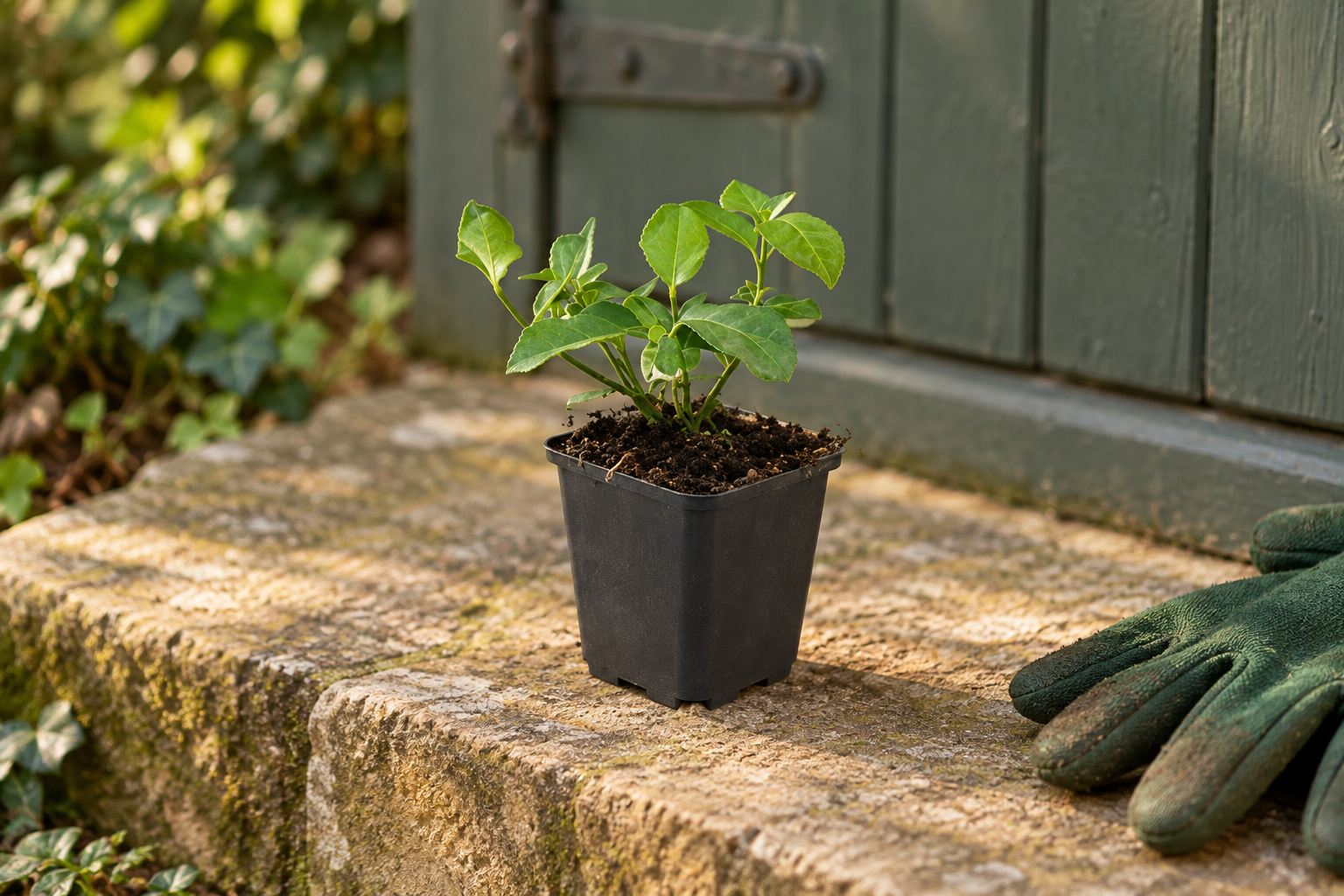
This plant at Exotenherz
Check the shop offer for current availability, price and what is included.
Product and delivery details are given in the individual offer.
Your care table
| Topic | What to do | Why it helps |
|---|---|---|
| Light | Choose a sunny to partially shaded garden edge. | Light and accessible root room together determine suitability. |
| Root ball | Moisten young pots before planting. | Dry pot substrate may otherwise absorb water unevenly. |
| Water | Supply thoroughly as needed after planting and in dry periods. | Lateral spread begins after a well-supported root start. |
| Soil | Prepare compacted areas and avoid standing water. | A dense leaf edge should not sit above permanently wet roots. |
| Nutrients | Supplement only according to existing soil supply. | Not every garden soil needs regular extra fertiliser. |
| Edge | Selectively shorten overly long shoots. | Later width exceeds the young delivery picture. |
| Container | Provide more root room and free drainage holes. | Small pots have limited water and nutrient reserves. |
| Inspection | Inspect undersides and branches for deposits or damage. | Unusual spots and scales are not explained by leaf colour alone. |
For young plants, feel the soil directly at the root ball. The surface and deeper soil may have different moisture levels.
Water thoroughly after planting; later, water according to the soil, weather and establishment rather than a fixed calendar.
Avoid standing water. For plants in containers, also check that water runs out of the drainage hole.
A blanket of leaves does not form on the first day
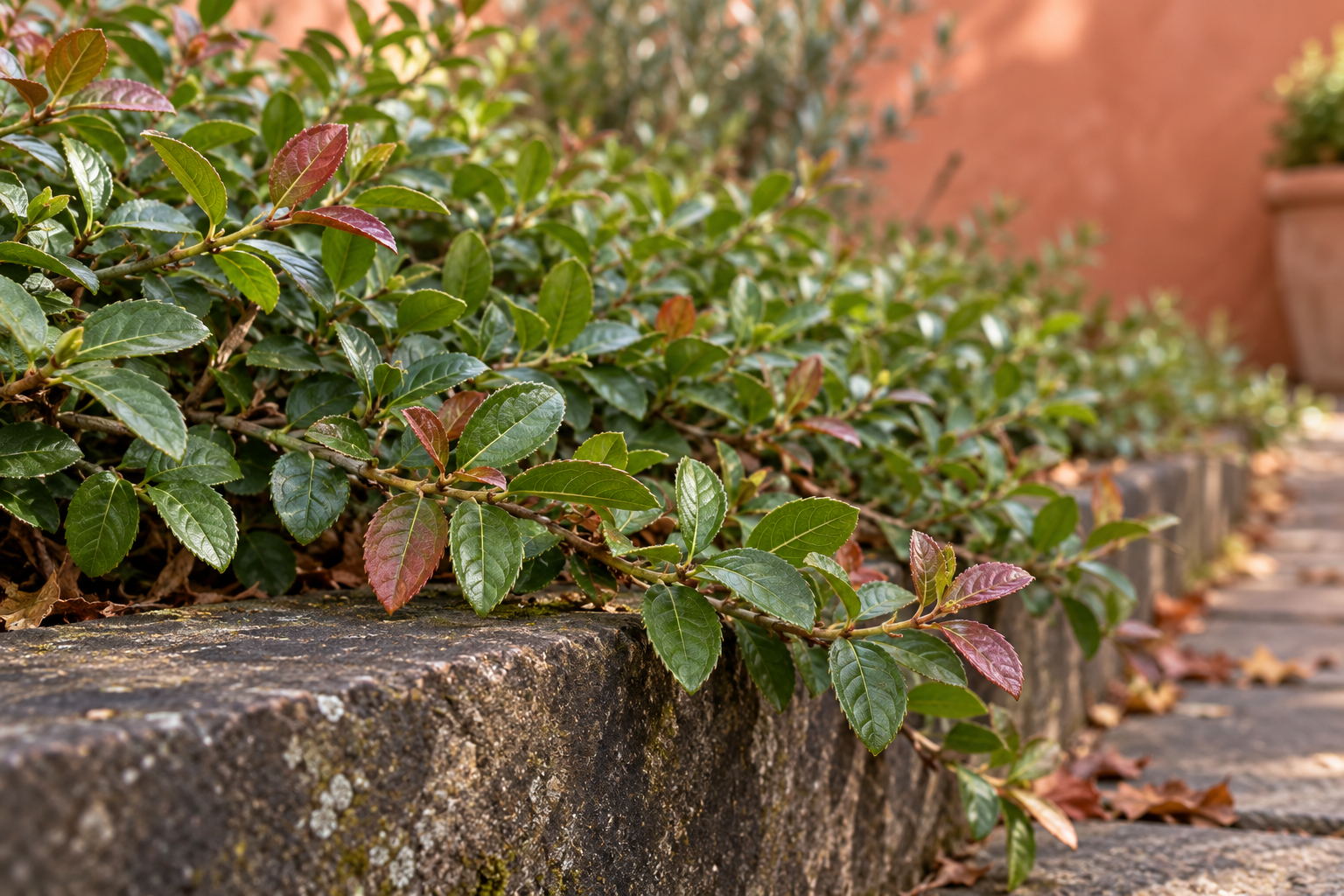
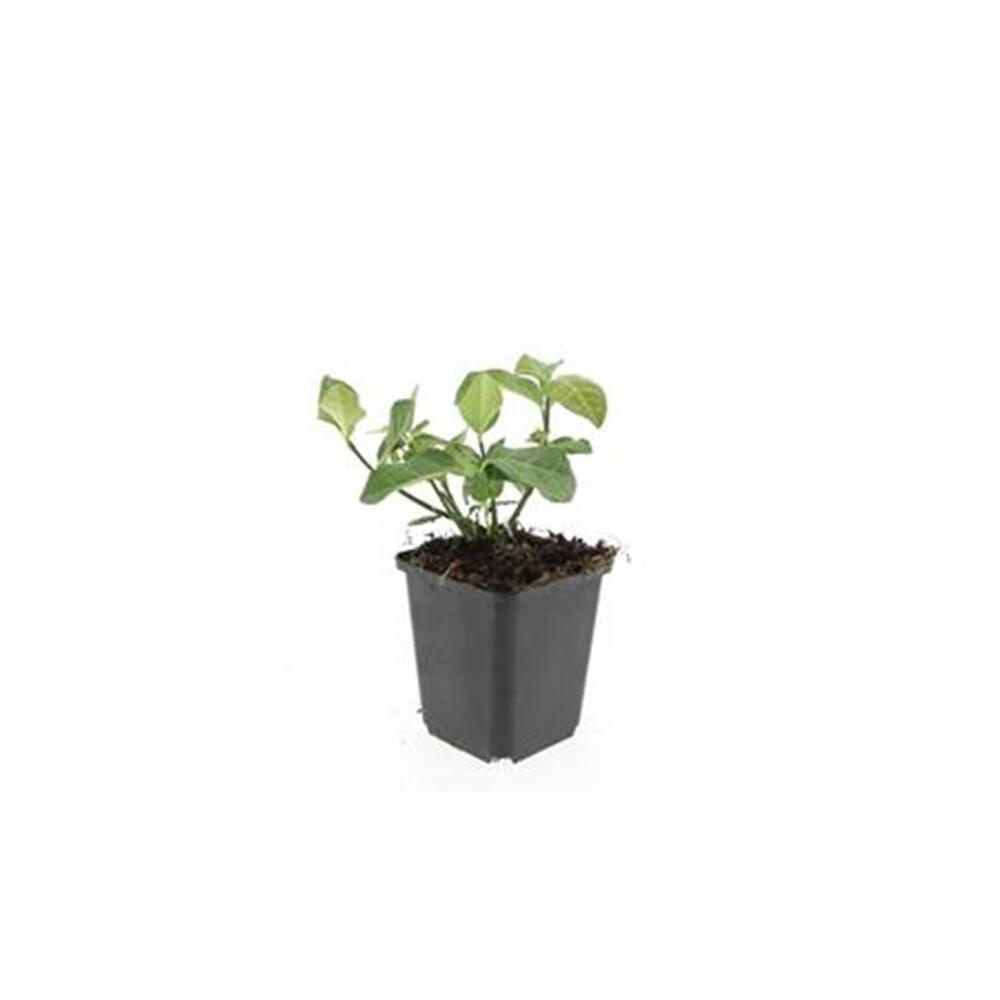
Dart’s Blanket initially shows a small rather open young plant with green oval leaves. Pairs sit on thin shoots that become woody and spread sideways with time. Between old steps and a quiet bed, a continuous green edge can develop. The cultivar name suggests a blanket; a freshly unpacked plant is not yet a finished carpet. Allow room and time. Initial looseness helps recognise shoots and guide unsuitable growth early. The effect comes from leaf surface, not one large showy flower.
Its own cultivar needs its own space plan
Dart’s Blanket belongs to Euonymus fortunei and is listed as its own cultivar. It is not simply another delivery name for Coloratus. Nursery guidance spans roughly 25 to 75 cm height and one to 1.8 m width for developed planting. These describe possible older garden growth, not an instantly reached state. The shop offers young plants in individual 9-cm pots around 10 to 25 cm total height including pot, with 40 to 50 cm spacing guidance. Still plan controllable edges beside narrow paths; small nearby perennials should not disappear beneath later-reaching shoots.
Look at the garden edge before planting
An open sunny to partially shaded place makes planting manageable. Notice how rain flows over steps and paving. It should neither stand permanently in roots nor pass by leaving the small ball dry. Well-prepared draining soil offers a better foundation than a decorative position in compacted earth. Arrange pots loosely before planting and test whether your hand will still reach their bases. Immediately between tight paving and a large woody root, watering may be harder than a garden photograph suggests.
Invest water in the start
Spring or autumn usually provide comfortable planting conditions while soil is neither frozen nor waterlogged. Moisten the ball, release gently and set at previous level. Water slowly so soil and ball connect. In following weeks check moisture exactly where young roots are. Supply thoroughly as needed in warm dry weather. Older Euonymus later coping better with occasional dryness does not apply to a newly planted specimen. Reserves grow only as roots enter surrounding soil. First visible new growth is a good reason to continue observation.
Green remains the main motif
Reddish foliage is possible in autumn. Weather and position influence how clearly this change appears; it is not fixed delivery colour. Small white flowers are described in June and July for developed planting; young plants may not flower. Dart’s Blanket therefore does not suit expecting a permanently conspicuous flowering area. Oval leaves and gradually denser branching contribute its picture. Looking closer turns apparently uniform green into pairs of leaves, fresh tips and older branches. These fine differences stay interesting outside possible flowering.
Use secateurs to organise individual lines
Selectively shorten shoots reaching paths or small neighbours. Clean secateurs allow individual branches to be removed without cutting across many leaves. Plan larger shaping preferably in spring and check active bird nests first. This green form needs no checking of yellow-green reversions like heavily variegated cultivars. Growth direction counts instead: guide edges attentively for a low border. Inspect undersides and branches if unusual pale deposits, spots or bitten edges appear. Not every leaf change is a nutrient deficiency; examine actual condition before altering supply.
A pot shows growth directly
A broad outdoor container allows close observation of shoots. The small 9-cm sales pot remains a starting point, not spacious permanent accommodation. Give suitable extra root space as roots fill the ball, use draining substrate and allow residual water to escape. Check moisture more often than in established bed plants. Match moderate nutrients to growth and existing feed. Shelter outdoors in winter and inspect dryness in frost-free weather. Euonymus is ornamental; do not eat plant parts and wear gloves for pruning. A simple accessible garden position makes care of this green blanket understandable.
One plant, several views
Good to know
Is Dart’s Blanket the same as Coloratus?
No. Both belong to Euonymus fortunei but are separately named cultivars.
Must a delivered young plant be dense already?
No. Later spreading growth develops with growth and good establishment.
How wide can the cultivar grow?
Nursery guidance gives roughly 1–1.8 m for developed planting. This is not promised delivery width.
Does Dart’s Blanket flower in summer?
Small white flowers in June–July are possible in developed plants; young plants need not flower yet.
How do I keep the path clear?
Shorten longer shoots selectively with secateurs and check growth regularly.
Do newly planted specimens need little water?
Young root balls need controlled supply. Conditions of older established plants do not apply yet.
Sources and editorial note
- Exotenherz: offer and original photographs (03.10.2026)
- Ebben Nurseries: Dart’s Blanket – cultivar sheet read directly (03.10.2026)
- International Dendrology Society: Euonymus fortunei and cultivars (03.10.2026)
- RHS: planting and caring for Euonymus – read directly (03.10.2026)
- RHS: evergreen Euonymus – position and limitations (03.10.2026)
- Exotenherz: checked 6-plant child offer (03.10.2026)
- Exotenherz: checked 12-plant child offer (03.10.2026)
- Exotenherz: checked 20-plant child offer (03.10.2026)
- Exotenherz: checked 40-plant child offer (03.10.2026)
- Exotenherz: checked 60-plant child offer (03.10.2026)
Shop offer, article number, availability and original images checked directly on 03.10.2026. Specialist sources read directly. Ebben cultivar sheet read directly as PDF on 03.10.2026: height 25–75 cm, width 1–1.8 m, white flowers June–July; not delivery flowering. IDS separates Dart’s Blanket and Coloratus. No environmental or air-purification details adopted. Position care compared with RHS. All five child offers checked separately; available quantities: 6, 12, 60. Public originals unchanged without product stamps; new images visually checked separately.