
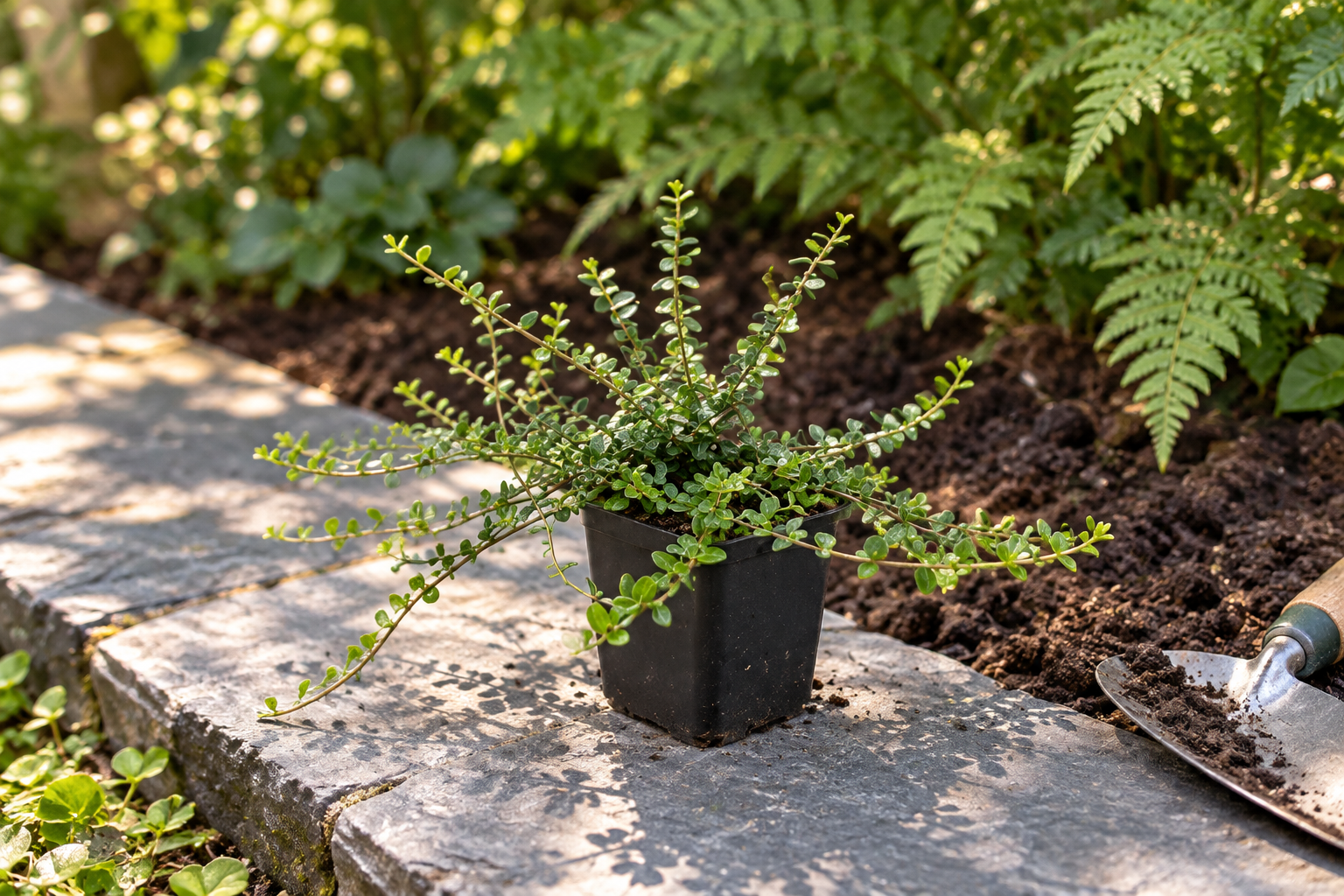
This plant at Exotenherz
Check the shop offer for current availability, price and what is included.
Product and delivery details are given in the individual offer.
Your care table
| Topic | What to do | Why it helps |
|---|---|---|
| Light | Combine sun to suitable shade with accessible soil. | A shaded position can still be dry from woody roots. |
| Planting | Moisten young root balls and set at previous height. | Small leaves do not change necessary root contact with garden soil. |
| Water | Check ball moisture while rooting in and water thoroughly as needed. | A denser older planting has different reserves from the small delivered ball. |
| Soil | Choose free-draining soil without lasting waterlogging. | Fine above-ground shoots still need ventilated root space. |
| Shape | Selectively shorten overlong branches; larger corrections in spring. | Small leaves do not mean permanently fixed plant height. |
| Feeding | Check soil nutrition and add only as needed. | Stronger feeding replaces neither suitable space nor moisture checks. |
| Winter | Protect container balls and check dryness frost-free. | A small pot offers less buffering than a garden planting. |
| Safety | Do not eat and wear gloves for cutting. | Euonymus is ornamental; eating can be harmful. |
For young plants, feel the soil directly at the root ball. The surface and deeper soil may have different moisture levels.
Water thoroughly after planting; later, water according to the soil, weather and establishment rather than a fixed calendar.
Avoid standing water. For plants in containers, also check that water runs out of the drainage hole.
Small leaves rather than a large colour block
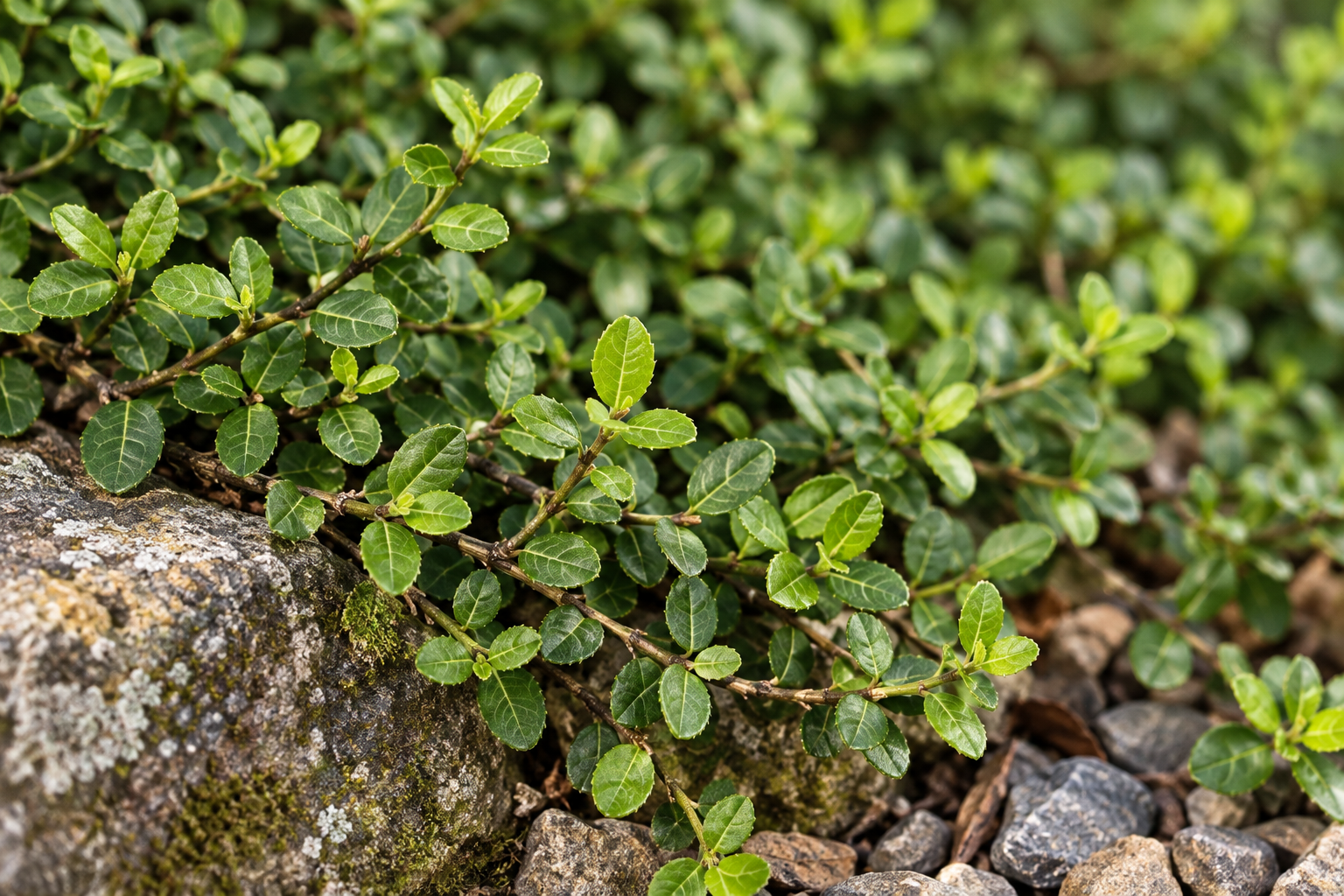
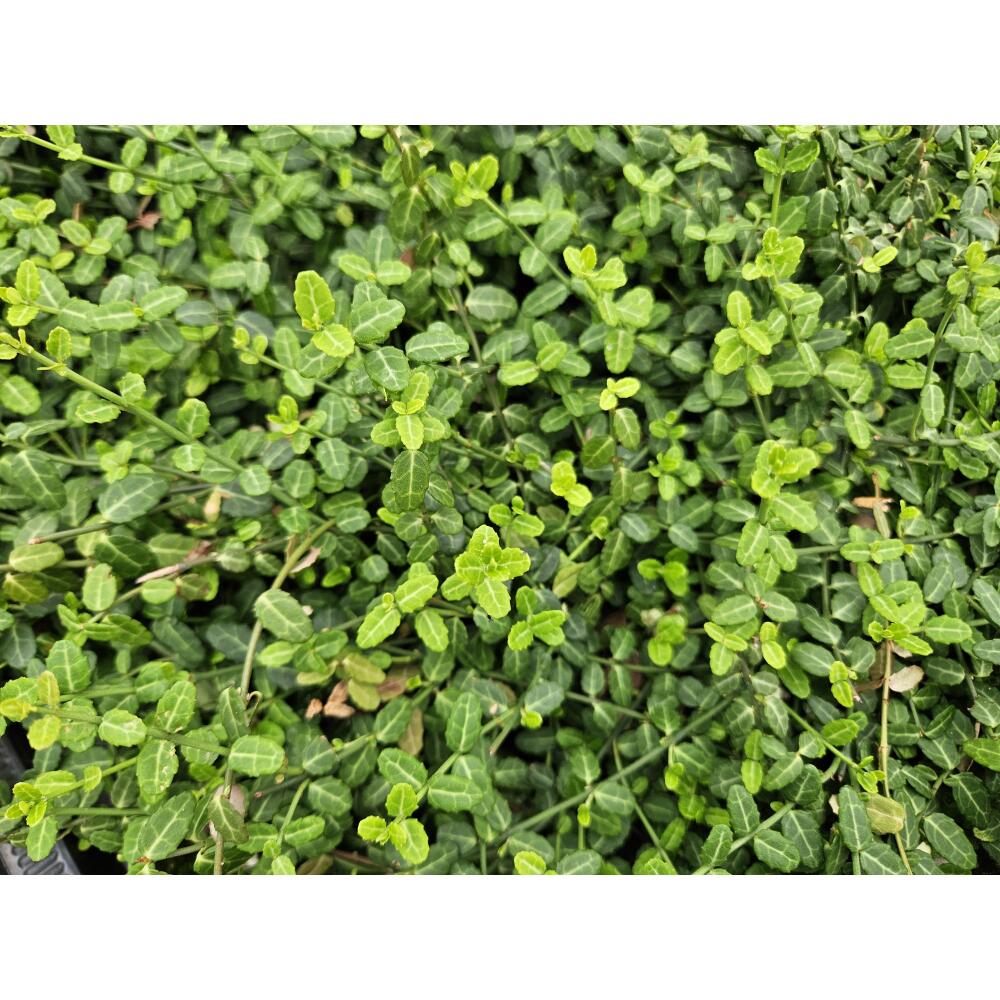
Minimus carries very small simple oval leaves. They sit in pairs on fine branches, forming a particularly fine structure between old stone and pale earth. Close up you see leaf pairs and small growing tips; from farther away they merge into a quiet green area. The pattern looks smaller-scaled than broader-leaved wintercreepers. That is this cultivar’s distinction. Minimus needs neither striking flowers nor an invented yellow marking to be interesting. A low garden edge or deliberately guided small mound can show its fine leaf size well. The eye then travels from stone into green without catching on a large flower.
Delicate leaves do not fix final height
The name and small leaves can give the impression that Minimus always stays only a few centimetres tall. Wintercreeper is actually a woody small shrub. It can spread flat, form little mounds and climb suitable structures. For developed plants the RHS gives a height class of 0.5 to one metre and roughly one to 1.5 m wide. This describes development over years, not a groundcover mat kept constantly short. Shop sets contain young plants in 9-cm pots at around 10 to 25 cm total height including pot. Separate three things: small leaves, delivery dimensions and later guided garden form.
Keep the fine garden edge accessible
Sun, partial shade or suitable shade are possible if drainage and supply suit. Beneath larger shrubs, a shaded ball sometimes stays drier than expected. Check the precise planting spot rather than just the green surroundings. Beside paving, soil should not be so compacted that water runs past on the surface or stands for a long time. The shop gives 40 to 50 cm spacing as guidance. Lay out young pots first and plan how you will reach spreading branches later. Small perennials need clear space; their low height alone does not protect them from wintercreeper growing denser sideways.
A good start remains necessary despite small leaves
Spring and autumn often help rooting if soil is neither frozen nor waterlogged. Slowly moisten a dry ball, gently unpot and set at its previous level. Connect with loose soil and water in. Initially check directly at the ball whether water has arrived. Windy warmth may require more frequent checks than calm rainy weather. Do not give a fixed small amount every day: assess need and then supply thoroughly. New shoot tips show development but do not replace moisture checks. A young plant must expand its roots before reliably reaching larger ground reserves.
Gently develop an individual shape
If branches reach too far into a path, cut back at suitable points. Check active bird nests before larger spring pruning. Secateurs can order the fine lines without cutting across all foliage. For a small mound, base height on actual branching instead of abruptly cutting all shoots low. If upward growth is unwanted, recognise it early and redirect or shorten. Small leaves can sit on long branches; their size says nothing about the area the plant will later occupy. Regular close observation makes shaping manageable.
Interpret flowers and leaf changes correctly
Inconspicuous pale green-yellow summer flowers are possible on developed plants. Minimus is presented for fine evergreen foliage, not as a reliably flowering carpet. A young flowerless delivery therefore fits the offer. If unusual spots, deposits or notched leaf edges appear, inspect branches and undersides too. A distant photograph cannot safely diagnose pests. Also check whether the ball is very dry or has stayed wet. Heavy additional feeding is not a general solution to every change. Healthy green with suitable new growth is more informative than trying to recreate a particular flower photograph.
Reserves remain limited in containers
An outdoor container can show the delicate texture beautifully beside stone. Allow more root room as it develops and keep drainage holes open. The 9-cm sales pot remains a limited starting container. Supply nutrients moderately as needed by label; an adequately supplied bed does not automatically need frequent extra feeding. In winter shelter small containers and check dryness on frost-free days without unnecessarily soaking frozen soil. As a Euonymus, Minimus is not for eating; wear gloves for work and do not present parts to children or pets as edible. Its fine effect comes from suitable space and guided shape, not a promise to keep itself permanently small.
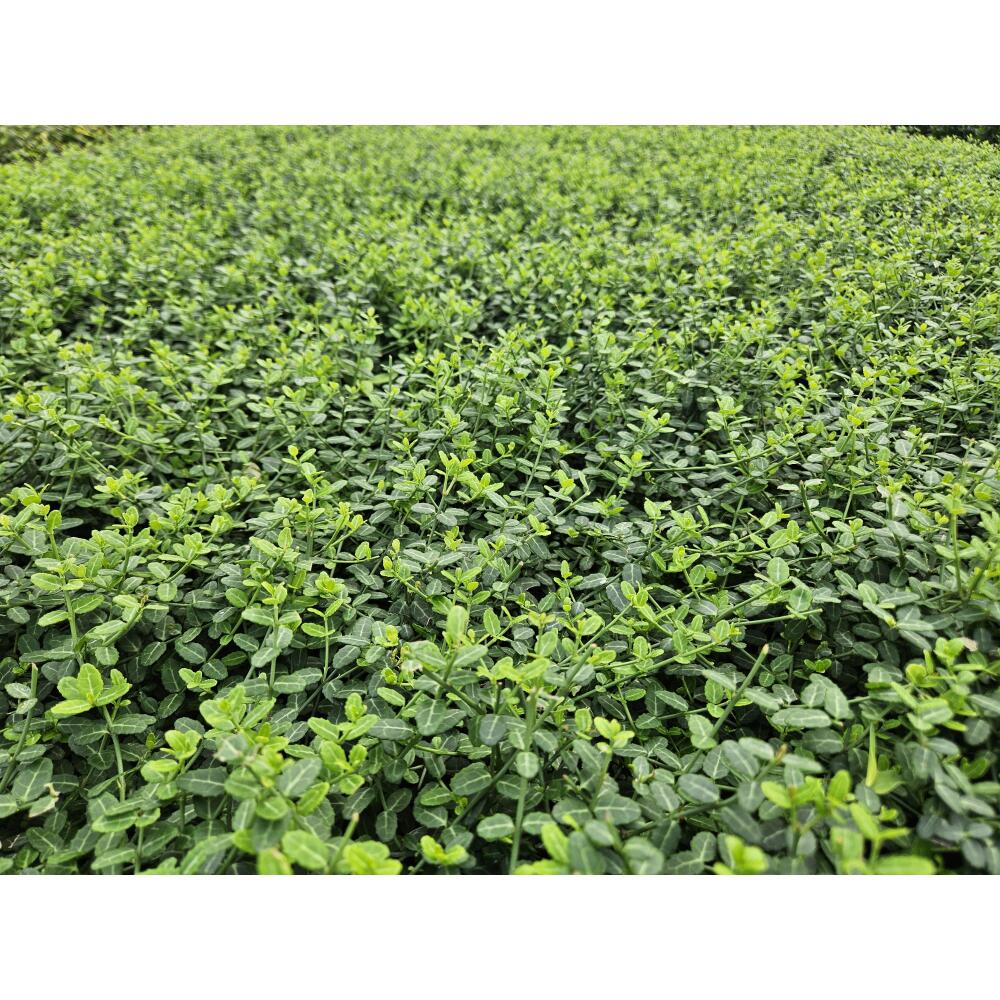
One plant, several views
Good to know
What distinguishes Minimus?
Very small green oval leaves give its woody growth a fine small-scale structure.
Does Minimus always stay completely flat?
No. It can mound and climb; the form actually guided also shapes garden growth.
How large does a developed plant become?
The RHS gives 0.5–1 m height and 1–1.5 m width over several years. These guide developed growth, not delivery dimensions.
Can I plant Minimus in shade?
Suitable shade is possible. Soil must still drain and the small ball receive water.
Why are there no flowers on delivery?
Inconspicuous summer flowers are possible on developed plants; young shop plants need not flower yet.
How do I prevent branches hanging into the path?
Check the edge and selectively shorten longer branches before they obstruct passage.
Sources and editorial note
- Exotenherz: offer and original photographs (03.10.2026)
- RHS: Minimus – cultivar profile read directly (03.10.2026)
- International Dendrology Society: Euonymus fortunei and cultivars (03.10.2026)
- RHS: planting and caring for Euonymus – read directly (03.10.2026)
- Morton Arboretum: wintercreeper and baby wintercreeper (03.10.2026)
- Exotenherz: checked 6-plant child offer (03.10.2026)
- Exotenherz: checked 12-plant child offer (03.10.2026)
- Exotenherz: checked 20-plant child offer (03.10.2026)
- Exotenherz: checked 40-plant child offer (03.10.2026)
- Exotenherz: checked 60-plant child offer (03.10.2026)
Shop offer, product number, availability and original images directly checked on 03.10.2026. Specialist sources directly read. Minimus cultivar RHS profile directly read on 03.10.2026: height class 0.5–1 m, width 1–1.5 m, mounding/creeping/climbing. Morton gives 30–46 cm for Baby wintercreeper; not reduced to supposedly exact groundcover-mat height. IDS confirms climbing habit. Shop planting density not adopted due to unsuitable m² conversion; 40–50 cm spacing retained as shop guidance. All five child offers individually checked; available quantities: 6, 12, 60. Public originals unchanged without product stamps; new images individually visually checked.