
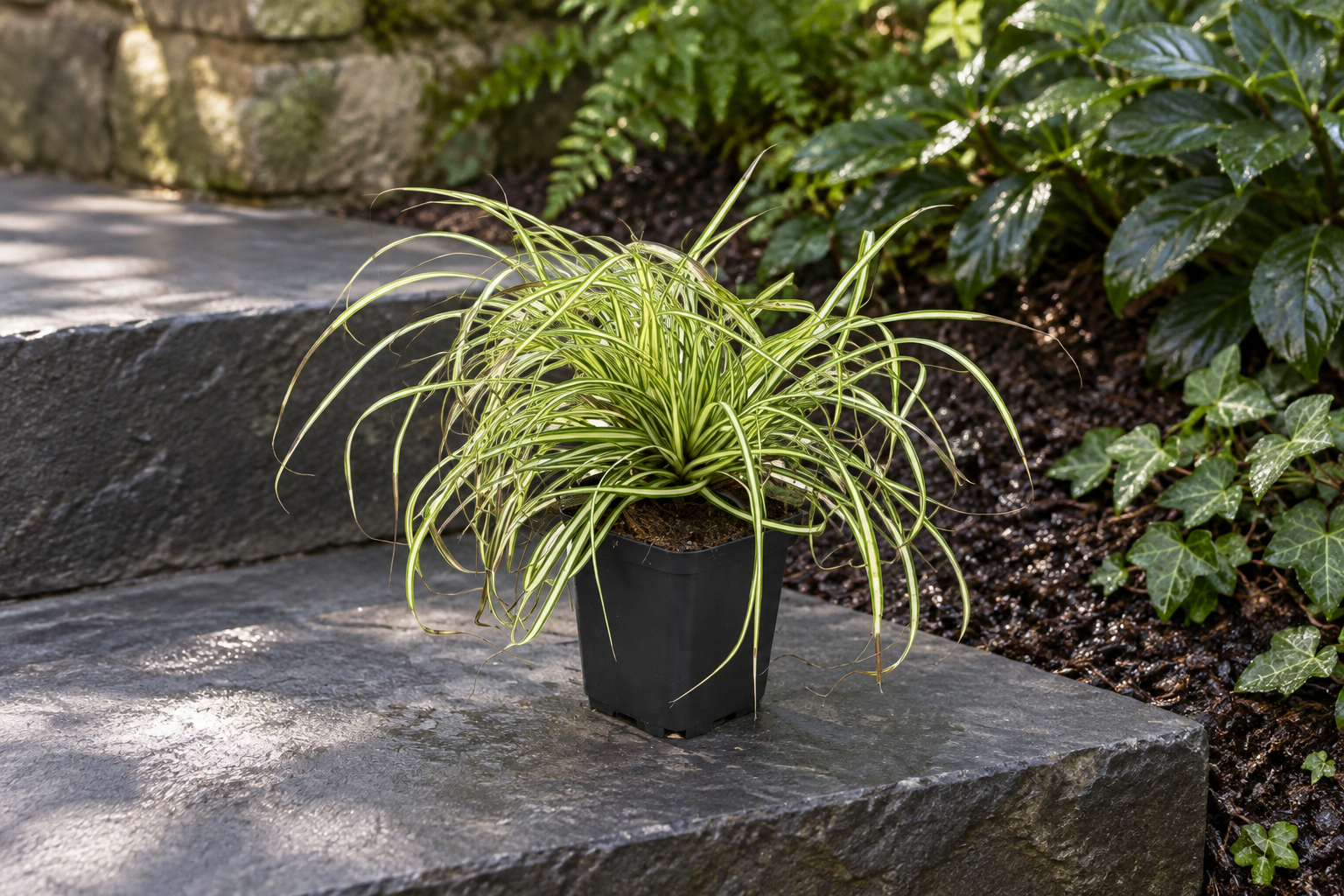
This plant at Exotenherz
Check the shop offer for current availability, price and what is included.
Check the shop for the current price, availability and offer contents.
Your care table
| Topic | What to do | Why it helps |
|---|---|---|
| Place | Choose partial shade with a fairly cool root zone. | Strong summer sun makes water supply to the fine arches more demanding. |
| Substrate | Keep humus-rich, fresh and well drained. | Yellow leaf centres sit above roots needing water reserves and air. |
| Planting | Moisten a dry root ball first; plant at its old height and water in. | The small young root ball should not start surrounded by dry soil. |
| Bed planning | Use around 30–40 cm spacing as guidance. | An older clump hangs sideways beyond the delivery root ball. |
| Water | During drought, water slowly and deeply and check drainage. | Wetting leaves does not replace adequate moisture in the root zone. |
| Nutrients | Feed modestly; use only suitable low amounts in containers. | Excessive feeding is not appropriate support for this fine clump. |
| Foliage | Remove dead leaves and old spikes individually. | Living winter-green foliage rebuilds slowly after heavy shearing. |
| Renewal | Divide suitably large older clumps during growth. | Strong pieces can continue growing as new small leaf cascades. |
| Winter | Place outdoor containers in shelter, insulate roots and check moisture. | A restricted pot root ball reacts more strongly to frost and dryness than bed soil. |
For young plants, feel the soil directly at the root ball. The surface and deeper soil may have different moisture levels.
Water thoroughly after planting; later, water according to the soil, weather and establishment rather than a fixed calendar.
Avoid standing water. For plants in containers, also check that water runs out of the drainage hole.
The yellow centre makes the difference
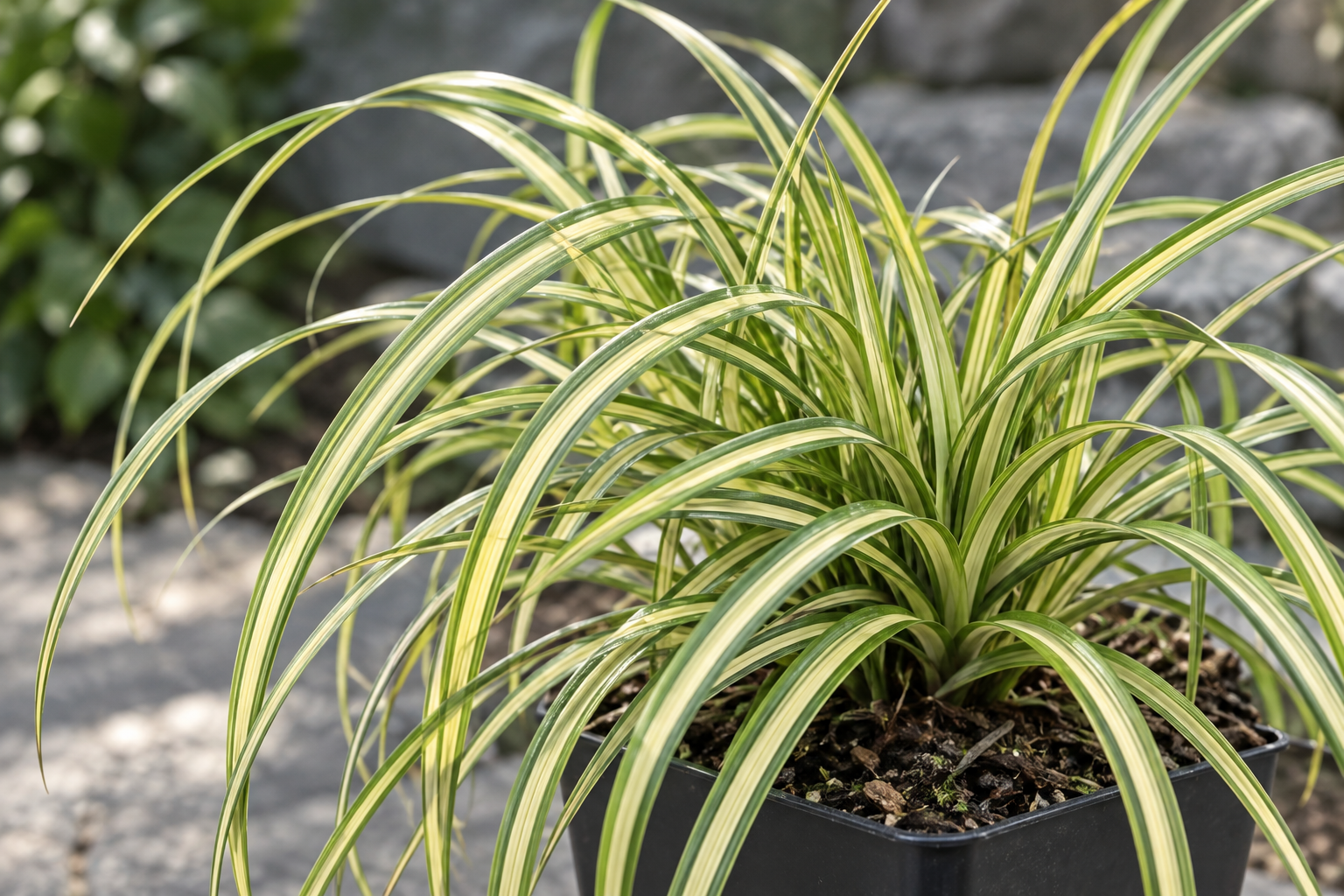
Evergold looks bright even with a few leaves. In each narrow ribbon, a creamy yellow to yellow pattern runs through the middle while the edges stay green. This arrangement matters when comparing sedges: a cultivar with yellow edges produces a different leaf picture. Evergold’s clump lays its fine leaves in arches over its neighbours. Beside a stone step or in front of broad perennial foliage, this creates a small recognisable cascade. As a sedge, it belongs to Cyperaceae even though it is used like a small ornamental grass.
From delivery plant to a wider garden clump
The offer starts with 9 cm pots at about 10–25 cm total height including the pot. Choose quantity in the respective set. An established clump frequently reaches roughly 30 cm high and spreads its leaves well beyond the small root ball. Plan around 30–40 cm between plant centres as a gardening guide. At a step, it also matters that overhanging leaves do not hide the tread. Plant young specimens according to their later habit rather than placing their still-small pots tightly together.
Partial shade protects the fine leaf surface
A partially shaded garden position with fresh well-drained soil suits Evergold. More sun is possible in cooler locations, while heat and unreliable moisture make care harder. Under trees, check water supply despite the shade. Leaf arches should not stand over a constantly dry root ball. Loose humus-rich soil holds moisture while letting air reach roots. A wet hollow is unsuitable even for this moisture-demanding sedge. Especially after prolonged rain, check whether water really drains from the bed or container.
After planting, do not water only the surface
Thoroughly moisten a dry root ball before planting. Plant at the same height as in the nursery pot, then water in slowly. During rooting, moisture in the original small root ball matters; surrounding garden soil may be in a different state. Mild spring or early autumn are usually easier to manage than summer heat. Water deeply during drought rather than frequently spraying only upper leaves. In a container, root-ball reserves and free drainage must fit together or supply fluctuates too strongly.
Preserve the leaf cascade through the seasons
Evergold is a perennial winter-green foliage plant. In favourable positions, much of its yellow-green foliage stays visible, though individual leaves may still suffer in winter. Small brown flower spikes are far less conspicuous than the pattern. Specialist sources place flowering differently between spring and summer, so a fixed month would not be a reliable promise. When tidying, carefully remove dead leaves and old spikes. Healthy foliage is not cut to ground level pre-emptively; after heavy shearing, the clump needs time to rebuild its leaf picture.
Restraint with feeding and renewal
A well-prepared bed often supplies Evergold adequately already. For weak growth, first check moisture, light and roots. Overgenerous feeding is not a shortcut to a prettier clump for this fine plant. In a container, a low suitable amount during growth may help. An old overcrowded clump can be divided during the growing period; replant and water strong pieces. In winter, a quiet outdoor spot and possibly an insulated container protect the root zone. Moisture remains an issue on frost-free winter days too.
One plant, several views

Good to know
Where is Evergold’s light colour?
In the leaf centre. Narrow arches have a yellow to creamy-yellow middle and green edges.
Is 10–25 cm its garden height?
No. That is the total height of the young potted plant including the pot. Older clumps are usually about 30 cm high and wider sideways.
Does Evergold flower in a fixed month?
No. Specialist sources give spring or summer depending on cultivation climate. Small brown spikes are less conspicuous than the leaves anyway.
Why do I not cut it like feather reed grass?
Evergold retains living foliage. Care removes dead material selectively, whereas deciduous grasses lose all their old leaves annually.
Can I plant it in a terrace container?
Yes, in suitable partial shade with enough soil volume and free drainage holes. Small containers require more frequent moisture checks.
Sources and editorial note
- Exotenherz: parent offer, dimensions and original images (accessed 3 October 2026)
- Specialist reference: evergold-rhs (read directly 3 October 2026)
- Specialist reference: evergold-hoffman (read directly 3 October 2026)
- Specialist reference: grasses-cutting (read directly 3 October 2026)
- Specialist reference: grasses-growing (read directly 3 October 2026)
- Exotenherz: checked 6-plant child offer (accessed 3 October 2026)
- Exotenherz: checked 12-plant child offer (accessed 3 October 2026)
- Exotenherz: checked 20-plant child offer (accessed 3 October 2026)
- Exotenherz: checked 40-plant child offer (accessed 3 October 2026)
- Exotenherz: checked 60-plant child offer (accessed 3 October 2026)
Parent offer and all associated child offers read directly on 3 October 2026; article numbers, GTIN where present in child offers, availability and files documented separately. Delivery height 10–25 cm including a 9 cm pot explicitly separated from later garden height. Quantity variants are not new plant identities. Specialist sources read directly, complete reference portraits fargesia-rufa-guide and heidelbeere-jersey-guide compared. Clean original view 2 retained unchanged; stamped montages excluded. Scene shows one young reference plant regardless of set count. Draft; shared-page and browser acceptance still pending. RHS Evergold synonym profile and Hoffman read directly; differing spring/summer flowering indications deliberately explained as a range.