This plant at Exotenherz
Check the shop offer for current availability, price and what is included.
Check the shop for the current price, availability and offer contents.
Your care table
| Topic | What to do | Why it helps |
|---|---|---|
| Position | Bright indirect daylight, glass outside direct summer sun. | The white network stays visible in good light; hot sunlit glass may damage foliage. |
| Water | Check substrate, glass wall and bottom layer together before a small dose. | Fittonia needs reliable moisture while closed containers lose little water. |
| Ventilation | Remove cork for a while if condensation is excessive. | Too much moisture on shoots and leaves encourages rot; permanently open glass loses more water. |
| Planting | Set the rootballs carefully with space between Fittonia, fern and glass. | Healthy leaves should unfold without always touching wet walls. |
| Soil | Use loose humus-rich soil by instructions without flooding the bottom. | Shallow roots need air and moisture; granules cannot replace drainage. |
| Shaping | Cleanly shorten individual long shoots, remove dry leaves and debris. | The low form remains clear and dead material cannot mould unnoticed. |
| Nutrition | Account for fresh soil; later feed cautiously if needed by appropriate instructions. | Heavy doses add no white pattern and promote excess growth in little space. |
| Seasons | Warm and adequately bright in winter, away from heaters and cold draughts. | The tropical plant has no cold rest, but light and moisture use can change. |
Check the compost and pot weight. The care table explains how far the compost may dry.
Water only when needed. The water should reach the root ball without spilling over the rim.
Remove surplus water from the saucer or cachepot. Then return the plant to a suitable position.
White lines leave green islands
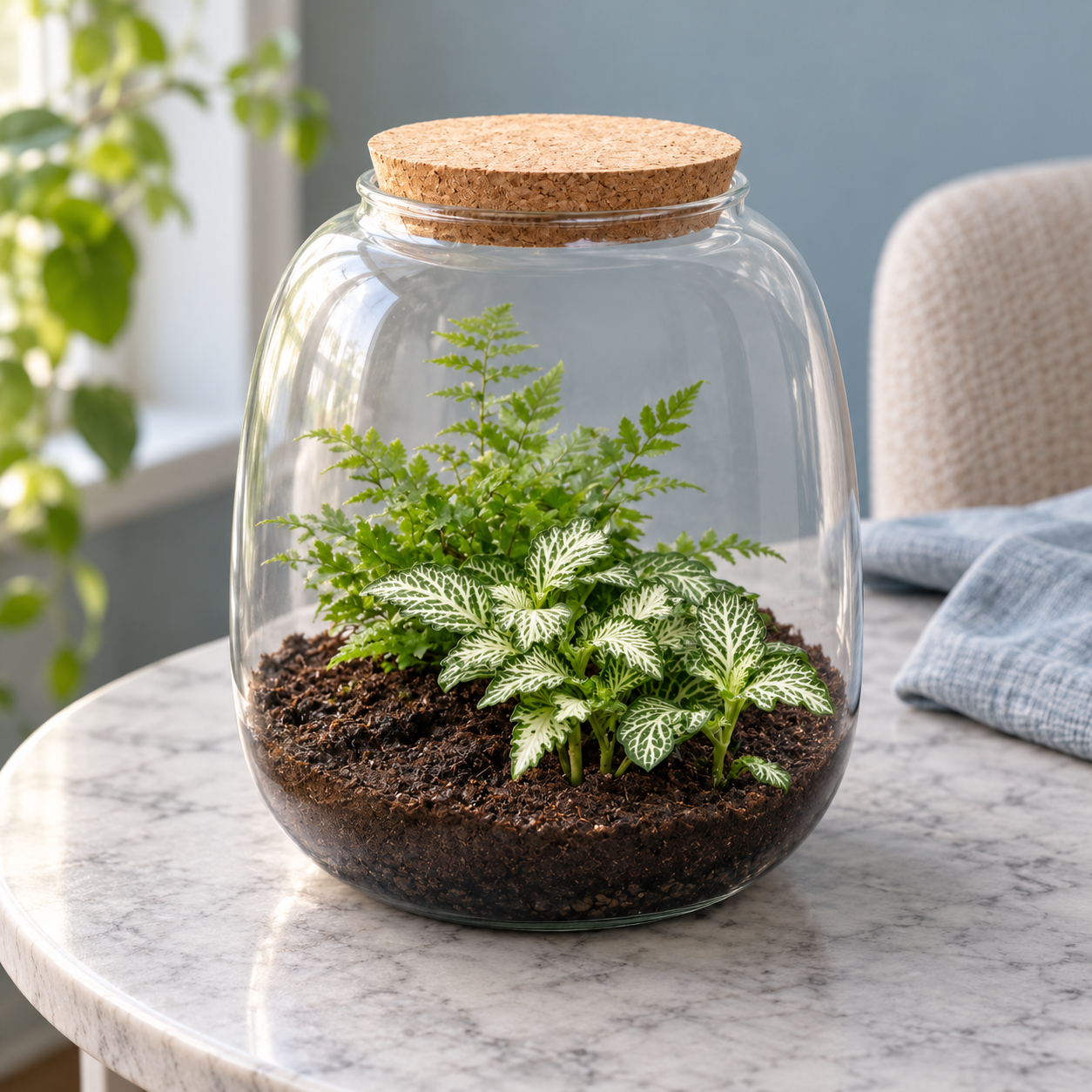
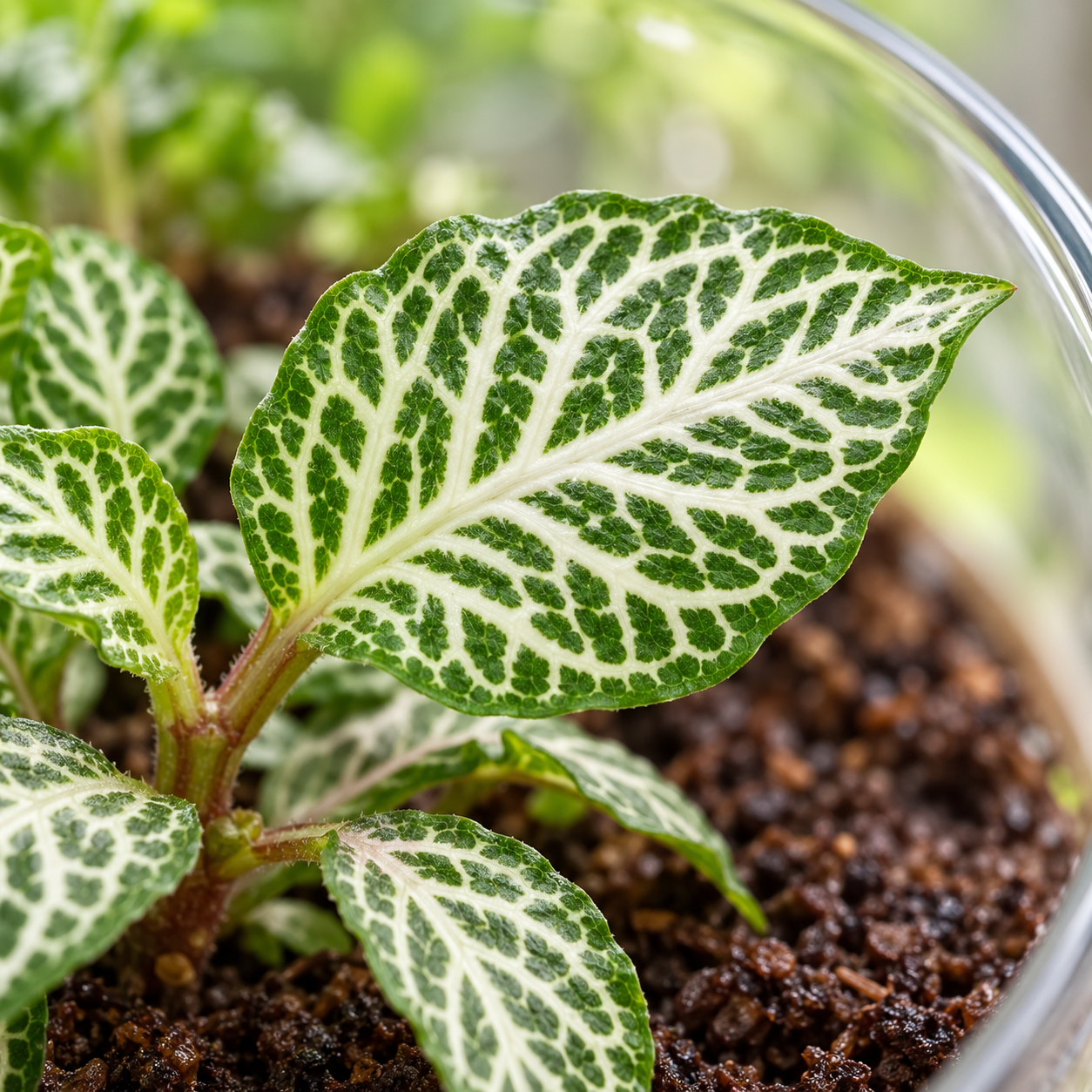
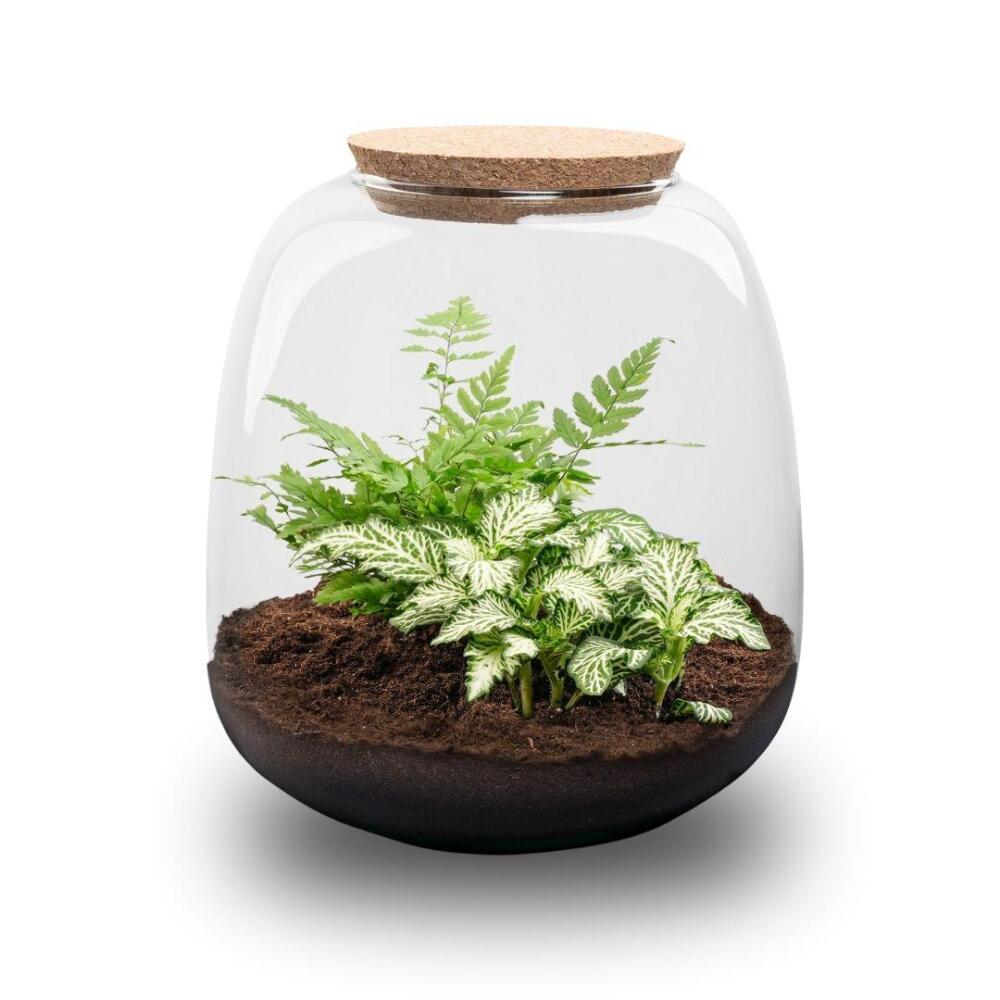
White Tiger brings a striking pale accent on small leaves. Its network is so dense and broad that dark-green areas lie like little islands between ivory lines. Oval leaves end in soft points on short branching shoots. The original shows Fittonia forming the low foreground of a glass garden. Behind it green fronds of a little fern open. The difference between flat leaf pattern and fine divided fronds interests without flowers. Choose a visible place: clear glass permits watching every new leaf without touching or turning the plant.
The cultivar name describes a real selection
White Tiger is a named Fittonia selection also treated as a Fittonia albivenis cultivar in horticultural literature. A producer profile places it in Verschaffeltii Group. Fittonia verschaffeltii itself appears as an older species name. The genus belongs to Acanthaceae; its commonly cultivated species comes from tropical South America. Shoots creep low and can root at nodes. Pale markings belong to the leaf, not paint or a deposit to remove. The young cushion may broaden later. A little jar limits development and requires occasional shaping.
A DIY kit with two different plants
White Tiger is offered in the Kleine Emma bottle garden. Glass about twenty centimetres tall and nineteen wide has a cork lid. Fittonia, fern, hydrogranules, activated charcoal, potting soil and instructions accompany it. No precise plant height is given, so glass measurements are not transferred to foliage. The clean original shows an already planted example. Supplied components are assembled into a composition yourself. Unpack carefully and check both rootballs. Hold by pot or rootball when moving rather than pulling leaves. The fern stays a companion without an offer-specified species.
The network needs gentle daylight
White Tiger likes bright indirect light. A little table near a bright window shows its pattern clearly while strong direct sun may damage leaves. Protect closed glass especially from overheating. Check the sun’s path before keeping an apparently attractive place all summer. An airy room suits it, but cold ventilation draughts should not hit glass directly. Immediate heating proximity is poor too. Cork retains moisture but replaces no daylight. A dark surface needs suitable plant lighting or another position even if pale foliage looks decorative there.
Read condensation before adding water
Fittonia copes poorly with repeated complete rootball drying. In glass water stays in circulation a long time, however, making habitual pot watering quickly excessive. Look through the wall at soil and lower layers. Light temporary misting may occur with balanced moisture. If large drops hang permanently or leaves stay wet, ventilate first rather than watering. If moisture genuinely declines a small careful addition suffices; then observe development again. The container has no bottom drainage. A granule layer can hold water without making it disappear. Avoid a standing reserve beneath roots.
Gently shape a low carpet
The supplied instructions guide planting layers and arrangement. Loose humus-rich soil surrounds the little rootballs without burying shoot bases. Leave room between plants and glass walls. If later shoots lengthen, shorten individual tips with clean tools. Healthy sections may serve a cutting attempt in their own little container. Low growth need not be forced by frequent hard cuts. Growth, light and moisture all belong to assessment. Fresh soil initially contains food; later feed moderately if needed. More nutrition does not automatically make the network whiter.
Clean leaves and a steady winter position
Remove dry or dead leaves promptly, and cut remnants too. They decay quickly in moist glass and may encourage mould. Inspect undersides and young bases then. Little animals, unusual deposits or soft stems need closer assessment. Yellow leaves may relate to excess water, though one older leaf can age naturally. Keep White Tiger warm and bright in winter. Slower growth often means lower consumption, not a complete dry pause. Correct a recognised cause selectively, then watch fresh growth. Healthy new leaves are easy to follow in this pale-patterned Fittonia within the little glass.
One plant, several views
Good to know
Is White Tiger just an unnamed white Fittonia?
No: it is a named selection explicitly in the kit, producer profile and specialist literature.
Is the white pattern a deposit?
No. It belongs to the leaf. It is not rubbed off or created by extra feed.
Does glass arrive planted?
The offer is a DIY kit with instructions. The original shows a planted example.
How large are glass and plants?
Glass about 20 cm tall and 19 cm wide. No exact individual plant height or pot size is given.
What second plant is included?
A fern. Its species is unspecified and is not added in the portrait.
Must cork always stay open?
No. Suitable closed glass retains moisture longer. Open temporarily with excessive condensation or constantly wet foliage.
What if leaves go limp?
Check soil, temperature and the root zone first. Dry rootballs and damaged roots in wet soil need different measures.
Can it outgrow the glass?
Yes. Sideways shoots lengthen. Gentle shortening or a new arrangement keeps room for both plants.
Sources and editorial note
- Exotenherz: offer and original images (03.10.2026)
- Masson Farms: White Tiger cultivar profile and care (03.10.2026)
- The Horticulture Journal: White Tiger as a studied cultivar (03.10.2026)
- NC State: Fittonia albivenis, synonyms and habit (03.10.2026)
- RHS: bottle gardens, light and water management (03.10.2026)
Offer, article number, GTIN, availability and originals directly checked03.10.2026. Specialist sources directly read. Distinct named selection from directly read Masson Farms profile and originalresearch (White Tiger explicitly in plantmaterial/abstract). No cultivarpatent/neworigin asserted. Current DIYtitle and labelled componentoriginal specifically WhiteTiger; longtext onlywhiteFittonia, no contradictory cultivar. Glass dimensions not plant deliveryheight. Clean original1 unchanged; labelledmotifsinternal.