
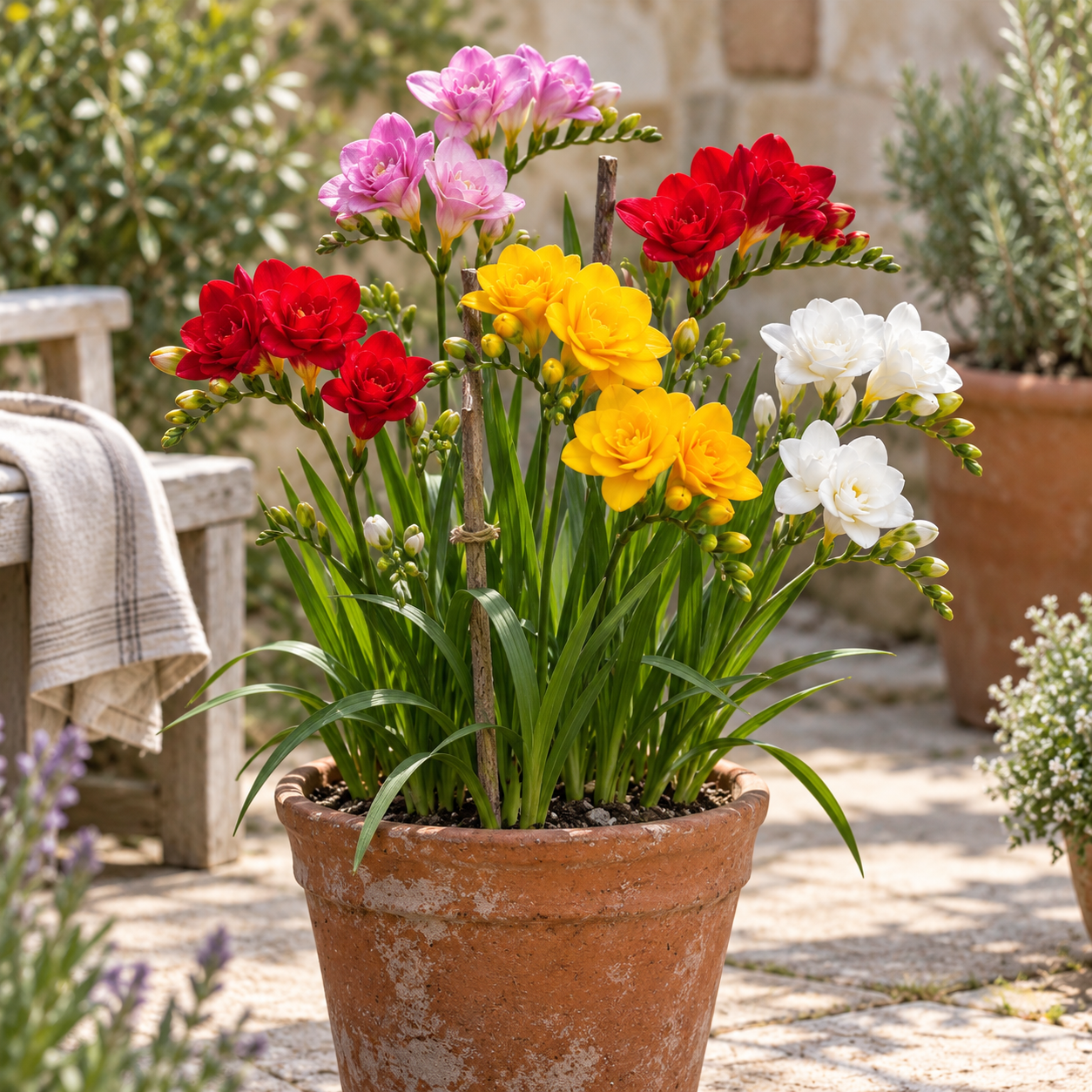
This plant at Exotenherz
Check the shop offer for current availability, price and what is included.
Check the shop for the current price, availability and offer contents.
Your care table
| Topic | What to do | Why it helps |
|---|---|---|
| Light and climate | Grow bright, airy and cool, avoiding frost. | Hot indoor conditions may promote soft stems and rapidly fading flowers. |
| Start | Sheltered autumn culture or frost-free spring start; follow packaging. | Heat treatment and position affect flower timing. |
| Soil and pot | Deep freely draining pots, humus-rich soil with mineral components. | Roots need space, corms protection from persistent wetness. |
| Planting | Tips upwards; shallow in pots, about 5 cm deep in spring beds. | Depth depends on cultivation; dormant corms are not delivery plants. |
| Water | Careful initially, moderately moist in growth; remove remnants. | Little foliage consumes less than a flowering pot. |
| Feed | Active shoots by label; potassium emphasis at budding. | Nutrients support growth without forcing flowers in unsuitable climate. |
| Flowers and foliage | Support thin stems early, remove faded flowers, let green mature. | Green leaves feed corms after flowers end. |
| Rest and storage | Dry corms frost-free; repeat bloom needs warm ripening. | A suitable temperature cycle is necessary; second flowering remains demanding. |
Check the compost and pot weight. The care table explains how far the compost may dry.
Water only when needed. The water should reach the root ball without spilling over the rim.
Remove surplus water from the saucer or cachepot. Then return the plant to a suitable position.
Scented funnels along slender flower rows
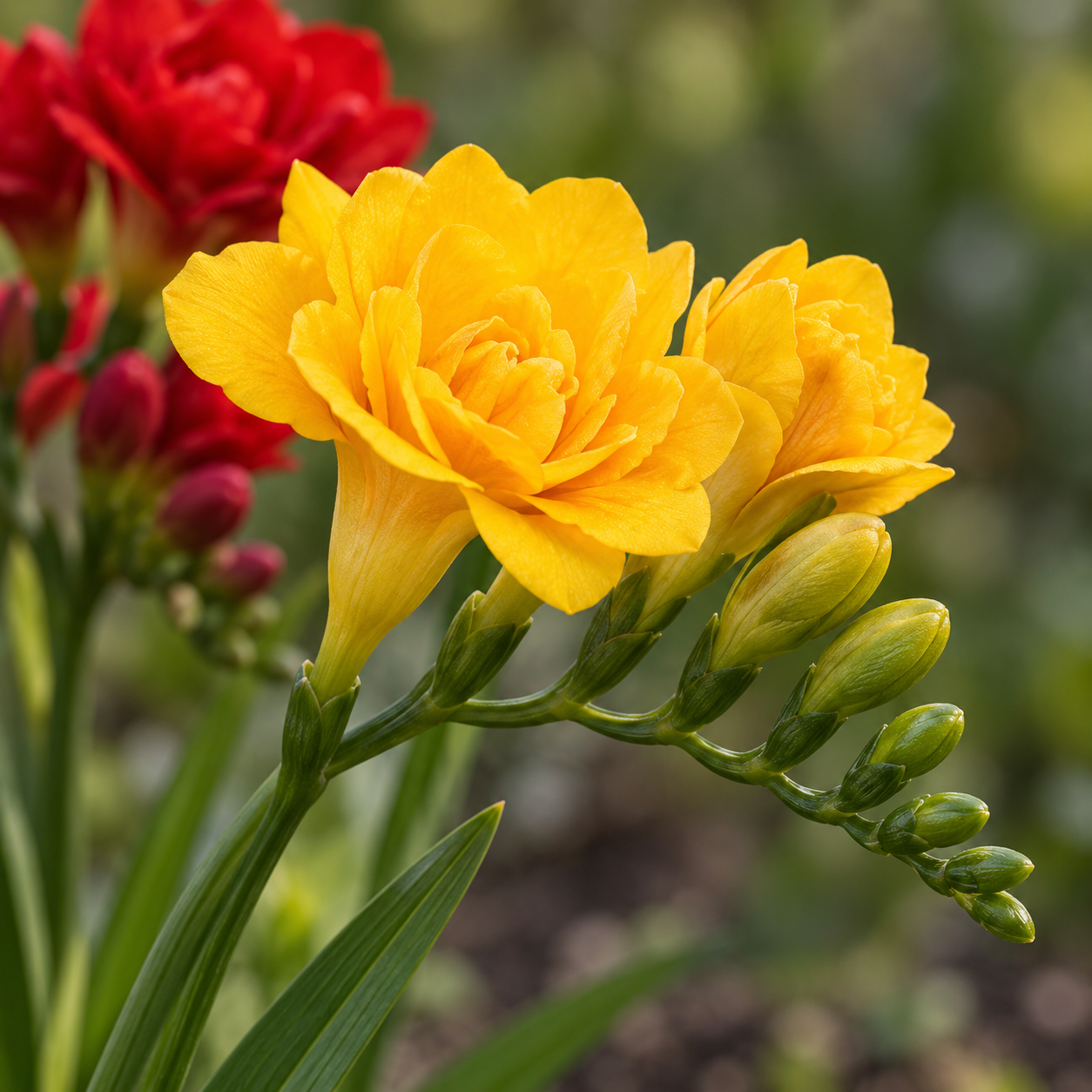
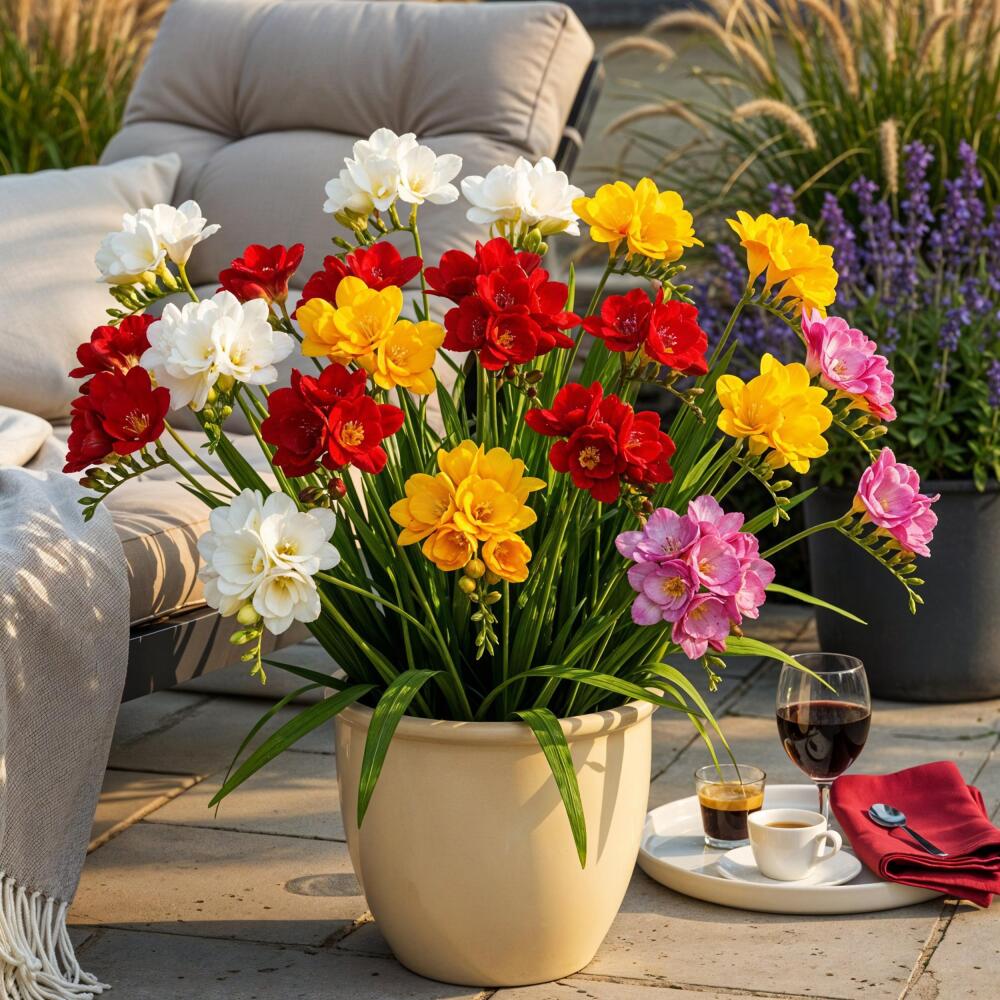
The first yellow flower opens wide beside a firm green bud. Further along the sideways-curving stalk, more petals emerge from a narrow funnel. Double freesias have many petals but keep their typical sequence of flowers opening in a row. Narrow green leaves form little sword fans beneath fine stems. Double Mix combines several colours; shop images show yellow, red, white and pink-violet. With scent it makes an attractive motif for a bright place near a terrace often passed. Freesias belong to the iris family. Garden forms are largely hybrids from African freesias. This double mixture is grown from corms and needs more attention than a bulb simply planted in autumn and left for years in a bed.
Forty corms are the beginning, not the finished flowerpot
The offer contains 40 dormant corms. Flowering images show a later phase; neither planted pot nor decoration is supplied. Examine each corm before planting: gently hold a firm intact body without breaking its tip. Reject soft, mouldy or rotten-smelling pieces. Commercial corm size is 5–6 cm, not delivery-plant height. A deep pot with holes gives roots room. Distribute some among several pots rather than crowding all into a small bowl. Keep label and planting date. Later flowering stems may reach about 40 cm, influenced by light, temperature and culture. No fixed final mixture height can be promised.
Plan light and coolness together
Freesias like a bright airy place and relatively cool growing conditions. An unheated frost-free conservatory or well-ventilated greenhouse often suits better than a heated living room. Sheltered pots may start in autumn; outdoors in frost-prone areas grow only after frost risk. Flowering also depends on whether corms were heat-treated, which is unspecified here. Do not plan this mix for a particular holiday or fixed flower week. Cool pots may start with establishment around 5 °C followed by about 10–15 °C and plenty of light. A sunny wind-sheltered outdoor spot suits frost-free periods. Regularly check warmth behind closed glass: much light should not become a hot stuffy place.
Roots need loose soil and free drainage
For beds choose loose humus-rich well-drained soil. Where water stands after rain, prefer a pot with controllable drainage. Spring bed corms may go about 5 cm deep, tips upwards. Sheltered pots also commonly use shallow planting with tips just visible above soil, requiring careful moisture checks. Allow about 5–8 cm spacing in pots. Stable soil with coarse mineral components holds moisture without permanently wet corm surroundings. Keep holes clear and remove saucer surplus. Insert fine twigs or small support early so later thin stems find a hold without working among flowers.
Water attentively from first leaf to last bud
Water gently after planting. Little foliage uses less than a developed group. Check soil and pot weight before adding more. As leaves grow keep the root zone evenly slightly moist; soaked corms may rot. In a sunny position inspect soil under leaves, not just flowers. Feed active growth by a suitable liquid label, accounting for pre-feeding. Potassium-rich flower feed suits bud development. Do not add a dose simply because first flowers are missing: temperature, light and corm condition determine progress too. Remove faded flowers. When cutting vase stems leave green leaves and keep scissors clean.
After flowers let green leaves mature calmly
The last flowers ending does not finish the plant. Continue caring for green leaves and remove only when naturally yellow or brown and dry. Do not knot foliage. Reduce water as it dies back, then stop. Mature corms may be gently lifted and stored dry, airy and frost-free. Repeat flower formation requires a special warm ripening phase; a cool cellar alone cannot replace it. A repeat attempt is described with dry storage around 25–30 °C for several months. Check mould and damage, without sealing in a wet bag or drying on a hot heater. Next-year bloom remains demanding and unguaranteed. Fresh corms may be the simpler new start.
Watch fine stems and choose a place to enjoy them
Long soft stems may indicate too little light or excessive warmth. Check position before further feed. If leaves become glassy and collapse after a cold night, move frost-free; more water does not heal damaged tissue. Yellow leaves in wet soil first need drainage checks. Occasionally inspect buds and young shoots for aphids, especially under cover. Airy spacing simplifies water and checks. For later flowers a plain terracotta pot beside pale stone feels calm and warm. Flowers may retain different heights. Some corms in a second pot extend design flexibility without expecting a large finished bouquet. The manageable little project lets you follow sword leaves through to scented flower rows consciously.
One plant, several views

Good to know
Do I receive a flowering pot?
No: 40 dormant corms. Flowering images illustrate later cultivation.
Are freesias winter-hardy?
They need protection in frost-prone areas. Bright cool frost-free pots are more reliable than unprotected bed wintering.
When does Double Mix flower?
Depends on planting, temperature and possible preparation. No heat treatment is specified and no fixed flower week guaranteed.
What does 5–6 cm mean?
A commercial corm size, neither delivery-plant height nor later flower.
Can I cut leaves after flowering?
Keep and care for healthy green foliage. Remove only after yellow or brown dieback.
Do corms flower again next year?
Possible with appropriate warm ripening followed by cool culture. Repeat flowering is demanding; fresh corms simplify a new start.
Sources and editorial note
- Exotenherz: exact corm offer 1517430102025
- JUB Holland: X 40 Freesia Dubbel Mix, article323688
- RHS Growing Guide: cultivation, frost protection and care
- NC State Extension: botanical features and cultivation-specific care
Named horticultural group, oneportrait, no additional identity percolour/quantity. All27ownnatives actuallyread/viewed; cleanflowers1/2public, charts/brand/decorativebulbdelivery excluded. Shop5–6cm neutral trade size only, no circumference-diameterconversion/deliveryheight. JUBgenericseason/hardiness not blindlyapplied; RHSspecificFreesia/R.asiaticus controlsfrost/temperature/preparationunknown. Ranuncpastelcopyline internal; no exactpalette/cultivar guarantee. Stockdates03.10preserved, no freshproductHTTP04.10claimed. Laterbloomcaptionsconsistent.