
This plant at Exotenherz
Check the shop offer for current availability, price and what is included.
Check the selected shop offer for price, availability and delivery contents.
Your care table
| Topic | What to do | Why it helps |
|---|---|---|
| Position | Choose warm and sunny. | Tall crowns need a visible area in the border. |
| Soil | Prepare deep fertile soil with drainage. | Water must not stand in deeper layers either. |
| Planting | Set carefully in early autumn. | Do not press sensitive bulbs forcefully. |
| Depth | Compare packaging with actual bulb and soil depth. | RHS gives at least 30 cm; specialist suppliers differ. |
| Spacing | About 30 cm as a garden guide. | Allow for later neighbouring foliage. |
| Water | Check and water during growth in dry conditions. | Wetness remains unfavourable. |
| Nutrients | Supplement suitably while growth is emerging. | Consider reserves and fertiliser label. |
| After flowering | Let green parts die back naturally. | Dormancy belongs to the annual cycle. |
For young plants, feel the soil directly at the root ball. The surface and deeper soil may have different moisture levels.
Water thoroughly after planting; later, water according to the soil, weather and establishment rather than a fixed calendar.
Avoid standing water. For plants in containers, also check that water runs out of the drainage hole.
A crown rising above the spring border
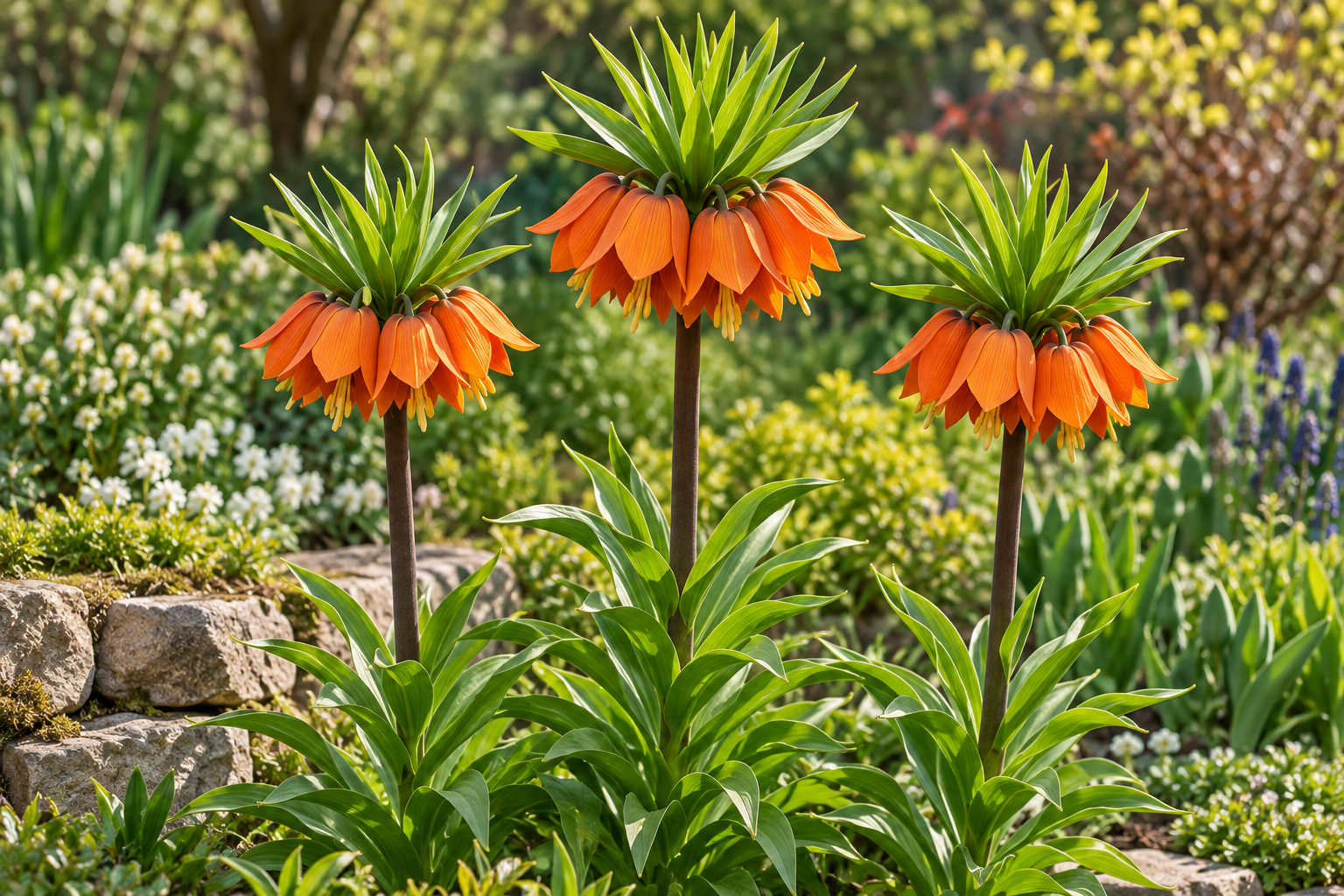
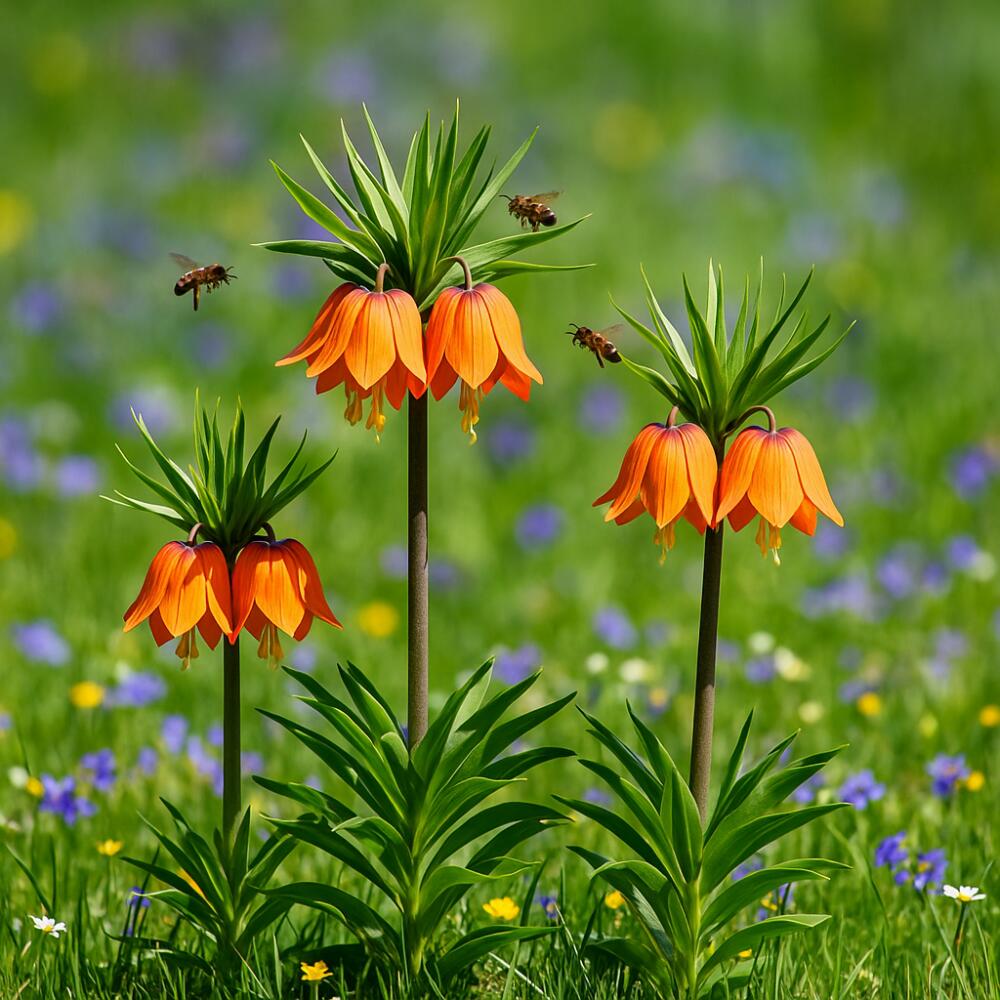
Garland Star bears large orange bells beneath a striking tuft of green leaves. The flowers hang in a group around the upper stem. Reddish and yellow nuances give depth to the colour. Narrow green leaves stand below on a sturdy darker stem. At about ninety to a hundred centimetres in flower, this crown imperial forms a tall accent among lower spring plants. A calm background reveals its shape. It needs a place where the whole plant can stay visible rather than disappearing behind already dense shrub foliage.
Five bulbs with space to develop
The assortment contains five bulbs for planting. The scene shows the later mature flowering stage, not a flowering delivery. Use them in a loose group or spread them among suitable border positions. The RHS gives about thirty centimetres spacing as a guide for crown imperials. Choose the position first and assess its effect from a path or seat. Later neighbours may accompany the emerging shoots, but should not crowd each stem from the start. Containers and decoration in the scene are examples.
A good position begins below the surface
Choose a warm sunny position with deep fertile soil and good drainage. Soil structure is crucial because large bulbs need space below the surface too. Check that rain drains in deeper layers. A heavy wet hollow is unfavourable. A suitably constructed raised bed may be an option when the original garden soil is unsuitable. It should function as a whole rather than creating just a small gravel-filled planting hole. Plan for the dormant summer position too.
Choose depth according to bulb and soil
Plant in early autumn when soil is workable. Specialist guidance differs on depth: de Jager gives fifteen centimetres for large bulbs, while RHS recommends at least thirty centimetres for crown imperials in gardens and warns against shallow planting. Use packaging instructions together with the actual bulb and suitable soil depth. Do not force sensitive bulbs into tight holes. A slightly sideways position is sometimes recommended; it does not replace working drainage. Mark the planting site so later garden work does not strike the dormant bulb.
Nourishment during vigorous new growth
The above-ground part develops quickly in spring. In dry conditions, check moisture around the roots and water as needed. Already wet soil requires no extra water. RHS describes supplemental nourishment during emerging growth, respecting the fertiliser label’s dose and frequency. Consider soil and existing reserves first. Do not wait until stems are completely finished flowering to assess nourishment. A single nutrient does not explain every flowering problem; light, depth, soil and bulb condition must be considered too.
Leaf care continues after the crown
After the orange flowers finish, let the green foliage complete its work. Do not immediately remove the whole stem. Only naturally fading and dead parts are removed later. Lower neighbours may carry the border forward as crown imperial dies back in early summer. Check new growth for feeding damage when needed; slugs and lily beetles may occur. The bulbs are ornamental plants, not intended for eating. Wear gloves when handling. A whole-plant photograph in the plant book helps estimate the space needed next spring.
Gently support an established group
Crown imperials are perennial and may form larger groups in a suitable place. Weaker flowering later need not immediately lead to constant moving. First check changes in the border, soil, planting depth and previous care. When moving is necessary, lift the dormant plant carefully and replant in a well-prepared position. It may then need time to establish. Record observations over several years. This shows whether the orange crown fits permanently into the garden scene or its conditions still need adjustment.
One plant, several views


Good to know
What is delivered?
Five bulbs for planting, not tall flowering plants.
How tall does Garland Star grow?
About 90–100 cm at the later flowering stage.
What colour are its flowers?
Orange with reddish and yellow nuances.
Is every crown imperial planted the same way?
Bulb size, packaging and soil conditions must be considered.
Can I compensate for deep wet soil with gravel in the hole?
One gravel hole does not create reliable drainage.
Why is flowering absent in a later year?
Check position, soil, depth, bulb condition and nourishment together.
Sources and editorial note
- Exotenherz: offer and original images (03.10.2026)
- de Jager – Garland Star (03.10.2026)
- RHS – crown imperials in the garden (03.10.2026)
- RHS – Rubra Maxima crown imperial, species cultivation (03.10.2026)
Shop offer, article number, GTIN, availability and original images directly checked on 02.10.2026; specialist acceptance 03.10.2026. Specialist sources read directly. Shop variant, quantity, SKU, current orderability and both original shop images directly checked. Specialist sources read on 03.10.2026. Images show later flowering, not delivery condition. Trade size classes not adopted as measured bulb or tuber diameter. Specialist acceptance with published Pflanzenwelt portraits; no tool or Wawi changes.