

This plant at Exotenherz
Check the shop offer for current availability, price and what is included.
Product and delivery details are given in the individual offer.
Your care table
| Topic | What to do | Why it helps |
|---|---|---|
| Light | Place sunny and warm. | Flower heads respond to light and time of day. |
| Planting time | Plant after frost risk and acclimatisation. | The young group is not intended for frost experiments. |
| Watering | Let the upper soil dry out partly, then supply. | Drought tolerance is not a ban on watering. |
| Drainage | Empty sleeves and keep holes clear. | Wet roots do not suit cultivation. |
| Soil | Choose well-drained soil. | Avoid heavy waterlogged areas. |
| Nutrients | Feed moderately during growth according to the label. | A closed head is not a fertiliser-deficiency signal. |
| Cleaning | Remove faded stems selectively. | Preserve new buds. |
| Winter | Plan seasonal cultivation or suitable frost-free continuation. | Do not promise safe outdoor overwintering in Germany. |
Check the compost and pot weight. The care table explains how far the compost may dry.
Water only when needed. The water should reach the root ball without spilling over the rim.
Remove surplus water from the saucer or cachepot. Then return the plant to a suitable position.
The flowers wait for the right moment
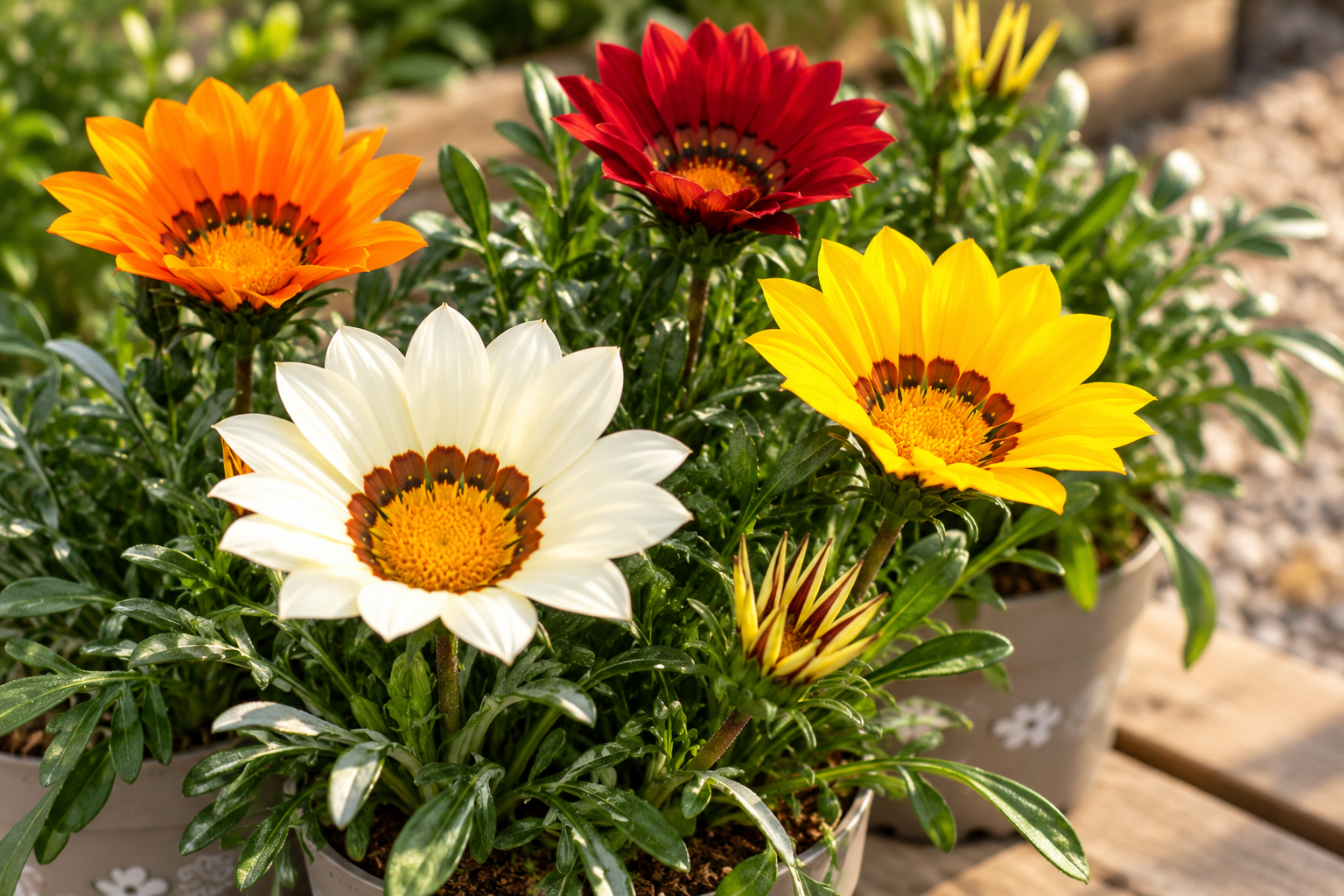
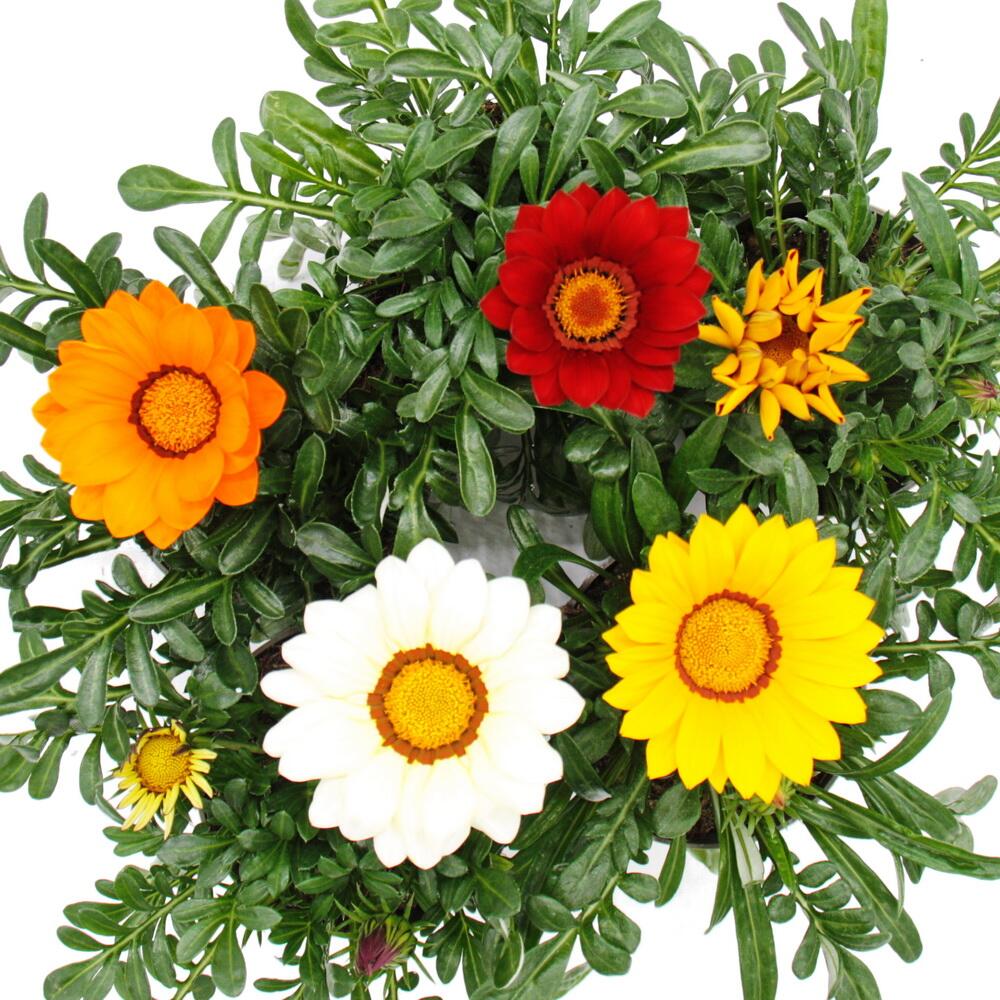
Gazania may look closed in the morning, showing its large flower heads later in sunlight. White, yellow, orange or red rays carry darker ring markings near the centre in the original photograph. Narrow, partly divided green foliage sits between them. This daily change becomes particularly visible beside a sunny seating place. The shop name Big Kisses is retained. Specialist catalogues use the related series name Big Kiss; we do not turn this into a promise of one particular colour or exactly equal plant heights in the set.
Arrange the young group with some space
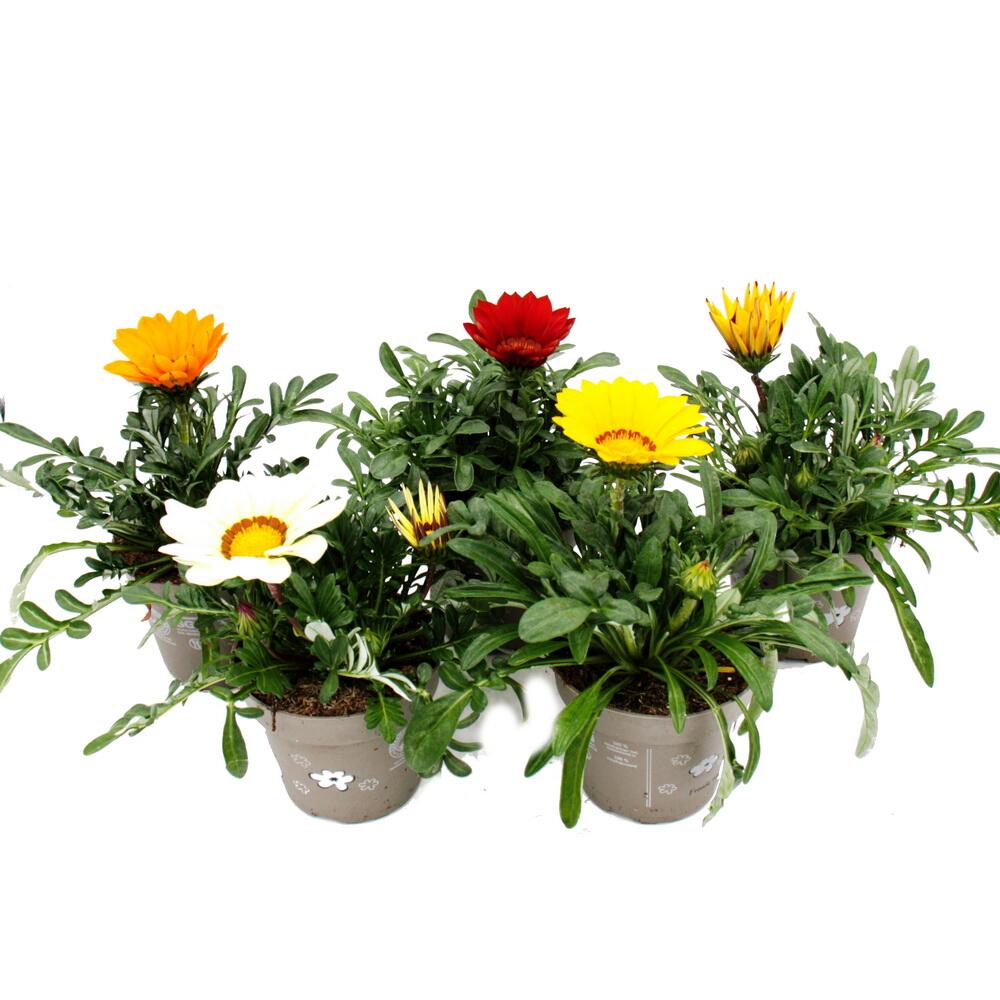
The offer describes three plants in 12 cm pots with approximately 20 to 25 cm plant height. Later series measurements vary with selection and cultivation and are no uniform delivery guarantee. Around twenty to thirty centimetres spacing can guide a low loose group. Lay out the young crowns before planting so they can develop sideways. A single closed flower on unpacking does not mean the plant is faulty. Light and time of day already belong to the first impression.
Sun is part of the flower display here
Choose a sunny warm position with well-drained soil. Gradually acclimatise plants from protected cultivation to strong outdoor radiation and plant only after frost risk. A house wall can provide warmth, but a shady space behind large pots does not help heads open. Flowers can remain closed in cloudy weather or at night. Do not treat this with extra fertiliser. Observe the course of the day first. This distinguishes normal flower movement from a real care need of the whole plant.
Partial drying is different from forgetting
Gazania tolerates dry phases better than many moisture-demanding summer flowers. A small nursery pot nevertheless remains a limited root space. Check soil and weight, let the surface dry out partly between applications, then supply specifically. Water must drain away. Heavy permanently wet soil does not suit its position preferences. Check sleeves and saucers after a rainy day. The argument that the plant handles sunshine does not become a ban on watering. Young roots also need to explore their new soil after planting.
Clean flower heads and preserve the leaf base
Free-draining soil and modest nutrient applications according to the fertiliser label accompany active growth. Faded stems may be removed while preserving the healthy leaf base. Do not cut off a small bud because it is still closed. With weak development, look at air and moisture around the roots too. Prolonged weather changes may affect flowering. A photograph of the same plant in the morning and later in sunlight is worthwhile in the plant book. It often reveals its character better than a picture seeking only as many simultaneously open heads as possible.
Honestly accompany a sunny season
Gazania is frost-sensitive and often grown seasonally in cold regions. Continuing cultivation would require suitable bright frost-free conditions; safe garden overwintering is not promised. Flowering may continue through the warm season without looking identical every day. Record position, light-facing side and actual development of the young group. Dark rings and different colours remain good recognition features. Part of its appeal lies in flowers opening and closing, not a fixed picture that must stay unchanged in every weather.
One plant, several views
Good to know
Why are the flowers closed in the morning?
Gazania heads respond to time of day and light; cloudy weather can also keep them closed.
Do Big Kisses and Big Kiss need different care?
Big Kisses is the shop name; specialist catalogues describe the Big Kiss series. No individual colour is fixed.
Is 25 cm always the mature height?
No. It is the young assortment figure; series profiles list differing cultivation measurements.
Can I omit watering entirely?
No. The small root ball needs controlled supply.
Which colours will I receive?
The chosen assortment selection is decisive, not the example scene mix.
Sources and editorial note
- Exotenherz: offer and original photographs (03.10.2026)
- NC State Extension – Gazania rigens, flower movement and cultivation (03.10.2026)
- Syngenta Flowers – Big Kiss series, selection characteristics (03.10.2026)
- Ball Seed – Big Kiss form and cultivation sizes (03.10.2026)
Shop offer, article number, GTIN, availability and original images checked directly on 02.10.2026; specialist acceptance on 03.10.2026. Specialist sources read directly. Specific SKU, dimensions, original images and orderability checked directly in the shop on 03.10.2026. Specialist sources read in full; shop name and botanical synonyms remain distinguishable. Currently not orderable: informational portrait without a purchase link, social drafts not cleared for sending. No Wawi, server or tool changes. Currently not orderable: informational portrait without a purchase link; social drafts not cleared for sending.