

This plant at Exotenherz
Check the shop offer for current availability, price and what is included.
Check the selected shop offer for price, availability and delivery contents.
Your care table
| Topic | What to do | Why it helps |
|---|---|---|
| Light | Choose sun to bright partial shade. | Finely divided leaves and open flowers show well at a suitable bed edge. |
| Soil | Prepare loose garden soil with good drainage. | Roots need moisture while establishing, but no permanent water hole. |
| Planting | Set the moist root ball at its previous height and water in. | Good soil contact supports the young delivery plant’s start. |
| Spacing | Allow approximately 40–50 cm between plant centres. | The later clump spreads noticeably beyond the small pot root ball. |
| Water | Supply new plants during drought; later assess soil and weather. | An established planting needs a different rhythm from freshly set plants. |
| Fertiliser | Supply moderately in spring if needed. | Good garden soil and appropriate light matter more than continual new fertiliser doses. |
| After flowering | Cut back unattractive leaves and spent shoots appropriately. | Fresh foliage and occasionally more flowers may regrow. |
| Division | Divide healthy larger clumps in spring if needed. | Rooted portions can be replanted and retain cultivar type. |
For young plants, feel the soil directly at the root ball. The surface and deeper soil may have different moisture levels.
Water thoroughly after planting; later, water according to the soil, weather and establishment rather than a fixed calendar.
Avoid standing water. For plants in containers, also check that water runs out of the drainage hole.
Flowers like little open bowls
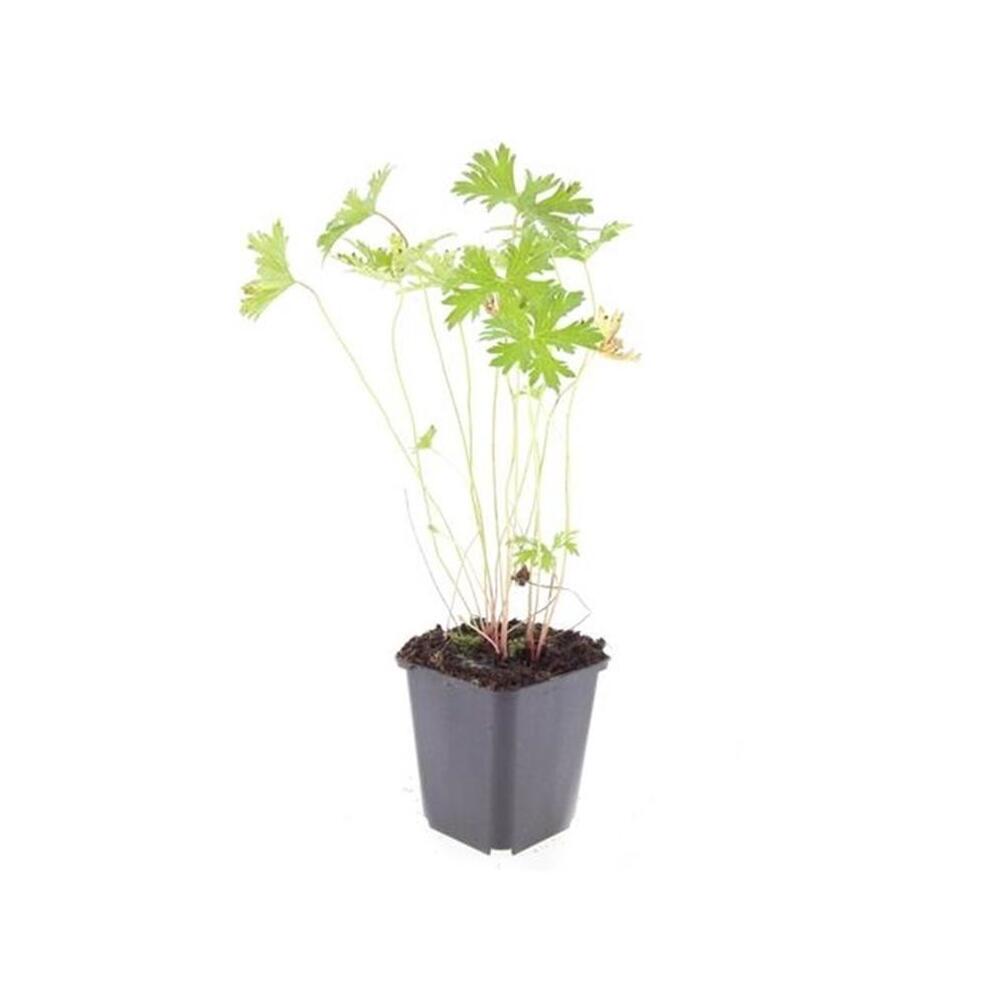
With Johnson’s Blue I particularly like the open flowers among finely divided foliage. Five lavender-blue petals look light rather than densely double. Fine darker veins add detail up close. Stalks carry flowers loosely above the green clump, so the plant does not resemble a stiff bouquet. Near small garden steps or at a bed edge, these details are easy to see. Young plants in the shop, however, are still the beginning: a 9 cm pot and about 10–25 cm delivery height do not describe a fully established flowering cushion.
Distinguish the name for ordering from the plant for care
The offer is named Geranium pratense Johnsons Blue. Botanical listings show the same cultivar as Geranium × johnsonii Johnson’s Blue. The selected article number with its direct shop link is therefore helpful for ordering. This is a perennial garden cranesbill, not the ordinary balcony pelargonium. Developed growth often lies around 30–50 cm and can be taller in favourable places. It needs width as well. Looking only at the small nursery pot makes it easy to underestimate how loosely leaf stalks and flowers later lie across neighbours.
A bed edge can be welcoming without staying wet
I would place Johnson’s Blue in sun or bright partial shade and check the soil by hand first. Does it loosen well, or does water stand in a hollow long after rain? That observation helps more than a sweeping claim that a perennial is undemanding. It should be able to root without its root ball continually standing in water. It looks attractive among other garden perennials but needs its own space. Directly beneath dense foliage, conditions differ from an open bed edge. A change of position therefore cannot be compensated just with the same number of watering cans.
Plan a later group with the set plants
Offers contain different quantities of the same young cultivar. Before planting I lay out the pots on the intended area before making holes. Approximately 40–50 cm from centre to centre is the shop guidance; it specifies four to six plants per square metre. Along a narrow path, spacing can be looser than on an area intended to close later. Moisten the root ball and set at its previous height. After watering in, check that soil connects well. This start is easy to support in spring; autumn planting must suit frost-free soil that is not waterlogged.
Main flowering belongs to early summer
Johnson’s Blue has its main flower phase in late spring and early summer. For bed planning, that is more useful than promising an evenly closed display throughout the warm season. The picture changes after the main flush. Individual shoots lengthen, and leaves can look untidy in heat or after many flowers. I deliberately assess the planting then rather than overfeeding it. Appropriate cutting back of spent shoots and unattractive leaves may encourage fresh growth; further flowers sometimes appear. Repeat bloom is a possibility, not a fixed date every plant must fulfil.
Care does not start from zero again after cutting
When foliage has been cut back, I check soil moisture especially carefully. Dry garden soil and a newly planted clump need more support than a well-rooted planting after rain. I water into the soil when needed without keeping the position wet permanently. The cleared space also gives a chance to remove densely emerging competition gently. The aim is not to force every leaf instantly into a flawless form. A healthy base and fresh shoots finding their way matter more to me. I look more closely at unusual spots or coatings before choosing further measures.
The flowerless time belongs to the cranesbill too
This deciduous cranesbill changes considerably in autumn and winter. Foliage dying back does not mean the garden clump has disappeared. The resting perennial retains its place for next growth. Healthy larger plants can be divided in spring if needed; rooted portions are replanted carefully. That is also a good time to reassess bed spacing and position. Water and root space are much more limited in a small container than in the bed. Anyone holding Johnson’s Blue there temporarily watches the root ball especially carefully and does not confuse that cultivation with the later broadly grown garden planting.
One plant, several views
Good to know
Does Johnson’s Blue flower all summer?
Main flowering is in late spring and early summer. Repeat bloom is possible after suitable cutting, but not guaranteed.
Is this a balcony geranium?
No. It is a perennial garden cranesbill in the genus Geranium, not an ordinary pelargonium.
Why does the portrait show another botanical name?
The shop specifies Geranium pratense Johnsons Blue; botanical listings place the cultivar under Geranium × johnsonii Johnson’s Blue. Specific offers are linked with their article numbers.
How much room should I leave?
Roughly 40–50 cm between plant centres, four to six plants per square metre as shop guidance. The later clump grows wider than the small pot.
Can it grow in partial shade?
Bright partial shade is suitable. This does not mean very dark positions beneath dense growth.
When should I cut the plant?
After the main flowering, spent shoots and unattractive foliage can be cut back. Protect the base and fresh shoot beginnings.
Is a small delivery plant already in full flower?
The offer describes young plants in 9 cm pots about 10–25 cm tall. Developed full flowering at delivery is not promised here.
Sources and editorial note
- Exotenherz: checked quantity sets, delivery size and spacing (01.10.2026)
- RHS: Johnson’s Blue, botanical name, cultivation and cutting (01.10.2026)
- RHS: planting and caring for perennial cranesbills (01.10.2026)
- Illinois Extension: Johnson’s Blue, growth and main flowering (01.10.2026)
- Iowa State University: cultivar comparison and flowering phases (01.10.2026)
Five child sets checked live: 6/12/60 active, 20/40 inactive. Shop name Geranium pratense Johnsons Blue retained; RHS lists the cultivar as Geranium × johnsonii. Main flowering in late spring/early summer, with no general all-summer advertising claim adopted. Height usually 30–50 cm, possibly taller in good cultivation; shop spacing 40–50 cm. Original 2 advertising-free. Visual acceptance: five open lavender-blue petals with fine veins, finely divided foliage and later bed growth appropriate. Warm garden light, no advertising text.