

This plant at Exotenherz
Check the shop offer for current availability, price and what is included.
Product and delivery details are given in the individual offer.
Your care table
| Topic | What to do | Why it helps |
|---|---|---|
| Light | Choose a partially shaded to shaded garden position with an accessible root zone. | Even shaded soil may dry out beneath shrubs. |
| Planting | First arrange the small set plants in their pots across the area. | This keeps path edges and weaker neighbouring plants clear. |
| Water | Check the root ball during establishment and water slowly and thoroughly as needed. | Young plants do not yet have the root space of an older planting. |
| Soil | Use humus-rich, well-drained soil without lasting standing water. | Moisture-retentive soil and standing water are not the same. |
| Feed | Supply moderately in spring as needed following the label. | Stronger growth is not always desirable where space is limited. |
| Pruning | Shorten unwanted shoots early and remove rooted portions. | Side shoots can quickly connect new planting spots. |
| Winter | Choose a sheltered garden position; protect potted root balls from severe cooling and drying. | The species profile does not guarantee every winter or every small container. |
| Safety | Treat as an ornamental plant and do not eat. | Children and pets should not nibble leaves or shoots. |
Check the compost and pot weight. The care table explains how far the compost may dry.
Water only when needed. The water should reach the root ball without spilling over the rim.
Remove surplus water from the saucer or cachepot. Then return the plant to a suitable position.
More leaf area, a different garden rhythm
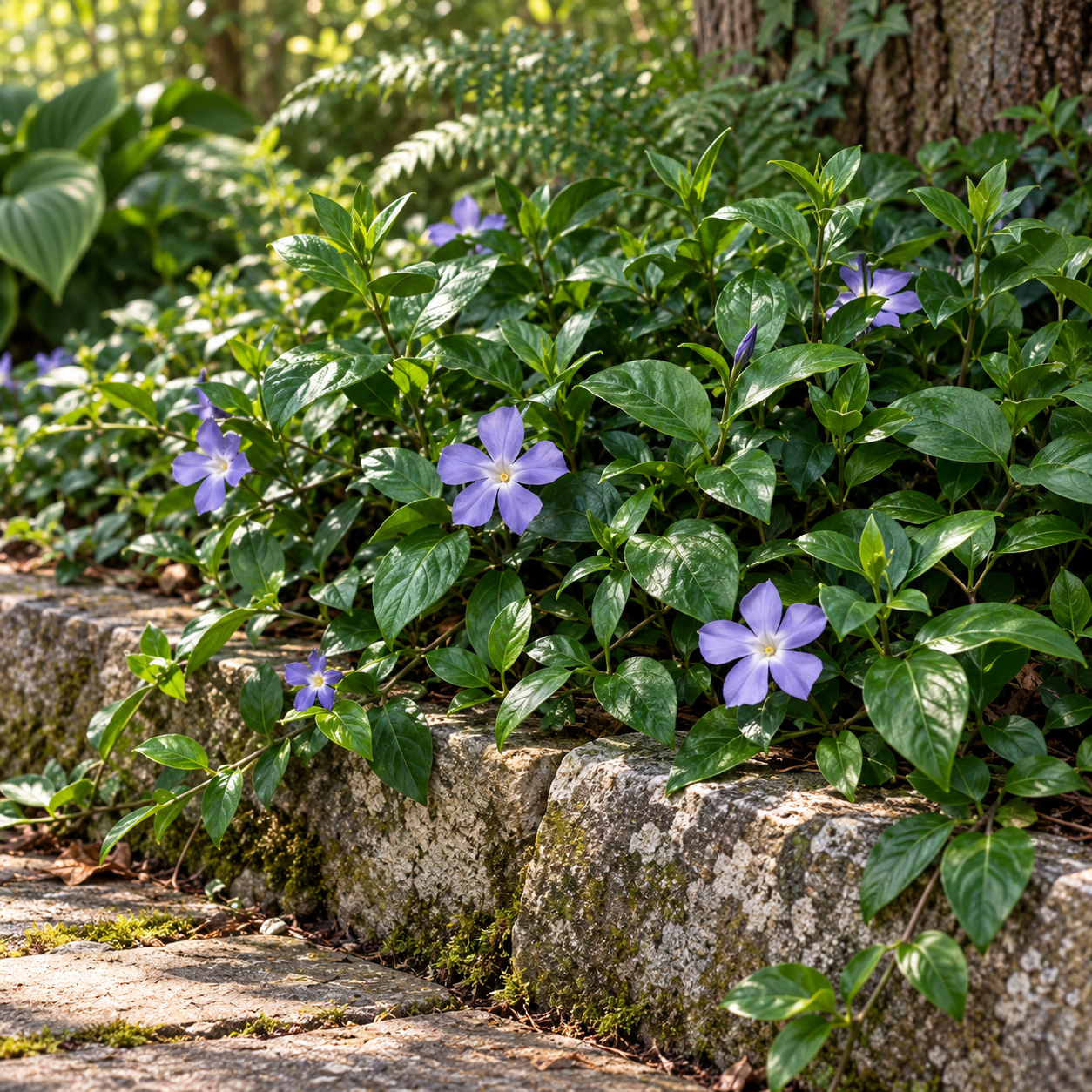
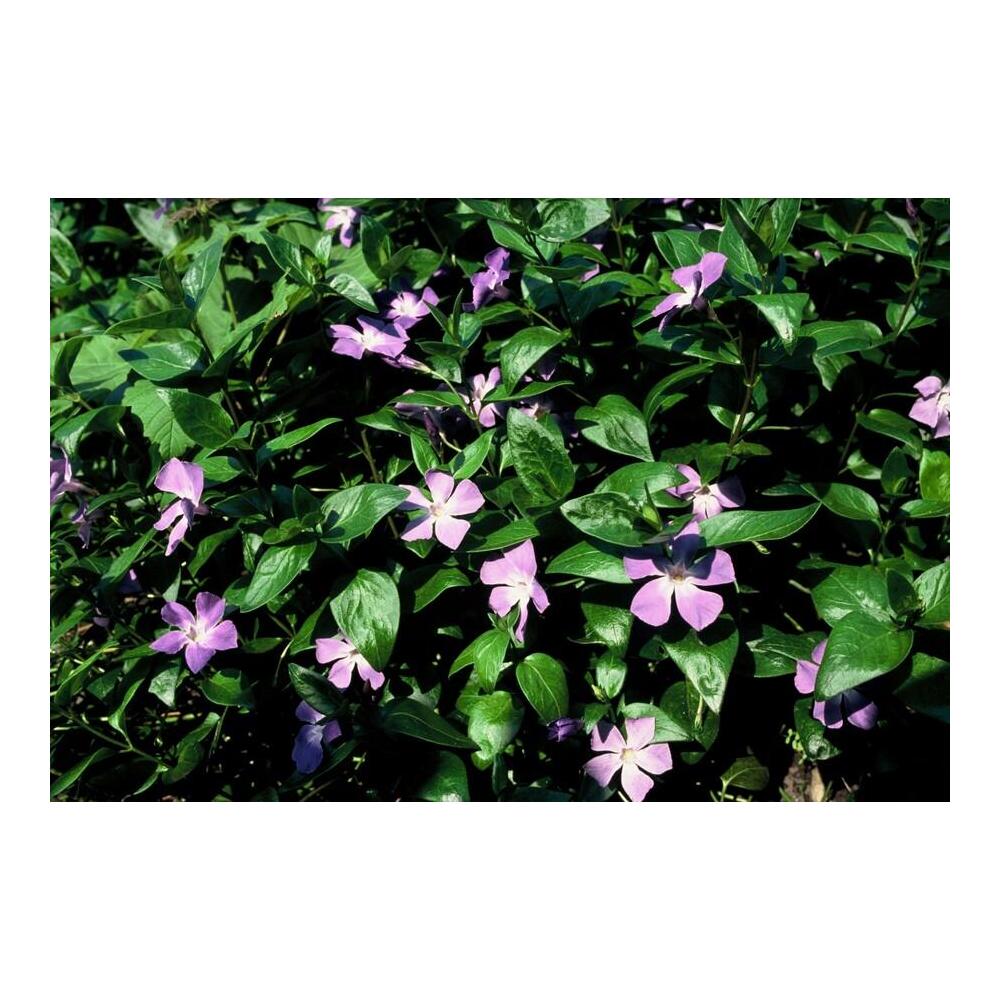
Greater periwinkle catches the eye first through its foliage. Opposite leaves are broader and larger than those of Vinca minor; their bases look rounded and their surfaces shine. Between them stand lavender-blue to blue-violet flowers in the typical pinwheel shape. This creates a stronger impression of green coverage than small-leaved cultivars. Such growth may look lovely against an old stone border if the plant has space and the edge stays accessible. This portrait describes the green-leaved species Vinca major. White-edged or white-flowered cultivars create different garden pictures and are not equated with it.
Do not measure vigorous growth by the delivery pot
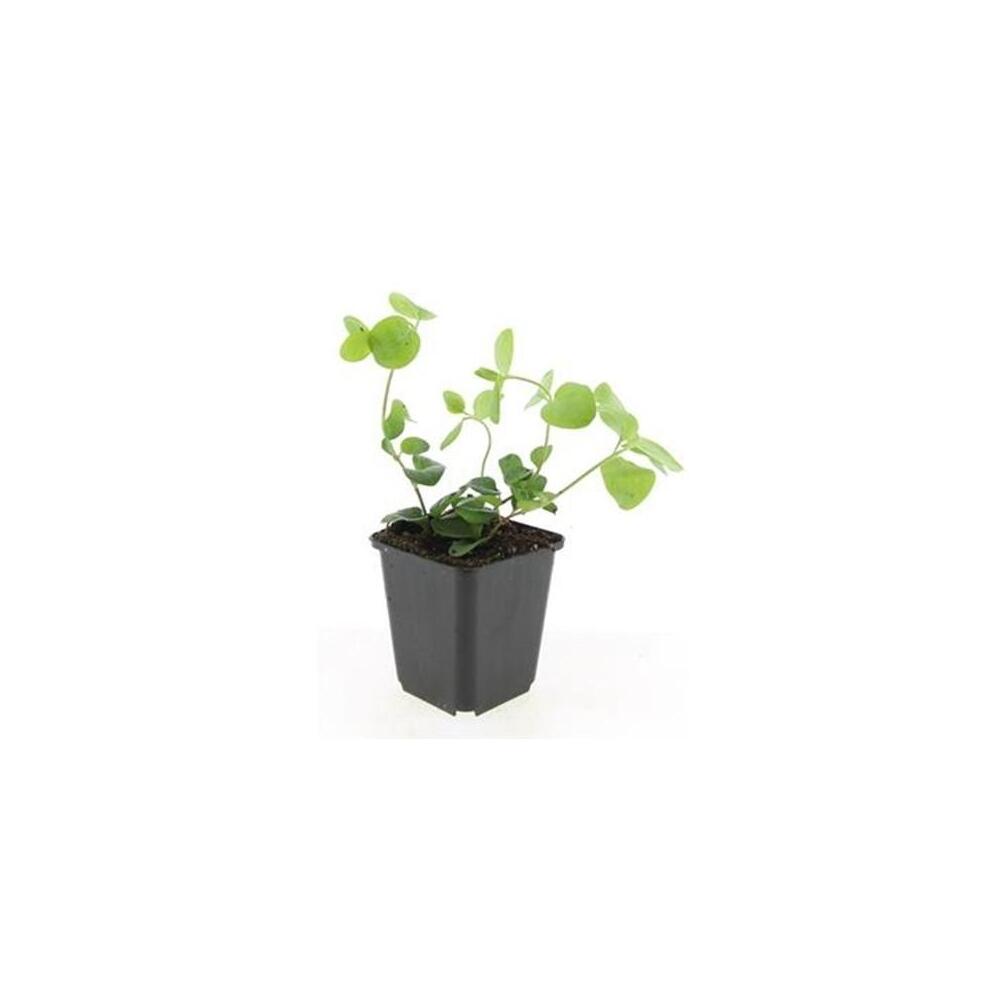
Young offers stand in 9-cm pots and measure roughly 10 to 25 cm overall, including the pot. A developed garden planting is different. Oregon State University gives around 30 to 46 cm height for the species; other profiles describe lower coverage. These differences show how strongly position and the part of growth considered matter. Do not plan a border edge kept low to the exact millimetre. Sideways spread particularly needs room. The shop gives 30 to 35 cm planting distance. Arrange the set plants beforehand and keep sensitive small neighbours out of the intended periwinkle area.
Choose shade and check the soil too
Partial shade to shade with humus-rich, moisture-retentive, well-drained soil makes a clear starting point. Looking at the ground matters as much as looking at the sky. Shrubs may intercept rain; beside stone surfaces, heat and wind can dry the edge. Check that water soaks in slowly and can then drain away. A permanently wet hollow is no substitute for a fresh root zone. Loosen the planting area and keep it accessible for watering. Strong later coverage should not hide the fact that every young plant begins with a small, limited root ball.
Make the first connection with garden soil
Spring or early autumn often ease establishment when soil is frost-free and not waterlogged. Moisten the root ball, remove the pot and plant at the same height. Do not pull the plant from its container by long shoots. Settle soil gently around it and water slowly so the root zone makes contact. During establishment check moisture directly around the former pot root ball. Dark surface soil nearby says little about a small ball that has dried out. Water thoroughly when needed; a little daily splash is not reliable supply. New shoots and firmly rooted extensions later show that the plant has gained ground.
Flowers are one part of the picture
Flowering is concentrated in spring. Occasional later flowers may follow without every spot constantly glowing blue. Their size and broad foliage distinguish this species from finer lesser periwinkle. An original photograph of a flowering garden planting shows possible development, not guaranteed flowers in a young delivery. If flowers are few, consider light, planting age and nutrition together. Lots of fertiliser is no certain route to more flowers and may intensify already vigorous spreading. Outside flowering, glossy green foliage remains the main design feature.
A clear boundary belongs to care
Vinca major can root shoots lying on the soil and occupy new places. Regularly inspect paths, planting edges and transitions to small perennials. A fresh overlong shoot is easier to remove than several firmly established rooting points. Completely remove unwanted rooted sections rather than just pinching off their tops. This species does not suit every tiny gap simply because it is called ground cover. Specialist reports of strong spread in other countries also do not establish its German legal status. The gardening consequence matters here: choose the area deliberately and keep tending its boundaries.
Think differently about winter in a pot
An outdoor container holds limited water and root reserves. Use open drainage holes, adequately well-drained soil and remove water from saucers. If the ball is densely rooted, move into a suitable larger container or plant in a border. Place somewhere sheltered in winter and check for dryness on frost-free days. A species description does not give an unrestricted frost guarantee for a small pot on a windy balcony. First assess brown leaves alongside cold, sun and moisture. In spring remove dead shoots and watch where living growth appears. Periwinkle remains ornamental and is not for eating.
One plant, several views
Good to know
Is Vinca major the same as Vinca minor?
No. Vinca major has larger, broader leaves and a stronger covering effect. Consider spread especially carefully in small gaps.
Why do specialist sources give different heights?
Species profiles consider different positions and growth stages. OSU gives around 30–46 cm: guidance, not a fixed final height in every garden.
What does 10–25 cm in the offer mean?
Total height of the young plant including its 9-cm pot. It describes neither later spread nor garden height.
Does this species flower white?
This green-leaved offer belongs to the species flowering blue-violet to lavender blue. White-flowered cultivars must be considered separately.
Can it overgrow a small neighbour?
Yes. Long shoots can root; check boundaries and remove unwanted growth early.
Is it intended for a dark living room?
No. This portrait describes a garden plant, not a houseplant for dim rooms.
Sources and editorial note
- Exotenherz: offer and original photographs (03.10.2026)
- Oregon State University: Vinca major – foliage, habit and position (03.10.2026)
- NC State Extension: Vinca major – species profile (03.10.2026)
- Exotenherz: checked 6-plant child offer (03.10.2026)
- Exotenherz: checked 12-plant child offer (03.10.2026)
- Exotenherz: checked 20-plant child offer (03.10.2026)
- Exotenherz: checked 40-plant child offer (03.10.2026)
- Exotenherz: checked 60-plant child offer (03.10.2026)
Shop offer, product number, availability and original images directly checked on 03.10.2026. Specialist sources directly read. OSU and NC species profiles directly read. Differing height ranges transparently classified as species guidance depending on position. No blanket frost temperature or easy-care promise. Direct links to child offers checked; 20- and 40-plant sets were not orderable when checked. Original gallery unchanged; stamped images were not used publicly.