
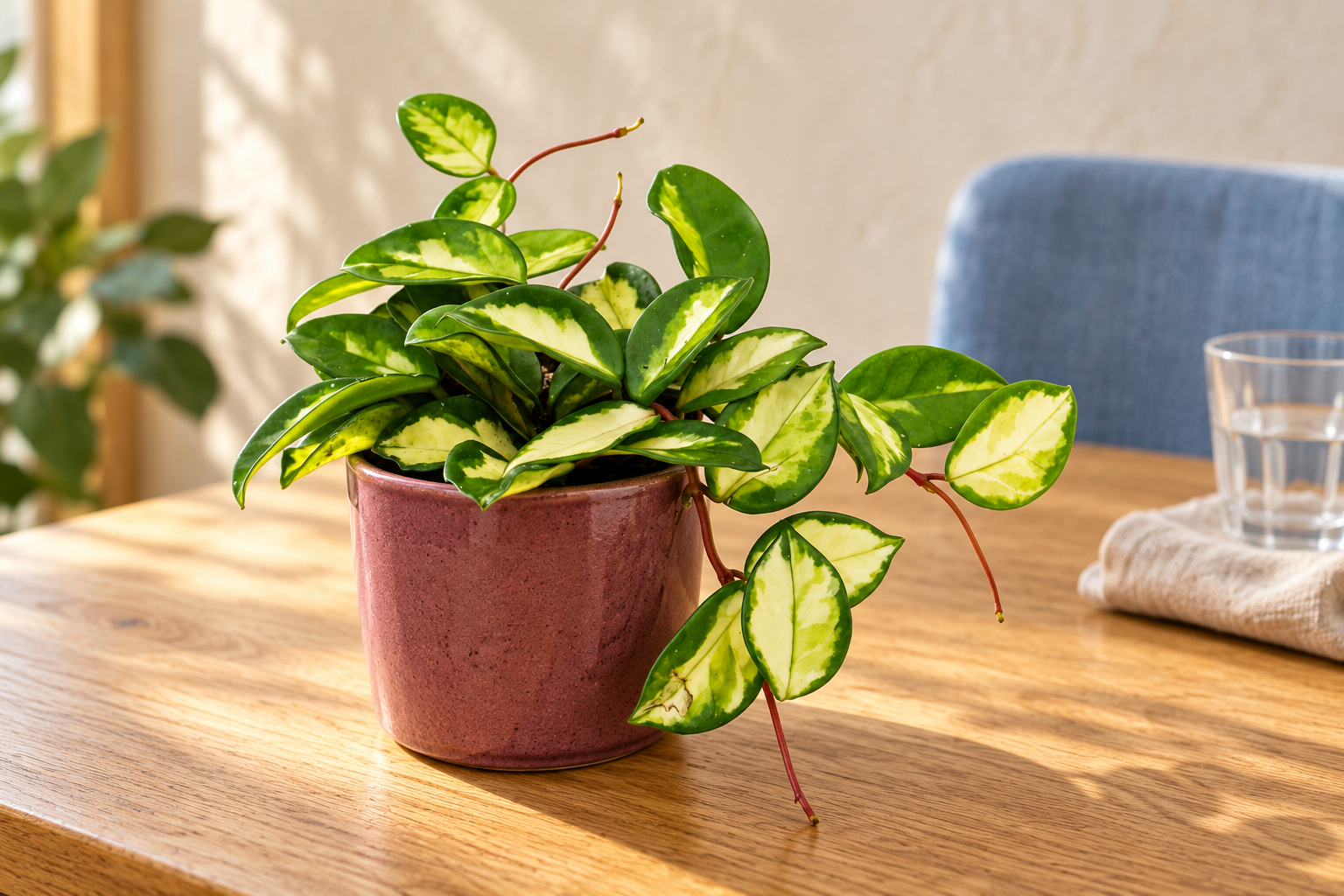
This plant at Exotenherz
Check the shop offer for current availability, price and what is included.
Check the selected shop offer for price, availability and delivery contents.
Your care table
| Topic | What to do | Why it helps |
|---|---|---|
| Light | Choose a genuinely bright open position; soften hot summer sun. | The variegated foliage should develop well without sensitive leaf surfaces burning. |
| Water | Let the root ball dry partly and check pot weight as well before watering. | A dry surface alone says little about moisture inside. |
| Drainage | Let water drain away and empty the outer pot afterwards. | Waxy leaves do not make roots insensitive to waterlogging. |
| Mixture | Use humus-rich loose soil with suitable coarse ingredients. | An airy structure supports the root space and prevents long-lasting stagnant wetness. |
| Nutrients | Feed moderately during active growth, following the fertiliser instructions. | Leaf colour and shoot development need suitable cultivation, not heavy extra doses. |
| Container | Choose a slightly larger pot only when the roots make good use of their space. | A large reserve of wet soil is no advantage for the young plant. |
| Vines | Guide loosely or allow to grow freely over a bright edge. | Healthy searching shoots continue developing and should not be cut off too quickly. |
| Flowers | Keep conditions stable when buds appear and retain healthy old flower stalks. | Moving positions can stress buds; existing flower stalks can flower again. |
Check the compost and pot weight. The care table explains how far the compost may dry.
Water only when needed. The water should reach the root ball without spilling over the rim.
Remove surplus water from the saucer or cachepot. Then return the plant to a suitable position.
The light pattern sits in the leaf centre
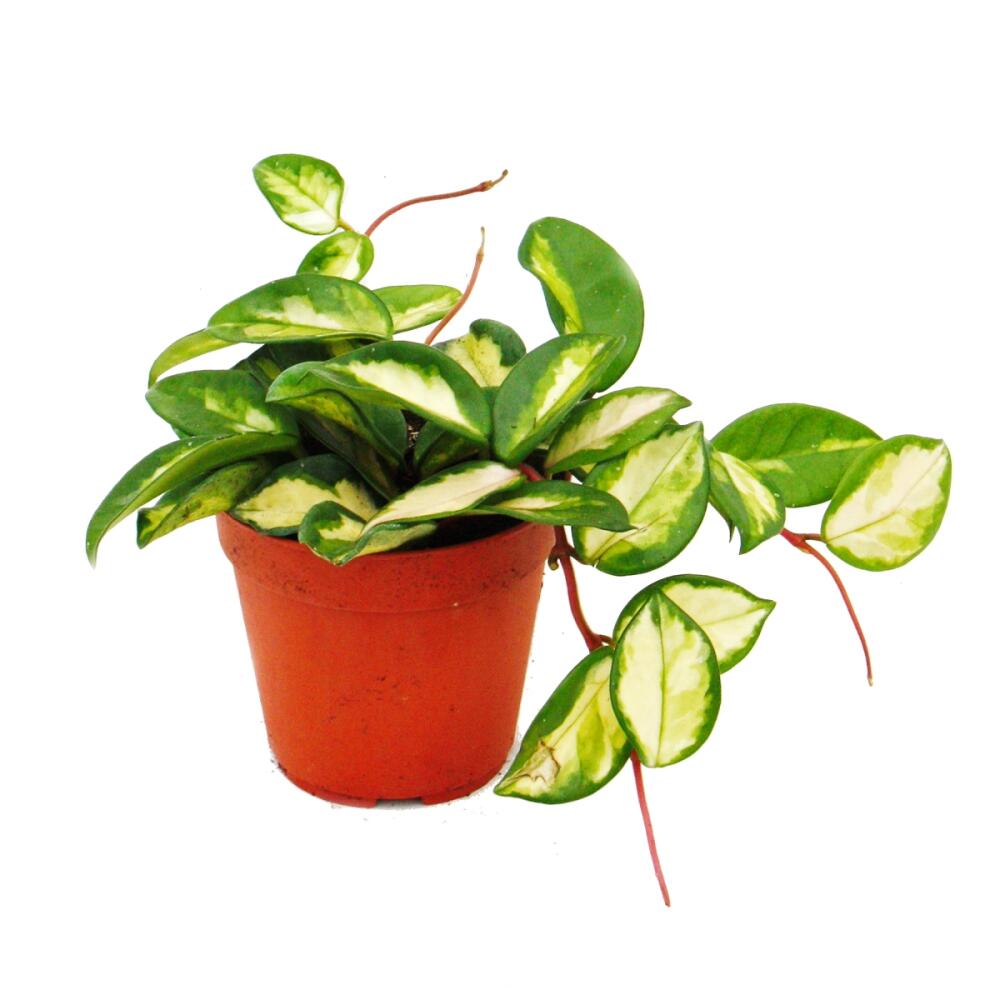
Not every variegated hoya has the same pattern. On the specimen offered here, cream areas lie mainly in the leaf centres, while green areas follow the edges. The light patch is broad on some leaves and narrower or more irregular on others. Firm oval leaves and reddish shoots together make a calm yet lively plant. We retain the shop name Tricolor and show the real original alongside it. An attractive leaf pattern alone does not establish another cultivar or clone name. It needs no extra leaf shine to be appreciated: its waxy surface already looks beautiful in gentle daylight.
A small specimen with room for its vines
The offer specifies a 12 cm pot and approximately 20 cm total length. That is a compact beginning, not a mature hanging plant with metre-long shoots. An open shelf or the side of a bright table can show the short vines well. Later they can grow over the edge or along a loose support. When unpacking, loosen thin shoots gently; do not pull a caught shoot out by its leaf. Then first choose a suitable quiet position. Repotting is not compulsory on day one. A sound container with clear drainage holes can keep doing its job while roots and root ball cope well.
Brightness without paying for it with sunburn
The variegated foliage suits a bright position, but not an unaccustomed move into the hottest direct summer sun. Gentle daylight makes its pattern easy to see and supports development. A curtain can soften strong radiation at the window. After shipping or a move, acclimatise slowly rather than taking it from a protected place straight to hot glass. We assess the leaf pattern across several new leaves. A single light or dark area is no precise measure of care quality. Nor must every free shoot immediately form perfect symmetry after the pot is turned: a vining plant can show its own movement.
Check the soil rather than being fooled by firm leaves
A hoya with its sturdy leaves can feel much firmer than delicate foliage. Its roots still need suitable water supply. Let the root ball dry partly between waterings and check its moisture before the next one. When needed, water evenly, allow to drain and see whether water remains in the outer pot. A light dry pot calls for a different approach from heavy moist soil with limp leaves. Repeated severe drying is no more ideal than constant wetness. During warm bright growth, pauses are often shorter; on darker days they lengthen naturally.
Plant loosely and let root space grow with the plant
The hoya does not need heavy compact soil. A loose humus-rich mixture with suitable coarse ingredients, such as a little bark, keeps air between the roots. The container must reliably release excess water. Repot as needed during active growth, handle the existing root ball gently and choose a container only slightly larger. Lots of additional wet soil does not speed up a young plant. We also stay moderate with feeding and account for whether the substrate is already fertilised. Suitable fertiliser instructions are the starting point; low light or root damage are first tackled at their cause.
Flowers need a well-grown plant
The appeal of this young plant lies first in its foliage. The specific shop offer is delivered without buds or flowers. With sufficient development and suitable conditions, a hoya may later produce scented clusters of star-shaped flowers. We give no fixed deadline. Good light and a healthy root ball help more than frequent moves or additional fertiliser. When buds appear, keep the established position as far as possible and attend carefully to water supply. Leave healthy short flower stalks after flowering: the plant can start again there. Searching shoots with few leaves also deserve patience while they look alive and healthy.
Notice winter slowdown and see small problems early
When a hoya grows more quietly on short days, the root ball usually takes longer to dry. Check more often now and water less by the calendar. Light remains important; avoid cold draughts and direct heater air on the foliage. An unchecked cold dry treatment is no reliable route to this young specimen’s next flowering. When checking, look at leaf bases and vines: small cottony patches may indicate mealybugs. First separate affected plants and examine more closely. Cut damaged parts only selectively with clean tools. Wear gloves when cutting and repotting, and keep escaping plant sap away from eyes and sensitive skin.
One plant, several views
Good to know
Where is the light pattern on this offer?
The original shop photo shows mostly cream leaf centres with green marginal areas. Distribution and width vary between leaves.
Does the shop name automatically mean another familiar hoya clone?
No. We use the documented trade name Tricolor and classify it under Hoya carnosa without claiming another clone name.
How large is the delivered plant?
The offer specifies a 12 cm pot and approximately 20 cm total length. Longer vines may develop only later.
Can it stand on a dark bookshelf?
An open bright shelf position is suitable; a deep dark recess slows development. Light at the plant itself is what matters.
Should I automatically water the hoya every week in winter?
No. Check root-ball moisture and pot weight. With lower consumption, soil takes longer to dry partly.
Will it arrive with flowers?
The specific offer states delivery without buds or flowers. Later flowering is possible but not guaranteed.
Sources and editorial note
- Exotenherz: documented trade form, delivery size and original
- RHS: Hoya carnosa, species characteristics and cultivation
- RHS: caring for hoyas, position, roots and flowers
Shop offer and sources read directly on 30.09.2026: SKU 137230112018, GTIN 4019515912346, 12 cm pot, approximately 20 cm total length, immediately available. Original photograph with cream leaf centres and green outer areas; no identification as an unsubstantiated Krimson Princess, Krimson Queen or other clone name. Tricolor is presented here as the documented trade form of Hoya carnosa; the specific pattern in the original takes precedence over a general cultivar description. Care based on RHS Hoya carnosa and hoya cultivation. Explicitly delivered without buds or flowers. No particular flower colour or flowering period is guaranteed for this trade form. Image acceptance passed: cream leaf centres, green outer areas, young short vines and pot proportions match the original. No flowers or writing.