
This plant at Exotenherz
Check the shop offer for current availability, price and what is included.
Check the selected shop offer for price, availability and delivery contents.
Your care table
| Topic | What to do | Why it helps |
|---|---|---|
| Light | Place in bright light; soften hot direct summer sun. | A bright position supports development; abruptly strong sun can damage the foliage. |
| Water | Let the root ball dry partly between waterings, then water thoroughly and allow to drain. | Fleshy leaves bridge dry spells, but the roots do not tolerate permanent wetness. |
| Winter | Maintain light and adjust water to lower consumption. | Short days slow growth; lower evaporation means longer pauses between waterings. |
| Root space | Use loose, humus-rich soil with coarse ingredients that provide structure. | Air in the root ball matters as much as moisture for this epiphytic wax plant. |
| Repotting | When the root ball is well rooted, move to a slightly larger pot during growth. | Too much unrooted soil stays wet for a long time and gives no automatic growth advantage. |
| Nutrients | Feed moderately during visible growth, following a suitable fertiliser’s instructions. | A small plant does not need heavy feeding to develop long vines. |
| Vines | Guide along a loose support or let them trail from a bright shelf. | Healthy searching shoots with few leaves can continue developing; they are not waste. |
| Flower stalks | Leave healthy old flower stalks in place after flowering. | Wax plants can form new buds on them. |
Check the compost and pot weight. The care table explains how far the compost may dry.
Water only when needed. The water should reach the root ball without spilling over the rim.
Remove surplus water from the saucer or cachepot. Then return the plant to a suitable position.
Narrow leaves with little points of light
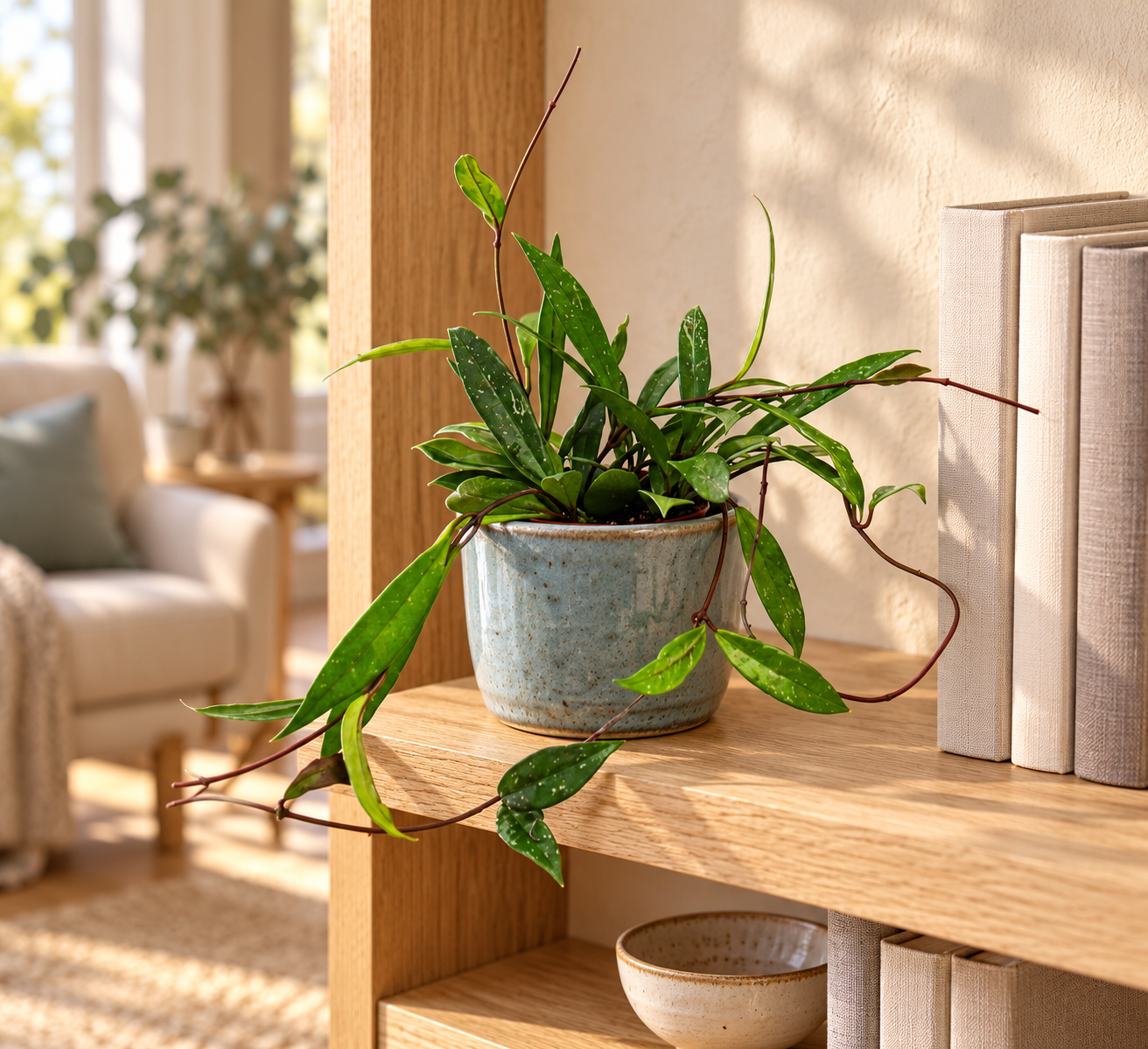
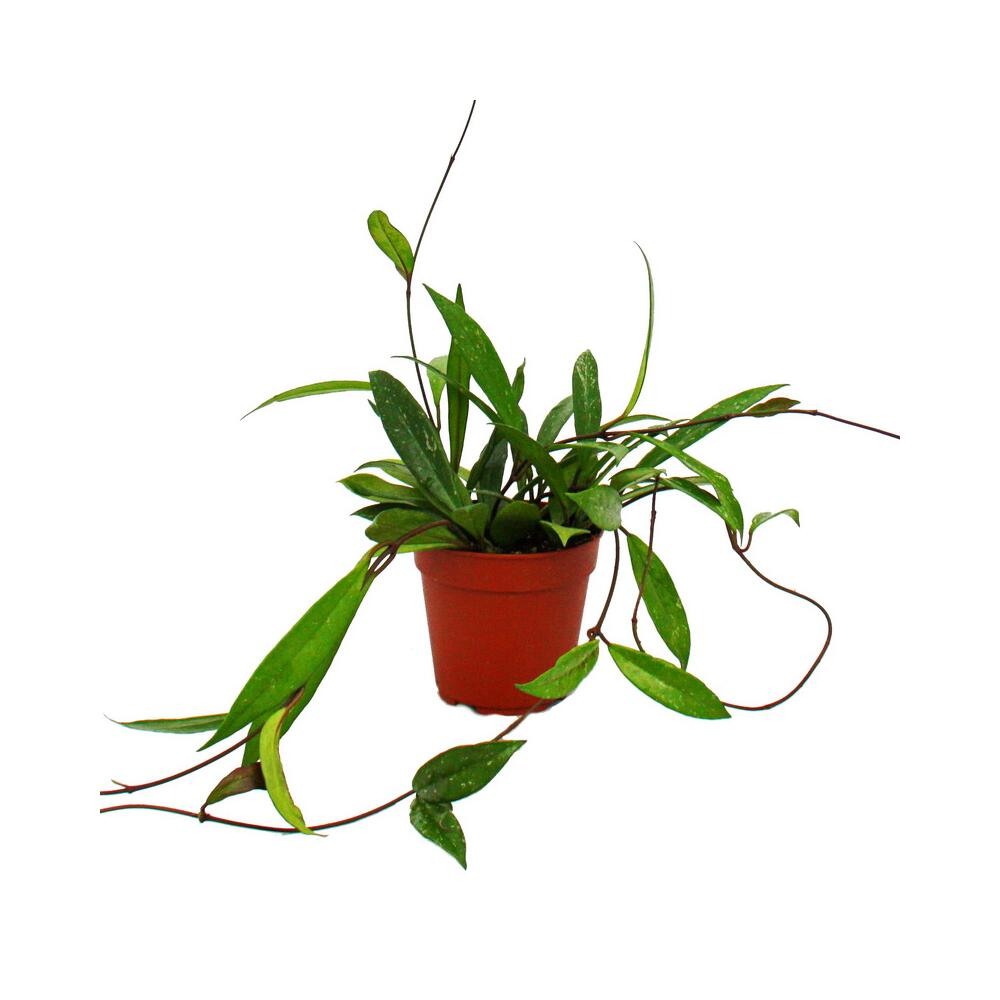
Hoya pubicalyx has a different silhouette from a round-leaved trailing plant. Its sturdy leaves narrow to pointed tips; the offered specimen shows irregular silvery flecks. Some surfaces have more of them, while others remain mostly green. These differences are part of its appearance, not a promise of a particular pattern distribution on every new leaf. We especially like the interplay between firm leaf surfaces and fine, flexible shoots. A bright bookshelf makes both easy to see. Please do not mistake the silvery patches for a deposit that needs hard rubbing: a gentle damp wipe is enough for cleaning.
Delivery length is only the beginning
The shop offer specifies a 12 cm pot and approximately 20 to 30 cm total length. This means a young plant with short to slightly trailing shoots, not a fully grown green curtain. Hoya pubicalyx can develop long vines later. Give them room without putting the small specimen into an enormous pot from the outset. When unpacking, loosen the vines gently rather than pulling individual leaves. A stable position at the front of a shelf looks attractive if no shoot can be trapped in a door or caught as someone passes. A hanging basket likewise needs secure suspension and soil that can be reached for care.
A bright bookshelf really must be bright
A bookshelf can be a good position as long as plenty of daylight reaches it. Hiding the attractive plant deep between dark rows of books does not help it. Choose an open space in a bright room; gentle morning or evening sun can often be used after acclimatisation. Soften hot direct midday sun through glass instead. After shipping and a change of position, introduce stronger light gradually. Observe new leaves and shoots rather than measuring only the distance from the window. Useful light combined with steady warmth matters more for development than especially unusual decoration around the pot.
Watering also means letting air back in
Before watering, we check the soil and pot weight. The root ball may dry partly between waterings; when needed, water it evenly afterwards. Let excess water drain away completely and check the outer pot. Firm leaves provide a small reserve, but that is no reason to let the plant dry out unattended for weeks. Nor does every dry surface need immediate watering if the centre is still moist. Wrinkled leaves can fit either water shortage or damaged roots. The first check is therefore the soil. Dark soft shoots or a root ball with an unpleasant smell deserve a closer examination of the roots.
A good root ball needs no oversized pot
In its native habitat, Hoya pubicalyx climbs in tropical surroundings. For pot cultivation, loose root space suits it better than heavy soil that stays wet for a long time. Suitable houseplant soil can be made airier with coarse bark and other structural ingredients. The nursery pot retains clear drainage holes even inside an attractive decorative pot. Repot to a slightly larger size during growth only when the roots make good use of the existing space. For feeding, we follow suitable product instructions and account for already fertilised soil. Heavy feeding is no repair for low light or wet roots; conditions must be right first.
Searching shoots can search, flower stalks can stay
A long thin shoot with few leaves is not automatically dead on a climbing hoya. It can explore space and continue developing. Guide it loosely along a support if needed; avoid ties that cut sharply into it. Older, well-grown plants can carry scented clusters of star-shaped flowers. Reddish to pink tones are described for this species, but this specific offer guarantees no particular flower and explicitly supplies the plant without buds or flowers. If buds form later, keep the established position as far as possible. After flowering, do not simply remove healthy short flower stalks: they can become the starting point for further clusters.
Winter attention rather than forced flowering
Consumption often falls on short days. Maintain a bright position, check the root ball and allow more time between waterings if it dries more slowly. Cold draughts and a wet pot on a cold surface are unfavourable. We do not force a cold dry phase on this young plant to get flowers quickly. A hoya first needs to be allowed to grow healthily. It is also worth checking leaf bases and vines: small cottony patches may be mealybugs, firmly attached shields may be scale insects. First separate a suspicious plant and clarify the finding. Wear gloves when cutting and keep plant sap away from eyes and sensitive skin.
One plant, several views
Good to know
Is Hoya pubicalyx a trailing or climbing plant?
Either is possible. Its vines can grow along a support or trail from a bright shelf or hanging basket.
Why does a new shoot have hardly any leaves yet?
Healthy searching shoots may initially grow thinly with few leaves. Do not cut them off for that reason alone; observe the shoot and further development.
Are the silvery flecks a pest?
On the pictured shop specimen, irregular silvery flecks are part of the leaf appearance. New spots accompanied by webs, changed leaf surfaces or animals need closer examination.
Will the plant arrive in flower?
No. The linked offer explicitly specifies delivery without buds or flowers. Later flowering depends on development and cultivation.
Should I cut off spent flower stalks?
Leave healthy short flower stalks in place. Flowers can develop there again. Damaged or dead parts can be removed selectively.
How often should I water it in winter?
Do not use a fixed number of weeks. Light, warmth, substrate and root-ball moisture determine demand; pauses get longer when drying is slower.
Sources and editorial note
- Exotenherz: delivery plant, size and original photo
- Kew: Hoya pubicalyx, species and origin
- RHS: Hoya pubicalyx, growth and flowers
- RHS: caring for hoyas, vines and flower stalks
Product and specialist sources read directly on 30.09.2026. Shop: SKU 192216072021, GTIN 4019515916313, 12 cm pot, total length 20–30 cm, immediately available; explicitly delivered without buds or flowers. The clean original photograph shows young narrow flecked leaves and searching shoots. Kew confirms the species and origin on Luzon; RHS confirms climbing or trailing growth and describes pale red star-shaped flowers with pink centres. The general shop statement of white flowers is therefore not adopted as a species-specific flower promise. No named clone or Splash cultivar is invented from the image. A general recommendation for cool overwintering of hoyas is not adopted unchecked as a flowering requirement for this young indoor specimen. Scene accepted: narrow green flecked leaves, searching shoots and young proportions match the original; bright bookshelf position, no flowers or writing on books.