
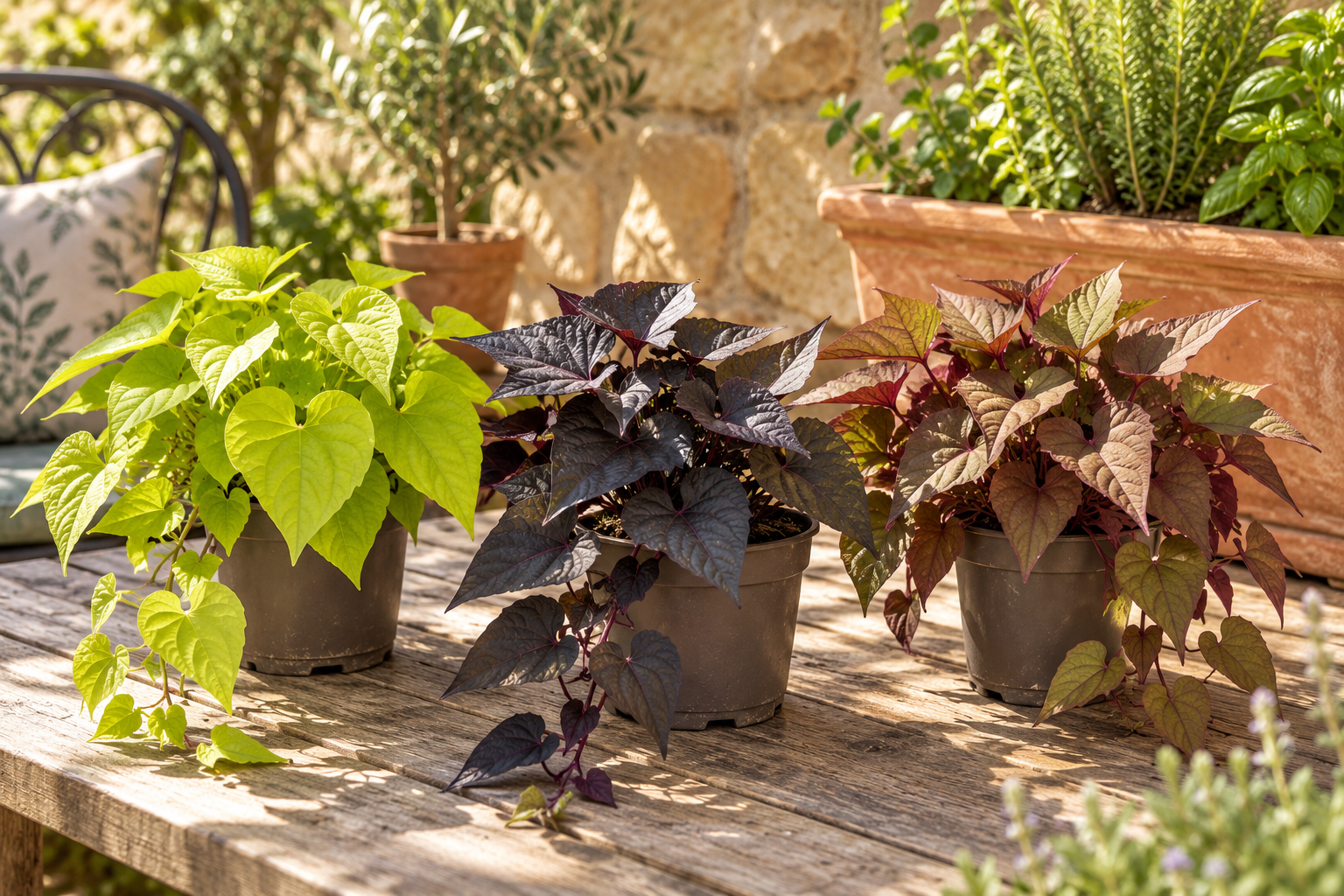
This plant at Exotenherz
Check the shop offer for current availability, price and what is included.
Product and delivery details are given in the individual offer.
Your care table
| Topic | What to do | Why it helps |
|---|---|---|
| Summer position | Choose a sunny, sheltered and warm position. | Cool weather does not suit tropical leaf growth. |
| Planting | Acclimatise slowly after frost risk. | Young foliage should not move abruptly into full heat. |
| Water | Check the root ball and supply before prolonged complete drying. | Increasing leaf mass uses progressively more water. |
| Drainage | Check holes and saucers. | A planter must not become a wet bathtub. |
| Soil | Free-draining, structurally stable planting compost. | Moisture and air for roots remain connected. |
| Nutrients | Supply during growth according to the label. | Existing fertilisation is part of total nutrition. |
| Shoots | Keep neighbours clear; gently arrange when needed. | Strong vines can shade other crowns. |
| Winter | Plan a bright, frost-free position. | Outdoor overwintering is not promised. |
Check the compost and pot weight. The care table explains how far the compost may dry.
Water only when needed. The water should reach the root ball without spilling over the rim.
Remove surplus water from the saucer or cachepot. Then return the plant to a suitable position.
Foliage brings the play of colour
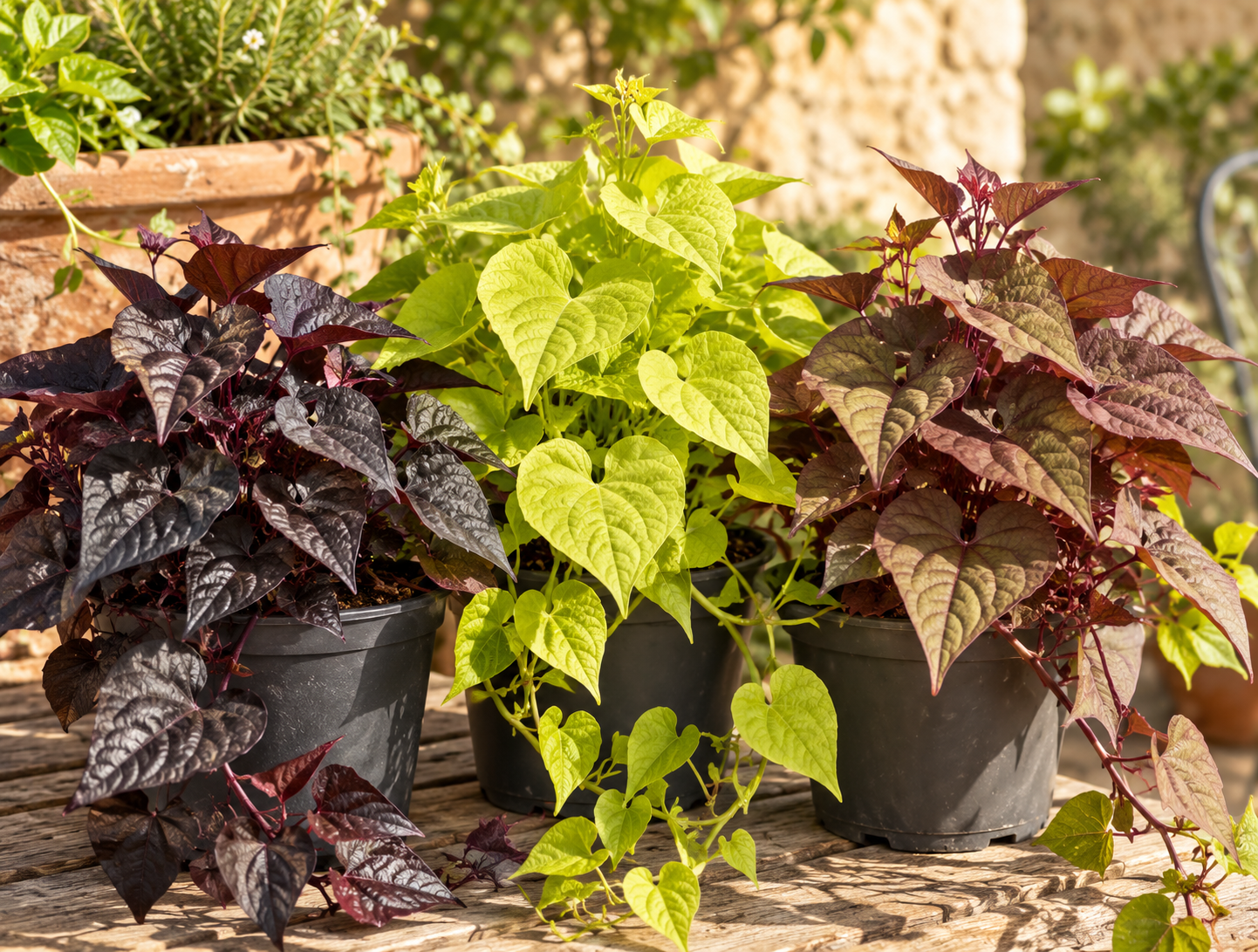
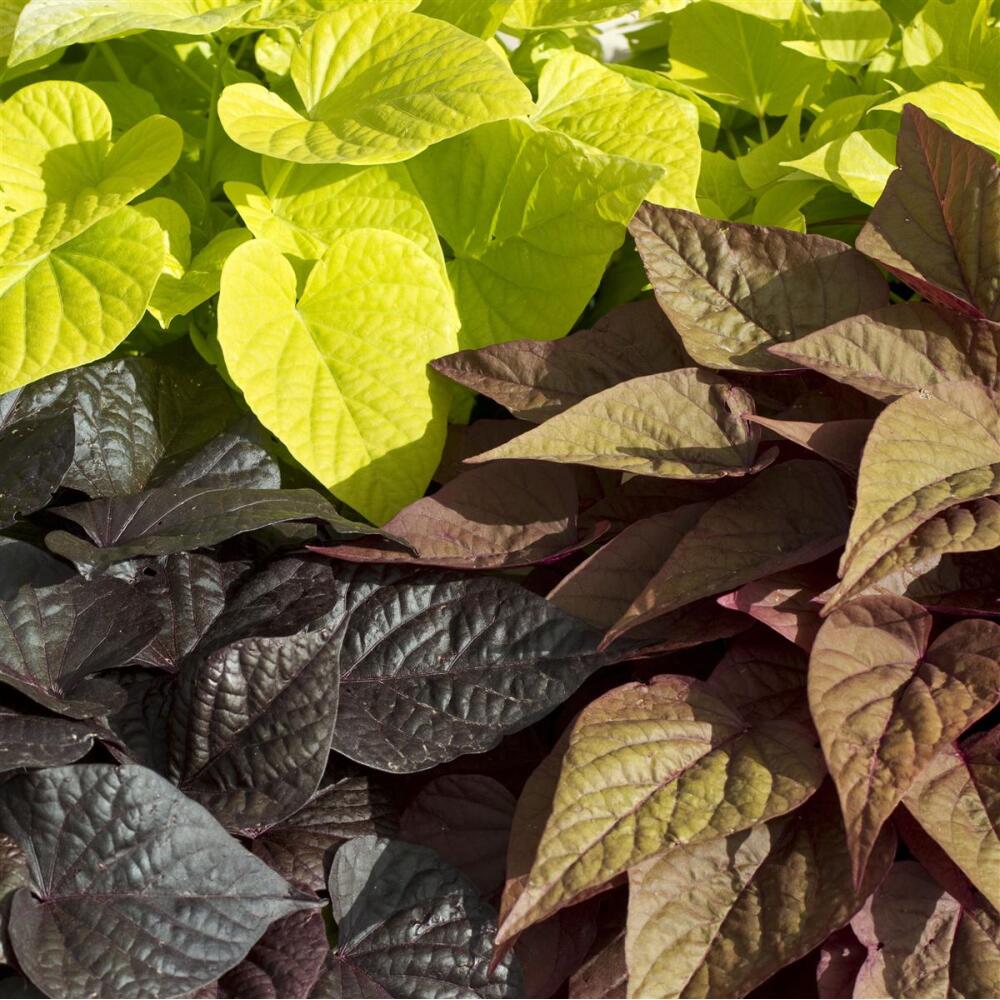
Light green heart-shaped leaves and dark purple, sometimes angularly lobed leaves make ornamental sweet potato a striking structural plant. It can stand among flowering neighbours without needing to carry large flowers constantly itself. The original shows different leaf colours; no fixed guaranteed colour combination for the set is inferred. Ipomoea batatas includes both food and ornamental forms. This assortment selection is described for its decorative foliage. An attractive balcony planter is therefore not evidence of a particular edible tuber variety or a later harvest.
Three small root balls create a lively edge
The offer states three plants in 12 cm pots and roughly 25 to 30 cm plant height. This means young plant height, not a newly calculated total height including the pot. Before planting, position the crowns loosely. Shoots may grow over the edge, but should neither obstruct a passage nor completely cover the centres of neighbouring small plants. A shared bowl remains accessible from the side for care. The unknown variety selection provides no precise later final length.
Summer warmth and light set the framework
A sunny, sheltered summer position suits the species. Acclimatise newly unpacked leaves gradually to stronger sun. Wait to plant until frost risk has passed and weather remains reliably warm enough. A cold, windy balcony in early spring is not a suitable start simply because the plant might already be available. Look behind the planter too: a heated wall changes the needs of the small root ball. Deliberately harsh dryness does not serve to intensify the existing leaf colour.
Leaf area contributes to consumption
Growing shoots quickly carry more foliage. Check the soil beneath an already dense crown too, and water before the root ball dries completely for a prolonged period. Apply water slowly to the soil and ensure free drainage. A planter hanging under a roof often receives no significant root supply from a rain shower. Assess drooping leaves together with warmth and soil moisture: do not water wet soil again without checking. In a shared container, distinguish the plants’ needs instead of treating every visible leaf defect as a general lack of water.
Keep root space and neighbours in view
Free-draining, structurally stable planting compost holds usable moisture and lets excess drain away. During active growth, supply according to the fertiliser label, considering existing fertilisation. A very strong shoot can be gently rearranged or shortened when needed so weaker neighbours retain light. Regular looks beneath the leaves help spot sap-sucking pests early. Remove soft, damaged parts specifically. A lot of new soil or fertiliser at once replaces neither a suitable position nor checks of the existing root ball.
A warm foliage garden is not a frost crop
The species is frost-sensitive. Arrange a bright, protected indoor position in good time for continued cultivation; do not leave the balcony planter outdoors as an experiment until the first frozen night. Less light changes water requirements, and the root ball remains under observation indoors too. Ornamental forms can differ markedly in their growth. A photograph of the planter before and after summer development therefore helps in the plant book. Record which leaf colour stood where and which shoots needed more space. This allows more deliberate planning of the next combination.
One plant, several views
Good to know
Is this an edible sweet potato?
The species includes food forms too; an unnamed ornamental foliage selection is presented here. A harvest is not guaranteed.
Must it flower?
No. Ornamental forms often flower rarely; decorative foliage is their focus.
Which leaf colours come in the set?
The offered selection remains decisive. The original shows light green and dark leaves.
Is 30 cm the final size?
No. It is the stated young plant height.
Can it stay outside in winter?
Garden overwintering is not promised for this frost-sensitive species.
Sources and editorial note
- Exotenherz: offer and original photographs (03.10.2026)
- RHS – Ipomoea batatas, ornamental forms and cultivation (03.10.2026)
Shop offer, article number, GTIN, availability and original images checked directly on 02.10.2026; specialist acceptance on 03.10.2026. Specialist sources read directly. Exact SKU, measurements, original images and orderability checked directly in the shop on 03.10.2026. Specialist sources read in full; shop name and botanical synonyms remain distinguishable. Currently not orderable: knowledge portrait without a purchase link, social drafts without sending approval. No Wawi, server or tool changes. Currently not orderable: knowledge portrait without a purchase link; social drafts are not authorised for sending.