
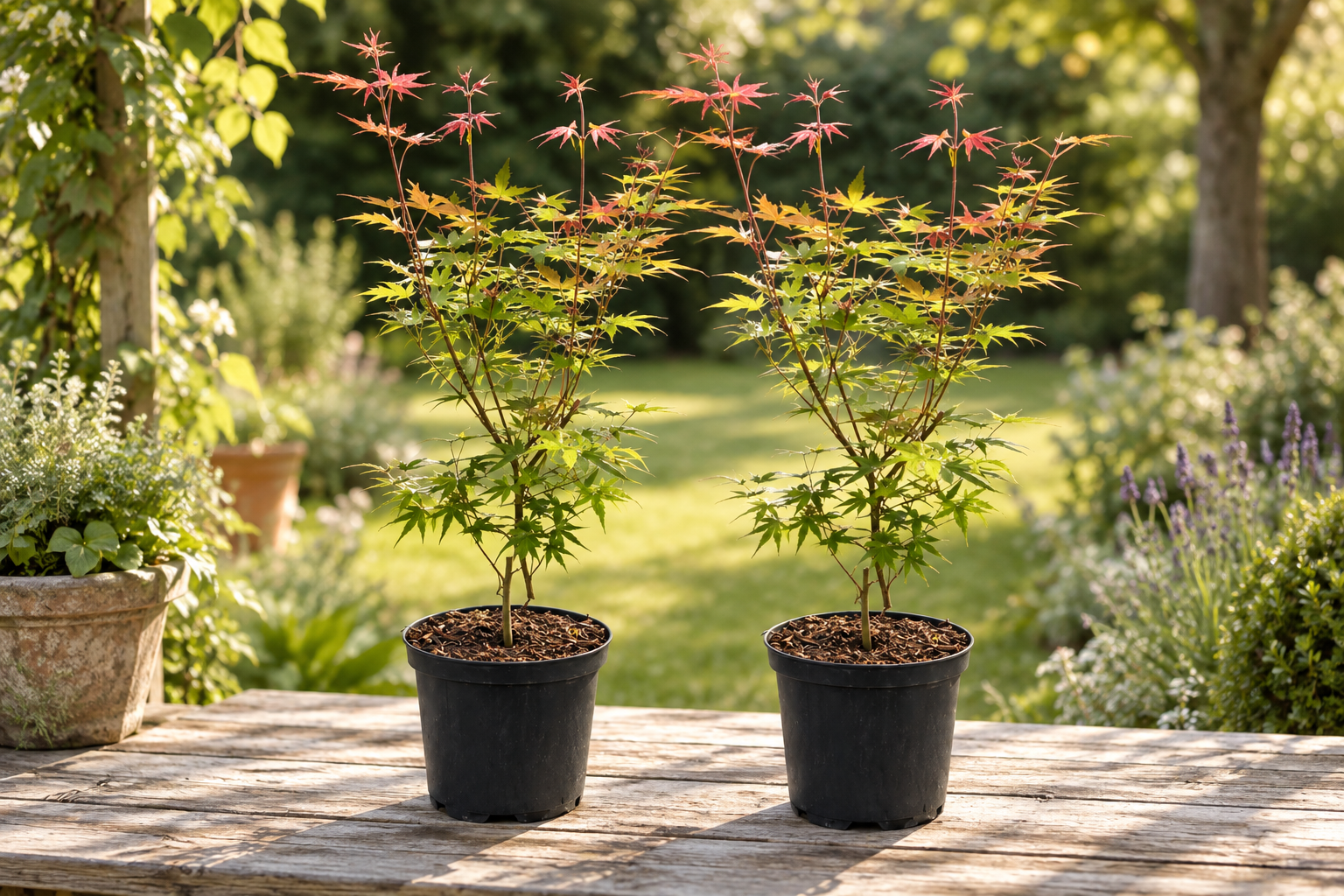
This plant at Exotenherz
Check the shop offer for current availability, price and what is included.
Product and delivery details are given in the individual offer.
Your care table
| Topic | What to do | Why it helps |
|---|---|---|
| Cultivar colour | Consider pink new growth, summer greening and autumn colour together. | One green summer leaf does not disprove the cultivar. |
| Light | Choose sheltered bright partial shade. | Fine young growth responds to hot sun and dry wind. |
| Soil | Use humus-rich, slightly acidic to neutral well-drained soil. | Fine roots need water reserves and air together. |
| Planting | Plant the ball at its former height, preferably in mild leafless conditions. | Deeply covered roots and trunk base are unnecessarily burdened. |
| Water | Check the original ball and water thoroughly as needed. | Damp soil beside it does not prove adequate supply inside. |
| Feed | Distinguish garden soil and containers used for longer periods. | Additional nutrients are no substitute for balanced moisture. |
| Pruning | Make selective interventions only as needed, preferably late autumn to midwinter. | Natural branching needs no constant tip pruning. |
| Late frost | Temporarily protect fresh growth if cold nights are forecast. | Young leaves are more sensitive than dormant wood. |
| Winter | Protect container roots in strong frost and keep outflow open. | Winter-hardy wood does not mean an unprotected small pot. |
For young plants, feel the soil directly at the root ball. The surface and deeper soil may have different moisture levels.
Water thoroughly after planting; later, water according to the soil, weather and establishment rather than a fixed calendar.
Avoid standing water. For plants in containers, also check that water runs out of the drainage hole.
A leaf changes its colour
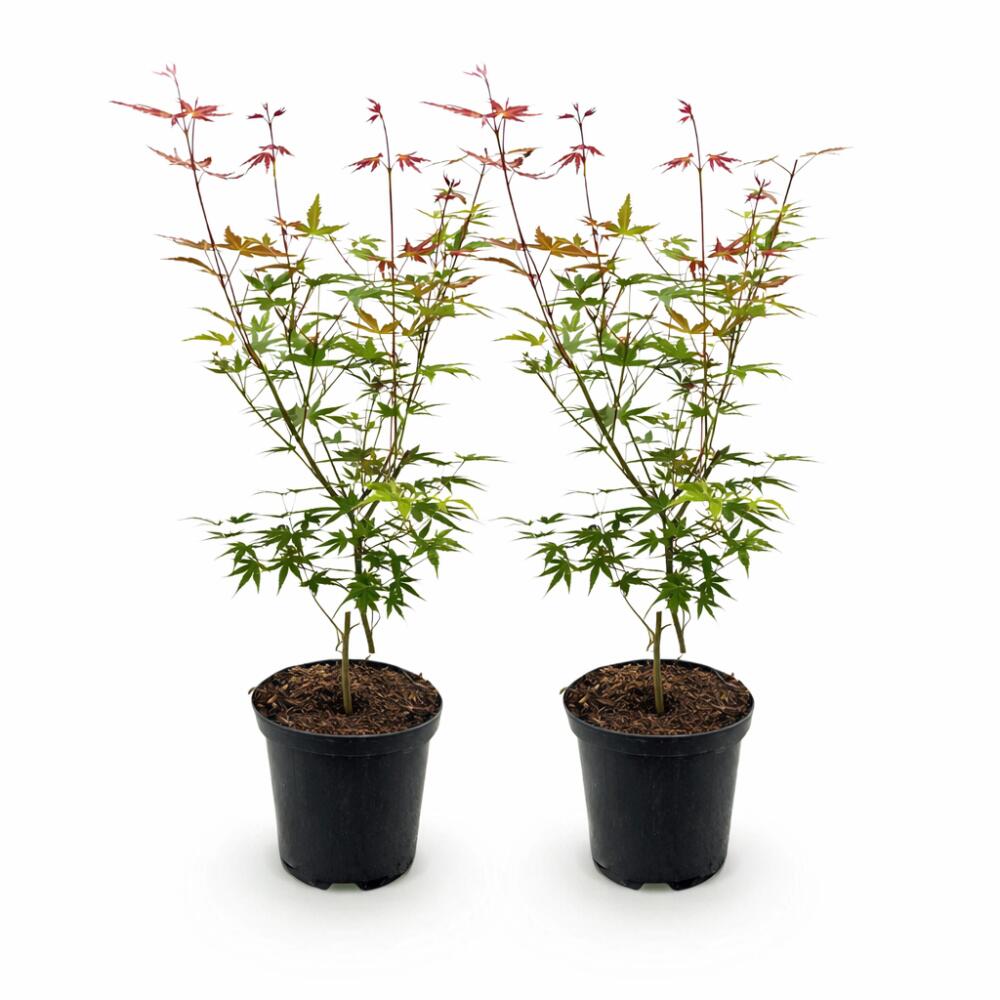
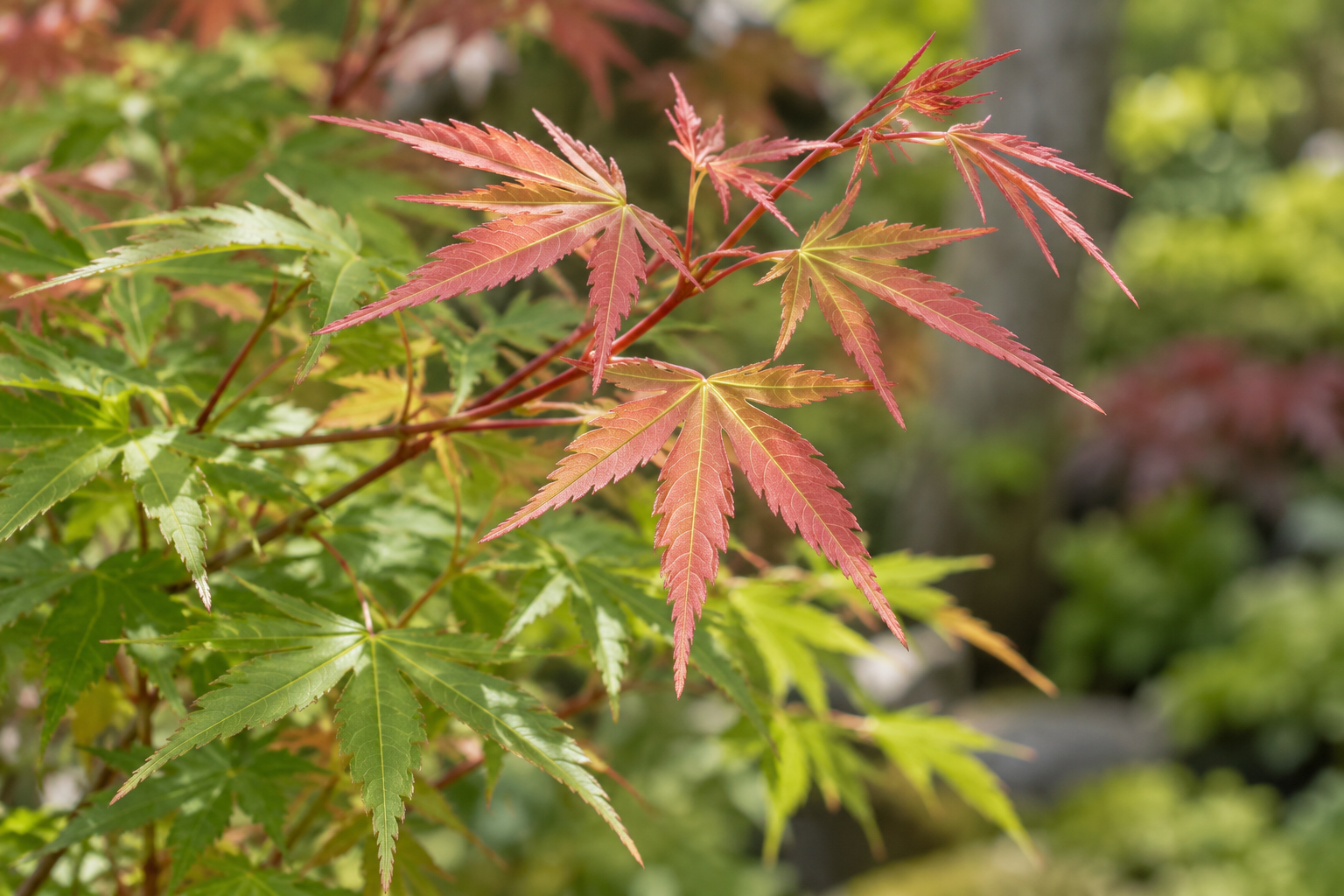
Phoenix opens pink new leaves with prominent yellow-green veins. Further development brings yellowish and finally glossy green tones. Autumn adds a change through orange, red and yellow. The cultivar belongs to the Palmatum Group of Japanese maples. The shop spelling Phönix is brought together here with the documented cultivar name Phoenix. A greener summer condition does not contradict the cultivar. Observing the plant from spring to autumn reveals its character through changing time rather than one permanently identical shade.
Two young trees with open crowns
The linked offer has two plants in individual 19-cm pots at roughly 70 cm total height including the containers. The clean original view shows young upright shoots, greener lower leaves and reddish new growth. It does not yet show a broad developed garden crown. Phoenix can reach several metres over many years; around 4–8 m should be considered as a garden range while limited culture may stay smaller. Unpack the plants by their pots and release fine branches from transport material. A young branched plant should not be pulled from packaging by its top.
Bright partial shade with room outwards
A sheltered bright partial-shade position is a good starting point. Tender new leaves need not prove their sun tolerance against a hot south-facing wall. Dry wind and hot sunshine together with water shortage may damage margins. Light under an open tree crown differs from permanently deep shade. Plan roughly 2.5–4 m room for a freely growing specimen from its later crown width. Both set plants need not stay close together; separate suitable places give them more time for their natural structure.
Let fine roots start shallowly
Humus-rich, slightly acidic to neutral soil should hold moisture while still taking water away. Main roots must not disappear deeply beneath added soil during planting; previous ball height is a clear reference. Mild frost-free days while leafless from autumn to early spring are favourable. Container plants outside this phase need more supply attention. Carefully water in after planting and keep dense root competition away from the young maple. A loose covering around roots stays away from the trunk base so this is not constantly wrapped in moisture.
Accompany the small ball through summer
Check the original ball regularly even when garden soil beside it looks moist. Sun and wind can quickly alter container reserves. Water slowly and thoroughly as soil dries and let water flow freely away. Both complete drying and standing wetness do not suit fine roots. A fixed weekly schedule overlooks warm days and rainy periods. Well-supplied garden soil does not automatically demand extra feed; in containers used for longer, moderate spring feeding following the label may make sense. Brown edges are not an unambiguous instruction to add more fertiliser.
Guide the broad shape with few cuts
Phoenix develops a branched shrub or small-tree form. Consider the whole structure before removing individual branches. Work selectively on dead, damaged or troublesome crossing wood; regularly topping all tips is unnecessary. When pruning is required, late autumn to midwinter suits it better than blanket spring cutting during initial sap flow. This delivery stage fixes no permanent height. As roots grow through the pot, a container plant needs a suitable larger pot and refreshed soil; an eternally small pot is no reliable alternative to planning space.
Protect new growth and winter rest differently
The dormant garden maple is winter hardy, but fresh leaves can still suffer late frost. When cold nights are forecast, suitable horticultural fleece can temporarily protect new growth. After damage, first assess which parts grow again rather than radically cutting the whole crown. Container roots need separate protection in severe frost and free drainage. Check soil on frost-free dry days. A heated living room is no suitable winter home for this deciduous woody plant. Bare winter structure and glossier summer green belong to the plant whose next pink growth starts again only in spring.
One plant, several views
Good to know
Are Phoenix and Phönix two cultivars?
The shop uses Phönix for the independently documented cultivar Phoenix. These spellings are brought together.
Why does a pink leaf later become green?
Phoenix changes through yellowish shades to green as leaves develop. This course belongs to the cultivar’s character.
Does the maple remain 70 cm tall?
No. Delivery total height including the 19-cm pot must be distinguished from garden development over years.
Must both plants share one container?
No. The set contains two specimens of one cultivar, which can have separate suitable places.
What does a brown leaf edge mean?
First check water, wind and sunshine. This feature does not prove a single nutrient deficiency.
Is a warm living room suitable for winter?
No. This deciduous garden tree needs its annual cycle. In a container, roots particularly need protection.
Sources and editorial note
- Exotenherz: current parent offer, delivery measurements and original gallery (03.10.2026)
- Specialist reference read directly: phoenix-rhs (03.10.2026)
- Specialist reference read directly: maple-growing (03.10.2026)
Identity and product SKU compared with canonical 642 and shared and isolated portraits. Public parent offer, child sets and specialist sources directly read on 03.10.2026; unambiguous URL and file-hash evidence held separately. Delivery total height and later growth distinguished. Sets and colour offers do not count as additional identities. No publication authorised: Root handles shared page construction and its acceptance.