
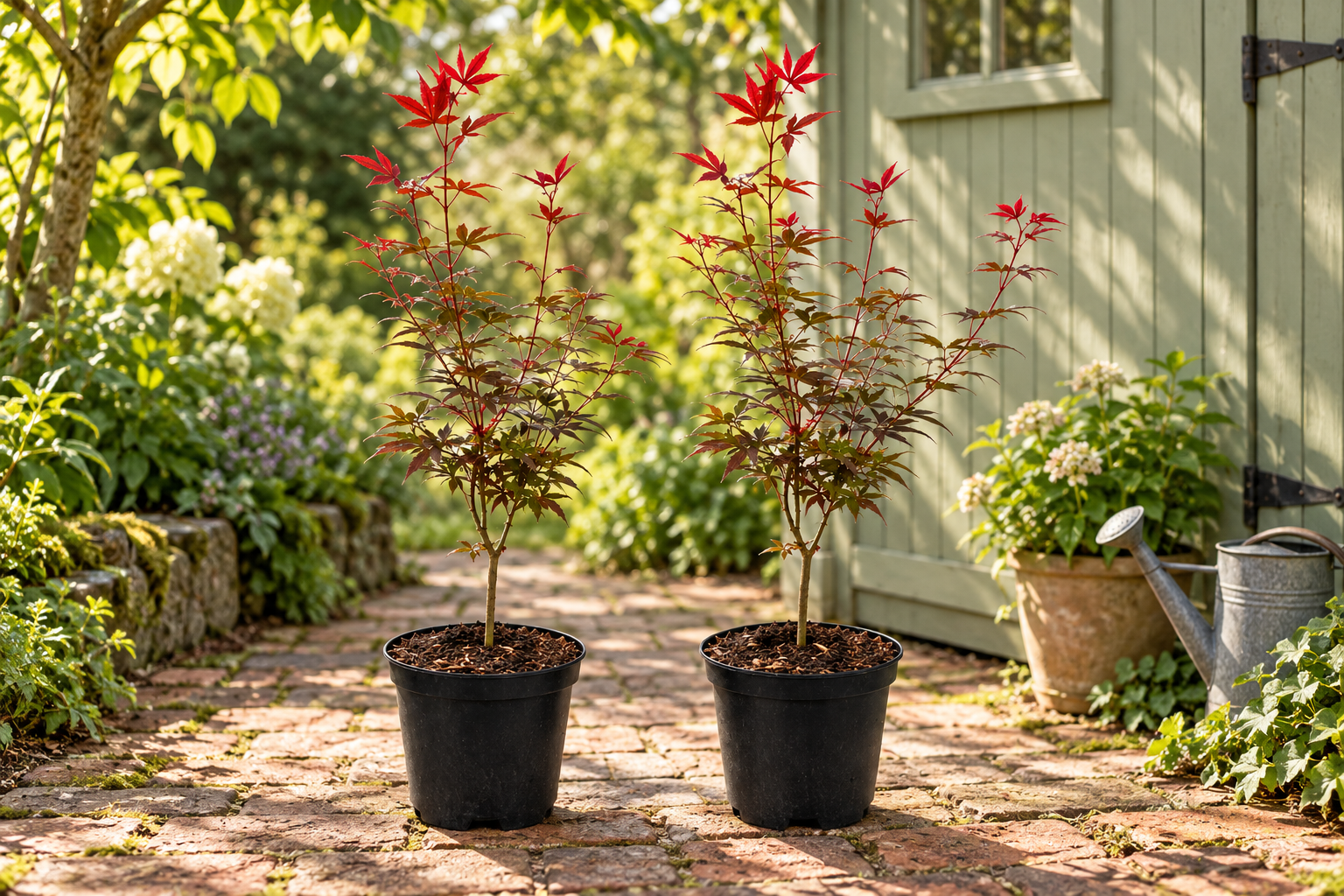
This plant at Exotenherz
Check the shop offer for current availability, price and what is included.
Product and delivery details are given in the individual offer.
Your care table
| Topic | What to do | Why it helps |
|---|---|---|
| New growth | Observe bright new growth and darker older foliage together. | The different reds belong to leaf development. |
| Space | Allow approximately 1.5–2.5 m for a free later crown. | Compact growth does not mean unchanged delivery size. |
| Light | Choose bright sheltered partial shade with mild sunshine. | Leaf colour needs light; young leaves suffer in heat and wind. |
| Soil | Use humus-rich slightly acidic to neutral well-drained soil. | Roots need water reserves and air in the container. |
| Water | Supply the ball according to moisture and weather. | Even a compact maple can dry quickly in a small pot. |
| Feed | Dose by actual container or soil need and the label. | A small habit justifies no frequent fertiliser schedule. |
| Pruning | Make selective interventions rather than regular shearing. | Natural upright branching should remain recognisable. |
| Late frost | Temporarily protect new growth if cold nights are forecast. | Young red leaves respond differently from dormant wood. |
| Winter | Protect container roots, ensure drainage and check in frost-free conditions. | Winter rest does not mean living roots may dry out. |
For young plants, feel the soil directly at the root ball. The surface and deeper soil may have different moisture levels.
Water thoroughly after planting; later, water according to the soil, weather and establishment rather than a fixed calendar.
Avoid standing water. For plants in containers, also check that water runs out of the drainage hole.
Bright tips above darker foliage
Skeeter's Broom develops a narrow upright basic form with palmate, usually five-lobed leaves. New leaves emerge bright red in spring; older ones may look deeper reddish-purple. A ruby-red shade follows in autumn. This selection belongs to the dwarf group of Japanese maples. It is also known as Skeeters Red and Skeeters. The shop writes Skeeters Broom. On the young original plant, brighter tips above the darker lower structure are particularly noticeable.
Comparatively small remains a living woody plant
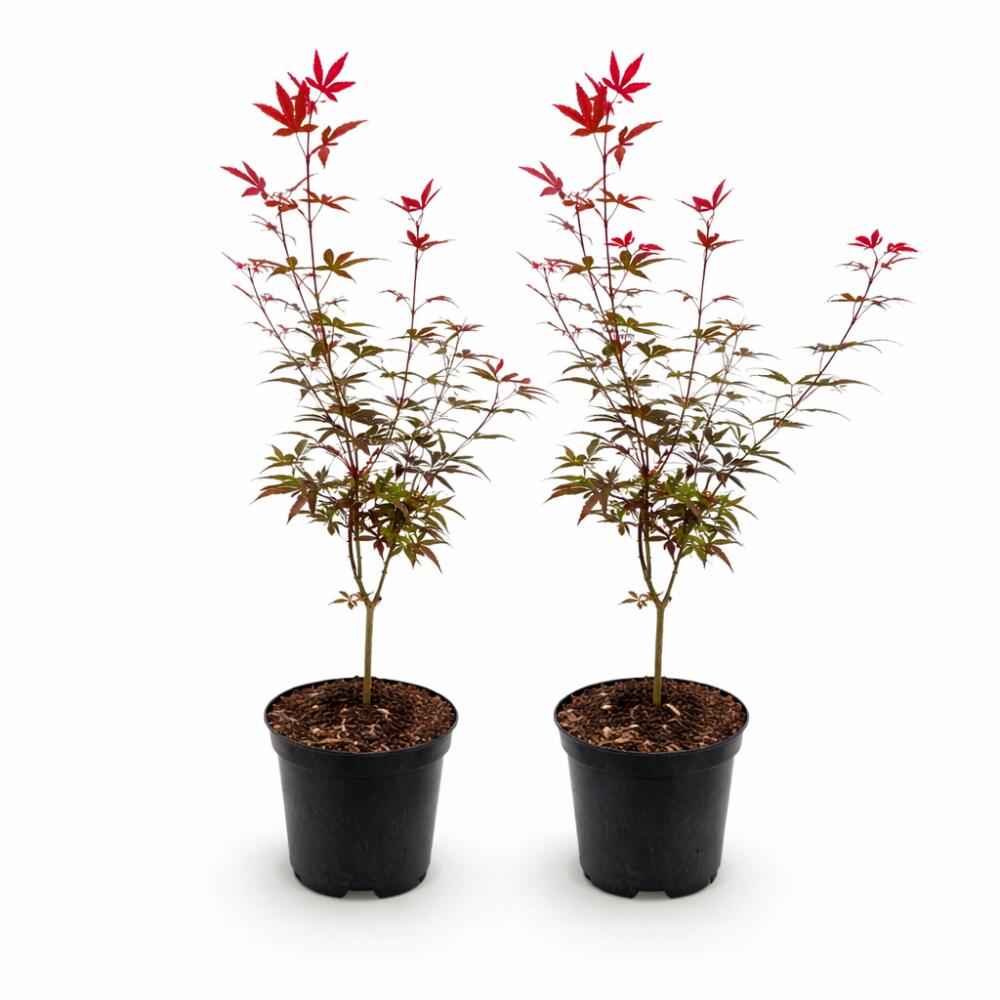
The offer contains two plants, each in a 19-cm pot at around 70 cm total height including the container. Their slender young shoots are still openly branched and form no finished broad crown. Later garden height and width of roughly 1.5–2.5 m provide guidance. Classification as a compact selection therefore promises neither permanent 70 cm nor unchanged low root needs. Carefully remove transport material from both set members and check their balls. They may stand separately or be planted at separate suitable places.
The upright shape needs sideways space
A sheltered bright partial-shade place with mild sun suits it. Red foliage effect requires light, but hot sun against reflective surfaces and dry wind may burden leaf quality. Its slender initial form tempts placement in a narrow passage. Still allow roughly 1.5–2.5 m for a freely developed specimen from its later width. Near a terrace, the crown should not constantly be brushed by clothing or chair backs. A smaller maple can be an accessible individual accent without being wedged among densely rooting neighbours.
Container size follows the root ball
Humus-rich slightly acidic to neutral well-drained soil combines water reserves with air around roots. Set the ball at its former height and do not bury the trunk base under added soil. A moderately larger container makes sense for container plants once roots have occupied the previous pot well. An excessively large constantly wet soil volume is no shortcut to healthy growth. Mild frost-free days during the leafless period from autumn to early spring suit planting. With later planting, watch weather, water and the small original ball volume particularly closely.
Compact growth does not reduce the need to check
Water slowly and thoroughly as the ball dries and keep drainage openings free. A 19-cm pot may dry after warm wind faster than the comparatively small crown suggests. In a border the original ball remains the decisive initial checking point. A rigid rhythm without looking at soil and weather does not suit it. Additional feed is dosed according to container, soil and label; good garden soil needs no blanket regular nutrient replenishment. Brown or crinkled margins may relate to moisture and exposure. They do not prove that the compact cultivar needs particularly large amounts of fertiliser.
A dwarf shrub is not a sheared shape
Let healthy branches develop their natural structure. Frequent blanket cutting across all tips would make precisely the fine upright outline uniform. Selectively remove dead, damaged or troublesome crossing branches while considering the remaining branching. If pruning is needed, late autumn to midwinter is suitable; blanket shortening at initial spring sap flow is no care principle for this maple. Two set plants impose no requirement for a dense hedge. Nor does a narrow young shape become a reliably healthy miniature through permanently restricted roots.
Red leaves belong to the annual cycle
In autumn leaves turn more ruby-red and later fall. Leafless winter is normal for this shrub. Containers need root protection in severe frost and open water drainage. Check the ball on frost-free dry days rather than bringing the plant into a permanently warm room. Fresh growth can be temporarily protected if late frosts are forecast. After a cold night first watch further development before shortening all tips. Persistent unusual wilting or dead branches need separate assessment of roots and possible disease; ordinary colour change alone is no illness.
One plant, several views

Good to know
Which names mean the same selection?
Skeeter's Broom is also known as Skeeters Red and Skeeters. The shop writes the cultivar name Skeeters Broom.
Does dwarf group mean permanently tiny?
No. Later height and width around 1.5–2.5 m are possible despite compact classification.
Are the 70 cm only tree height?
The shop means total height including the 19-cm pot and describes delivery.
Why are upper leaves brighter red?
Young growth and further-developed leaves may show different reds simultaneously. This suits the described annual cycle.
Should I constantly cut the tips for compactness?
That is unnecessary. Guide natural form with few selective interventions rather than regular shearing.
Can the cultivar stay in the small delivery pot?
The nursery delivery pot is no permanent root-space limit. Increasing roots need suitably more room and good soil.
Sources and editorial note
- Exotenherz: current parent offer, delivery measurements and original gallery (03.10.2026)
- Specialist reference read directly: skeeters-rhs (03.10.2026)
- Specialist reference read directly: maple-growing (03.10.2026)
Identity and product SKU compared with canonical 642 and shared and isolated portraits. Public parent offer, child sets and specialist sources directly read on 03.10.2026; unambiguous URL and file-hash evidence held separately. Delivery total height and later growth distinguished. Sets and colour offers do not count as additional identities. No publication authorised: Root handles shared page construction and its acceptance.