
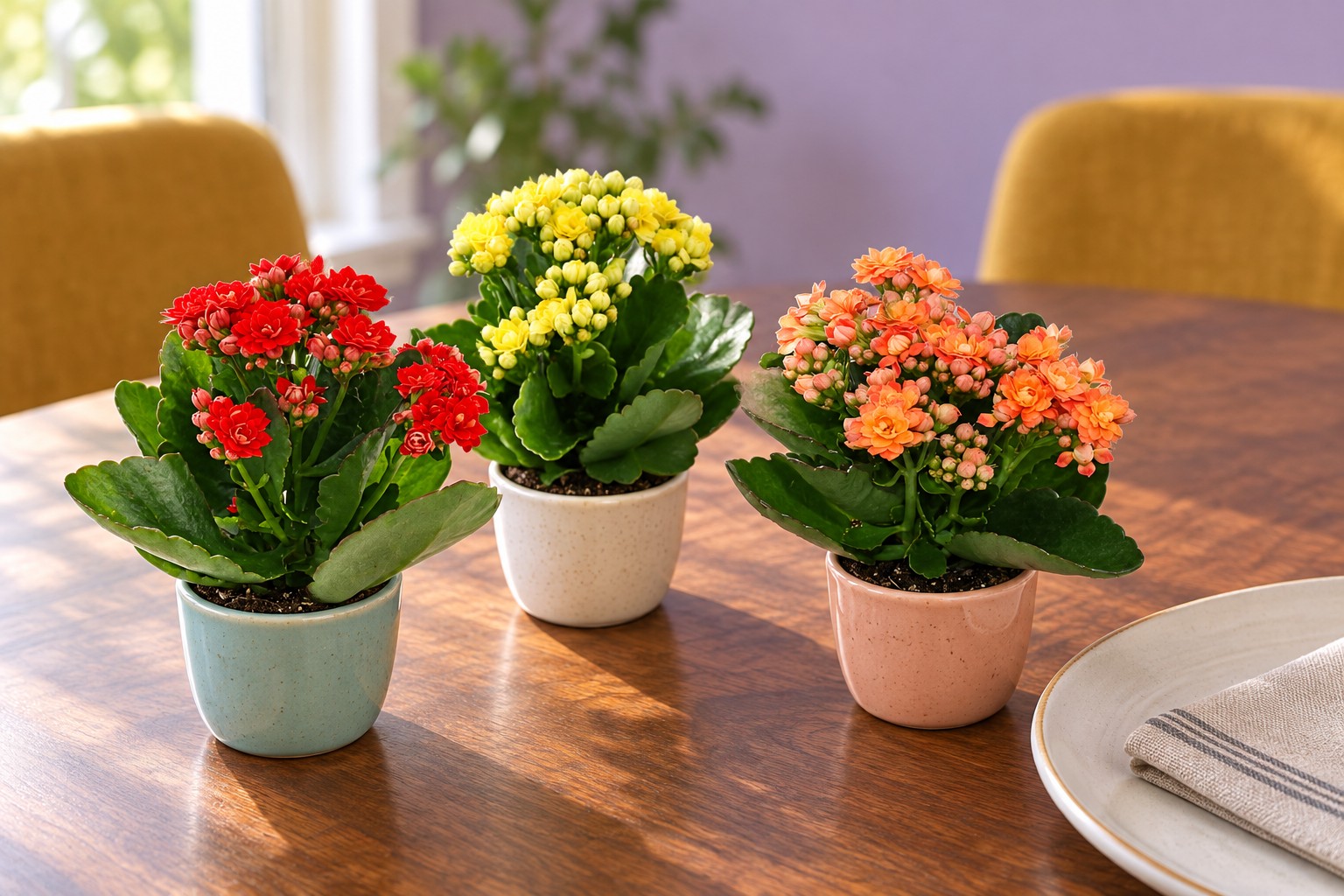
This plant at Exotenherz
Check the shop offer for current availability, price and what is included.
Check the shop for the price, current availability and what is included.
Your care table
| Topic | What to do | Why it helps |
|---|---|---|
| Light | Bright and warm; acclimatise gently to sunshine. | Compact growth needs sufficient daylight. |
| Water | Check each pot and allow drying between waterings. | The three small root balls do not consume equal amounts. |
| Drainage | Let drain thoroughly and empty outer pots. | Fleshy leaves do not protect against root rot. |
| Flowers | Remove faded flower heads carefully. | Healthy foliage remains for continued cultivation. |
| Fertiliser | Sparingly during active growth according to the label. | Small pots require moderate quantities. |
| New buds | Allow long uninterrupted nights for several weeks. | Bud initiation responds to the day-night rhythm. |
| Winter | Position frost-free, bright and protected from cold draughts. | The species originates in Madagascar. |
| Handling | Do not eat; keep protected from children and animals. | Leaves and flowers contain toxic substances. |
Check the compost and pot weight. The care table explains how far the compost may dry.
Water only when needed. The water should reach the root ball without spilling over the rim.
Remove surplus water from the saucer or cachepot. Then return the plant to a suitable position.
Small flowers with many petals
Rosalina here denotes a selection of double-flowered Kalanchoe. Individual flowers carry many closely arranged petals and consequently resemble little roses. Botanically, flaming Katy belongs to the Crassulaceae family. Its glossy fleshy leaves store water, explaining why daily watering is usually unsuitable. After flowering, the plant is by no means used up. Healthy green foliage can keep growing and carry buds again later under suitable conditions.
Three plants, three colours and manageable space needs
The shop offer contains three plants, each in a 5.5 cm pot. Overall height per plant is approximately 10 to 12 cm. Three different colours are intended; the specific combination may differ from the image depending on availability. The plants stand individually in the scene so their small scale and own growth remain recognisable. They may be displayed together or distributed among suitable bright positions. Decorative outer pots and table styling are not automatically part of delivery contents.
Brightness supports flowers and compact foliage
Choose a bright warm position. Gentler morning or evening sunshine can suit after acclimatisation, while prolonged hot midday sun may damage leaves. A table in the middle of a dark room is unsuitable as a permanent position even if the flowers initially look attractive there. A sheltered outdoor position is possible in summer once nights are reliably mild. Bring them back indoors in time before cool nights. Flaming Katy is not a winter-hardy border perennial and does not tolerate frost.
Check each miniature root ball individually
The three plants may consume water at different rates. Check each pot, therefore, and water thoroughly after a distinct dry interval, then let drain well. Leaves and flowers should not remain permanently wet. If a root ball stays moist, that plant waits longer even if its neighbour already needs water again. A small pot dries rapidly in warmth; weeks of neglect during full flowering are therefore unfavourable too. Soft yellow leaves together with wet soil suggest root problems rather than too little water.
Care continues after flowering
Remove dried flower heads carefully without unnecessarily shortening healthy foliage. When densely rooted, move into a pot only slightly larger with draining succulent compost. Feed sparingly during active growth according to the fertiliser label. Long uninterrupted nights support renewed bud formation: as a guide, approximately 14 hours of darkness daily for at least six weeks, while retaining a bright daytime position. Continuous evening room lighting may disturb this rhythm. This does not mean the plant belongs in a closed dark cupboard for days.
Preserve healthy leaves and recognise small problems early
Air between the three plants helps wet flowers and dense leaves dry again. Regularly look for aphids on young shoots and mealybugs at their bases. A powdery coating must be distinguished from normal dust and calls for closer inspection. Propagation with suitable healthy cuttings is possible; freshly cut tissue should dry before insertion. Kalanchoe is poisonous when eaten. Even on an attractively laid table, its flowers remain purely ornamental and do not belong on food.
One plant, several views


Good to know
Will I receive exactly the three colours in the photo?
The set contains three different flower colours. The specific selection may vary depending on availability.
Must the plant be discarded after flowering?
No. Healthy foliage can be cared for further, and flowering again is possible in suitable conditions.
Why are there no new flowers despite healthy leaves?
Besides daylight, too much light at night can disturb bud formation. Long uninterrupted nights for several weeks help.
Are the little flowers edible?
No. Kalanchoe is poisonous when eaten and is used exclusively as an ornamental plant.
Sources and editorial note
- Product and delivery contents: Exotenherz
- NC State Extension: plant profile
- Royal Horticultural Society: plant and care information
Sources checked: 15 September 2026. Product information and the contents of delivery follow the linked shop offer. Care advice was checked against the cited specialist sources and should still be adapted to the plant’s condition, position and season.