
This plant at Exotenherz
Check the shop offer for current availability, price and what is included.
Check the selected shop offer for price, availability and delivery contents.
Your care table
| Topic | What to do | Why it helps |
|---|---|---|
| Light | Keep bright with filtered daylight. | A shaded woodland character does not mean a permanently dark room. |
| Moisture | Keep each root ball lightly moist without leaving it persistently wet. | Frond form, growing medium and species affect actual water use. |
| Drainage | Remove residual water from each cover after watering. | Air in the root zone protects against constant waterlogging. |
| Air | Avoid hot radiator air and allow gentle air exchange. | Sensitive fronds suffer in dry heat, but trapped wetness does not help. |
| Soil | Use loose well-drained suitable houseplant soil. | Dense wet soil supplies roots less well than an airy moist root ball. |
| Nutrients | With visible growth, feed moderately according to the label. | Lots of fertiliser compensates for neither lack of light nor drought stress. |
| Fronds | Remove only clearly damaged or dead fronds selectively at the base. | A frond cut off at the top does not become complete again. |
| Winter | Keep bright frost-free and water less often with slower growth. | Need declines, but the root ball should still not dry completely. |
Check the compost and pot weight. The care table explains how far the compost may dry.
Water only when needed. The water should reach the root ball without spilling over the rim.
Remove surplus water from the saucer or cachepot. Then return the plant to a suitable position.
Fronds show three different signatures
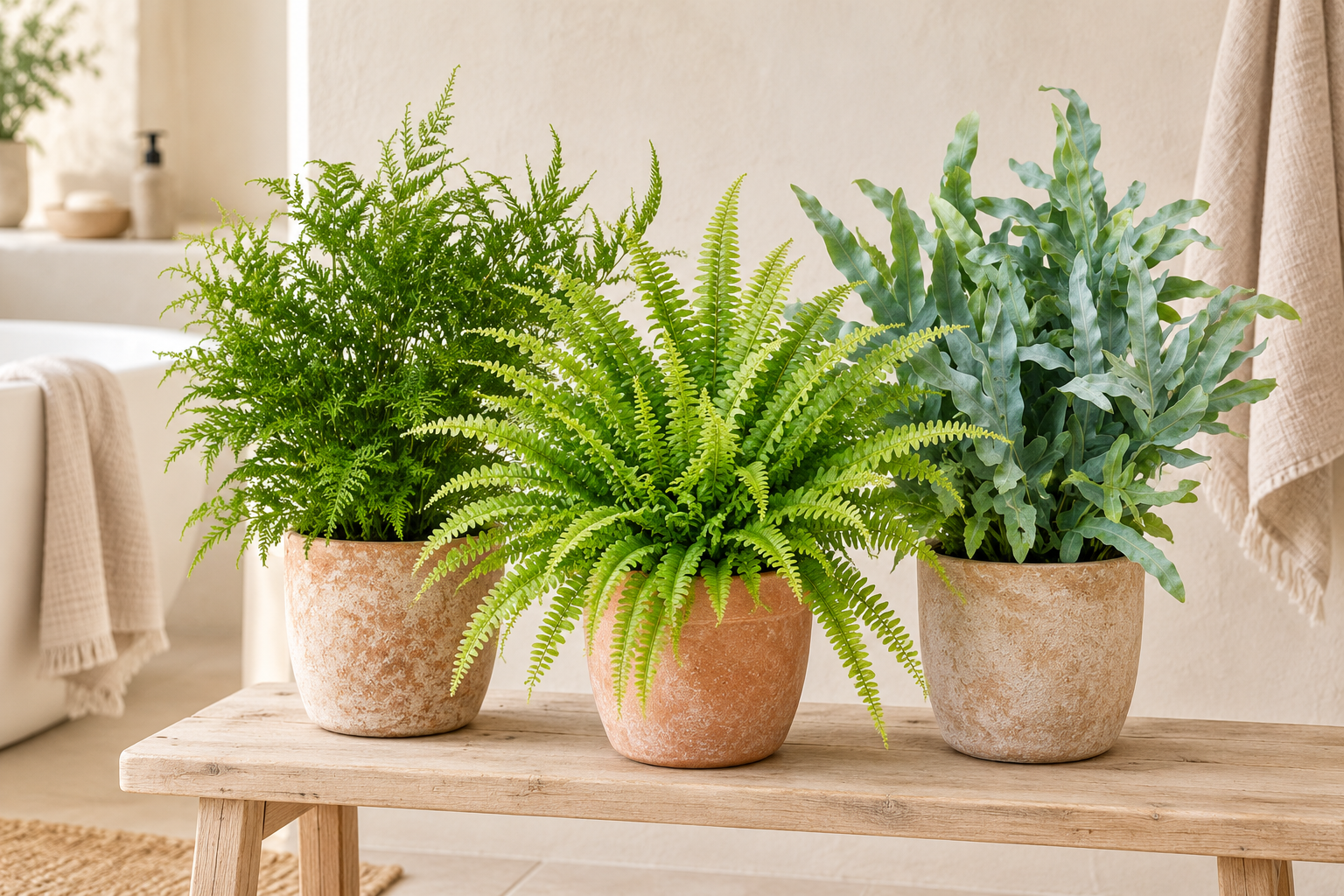
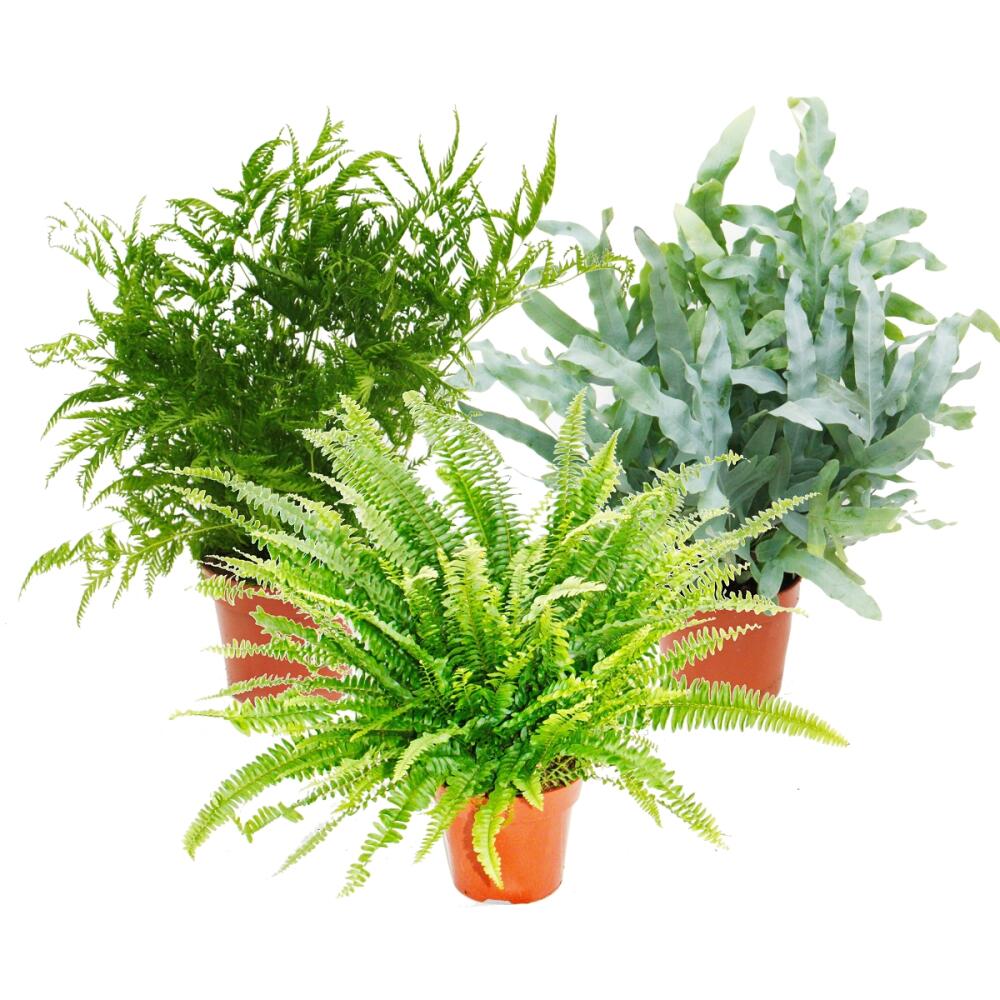
It is worth looking along an individual frond on a fern. Some forms have many small leaf sections along a long central axis; others carry broader lobed surfaces in gentle blue-green. The trio makes this difference particularly clear. The offer contains three indoor ferns but sets no fixed botanical species list. Our scene follows the forms in the original photograph and remains a selection example. Keep your delivery labels. A specific identification later helps decide which fern needs particularly reliable root-ball moisture and which may dry somewhat more between watering.
Three containers need room for their fronds
The plants stand in seventeen-centimetre pots, each about forty to fifty centimetres overall height. These figures describe delivery condition including container. Depending on frond shape, lateral spread may already need substantially more room than pot diameter. On a bright plant bench, the three containers may work together as long as outer fronds do not constantly rub wall, curtain or neighbouring plant. Remove each inner pot comfortably to check and let it drip. Decorative covers in our scene are not part of the offer; space and accessible care matter more than their colour.
A bathroom is a position only with daylight
A well-lit bathroom can be a lovely setting if warmth, air and light really suit. Without a window or suitable plant lighting, it is no good lasting position despite higher humidity. A bright living room also suits if the trio is protected from hot midday sun and direct radiator air. Look at daylight where the plants stand, not just the room’s name. Avoid extreme changes after transport. Fine fronds respond to dry warmth faster than firm lobed leaf surfaces; both remain living foliage needing free air movement and a supplied root zone.
Distinguish moist and wet clearly
Check all three root balls separately with finger and pot weight. In many indoor ferns, soil should reliably stay lightly moist without standing in a filled cover. A divided Boston fern, for example, is sensitive to complete drying; a Phlebodium can tolerate somewhat more drying. These are notes on known fern forms, not a guaranteed species list for the set. Once actual identification is clear, adapt the supply to it. Water the growing medium thoroughly and allow drainage. Frequent misting does not compensate for a dry root ball or restore balance to an already wet container.
Airy soil supports the next growth
When repotting, choose loose well-drained suitable soil and only sensibly more root space. Small roots do not immediately use a large new mass of wet soil. Do not bury visible surface rhizomes deeply without checking; their position may belong to the actual fern species. Hold the root ball while working, not sensitive frond tips. During active growth, feed moderately according to the label and account for fresh pre-fertilised soil. New fronds first unfold rolled and may look soft. Give them time rather than pulling apart with fingers or trying to open them faster with extra fertiliser.
Spores are not flowers or automatically an infestation
Ferns do not form flowers like an orchid. Ordered spore clusters may become visible under mature fronds; shape and arrangement differ by species. Regular round groups are known in Boston fern and Phlebodium. Such patterns are not treated as pests solely for their brown colour. Irregular sticky coatings, moving animals or fine webs instead need closer checking. Remove clearly dead fronds selectively at the base. A half-cut frond does not resume growth at the cut edge like a new branch. Renewal comes from fresh growth.
Accompany winter with less growth
In the low-light season, water consumption often falls although plants remain leafy. Therefore check anew rather than continuing summer rhythm unchanged. Frost-free warmth, a bright place and distance from heating remain important. Assess brown edges together with root-ball moisture, dry air and position changes. A soft wilted plant in wet soil does not automatically get more water. Inspect undersides and base regularly without heavy pruning and repotting at the same time. Note how fresh fronds arise in each fern. These small differences make three similar green pots a well-supported collection.
One plant, several views
Good to know
Are exactly the three fern species in the picture included?
The botanical selection is not firmly promised. Photo and scene show examples of offered indoor ferns.
Can the trio stand in a windowless bathroom?
Long-term it needs suitable daylight or plant lighting. Humidity does not replace light.
Should all three be watered the same day?
Check each root ball individually. Species, leaf mass and growing medium may create different needs.
Are brown dots under a frond always pests?
Regularly arranged spore clusters may be normal. Distinguish these from irregular changes and animals.
May I open rolled fronds?
No. Young fronds unfold themselves; pulling can damage them.
What does 40–50 cm describe?
Approximate overall delivery plant height including pot, not a fixed later height or frond width.
Sources and editorial note
- Exotenherz: offer and original images (02.10.2026)
- NC State Extension: Boston fern, moisture and spore clusters (02.10.2026)
- NC State Extension: Phlebodium, growing medium and fronds (02.10.2026)
Shop offer, article number, GTIN, availability and original images checked directly on 02.10.2026. Specialist sources read directly. No fixed species promised from the picture. Second shop photograph shows other plants in a wall arrangement and is not published as a photograph of the delivered trio. No air-purification claim adopted. Scene checked directly against original on 02.10.2026: quantities, leaf forms, growth and size relationship appropriate; changing selection identified.