
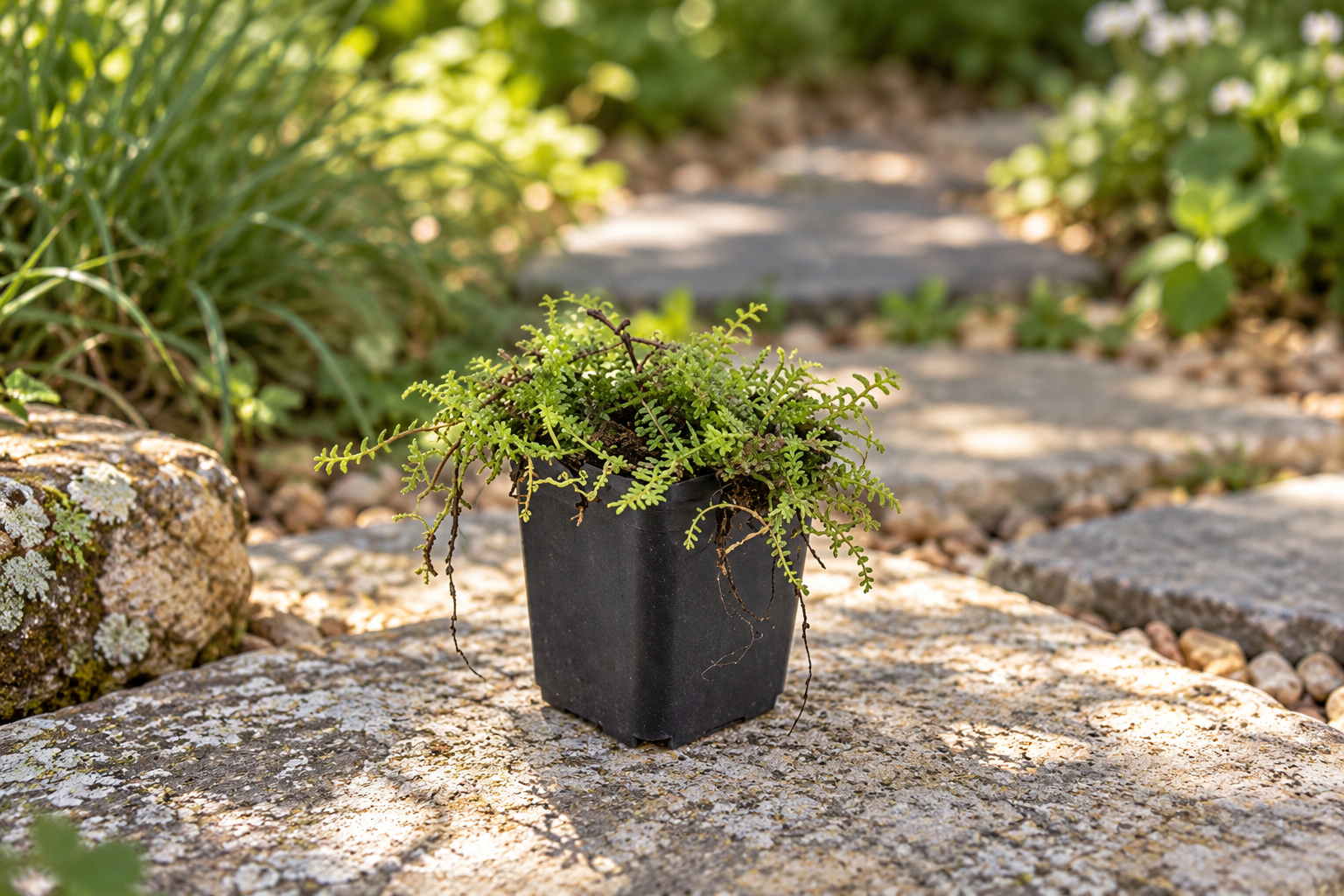
This plant at Exotenherz
Check the shop offer for current availability, price and what is included.
Check the shop for the current price, availability and offer contents.
Your care table
| Topic | What to do | Why it helps |
|---|---|---|
| Light | Choose a bright partially shaded outdoor position and watch stone heat. | Sun is possible in cooler situations; hot dry gaps are harder. |
| Water | Keep the root zone moist without waterlogging. | This fine perennial should not regularly dry out completely. |
| Planting | Place a moistened rootball at its previous height in suitable soil. | A narrow dry sandy gap does not automatically offer enough root space. |
| Soil | Use moisture-retaining draining soil. | Supplied moisture and aerated roots must work together. |
| Edges | Monitor newly rooted runners near small neighbours. | The low cushion may grow sideways more strongly than it initially appears. |
| Feeding | Supplement sparingly as needed, allowing for existing supply. | More fertiliser fixes neither drought nor a waterlogged base. |
| Division | Divide strong older planting in spring if needed. | Divisions need good soil contact and controlled moisture afterwards. |
| Winter | Shelter containers outdoors and observe winter foliage. | Partly evergreen leaves do not remain equally dense everywhere. |
For young plants, feel the soil directly at the root ball. The surface and deeper soil may have different moisture levels.
Water thoroughly after planting; later, water according to the soil, weather and establishment rather than a fixed calendar.
Avoid standing water. For plants in containers, also check that water runs out of the drainage hole.
A little leaf like a fine drawing
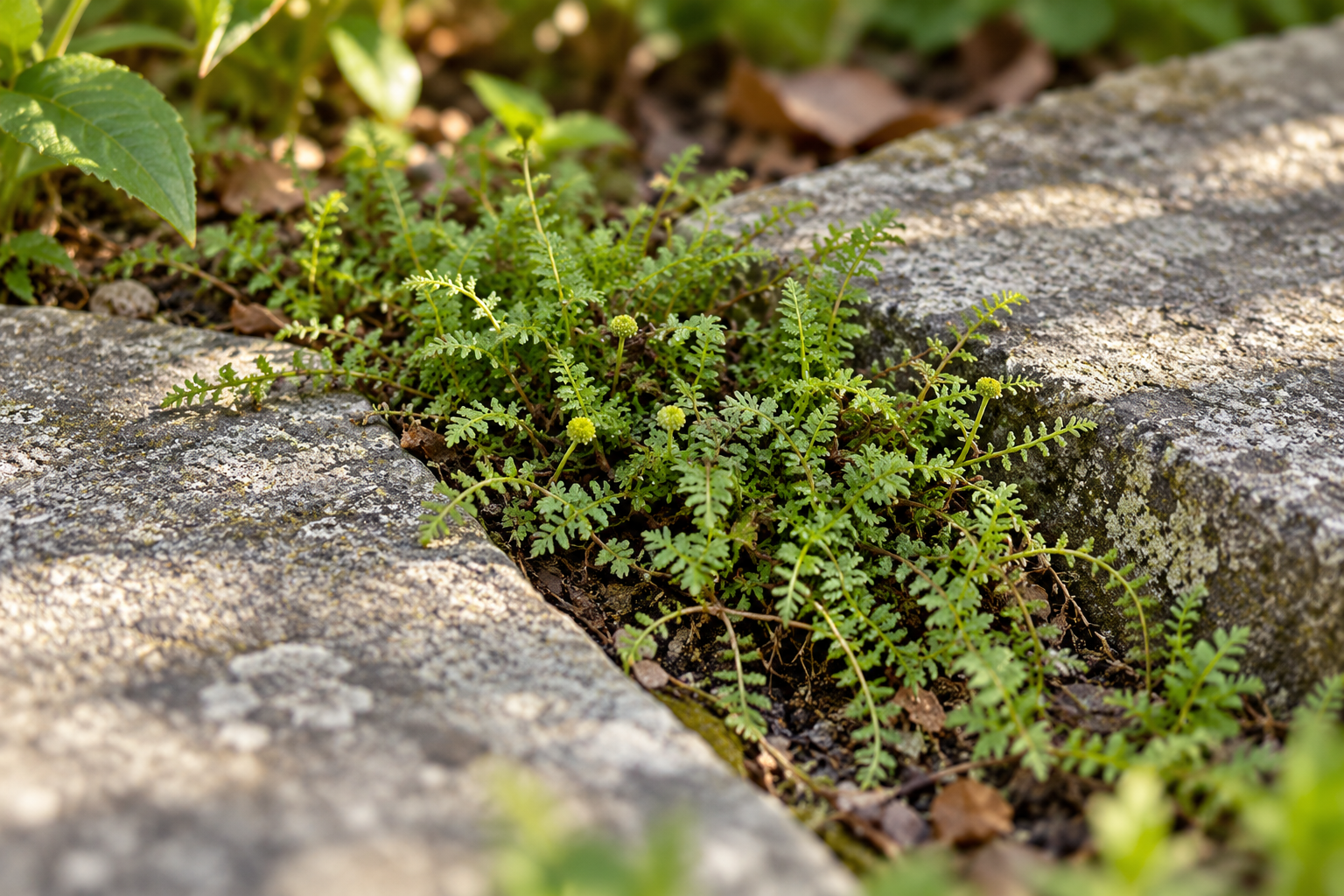
Leptinella squalida does not develop large leaves. Its finely pinnate segments spread densely over the ground and at first glance recall tiny fern fronds. Botanically it is a flowering perennial in the daisy family. Moss in the shop name does not make it true moss either. Look closely at the pattern: bronze or purple tones may appear among green foliage. The German trade name Braunes Fiederpolster describes this possible effect, not a permanently uniform brown appearance. The offer names Leptinella squalida; no special nearly black cultivar is added here. Its fine structure is precisely what makes a small garden spot interesting.
Even between stones, it needs soil
At an old garden edge or between suitable stepping stones, the low cushion displays its leaf shape well. What matters is beneath the visible green. A dry gap containing little sand is not automatically suitable. The young plant needs enough draining moisture-retaining soil and accessible watering. Partial shade makes care easier in warmth; sun is more suitable in cooler conditions with assured supply. Check how strongly adjacent stones heat in the afternoon. A pretty green path margin also does not promise regular heavy foot traffic tolerance like a lawn.
Separate delivery height from low garden growth
Sets contain young plants in individual 9 cm pots at approximately 10–15 cm total height including pot. Later the perennial forms low planting up to about 10 cm above ground. These do not conflict because delivery includes the pot. Over the years, the cushion can gain about half a metre to a metre in width. The shop gives 30–35 cm spacing. Lay out pots at planned positions first and leave space beside smaller neighbours. Growth expands wherever stems root at nodes; low height therefore says little about later sideways space needs.
Moisture helps an even start
Spring or early autumn is often favourable in unfrozen soil that is not waterlogged. Thoroughly moisten the delivery rootball, unpot gently and plant at its previous height. Bring loose substrate around it and water slowly. Then check moisture directly in the young root zone. It should not dry completely, but surplus must drain. A small surface splash beside a dried plant is not reliably enough. Check more often along warm stone than in a cool border. This follows actual need rather than a fixed watering calendar detached from weather and root condition.
Flowers remain a quiet detail
In summer, little button-like flower heads may appear on short stems just above the leaves. Depending on the view they look greenish-yellow to yellowish-white and are much more understated than large daisy flowers. Leaf shape still defines the whole. A young delivery without flowers therefore fits the offer and need not be pushed into bloom through extra feeding. New leaves, good soil contact and a supplied rootball initially say more about its start. Look close to discover the tiny heads. It is a fine leaf accent beside the garden here, not a promise of a conspicuous or permanent flower carpet.
Watch the edges and divide older cushions
Creeping stems and rhizomes can expand a suitable area quickly. Where it reaches smaller neighbours, lift unwanted rooted sections individually before several plants mingle. Regular overall cutting is unnecessary. Strong older planting can be divided in spring when needed; the pieces then need suitable soil contact and moisture again. Do not move every thin piece somewhere else and abandon it. With patchy growth, first look for dry or persistently wet spots. An established plant’s sideways vigour does not prove every freshly separated small division can manage without watering support.
The garden picture may change in winter
This perennial is partly evergreen; leaf density and colour may change with weather. Temporarily thinner winter growth therefore needs seasonal interpretation. Maintain enough root space and open holes in containers, shelter outdoors and check dryness in frost-free weather. Do not answer every brown patch with more water: check the rootball and drainage. During growth, feed moderately only when needed according to the label. In spring, watch for fresh leaf tips and gently remove dead material. Cooler light, accessible soil and monitored edges keep this delicate pattern an understandably cared-for garden accent.
One plant, several views
Good to know
Is it moss?
No. Leptinella squalida is a perennial flowering plant with finely pinnate leaves. Cotula squalida is an older botanical name.
Why is the brown cushion also green?
Green leaves with possible bronze or purple tones fit the species. The name does not require constantly uniform brown colour.
Does it suit every paving gap?
Only with adequate root space and suitable moisture. A hot dry sandy gap is not automatically a good position.
Is 10–15 cm its later cushion height?
That delivery measurement includes the sales pot. Garden planting remains low, described as up to about 10 cm above soil.
Can I use it as a hard-wearing lawn?
This portrait gives no promise of regular heavy foot traffic tolerance. It presents a garden cushion for suitable edges and gaps.
How do I stop it covering smaller neighbours?
Monitor the sides and lift unwanted rooted sections early. Strong older planting can be divided in spring.
Sources and editorial note
- Exotenherz: offer and original photographs (03.10.2026)
- RHS: Leptinella squalida, directly read species profile (03.10.2026)
- Denver Botanic Gardens: Leptinella squalida, species and position (03.10.2026)
- Exotenherz: checked 6-plant child offer (03.10.2026)
- Exotenherz: checked 12-plant child offer (03.10.2026)
- Exotenherz: checked 20-plant child offer (03.10.2026)
- Exotenherz: checked 40-plant child offer (03.10.2026)
- Exotenherz: checked 60-plant child offer (03.10.2026)
Shop offer, article number, availability and original images directly checked on 03.10.2026. Specialist sources read directly. Shop dimensions of 9 cm pot and 10–15 cm total height directly checked. RHS and Denver directly read on 03.10.2026: low rhizomatous perennial, Cotula synonym, finely divided foliage, summer flower heads. No moss or fern identity and no invented Platt’s Black cultivar. No lawn-wear promise. All five child offers individually checked; available quantities: 6, 12. Public originals unchanged and without product stamps; new images individually visually checked.