
This plant at Exotenherz
Check the shop offer for current availability, price and what is included.
Check the selected shop offer for price, availability and delivery contents.
Your care table
| Topic | What to do | Why it helps |
|---|---|---|
| Light | Choose bright partial shade with gentle sun for part of the time. | Very deep shade can limit flowering; fierce hot sun increases water demand. |
| Soil | Prepare humus-rich loose and well-drained soil. | Moist soil supports establishment; permanently wet hollows stress the roots. |
| Planting time | Prefer spring or early autumn; plant only in frost-free workable soil. | Milder weather helps young plants connect with the bed. |
| Spacing | Plan 30–45 cm from one clump centre to the next. | Young plants in 9 cm pots grow noticeably wider later. |
| Water | During dry weather in the first year, check the small original root ball especially carefully. | Established clumps cope with temporary drought better than freshly planted specimens. |
| Fertiliser | Feed moderately in spring if needed, following product instructions. | Poor growth may also reflect drought or position, not just a nutrient shortage. |
| Foliage care | Remove dead and damaged leaves selectively in spring. | Healthy green leaves retain their calm structure; stronger cutting is needed only for unattractive old foliage. |
| Division | Divide strong older clumps in spring when needed. | Division retains cultivar characteristics and makes room for new growth. |
For young plants, feel the soil directly at the root ball. The surface and deeper soil may have different moisture levels.
Water thoroughly after planting; later, water according to the soil, weather and establishment rather than a fixed calendar.
Avoid standing water. For plants in containers, also check that water runs out of the drainage hole.
A green arch and later a purple accent
Not every plant at a bed edge has to flower simultaneously. Big Blue first forms a dense base of narrow sturdy leaves that start upright and then lean outwards. This calm greenery has a clear form even before flowering. Later, upright flower spikes may appear between the arches. Their many small purple flowers recall grape hyacinths from a distance. Liriope, however, is a different perennial garden plant, not a spring-flowering bulb. Its later season is precisely what makes it interesting in a varied planting.
Find bright partial shade for leaves and flowers
I like to choose a position at the edge of an open tree or shrub planting, where gentle light reaches the foliage for part of the day. In deep shade, the plant may stay green but form fewer flowers. Bright partial shade helps balance the two. Soil can be humus-rich and moist, but must drain. Water demand rises against a hot wall or in full summer sun. I check moisture just as carefully under trees: a shaded surface does not automatically mean the roots find enough water.
Plan sets for the later clump size
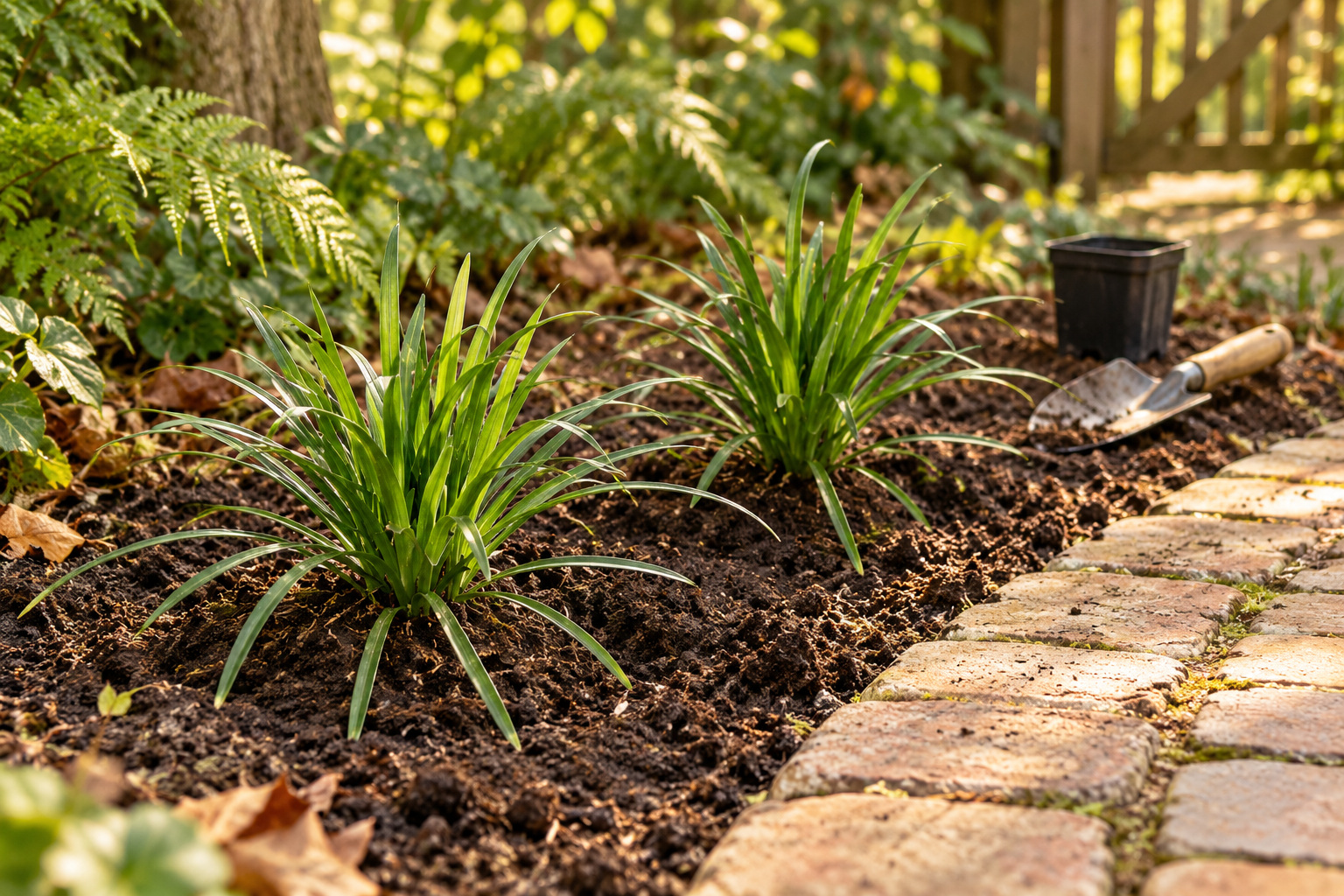
The offered plants are in 9 cm pots and approximately 10 to 25 cm high according to the shop. An established Big Blue clump may reach roughly 30 to 40 cm; its flower spikes are in about that range. When laying out, I use 30 to 45 cm between plants. The young pots initially remain individual points but can spread later. I moisten root balls before planting, set at the previous height and water in. Linked set offers lead to their own quantities. Two plants in our planting scene show just a part of the gardening work, not a complete set’s contents.
The first garden year needs more attention
An established liriope handles temporarily drier periods better than a fresh small root ball. In the first year, I therefore check regularly at the exact position of the young plant. If only the surroundings stay moist while the pot root ball is dry inside, water is not yet reaching the new roots well enough. Water slowly and thoroughly, then decide again according to condition and weather. If water stands in the planting hole for a long time instead, more watering does not help. First look at drainage and soil structure. A fixed weekday says little about that difference.
Support late flowers without forcing them
Big Blue may form violet-blue flower spikes in late summer and autumn; the display often falls between August and October, depending on garden, weather and development. The young delivery plant need not yet flower. If flowers fail to appear, I first check light and the clump’s condition. More fertiliser is no certain answer to too much shade. Dark fruit clusters may remain after flowering and continue structuring the bed. They are decoration here, not an eating recommendation. I also watch young shoots for feeding damage; not every damaged leaf tip calls for comprehensive treatment.
Do not remove all wintergreen foliage too quickly
Many leaves remain over winter but can become unattractive after cold wind or unfavourable weather. In spring I remove dead and damaged foliage selectively. If the entire old tuft looks poor, a stronger cut is also possible before fresh growth. Protect the new tips when doing so. Liriope is not continually trimmed to a fixed outline like a hedge. In the bed, a protected position helps against drying winter winds. A small container needs extra attention because its root space reacts more strongly to frost and changing moisture.
Keep an older clump and divide it usefully
Over the years, the leaf base becomes denser. To rejuvenate an older clump or extend a bed line, division in spring is an option. I use strong pieces with their own roots and support them afterwards like a new planting. This retains cultivar characteristics; seed does not automatically produce exactly Big Blue again. Thickened areas at the roots belong to the plant and are not automatically a sign of disease. Attentive soil and foliage care often suffices for an attractive planting. Only once position and water are right do I assess whether a moderate nutrient supply is really lacking.
One plant, several views

Good to know
Is liriope an ornamental grass?
Its narrow leaves give it a grassy appearance, but it belongs to the asparagus family and forms its own small flowers in racemes.
When does Big Blue flower?
In late summer to autumn, often August–October depending on position, weather and development. A young delivery is not guaranteed to be flowering.
How large does it grow later?
Plan for about 30–40 cm, flower spikes up to approximately 40 cm. Delivered plants are much smaller in 9 cm pots, approximately 10–25 cm according to the offer.
What spacing suits the bed?
Roughly 30–45 cm between clump centres. Soil stays visible initially until the plants fill out.
Can I put it entirely in deep shade?
Flowering may be reduced there. Bright partial shade with some gentle sun is the better choice for this cultivar portrait.
Must all foliage be removed each year?
No. First remove dead leaves in spring. Consider a stronger cut before new growth only when the old foliage looks unattractive overall.
Are white swellings at the roots damage?
Liriope develops thickened storage areas. On their own they do not prove disease.
Sources and editorial note
- Exotenherz: delivery size, four set offers, original and spacing (30.09.2026)
- RHS: Liriope muscari Big Blue, cultivar features and flower spike height (30.09.2026)
- RHS: planting, caring for, cutting and dividing liriope (30.09.2026)
- NC State Extension: Liriope muscari, leaf growth and root characteristics (30.09.2026)
Live shop read directly on 30.09.2026: parent article 513427092024, four child sets of 6/12/20/40, each with its own SKU and GTIN. 6 and 12 available; 20 and 40 unavailable. Delivery size 9 cm and 10–25 cm, shop spacing 30–45 cm. RHS cultivar profile Big Blue read directly, rather than using only the English species name big blue lilyturf as cultivar evidence. Flower spike height up to approximately 40 cm, purple flowers and clumping growth confirmed; shop timing August–October explained as weather-dependent late summer/autumn. Cultivation checked against RHS guide and NC State. No absolute frost, flowering or maintenance-free promise. Public gallery only unchanged clean original without environmental seal; silhouette and advertising montages remain internal. Image acceptance: young firm arching green leaves without flowers checked against original; two planted specimens form an explicitly labelled illustrative situation.