
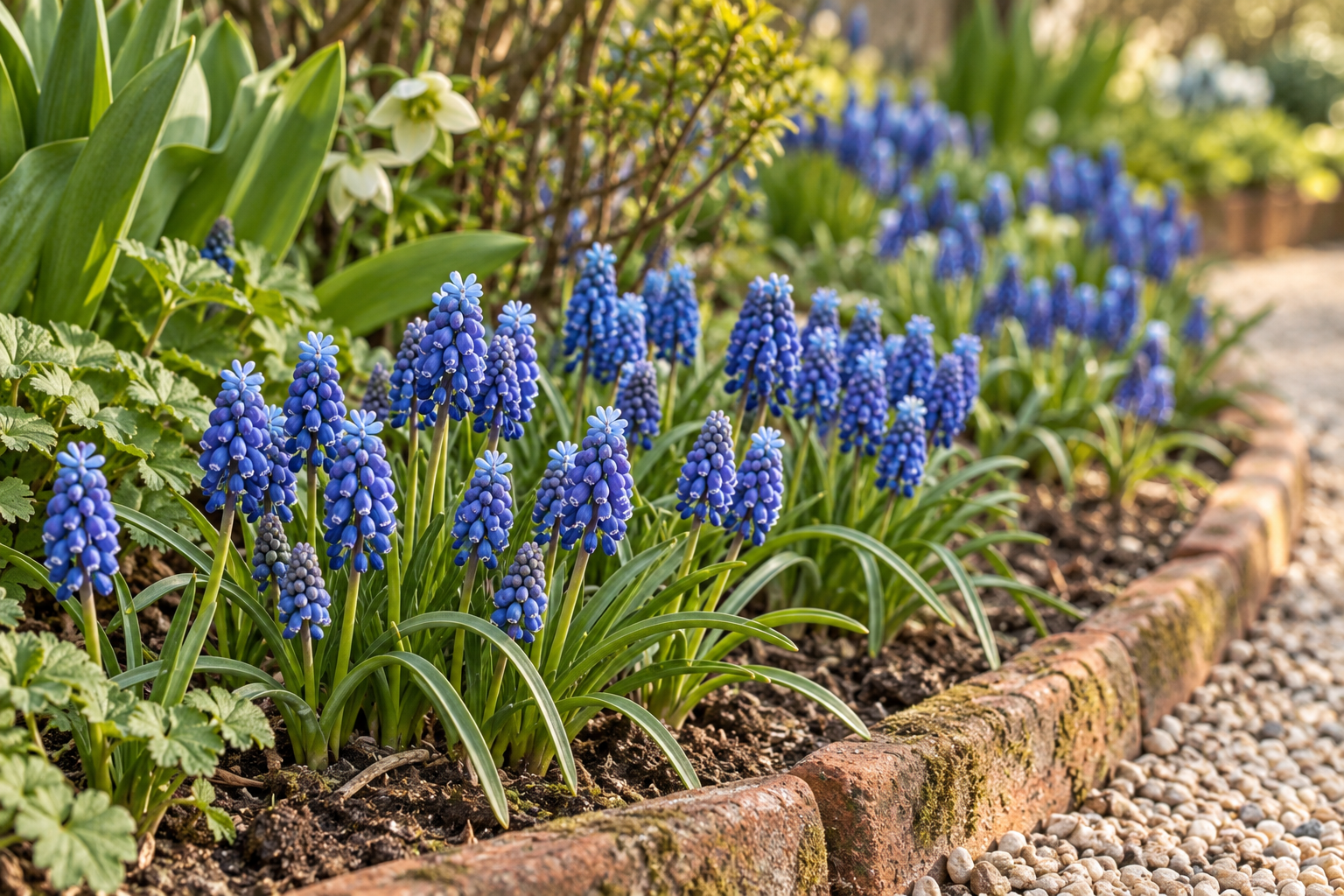
This plant at Exotenherz
Check the shop offer for current availability, price and what is included.
Product and delivery details are given in the individual offer.
Your care table
| Topic | What to do | Why it helps |
|---|---|---|
| Light | Choose sun to light partial shade. | The spring planting should not be deeply shaded. |
| Soil | Free-draining and somewhat moist during growth. | Standing water burdens bulbs. |
| Planting | Plant about 10 cm deep in autumn. | Packaging instructions and actual bulbs remain decisive. |
| Spacing | About 5–10 cm in borders as a guide. | Plan for vigour and later offsets. |
| Water | Water according to soil moisture during growth. | Green foliage remains active after flowering. |
| Nutrients | Consider existing supplies and supplement when needed. | A fixed extra dose is not always necessary. |
| Foliage | Allow to yellow naturally; do not cut autumn foliage unnecessarily. | The species may already carry leaves in autumn. |
| Group | Divide dense groups in summer. | This keeps their spread manageable. |
For young plants, feel the soil directly at the root ball. The surface and deeper soil may have different moisture levels.
Water thoroughly after planting; later, water according to the soil, weather and establishment rather than a fixed calendar.
Avoid standing water. For plants in containers, also check that water runs out of the drainage hole.
Blue made of many small flowers
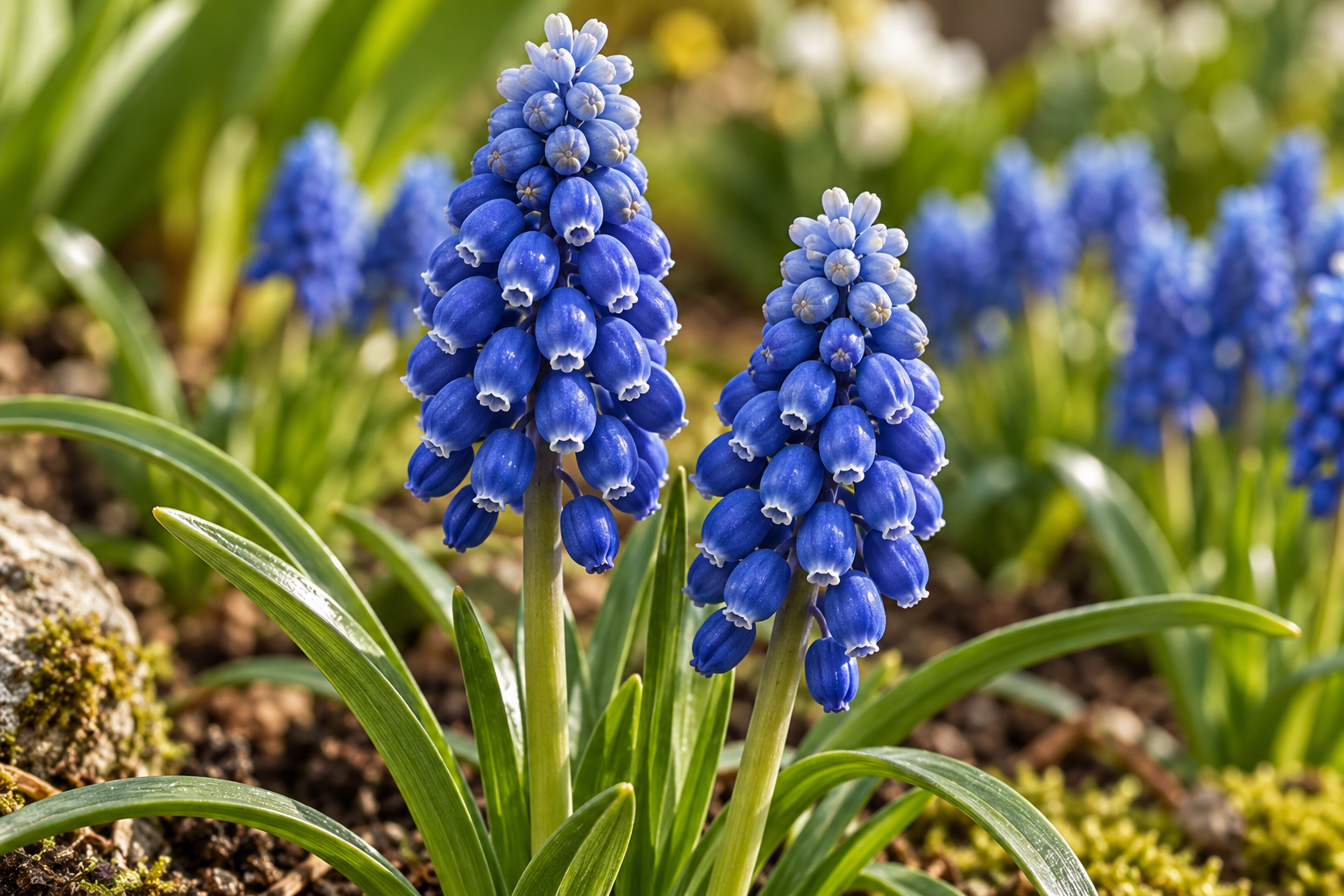
A grape hyacinth is not made of a single large bell. Many small urn-shaped flowers sit closely on an upright stem. In Muscari armeniacum they appear deep violet-blue, with fine pale rims at the opening. Narrow green leaves bend outwards over time. The plant remains roughly 15 to 20 centimetres tall when flowering. Several groups along a path can turn this into a blue ribbon. Among larger spring flowers, this low form remains a level of its own that is enjoyable to view close up too.
Distribute fifty bulbs deliberately
The assortment offers 50 bulbs. Images show later flowering, not delivery of ready-planted containers. Lay groups out on the ground first and assess the view from terrace and garden path. About five to ten centimetres spacing is a guide, depending on how loose you plan the planting. Muscari armeniacum can multiply considerably over time. Do not immediately fill a narrow spot between slow-growing small perennials completely. For a limited group, use a suitable container and keep later growth manageable.
Light in spring without a wet root area
Sun to light partial shade and free-draining soil suit this grape hyacinth. Under deciduous shrubs, the position may be sufficiently bright before they leaf out. Permanent dense shade is different. Check soil after rain: if water remains in a hollow, the planting needs a better-drained area. Somewhat humus-rich, loose garden soil holds moisture during growth without wetting bulbs excessively. A pot needs free holes and suitable soil. A pretty outer pot must not become an unnoticed water reservoir directly at the roots.
Autumn planting and possible early leaf emergence
Plant bulbs in autumn about ten centimetres deep, tips upwards and following packaging guidance. Loosen the area first and water a little if soil is dry. Trade sizes are not interpreted as measured diameters. This species may produce leaves in autumn and retain them through winter. Green foliage then is therefore not necessarily a faulty annual rhythm. Avoid unnecessary cutting. A small planting marker reminds you in summer that the above-ground dormant group is still present in the border.
Observe soil during growth
Even moisture without waterlogging helps in spring. Additional watering follows rain and soil; wind and limited compost volume matter in containers too. The surface alone does not always say enough; check moisture a little beneath. While leaves stay green, the plant remains active. Pre-fertilised compost and existing garden nutrients inform supply decisions. Supplement when needed according to the fertiliser label and avoid double doses. Active demand falls after leaves die back. A dormant pot is therefore not watered on the same plan as a growing spring bowl.
After flowering, room for leaves to work
Allow green leaves to yellow naturally. If no extra seed formation is wanted, remove faded stalks beforehand. Leaf area remains separately preserved. In grass, mow only once the relevant group has died back. In mixed borders, later-emerging neighbours can accompany yellowing foliage without concealing it too early. Keep a spring container bright after display and supply according to need. Bulbs are not food; store them separately from kitchen supplies. A short note on yellowing helps plan the next garden year.
Guide vigour sensibly in a small garden
Muscari armeniacum is perennial and may colonise new areas through offsets and seeds. This is viewed differently in a large open group than in a narrow border with small sensitive neighbours. Observe edges and divide overly dense groups during summer dormancy. Distribute healthy bulbs to suitable new positions. If flowering decreases, check light, foliage care and density first. Record spread with a photograph in the plant book. The blue ribbon thus remains a deliberately managed garden planting rather than being noticed only once it exceeds its intended space.
One plant, several views


Good to know
When does Muscari armeniacum flower?
In spring; the exact timing depends on weather.
Why does foliage show already in autumn?
The species can form leaves again after the summer break and retain them through winter.
How many bulbs does the offer contain?
50 bulbs for planting.
Can the plant spread?
Yes. Observe the group’s edge and divide in summer when needed.
Is a container possible too?
Yes, with drainage, sufficient root space and care after flowering.
Are the small flowers individual bells?
Many small urn-shaped individual flowers form the dense flower cluster.
Sources and editorial note
- Exotenherz: offer and original photographs (03.10.2026)
- RHS – Muscari armeniacum: plant profile (03.10.2026)
- NC State Extension – growth and annual rhythm (03.10.2026)
- RHS – grape hyacinths in the garden (03.10.2026)
Shop offer, article number, GTIN, availability and original images checked directly on 02.10.2026; specialist acceptance on 03.10.2026. Specialist sources read directly. Shop variant, quantity, SKU, current orderability and both original shop images checked directly. Specialist sources read on 03.10.2026. Images show later flowering, not delivery condition. Trade size classes are not adopted as measured bulb or tuber diameters. Specialist acceptance with published Pflanzenwelt portraits; no tool or Wawi changes.