
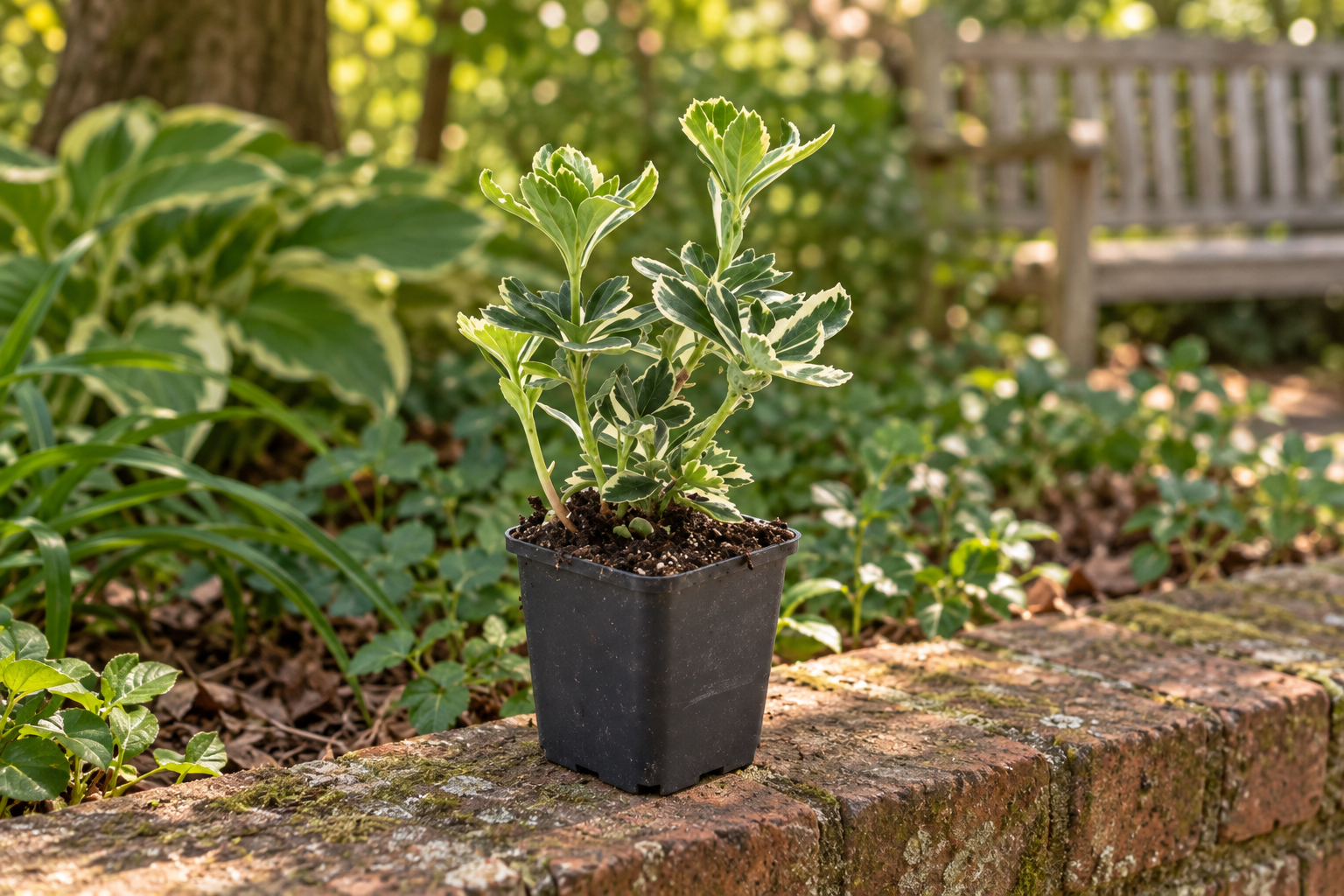
This plant at Exotenherz
Check the shop offer for current availability, price and what is included.
Check the shop for the current price, availability and offer contents.
Your care table
| Topic | What to do | Why it helps |
|---|---|---|
| Light | Choose partial shade to shade. | Pale margins are no evidence for hot full sun. |
| Planting | Lay out pots first and retain previous rootball height. | Slower coverage needs well-planned distribution. |
| Water | Check rootball moisture directly and water soil as needed. | Small root zones respond faster than older planting. |
| Soil | Provide humus-rich moisture-retaining soil with drainage. | Persistent wetness strains variegated garden plants too. |
| Colour | Distinguish regular pale margins from spots and dry patches. | Variegation is a cultivar feature, not automatically damage. |
| Edges | Observe new runners and smaller neighbours regularly. | Even a slower cultivar grows beyond the original pot area. |
| Feeding | Feed moderately only according to supply and growth. | Extra fertiliser does not ensure faster coverage. |
| Winter | Shelter pots outdoors and check moisture without frost. | Wind and winter sun can strain retained leaves. |
For young plants, feel the soil directly at the root ball. The surface and deeper soil may have different moisture levels.
Water thoroughly after planting; later, water according to the soil, weather and establishment rather than a fixed calendar.
Avoid standing water. For plants in containers, also check that water runs out of the drainage hole.
Pale edges invite a closer look
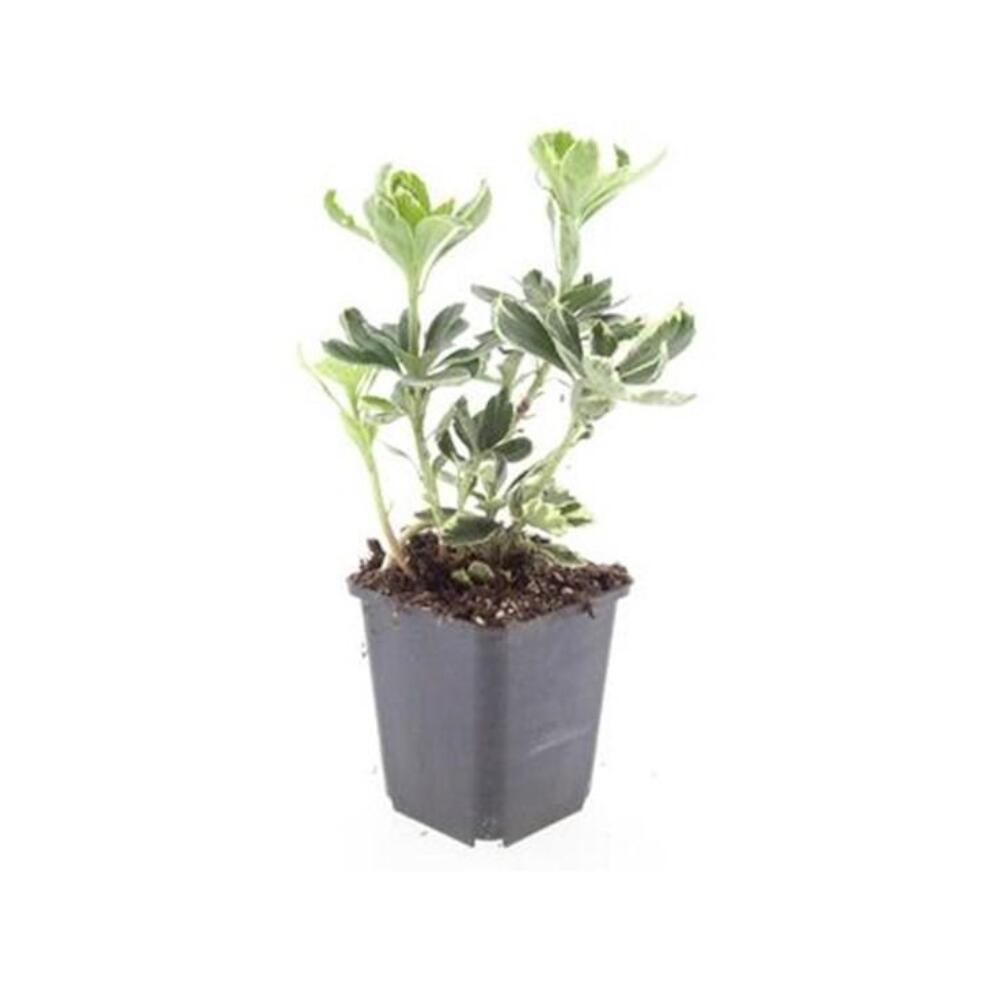
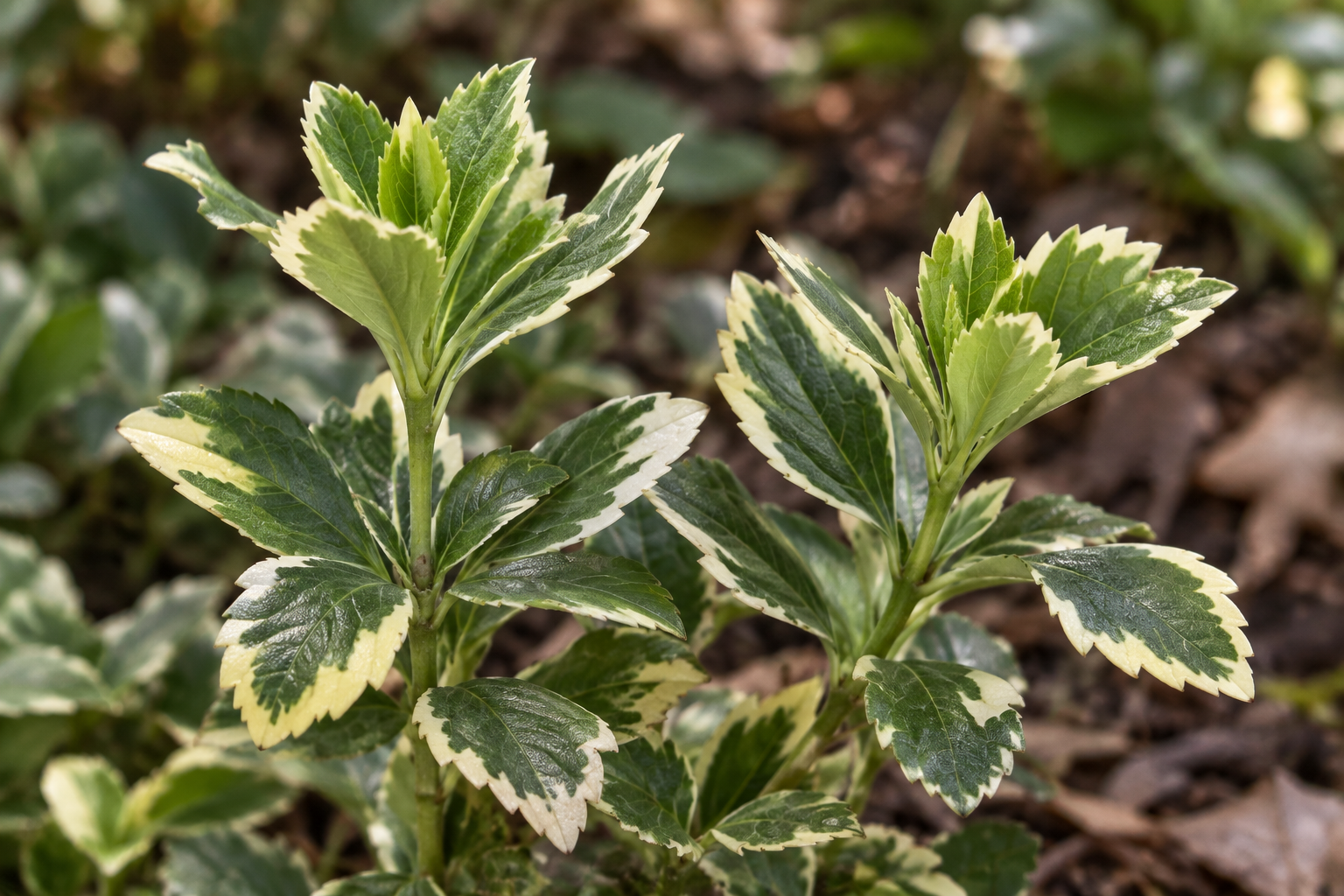
Cream-white markings follow Variegata’s green leaf. They may appear as an edge or pale stripe and stand out against darker garden soil. Leaf shape remains that of pachysandra: wedge-shaped, narrow below and more coarsely toothed above. The young shop photograph shows small upright shoots with clearly pale-edged leaves. White belongs to the cultivar, not a deposit that needs washing off. Yet not every pale patch is variegation. If a change is dry, spotted or suddenly limited to damaged leaves, inspect plant condition separately.
A slower carpet is its own garden picture
Variegata is described as slower growing than the green species. Allow time rather than expecting an immediately even closed covering. Individual pale margins can be interesting in a smaller group against dark soil. A border strip need not be completely covered from day one to look designed. Arrange pots before planting so later growth makes sense. Gaps remain accessible and maintainable initially. More fertiliser or ever-denser placement cannot reliably replace good rooting and suitable conditions.
Cultivar colour needs a suitable outdoor place
Partial shade to shade suits this garden plant. Pale leaf margins do not justify hot sun because they look cheerful in a photograph. Watch the day’s light, reflective walls and soil moisture. Under a tree, ground may look cool but dry through neighbouring roots. Humus-rich moisture-retaining draining soil helps the start. A persistently wet hollow remains unsuitable. In containers, plan open holes and enough later root space. The plant needs an understandably supplied outdoor position; small delivery size is not a suggestion for dark living-room decoration.
Interpret dimensions before planting
Sets contain young plants each in 9 cm pots. About 10–25 cm total height including pot is the delivery figure. Species profiles describe older pachysandra at about 15–30 cm garden height, not an exact promise for every Variegata. The shop gives around 25 cm spacing. Use it as placement guidance while considering the planned edge and smaller neighbours. Colour says nothing about quantity: the set determines how many plants arrive. If making several pale groups, establish positions first. Later distribution then makes more sense than a randomly divided quantity of young pots.
Support the start under woody plants
Spring or early autumn is often easier for care than a hot dry spell. Frost-free soil without waterlogging is essential. Moisten before unpotting and retain planting height. Gently bring soil around it, water in and then check the former container root zone directly. Young plants need accessible watering until their roots reach garden soil. Give water slowly at ground level as needed. A glossy surface or wet leaves do not prove the inside rootball is supplied. Check especially carefully beneath large roots. Care according to moisture and weather, not a rigid calendar, keeps closer contact with the actual plant.
Distinguish white markings from damage
Repeated cream markings along margins are characteristic of Variegata. Browning dry areas, unusual dots or dying shoots are different observations. Check soil, leaf undersides and how the change develops. Remove clearly dead material individually and seek expert assessment for recurring damage. Do not constantly wet dense coverage from above; give water preferentially to roots. Check edges even in a slower cultivar because pachysandra can produce underground runners. Small neighbouring perennials should remain accessible. A good view comes from cultivar markings and healthy shoots, not assuming every pale leaf is automatically fine.
Patience remains part of the design
After winter, leaves may look different from a summer product photograph. Evergreen does not mean wind, dry periods and winter sun leave no marks. In containers, check the rootball on frost-free days and do not routinely water frozen soil. In spring, watch new growth and remove unsightly parts individually. Supplement nutrients according to existing supply instead of constantly trying to accelerate slower growth. This restrained cultivar can therefore accompany a little garden path interestingly: not through immediate mass, but pale edges, recognisable leaves and a gradually developing area.
One plant, several views
Good to know
Is the white leaf edge a disease?
Cream-white edges and stripes belong to Variegata. New dry spots or dying shoots need separate assessment.
Does Variegata grow as fast as the green species?
It is described as slower growing, so do not expect immediate coverage.
Are the white parts flowers?
No. They are leaf markings. Small whitish spring flowers are a separate feature.
How large are delivery plants?
9 cm pot per plant and approx. 10–25 cm total height including pot; quantity according to set.
How far apart should I plant?
The shop gives about 25 cm. Also consider accessible care points and smaller neighbours.
Will more fertiliser help slow growth?
Not automatically. Check position and root supply first; slower growth belongs to the described cultivar.
Sources and editorial note
- Exotenherz: offer and original photographs (03.10.2026)
- International Dendrology Society: Pachysandra terminalis and Variegata (03.10.2026)
- Morton Arboretum: Pachysandra and Green Sheen and Variegata cultivars (03.10.2026)
- NC State Extension: Pachysandra terminalis, species features and cultivation (03.10.2026)
- Exotenherz: checked 6-plant child offer (03.10.2026)
- Exotenherz: checked 12-plant child offer (03.10.2026)
- Exotenherz: checked 20-plant child offer (03.10.2026)
- Exotenherz: checked 40-plant child offer (03.10.2026)
- Exotenherz: checked 60-plant child offer (03.10.2026)
Shop offer, article number, availability and original photographs directly checked on 03.10.2026. Specialist sources directly read. Variegata cream markings compared with IDS and Original2; slower growth directly read at Morton. Species sizes as guidance rather than exact cultivar values. No unsupported reversion or toxicity rule added. Internal water-source difference: no general drought tolerance. Morton web reading succeeded, local 403 recorded. All five child offers individually checked; available quantities: 6, 12, 60. Clean original view retained unchanged; young scene and leaf or flower detail appropriately labelled.