
This plant at Exotenherz
Check the shop offer for current availability, price and what is included.
Product and delivery details are given in the individual offer.
Your care table
| Topic | What to do | Why it helps |
|---|---|---|
| Light | Choose a bright, open shelf. | A deep, dark compartment is no substitute for daylight. |
| Watering | Water thoroughly after the upper compost has dried. | Small reserves in the foliage allow a short pause. |
| Drainage | Remove the nursery pot from the outer pot and let it drain. | Water must not collect unseen beneath the pot. |
| Compost | Keep loose and well drained. | The fine roots cannot tolerate compacted, permanently moist conditions. |
| Fertiliser | Feed sparingly during growth, following product instructions. | Its quiet growth needs no intensive feeding. |
| Shoots | Let them hang freely over the edge or shorten selectively. | Trapped trailing shoots are damaged during movement. |
| Repotting | Enlarge slightly only when the rootball is rooted through. | An oversized pot dries more slowly. |
| Winter | Keep bright and draught-free; water less often according to need. | Slower growth reduces consumption. |
Check the compost and pot weight. The care table explains how far the compost may dry.
Water only when needed. The water should reach the root ball without spilling over the rim.
Remove surplus water from the saucer or cachepot. Then return the plant to a suitable position.
Round leaves fall loosely over the edge
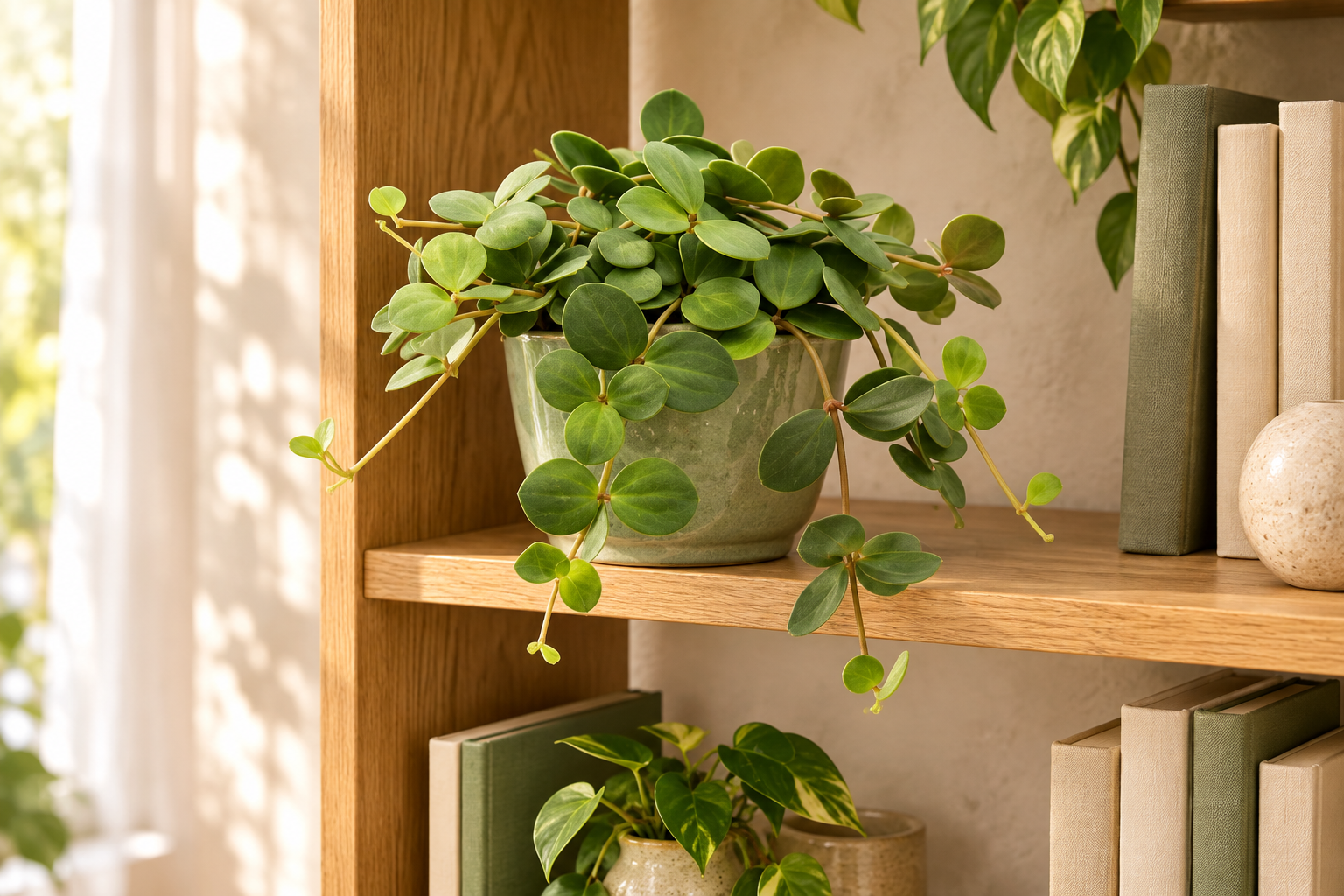
Hope looks friendly and calm without needing a complicated leaf pattern. Its rounded, fleshy leaves sit in small groups along a shoot that falls over the pot edge as it lengthens. This form can look particularly beautiful on an open bookcase. I leave some space between the plant and the compartment below so that its shoots hang freely. The shop lists it as Peperomia tetraphylla Hope, while the horticultural variety name is also simply Peperomia Hope. The plant offered is in a fourteen-centimetre hanging pot, around thirty to thirty-five centimetres high excluding the hanger.
A shelf needs more than an empty gap
An attractive empty shelf space is not yet a suitable plant position. Hope needs daylight on its leaves. This can work well in an open compartment close to a bright area; deep between tall books and a dark back panel, too little often remains. I therefore watch new development rather than only the decorative effect on the first day. If shoots become very long and leaf spacing noticeably increases, the position deserves checking. Hot, direct summer sunshine, by contrast, is softened. A light curtain lets brightness through without heating every little unprotected leaf.
Understand fleshy foliage correctly
The thick leaves can store some water. This does not make Hope a plant whose rootball should be left unchecked for months. A short dry phase in the top layer of compost is more useful than constantly adding water. I feel the compost before watering and briefly lift the pot to assess its weight. With a hanging plant, this check is easily forgotten because the soil lies above eye level. Here too, it is worth taking the plant down for watering. The growing medium, shoots and leaf undersides can then be inspected calmly rather than simply pouring some water from above between the foliage.
Water thoroughly, then let it drain
When the upper compost has dried and the whole rootball feels lighter, water is given carefully. Afterwards, I let excess water drain completely through the drainage holes. None remains in the outer pot or a watertight hanging cover. After a few minutes I check again because a rootball may continue to drip. Different rooms require different intervals between waterings. A warm, bright summer position consumes more water than the same spot during a grey winter week. This change is normal and no reason to treat the plant with an unchanging weekly schedule.
Roots like a manageable pot
Hope usually remains a manageable size. Its shoots can grow longer without immediately needing a large pot. During repotting, I first check how thoroughly the roots occupy the existing rootball. A slightly larger nursery pot with drainage and suitable loose compost is sufficient if needed. An airy structure prevents everything compacting into a mass that stays wet for a long time. I do not unnecessarily strip all the compost from the fine roots. Gentle handling and planting at the previous depth give the plant a calmer start than pressing it deeply into fresh compost for a tidy appearance.
Guide shoots rather than polish leaves
If trailing shoots come too close to a shelf board or frequently used door, individual shoots may be shortened. The remaining shape should still be able to fall freely. Leaves are gently dusted; leaf-shine spray is unnecessary for their naturally matt appearance. During active growth, feeding may be supplied sparingly, depending on the compost and product instructions. After repotting, care initially remains restrained. Small, inconspicuous flower spikes are possible, but not a required demonstration that everything is going well. With Hope, healthy, even foliage matters most.
Do not answer leaf loss with more water
If several leaves fall or a section of shoot becomes soft, I first check rootball moisture and drainage. A wet pot beside cold glass calls for a different change from a completely dry rootball in warm air. Trapped or broken trailing stems cannot be repaired by extra watering either. In winter, the plant remains bright, warm and away from cold draughts. When carrying it to its final position, I hold the pot, not the hanging leaves. The scene shows one possible shelf arrangement; the original gallery preserves the genuine offered starting plant and makes the distinction clear.
One plant, several views

Good to know
What is the plant’s botanical name?
Horticulturally the variety is listed as Peperomia Hope; the shop uses Peperomia tetraphylla Hope.
Is it suitable for a shelf?
Yes, if the open compartment receives enough daylight and the shoots can hang freely.
Does it need water daily?
No. Check the upper compost and the whole rootball before watering.
Are the thick leaves normal?
Yes. Fleshy, rounded foliage belongs to Hope.
Can long shoots be cut?
Individual shoots can be shortened to achieve a suitable shape.
Why do the leaves hang limply?
Distinguish drought, damaged wet roots and cold; do not water blindly.
Is the scene a delivery photograph?
No. The scene shows an arrangement; the original photograph appears separately in the gallery.
Sources and editorial note
- Exotenherz: offer and original photographs (01.10.2026)
- RHS: Peperomia Hope (01.10.2026)
- RHS: caring for peperomias (01.10.2026)
Shop offer, SKU, GTIN and availability checked live on 01.10.2026. Original photograph unchanged. Independently researched gardening texts and an individually reviewed scene. The shop name tetraphylla Hope and horticultural name Peperomia Hope are transparently distinguished.