
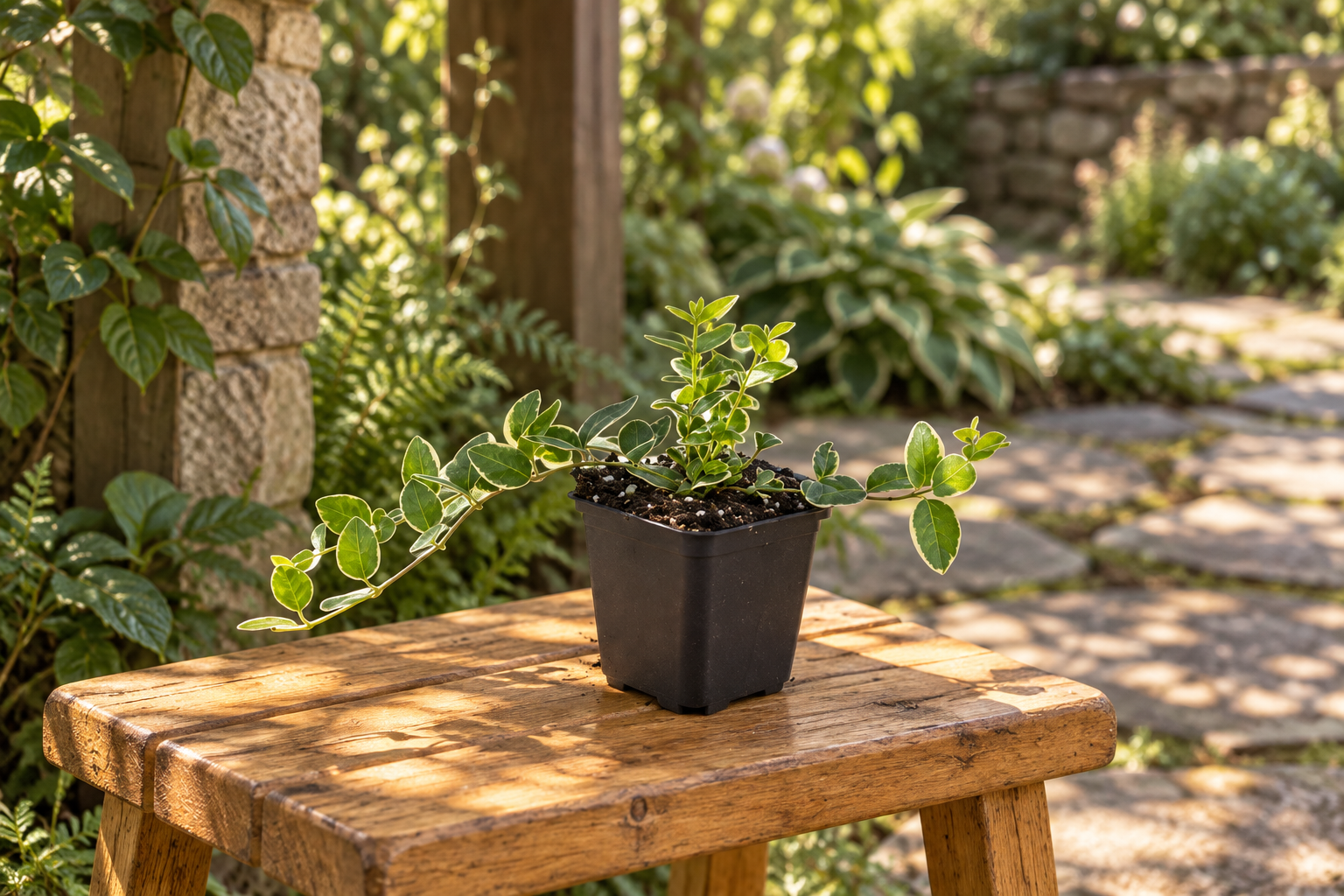
This plant at Exotenherz
Check the shop offer for current availability, price and what is included.
Product and delivery details are given in the individual offer.
Your care table
| Topic | What to do | Why it helps |
|---|---|---|
| Light | Choose partial shade or shade in the garden. | Fine pale edges need no hot midday sun to be visible. |
| Planting | Set the moistened ball at its previous height in loose soil. | Deeply buried shoot bases and compacted soil make establishment harder. |
| Water | Check directly around the small ball while establishing and water as needed. | A dry 9-cm ball is not automatically supplied by damp soil beside it. |
| Soil | Provide humus-rich soil with good water outflow. | Shade and waterlogging are different position conditions. |
| Feed | Supply moderately in spring as needed following the label. | More feed corrects neither drought nor blocked drainage. |
| Pruning | Selectively remove dead shoots and unwanted extensions. | Ground contact allows long shoots to form new rooting points. |
| Winter | Keep containers sheltered outdoors; check ball moisture in frost-free weather. | Evergreen leaves may lose water while the small potted ball is cold. |
| Safety | Do not use as an edible plant; keep children and pets from nibbling it. | Periwinkle belongs as an ornamental in the border, not the kitchen or feeding bowl. |
Check the compost and pot weight. The care table explains how far the compost may dry.
Water only when needed. The water should reach the root ball without spilling over the rim.
Remove surplus water from the saucer or cachepot. Then return the plant to a suitable position.
A fine line makes the difference
Ralph Shugert looks quieter than a cultivar with large yellow leaf areas. Dark green remains the main colour; a narrow irregular white line traces the small oval leaves. They sit opposite on slender shoots. Close up there is a clear rhythm of leaf pairs, farther away a pale fringe in the green. In spring, light-blue to blue-violet flowers open with five slightly twisted lobes. They do not stand like large bowls above a bush but are scattered between leaves. An edge beside old stones or beneath airy shrub foliage can accommodate this quiet effect well.
Plan the area before the shoots find it
A developed planting stays around 15 to 20 cm above the ground but gains space sideways. Young shop offers each stand in a 9-cm pot; roughly 10 to 25 cm total height includes that pot. Do not confuse this delivery figure with later garden height. For planning coverage, the shop gives 25 to 30 cm distance. Arrange the pots loosely before planting and check space from paths and small neighbouring perennials. A dense carpet forms only after rooting in. It is neither present when unpacked nor a firm promise for the first season.
Beneath a crown, shade also needs attention
Partial shade to shade suits this cultivar. Under shrubs, soil may still stay dry because roots take up water and leaves intercept rain. Check below the surface at the planting point and plan how to reach the small ball later. Loosen compacted soil without injuring large roots of existing woody plants. A humus-rich structure helps establishment but standing water must still drain away. A shaded garden spot is no wet hollow. At exposed sites strong sunshine can burden foliage, particularly on frozen winter soil; a sheltered position makes care easier.
Watch establishment at the root ball
Spring and early autumn often offer favourable conditions while soil is frost-free and not waterlogged. Slowly moisten a dry potted ball before removing its pot. Hold the plant by the ball, plant at its previous height, settle the soil and water gently. Afterwards do not just look at the border surface: check precisely around the former pot ball for remaining moisture. Water thoroughly as needed and let it soak in. Warm windy days call for more frequent checks than cool rainy weeks. Only new roots in surrounding soil give access to greater reserves; until then the small delivery ball remains crucial.
Spring flowers without a continuous-flowering promise
Flowering centres on April and May. Individual flowers may appear later until September, but that means no constantly blue carpet. Light, weather and development change the impression. A young plant with healthy foliage and no open flowers is therefore not automatically poorly cared for. Compare leaf shape and fine edging with the original photograph. Heavy additional feeding alone forces no suitable flowering. First observe new growth and root supply. Outside flowering in particular, the leaf pattern remains the reason to look closely at this cultivar: small pale outlines rather than a large colour block.
Deliberately tend the garden edge
Long shoots can root where they lie on the ground. Do not let them disappear unnoticed between small perennials or travel far beyond the intended boundary. Lift an unwanted section early together with its rooting point before several new connections form. Selectively remove dead material in spring; healthy leaf mass needs no blanket cut. Feed moderately as needed, accounting for already nourished soil. As an ornamental, periwinkle does not belong in food or animal feed. Its lovely low shape also does not mean spread and water needs will always perfectly match the garden plan without checking.
In a container it remains a garden plant
A broad bowl with open drainage holes can display the pale leaf margins but needs regular moisture checking. The small sale pot is no spacious permanent home. With a densely rooted ball, move into a suitable larger container or plant in a border. Keep sheltered outdoors in winter and remove collected saucer water. On frost-free days check for dryness without soaking a frozen ball. Assess individual brown leaves together with weather and root condition. In spring, fresh shoots show which parts live; this is more useful than a hasty complete cut.
One plant, several views
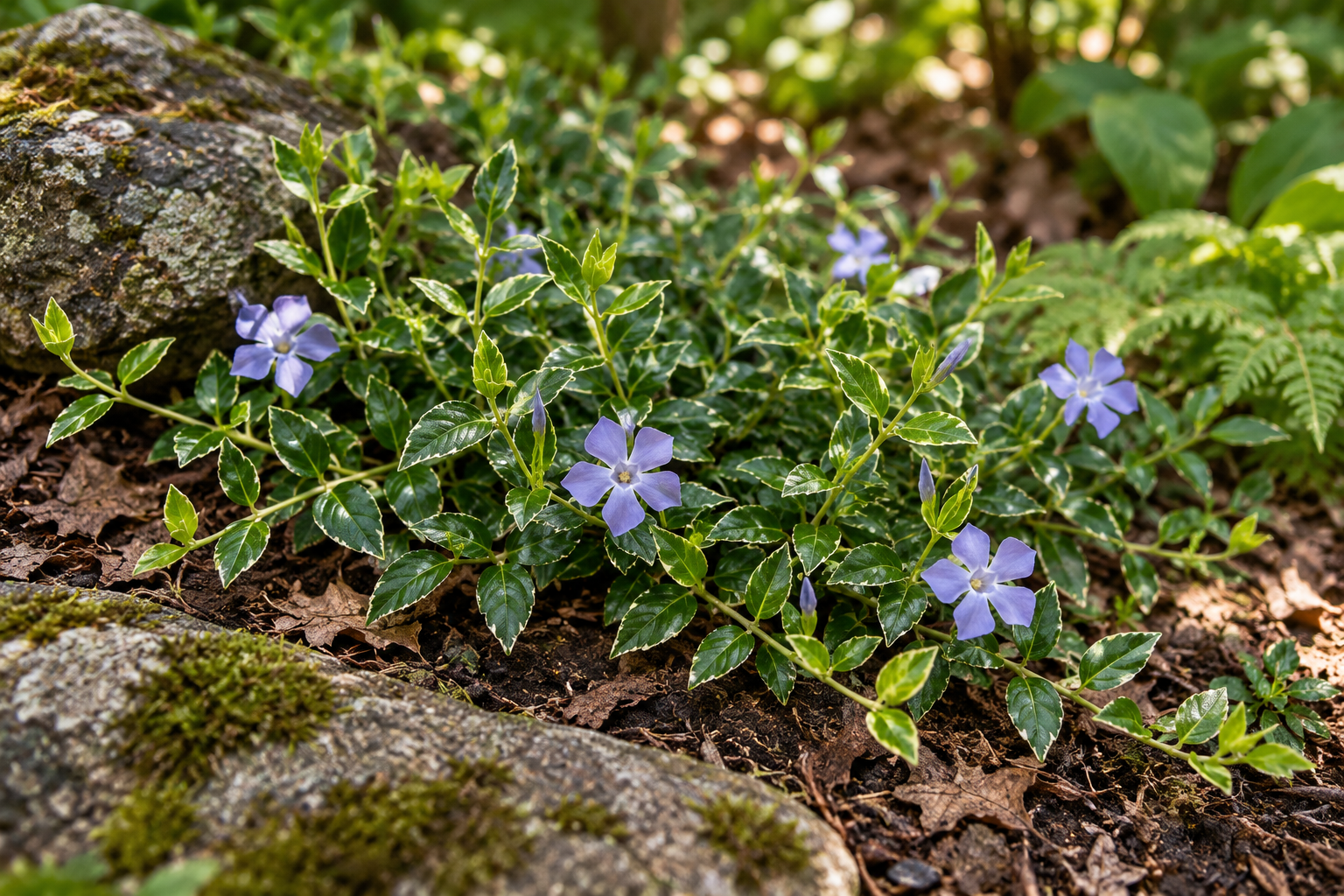
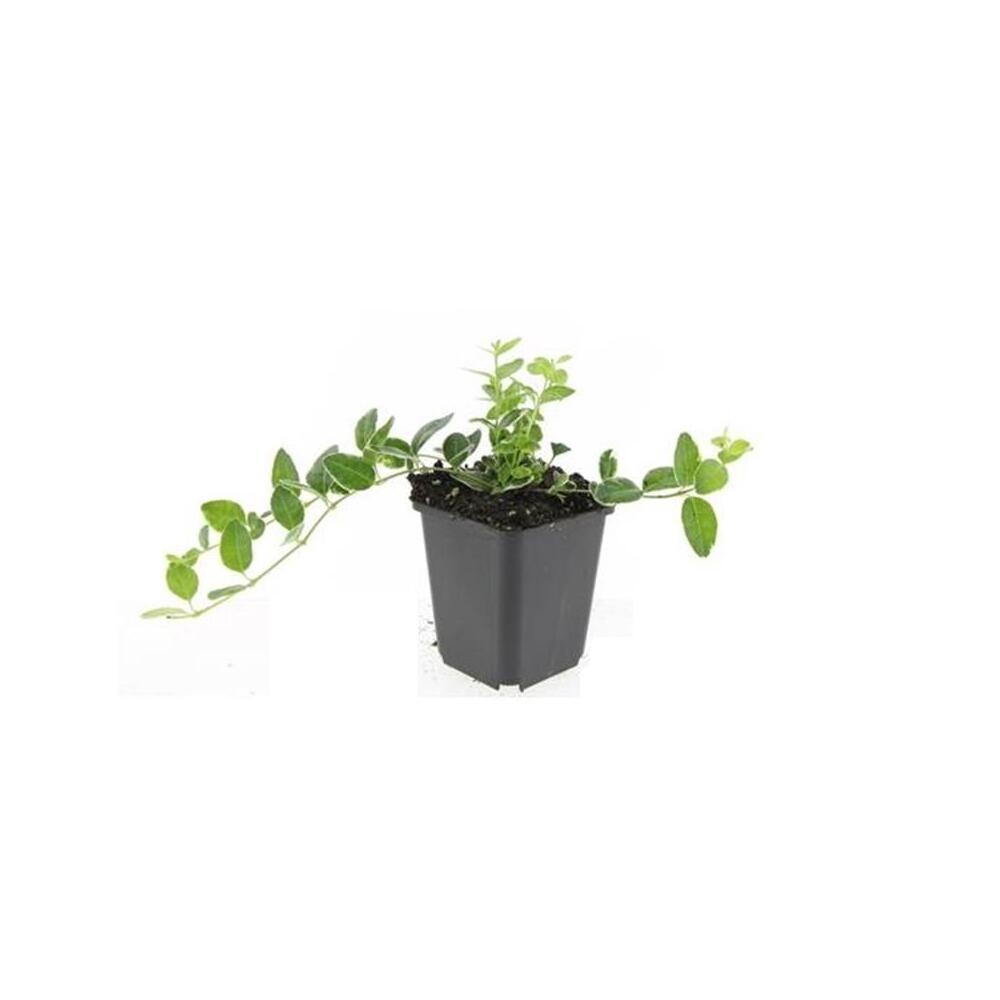
Good to know
What distinguishes Ralph Shugert from yellow-variegated cultivars?
Small dark-green leaves have a narrow white edge. Large yellow patterns are not typical of this cultivar.
Is this cultivar perennial?
Yes, a perennial evergreen ground cover. Side shoots can form roots at ground contact.
How tall is a developed planting?
Around 15–20 cm above the ground. Delivery height of approx. 10–25 cm, however, includes the sale pot.
When do blue flowers appear?
Mainly April and May. Occasional later flowers are possible, but not lasting flower coverage.
How close should set plants be planted?
The shop gives 25–30 cm as guidance. Small neighbours and clear path edges need additional room.
Does little sun mean little watering?
No. A shaded planting point beneath woody plants may be dry. Check moisture at the ball.
Sources and editorial note
- Exotenherz: offer and original photographs (03.10.2026)
- Polish Nurserymen Association: Ralph Shugert – cultivar profile read directly (03.10.2026)
- NC State Extension: Vinca minor – species care and safety (03.10.2026)
- Exotenherz: checked 6-plant child offer (03.10.2026)
- Exotenherz: checked 12-plant child offer (03.10.2026)
- Exotenherz: checked 20-plant child offer (03.10.2026)
- Exotenherz: checked 40-plant child offer (03.10.2026)
- Exotenherz: checked 60-plant child offer (03.10.2026)
Shop offer, product number, availability and originals directly checked on 03.10.2026. Specialist sources directly read. Nursery association Ralph Shugert cultivar profile directly read as PDF; 15–20 cm, white edges and April–May with possible later individual flowers. No blanket easy-care promise. Direct child-offer links checked; 20- and 40-plant sets were not orderable when checked. Original gallery remains unchanged; stamped photographs were not used publicly.