
This plant at Exotenherz
Check the shop offer for current availability, price and what is included.
Product and delivery details are given in the individual offer.
Your care table
| Topic | What to do | Why it helps |
|---|---|---|
| Light | Keep bright in filtered daylight. | Hot direct sun can damage firm leaves and open flowers. |
| Water | Check roots and bark before watering; let them dry largely. | Healthy roots becoming more silvery help assess the need. |
| Drainage | After watering, let it drain completely and empty the outer pot. | The orchid needs air around its roots rather than standing water. |
| Crown | Remove water from the leaf centre and leaf axils. | Persistent wetness in the crown encourages damage. |
| Substrate | Use airy orchid substrate with suitable bark pieces. | Ordinary dense houseplant soil does not suit these epiphytic roots. |
| Nutrition | During active growth, feed weakly according to the orchid fertiliser label. | Roots and fresh leaves determine demand; flower colour is not a feeding question. |
| Stems | Remove completely dry stems; assess green ones by condition. | Further growth is possible on healthy green stems but not promised. |
| Winter | Keep warm and bright; avoid cold draughts and hot heating air. | Light, warmth and root condition remain important after flowering. |
Check the compost and pot weight. The care table explains how far the compost may dry.
Water only when needed. The water should reach the root ball without spilling over the rim.
Remove surplus water from the saucer or cachepot. Then return the plant to a suitable position.
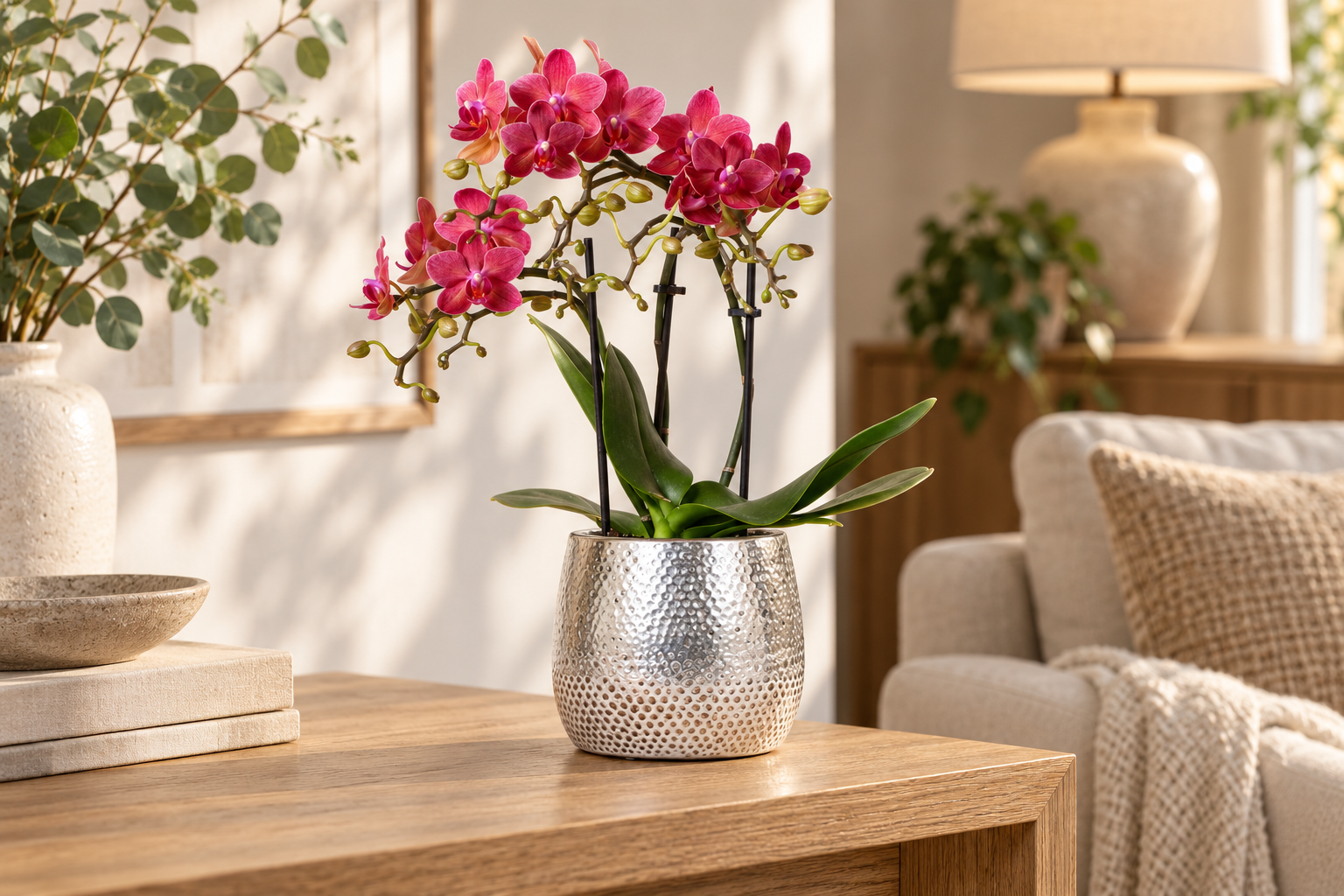
A red flower arch on the small console
Congo brings colour into a calm room. Its red to magenta flowers sit above firm green leaves, and the silver outer pot catches some light. On a small console beside an armchair, we especially notice the branching flower spikes. Individual buds remain between open flowers; every plant develops its own arrangement. The original image shows the offered flower character. In the scene the orchid remains young and manageable. It does not become a giant wall of flowers simply because a photograph could look especially lavish.
Look closely at the specific version
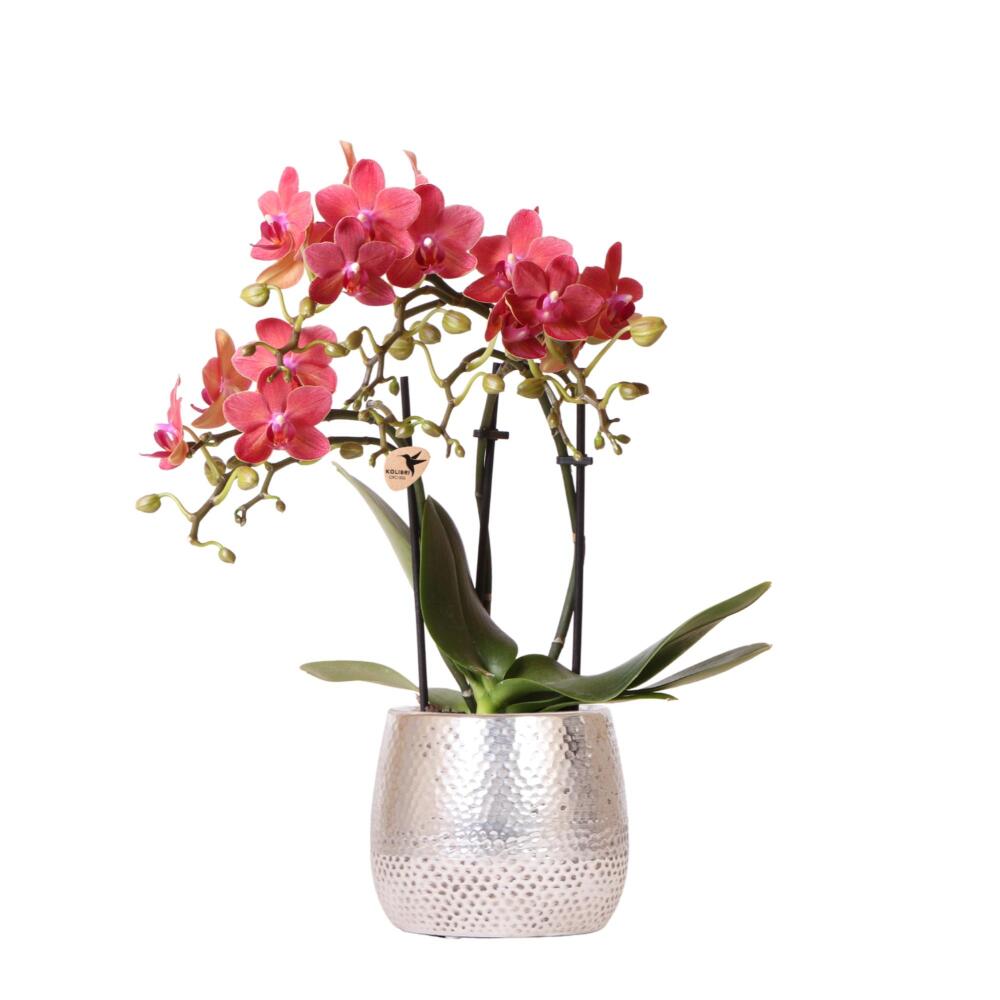
This offer states a nine-centimetre pot, about forty centimetres total height and two to three flower spikes. The silver Elite outer pot is included in this version. Another individual version includes a berry-coloured decorative pot, also at about forty centimetres total height. The separately linked COMBI DEAL, however, comprises two orchids each in a nine-centimetre pot without the same fixed height statement. Each offer retains its own delivery contents. Forty centimetres is therefore not a fixed figure for every version or a later final height. Leave spike supports in place when unpacking while they provide support. Remove the inner pot carefully for the first check, avoiding pulling on flower stems or aerial roots.
Brightness without hot midday sun
A position with plentiful filtered daylight suits this moth orchid. The console must actually receive light; a lovely lamp in the background does not replace a suitable plant position. Behind heated glass, leaves can be damaged. In winter a closer bright position is useful if the glass and root ball do not become cold. We choose a stable spot where buds do not constantly touch curtains or objects. Frequent changes of position and cold draughts during ventilation make settling in harder. A calm, warm place lets you enjoy the flower arch.
Look at the roots first when watering
Airy bark and healthy roots matter more than a fixed weekly plan. Check the inner pot, its weight and visible roots. When the substrate has largely dried and healthy roots look more silvery, water thoroughly and then let it drain completely. Check the silver outer pot for remaining water afterwards. If bark stays wet for a long time, do not water again merely because the flowers are open. Remove water from the leaf centre and axils. Wrinkled leaves may indicate water shortage but also damaged wet roots, so look into the pot first.
Care for bark, root space and nutrition together
When bark breaks down or root space becomes crowded, choose a suitable fresh orchid mixture. Ordinary heavy potting soil would be unsuitable for these roots. Do not cut off healthy aerial roots because they grow over the rim. When repotting, distinguish soft dead parts carefully from firm roots and work with clean tools. Feed weakly during active growth according to the orchid fertiliser label. A flowering plant does not need a heavy extra dose to retain its red colour. New roots and fresh leaves show that the orchid is still working beyond its current bloom.
Congo remains a plant after flowering
When flowers fall, the orchid is not used up. Completely dry stems can be removed. A healthy green stem may grow again; with a weakened plant, leaving strength for leaves and roots is more sensible. Cutting above a suitable node remains an option rather than a promise of another spike. Continue the bright, warm surroundings and moisture checks. Avoid deliberately giving a strong cold stimulus. Later flowering depends on the plant’s condition and cultivation, not simply the height at which a stem is cut.
Accompany small changes attentively
Check leaf undersides, the crown and root bases regularly. Individual old damaged areas do not become smooth or green again. New healthy growth helps assess an improved position more accurately. If buds suddenly fall, we first check transport, draughts and warmth rather than changing several care steps at once. A short note about the last watering and root condition gives an overview. Congo thus accompanies everyday life between flowering phases. The red flower arch is a lovely moment; the enjoyment of an orchid continuing to grow goes beyond it.
One plant, several views
Good to know
Is the silver outer pot included?
Yes, with this specifically described Elite version. Other linked versions have their own delivery contents.
What size is delivered?
A 9 cm pot and about 40 cm total height are stated for this version.
Are there always three flower spikes?
The offer states two to three spikes. Exact branching and the number of open flowers change.
How often is Congo watered?
Decide according to root condition, substrate and pot weight, then let it drain completely.
What happens after flowering?
Continue caring for leaves and roots. Remove dry stems and assess green ones according to plant condition.
Can it flower again?
Further flowering is possible under suitable care, but timing and spike number are not promised.
Sources and editorial note
- Exotenherz: offer and original images (02/10/2026)
- RHS: Phalaenopsis (02/10/2026)
- Orchid Society of Great Britain: Phalaenopsis care (02/10/2026)
Shop offer, article number, GTIN, availability and original images checked directly on 02/10/2026. Specialist sources read directly. Elite silver belongs to this version; other Congo versions retain their own delivery measurements.