
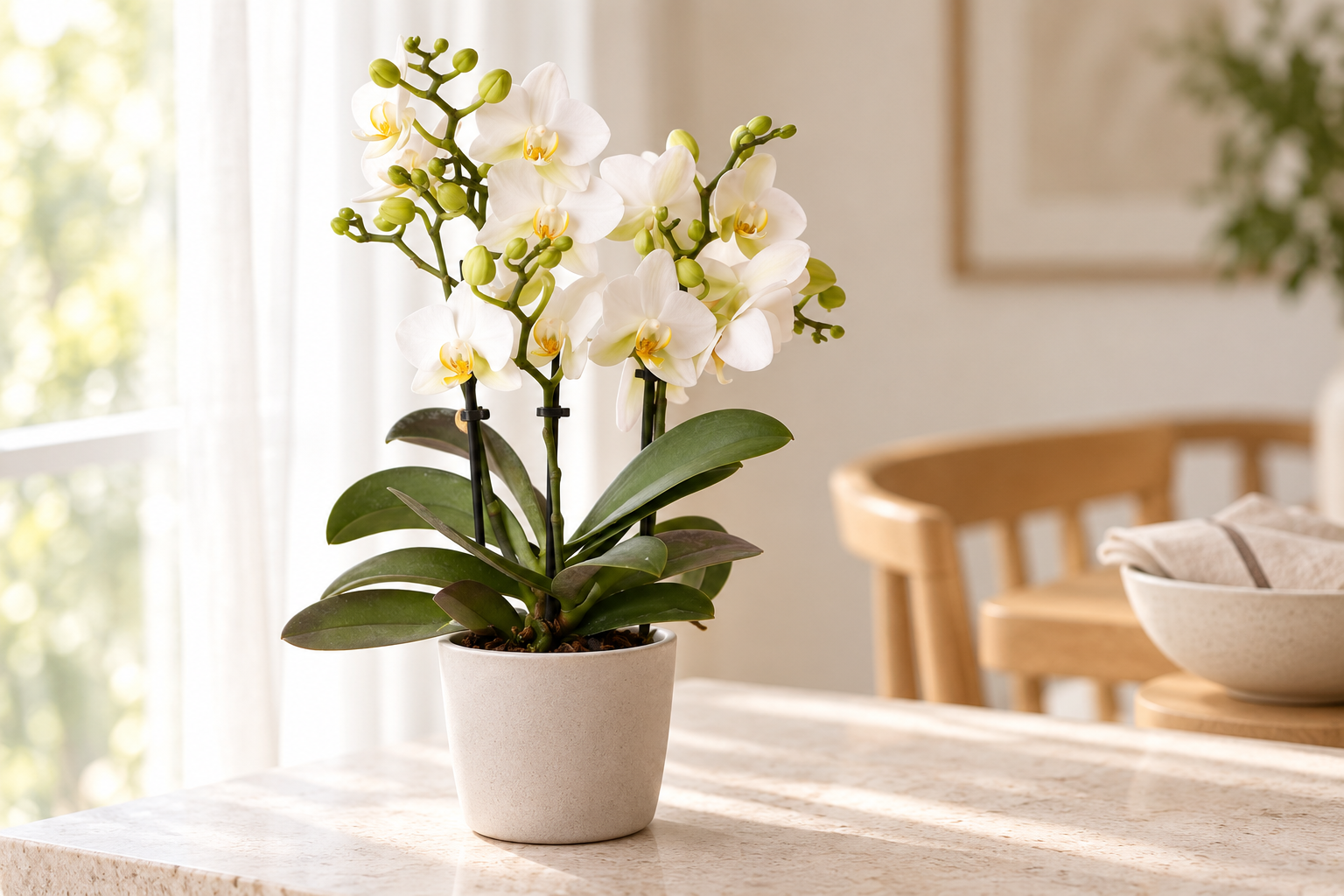
This plant at Exotenherz
Check the shop offer for current availability, price and what is included.
Product and delivery details are given in the individual offer.
Your care table
| Topic | What to do | Why it helps |
|---|---|---|
| Light | Keep bright with soft, filtered daylight. | White flowers do not indicate a lack of light requirement. |
| Water | Water or briefly dip a nearly dry root ball using room-temperature water. | Moisture supply and root-zone air must work together. |
| Drainage | Drain the inner pot completely, then return it dry to the outer pot. | Standing residual water encourages root damage. |
| Compost | Use loose orchid bark. | Dense ordinary potting compost does not suit epiphytic root culture. |
| Warmth | Keep warm year-round without cold draughts or hot heating air. | Buds and leaves react to abrupt position changes. |
| Feeding | Feed active growth moderately according to the orchid fertiliser label. | More nutrients guarantee neither extra buds nor a particular flowering date. |
| Repotting | When the mix breaks down, use active root growth and protect healthy tissue. | Fresh airy bark improves root space without creating excessive pot volume. |
| Stems | Carefully support later flower stems early; remove dry stems. | The next flowering need not branch exactly like the sales photograph. |
Check the compost and pot weight. The care table explains how far the compost may dry.
Water only when needed. The water should reach the root ball without spilling over the rim.
Remove surplus water from the saucer or cachepot. Then return the plant to a suitable position.
White and green share the shape
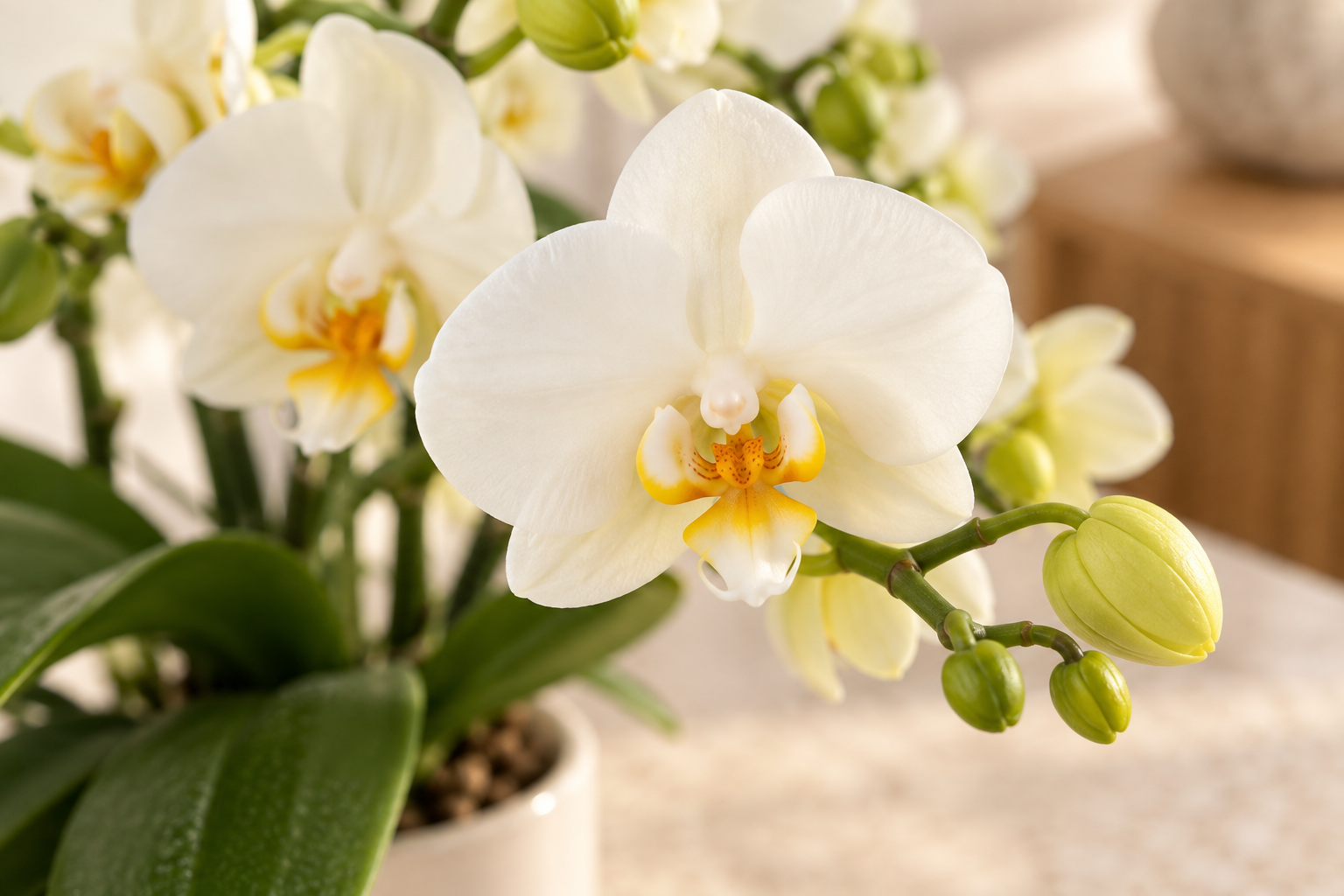
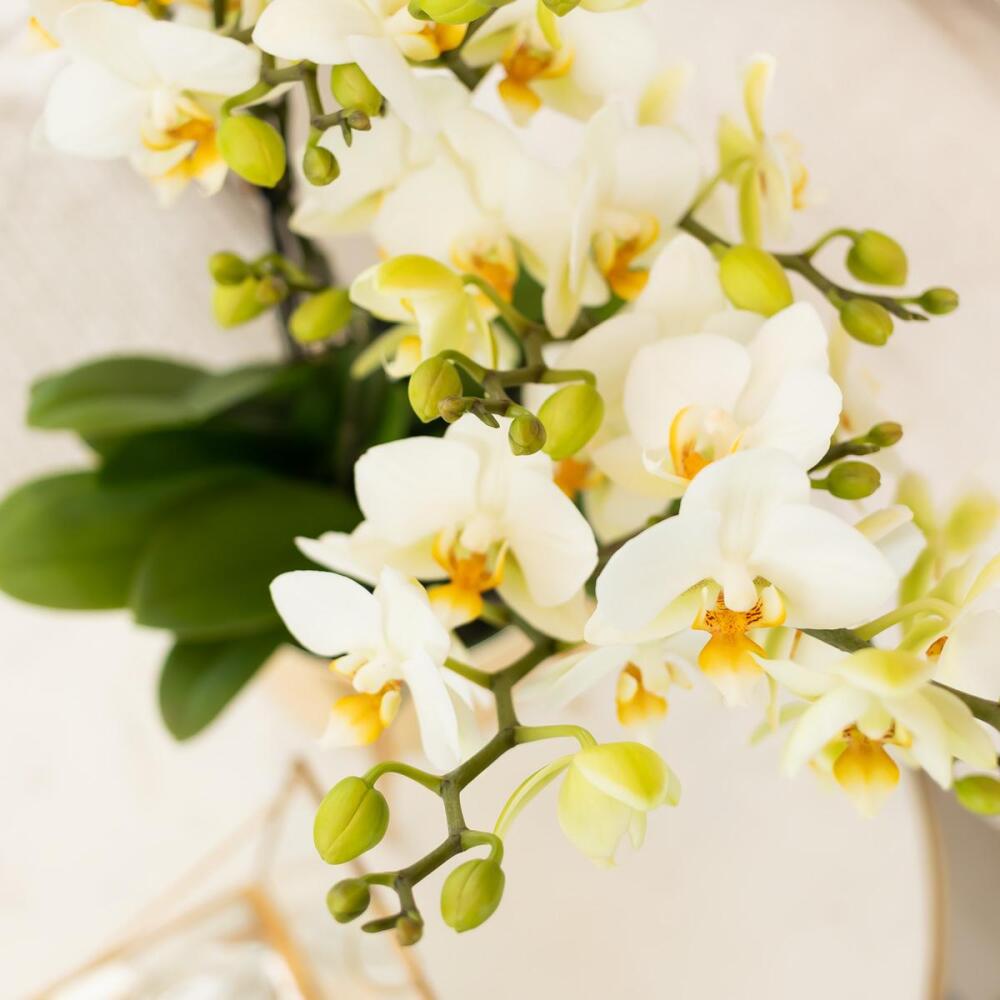
Lausanne’s open white flowers are not the only focus. Small pale-green buds sit along branched green stems, giving the flowers a living rhythm. Yellow to yellow-orange details lie within the flowers; white areas can look pale cream in warm light. Below, the darker leaf rosette fans out. A light console near the dining area offers this small plant a calm setting if enough genuine daylight reaches it. Leave some free space around outer buds. When moving crockery or textiles, do not use branched stems as handles; move the orchid by its container.
The producer names Lausanne separately
The Exotenherz individual offer describes a white-flowered Phalaenopsis hybrid Lausanne in a 9 cm pot, approximately 35–40 cm tall. Kolibri itself lists Lausanne as a named selection; in the original assortment its branched structure belongs to the Blossom group. This traceable designation forms the portrait’s basis. Delivery height and pot size belong to the selected offer. Other producer sizes are not transferred, and later stems receive no fixed final height or certain count.
A bright dining area without midday heat
Phalaenopsis remains a warm indoor orchid year-round. Filtered daylight suits it better than a dark decorative spot deep in the room. At a sunny window, check during hot hours whether direct rays strongly heat leaves and flowers. A light curtain can help without entirely screening the orchid from light. Do not put it directly beside heating or in cold draughts from a frequently opened winter window. After unpacking let it settle in its suitable place. The friendly pale flower colour does not replace a location check. A decorative outer pot should also leave the inner pot accessible so care remains straightforward between meals.
Green buds are not a signal for more water
Many buds may tempt you to water more often as a precaution. The root ball remains decisive. Lift the inner pot and check weight, compost moisture and firm visible roots. Supply room-temperature water only once the root ball is nearly dry; silvery roots may complement this observation. Watering or brief dipping is possible if everything then drains completely. Leaves and crown are not submerged. Check more often in warm bright summer than in winter. A persistently wet mix and prolonged complete dryness are both unfavourable. Existing bud count does not justify a rigid extra water reserve.
The bark mix stays airy
Phalaenopsis-group roots are grown in a loose bark-based mix. Ordinary fine potting compost is not a suitable replacement. Healthy firm root tissue outside the pot remains; aerial roots are not cut for a tidy table. Over time bark may decompose and hold water longer. Plan renewal during active root growth, preferably after current flowering subsides. Dead soft or hollow root areas can be removed with clean tools while protecting living tips. Give the inner pot only appropriate extra space. The leaf base stays at its previous height and is not sunk deeply into moist material.
The next flowers develop their own branching
The sales photograph shows a particular stage with open flowers, buds and supported stems. Later this balance changes. Fading does not turn the perennial orchid into used-up decoration. Support new leaves and roots and apply moderate orchid fertiliser according to the label during active growth. A fully dry stem may be removed. A vigorous plant may branch again from a still-green stem, but no particular flowering is promised. When needed, carefully guide new stems early with a thin support. Already firm shoots should not be forcibly bent into the exact shape of the original photograph.
Stay attentive beneath the white flowers
The pale flowers draw attention upwards; the base needs the same care. Keep leaf centre and axils dry and remove accidental water gently. Occasionally look under broad leaves and around stem bases, where sticky patches or small cottony nests may be overlooked. One lower leaf may gradually age. Several rapidly softening leaves with a wet root ball call for a root check before giving more water. The clean original detail shows Lausanne’s white flowers and green buds precisely. New motifs adopt this appearance without promising the entire flowering display as a fixed delivery condition, a certain duration or a repeatable yearly date.
One plant, several views
Good to know
Is Lausanne identical to every white Phalaenopsis ?
The original producer lists the named selection separately. White colour alone would not be sufficient identity evidence.
What size is offered ?
9 cm pot diameter and approximately 35–40 cm height according to the specific shop offer.
Do many buds need extra water ?
Demand follows roots, compost and pot weight, not bud count alone.
Can the inner pot stand in water ?
Drain completely after watering and remove residual water.
Is a cold winter position right ?
No. Lausanne remains a warm indoor orchid; reduced light lowers demand without requiring a cold dry rest.
Will new stems have the same shape ?
They may grow differently from the sales view. Support early and gently as needed, without expecting fixed branching.
Sources and editorial note
- Exotenherz: specific variant, measurements, identifiers and availability (accessed 03.10.2026)
- Kolibri Company: original selection profile read directly (accessed 03.10.2026)
- RHS: Phalaenopsis, roots, water and repeat flowering (accessed 03.10.2026)
- American Orchid Society: Phalaenopsis culture (accessed 03.10.2026)
- Kolibri Company: care of its own orchids (accessed 03.10.2026)
Shop offer and directly read specialist sources compared on 03.10.2026. Identity, synonyms and SKU checked against Canon 642, central new and isolated parallel portraits. Original Kolibri selection name and specific original compared. No registered grex, parent combination or guaranteed stem count inferred. Different quantities and outer pots are grouped. Delivery size only from the selected Exotenherz offer. Original producer separately names SKU501, white multiflora Blossom selection; OK Plant distinguishes Blossom form with branching inflorescences. Not Amabilis or Gibraltar renamed on colour alone. Specific original and offer match.