
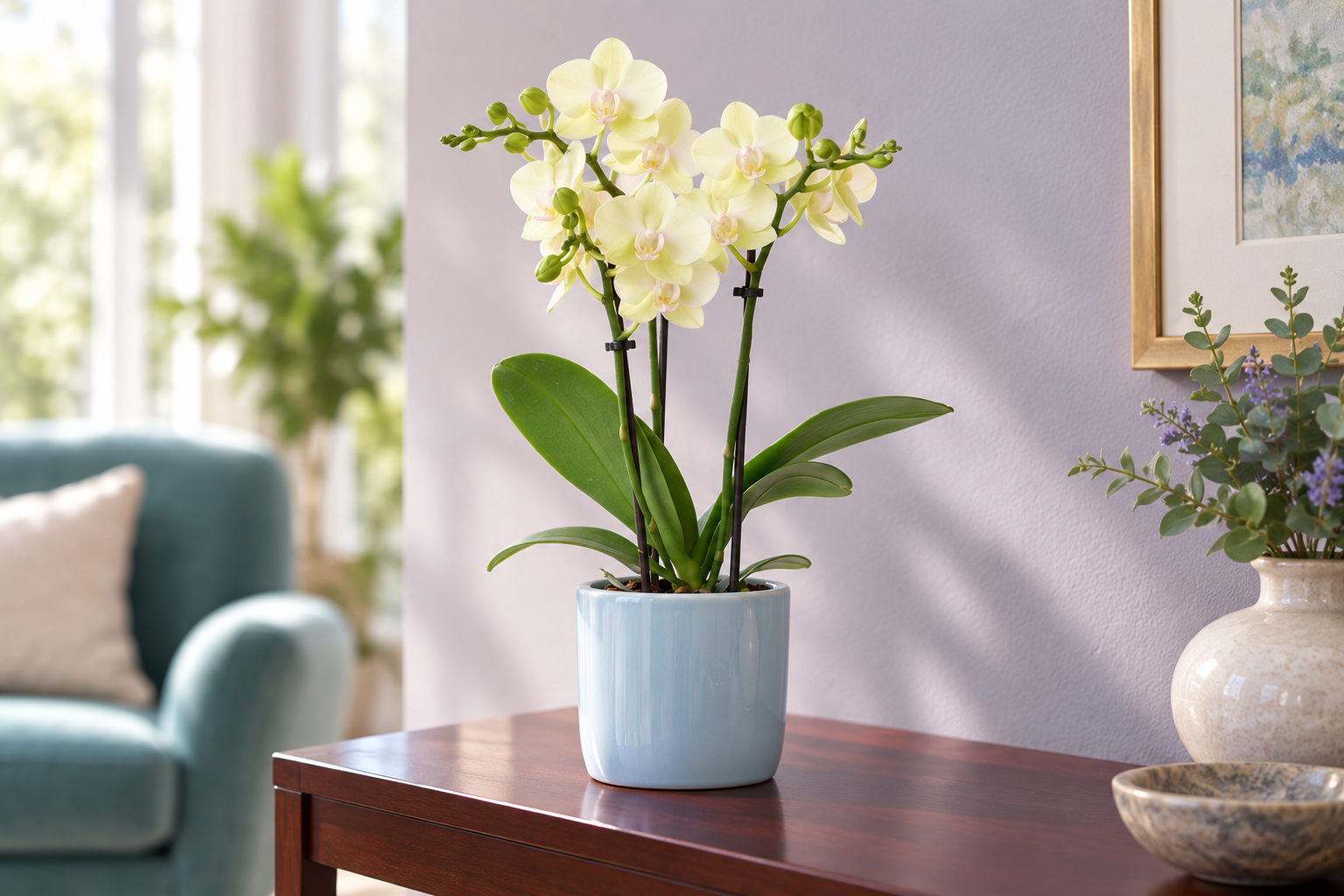
This plant at Exotenherz
Check the shop offer for current availability, price and what is included.
Product and delivery details are given in the individual offer.
Your care table
| Topic | What to do | Why it helps |
|---|---|---|
| Position | Keep bright with filtered daylight; screen hot direct summer sun. | Broad green leaves supply the orchid even after yellow flowers finish. |
| Watering | Check bark, visible firm roots and pot weight; water thoroughly when compost has largely dried. | Roots need alternating moisture and air without prolonged complete drying. |
| Water quality | Use room-temperature, preferably low-lime water and drain completely. | This supplies root space without leaving it submerged in a closed outer pot. |
| Leaf centre | Carefully absorb water from the crown and leaf axils. | Wetness persists between tightly placed leaves and may encourage rot. |
| Room climate | Provide consistent room warmth, preferably above 16 °C, without cold draughts or direct heating warmth. | Buds particularly respond to rapid changes in warmth and moisture. |
| Feeding | Feed weakly during active growth according to the orchid fertiliser label and occasionally water without fertiliser. | New roots need nutrients, but accumulated salts may damage them. |
| Repotting | With broken-down bark or crowded roots, place in suitable airy orchid compost. | Old compacted compost stays wet longer; too much added pot space worsens this. |
| Flower stems | Remove fully dry stems; shorten healthy green stems above a suitable node according to plant condition. | A new side shoot is possible, but strong roots and leaves take priority in weak plants. |
Check the compost and pot weight. The care table explains how far the compost may dry.
Water only when needed. The water should reach the root ball without spilling over the rim.
Remove surplus water from the saucer or cachepot. Then return the plant to a suitable position.
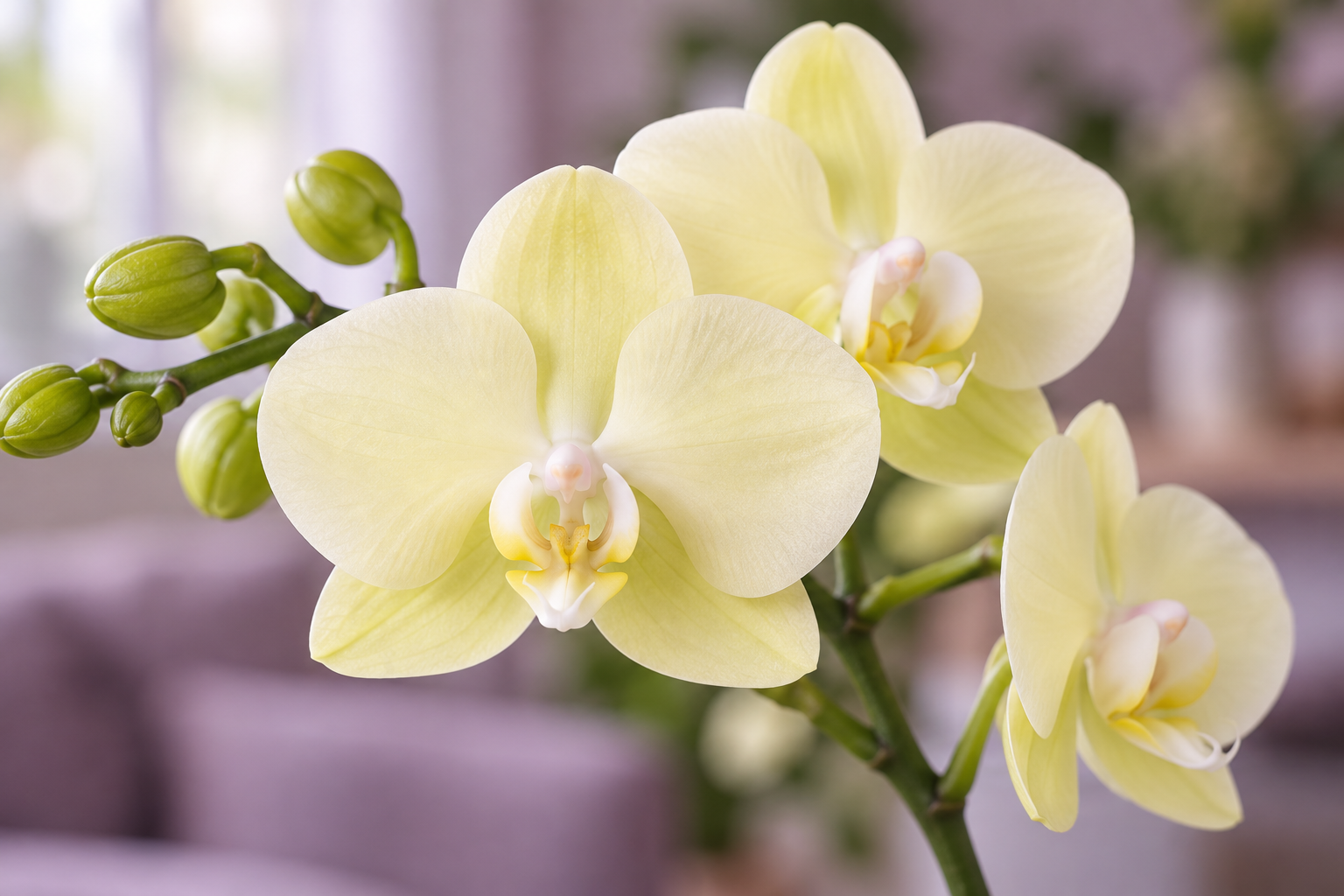
Pale yellow with a soft transition into cream
Mexico does not show strong golden yellow. Pale lemon tones lie on rounded flower surfaces, appearing creamier towards the edge and according to light. The small lip stays pale with a yellowish centre. Green buds sit between open flowers on slender branched stems. Below, broad firm leaves form a calm counterpoint. On a small console beside a bright living area, this structure can be examined without the plant occupying the whole room. Leave flowers sufficient distance from curtains and passing hands. One bud slowly opening tells more about the living orchid than an unchanging number of flowers in a photograph.
Mexico is the name of this Kolibri selection
Breeder Kolibri explicitly calls the pale-yellow orchid Mexico. In German trade the spelling Mexiko also occurs. Here this means a named Phalaenopsis hybrid selection with the described pale floral appearance. Phalaenopsis belong to the orchid family; firm leaves and roots requiring air explain the special pot culture. Mexico is not evidence of the natural ancestors’ origin. The orchid continues as a perennial even when a flower stem finishes. Its next flowering stage follows plant condition and cultivation. You can accompany this progress rather than expecting the same flowers at a particular holiday or fixed month.
The yellow striped pot belongs to this offer
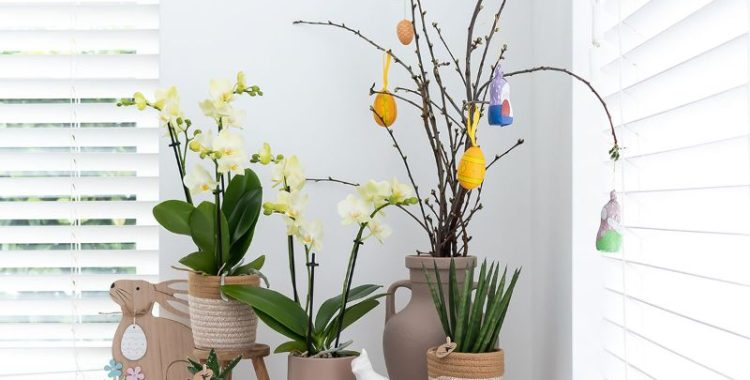
The current shop version contains a nine-centimetre growing pot and yellow Painted-Stripe outer pot. No fixed total height is given for this offer. When unpacking hold the container, carefully free flowers from packaging and avoid pulling supports. Then lift out the inner pot for checking. If bark and roots are still moist, the plant initially needs no additional water. The unchanged breeder photograph in the gallery shows an earlier Mexico interior with multiple plants; it is not a delivery photograph of this individual shop version. The pale-blue covering in the AI interior is also a styling example. For care, the growing pot needs to remain accessible and excess water must be removable safely.
Light should also reach the leaf base
A bright position with filtered daylight supports the entire orchid. Screen strong direct sun behind glass in summer. Do not check only the flowers above: lower green leaves also need sufficient brightness. On a console they function long-term only if daylight actually reaches them. Consistent room warmth, preferably above sixteen degrees, is a reliable basis. During ventilation the orchid must not remain in cold airflow. Direct heating warmth is also unfavourable. If buds drop after moving, first consider transport and position. Frequent movement between differently warm and bright places further complicates acclimatisation.
Empty the striped outer pot after watering
Assess bark, pot weight and visible roots together. Firm roots often look more silvery when dry and greener after watering; moisture may nevertheless remain inside the pot. When bark has largely dried, supply thoroughly with room-temperature, preferably low-lime water. Then drain completely and check the covering. A remaining water reserve in a closed outer pot displaces air around roots. Carefully absorb water from crown and leaf axils. Darker winter often means lower consumption than fresh growth. Wrinkled leaves therefore lead first to root inspection: both an overly dry root ball and damaged wet roots can impair supply.
New roots find space between bark pieces
Keep the orchid in a suitable airy mix with bark structure. Ordinary dense houseplant compost does not suit this root structure. If old bark breaks down or the pot is densely rooted, repot carefully, preferably during active root growth. Firm healthy aerial roots remain; soft dead parts are removed cleanly. The new pot should suit the remaining root space. An unnecessarily large container keeps unused compost moist for a long time. Moderate orchid fertiliser according to the label accompanies new leaves and roots. Occasionally water without fertiliser to wash out salts. The delicate flower colour needs no stronger feeding or special dye.
The green foundation remains after the flower arch
When all flowers have fallen, remove a fully dry stem at its base. A healthy green stem can be shortened above a suitable node and form a side shoot. On a weak plant, leaf and root development take priority. Remove existing supports only once no longer needed; guide new stems loosely early before they stiffen. When wiping leaves also inspect undersides and bases. Mealybugs or scale insects may hide there. A later reblooming Mexico may show different arches and distances between flowers. Keep observing its pale-yellow character while the plant develops its own shape.
One plant, several views
Good to know
What is the yellow orchid called ?
Mexico is the Phalaenopsis selection named by breeder Kolibri. Mexiko is the German spelling of the same name.
Which yellow tones are typical ?
Flowers are pale yellow to cream with a pale yellowish lip, as seen in the original photograph.
What is in the current shop version ?
One orchid in a 9 cm growing pot with a yellow Painted-Stripe outer pot. No fixed total height is given.
Does the original gallery show my delivery version ?
It shows an unchanged Mexico interior by the original breeder. The specific individual delivery version is given in the linked offer.
May water remain in the outer pot ?
No. Thoroughly drain the inner pot after watering and remove water remaining in the covering.
Do leaves still need light after flowering ?
Yes. Continue care for the perennial orchid with bright filtered light and suitable root moisture.
Are aerial roots a reason to cut them off ?
Firm healthy aerial roots belong to the plant and remain. Only damaged dead parts are removed when repotting.
How do I handle a faded flower stem ?
Remove fully dry stems; assess healthy green ones according to plant condition. A possible side shoot has no fixed promised flowering date.
Sources and editorial note
- Exotenherz: offer and original photographs (03.10.2026)
- Kolibri: Mexico, named pale-yellow selection and original interior photograph (03.10.2026)
- RHS: Phalaenopsis, protected indoor culture (03.10.2026)
- AOS: Phalaenopsis, roots, water and compost (03.10.2026)
- NC State: Phalaenopsis, development and typical problems (03.10.2026)
Shop offer, article number, GTIN, availability and original photographs checked directly on 03.10.2026. Specialist sources read directly. Original producer names Mexico in its post dated 28.02.2023, freshly read directly on 03.10.2026. Historic linked individual profile today404, not counted as current full-text evidence. Current individual offer535807102024 andGTIN directly InStock/cart. Clean unchanged original breeder blog photograph shows Mexico, same flower morphology as current own branded shop image; transparently identified as breeder styling photograph, not delivery image. Parent approved this alternative original origin. No unconfirmed RHS registration or ancestry added.